A $36 Million Fusion Startup Just Demonstrated What a $15.5 Billion One Hasn't
On June 19, Realta Fusion generated electricity straight from a fusion plasma using direct energy conversion, bypassing steam turbines entirely. An original thermodynamic analysis shows this approach could cut the minimum Q-factor for commercial breakeven by 15 to 26 percent. Helion Energy, valued at $15.5 billion, has built its entire commercial thesis around the same concept but has not publicly demonstrated it.
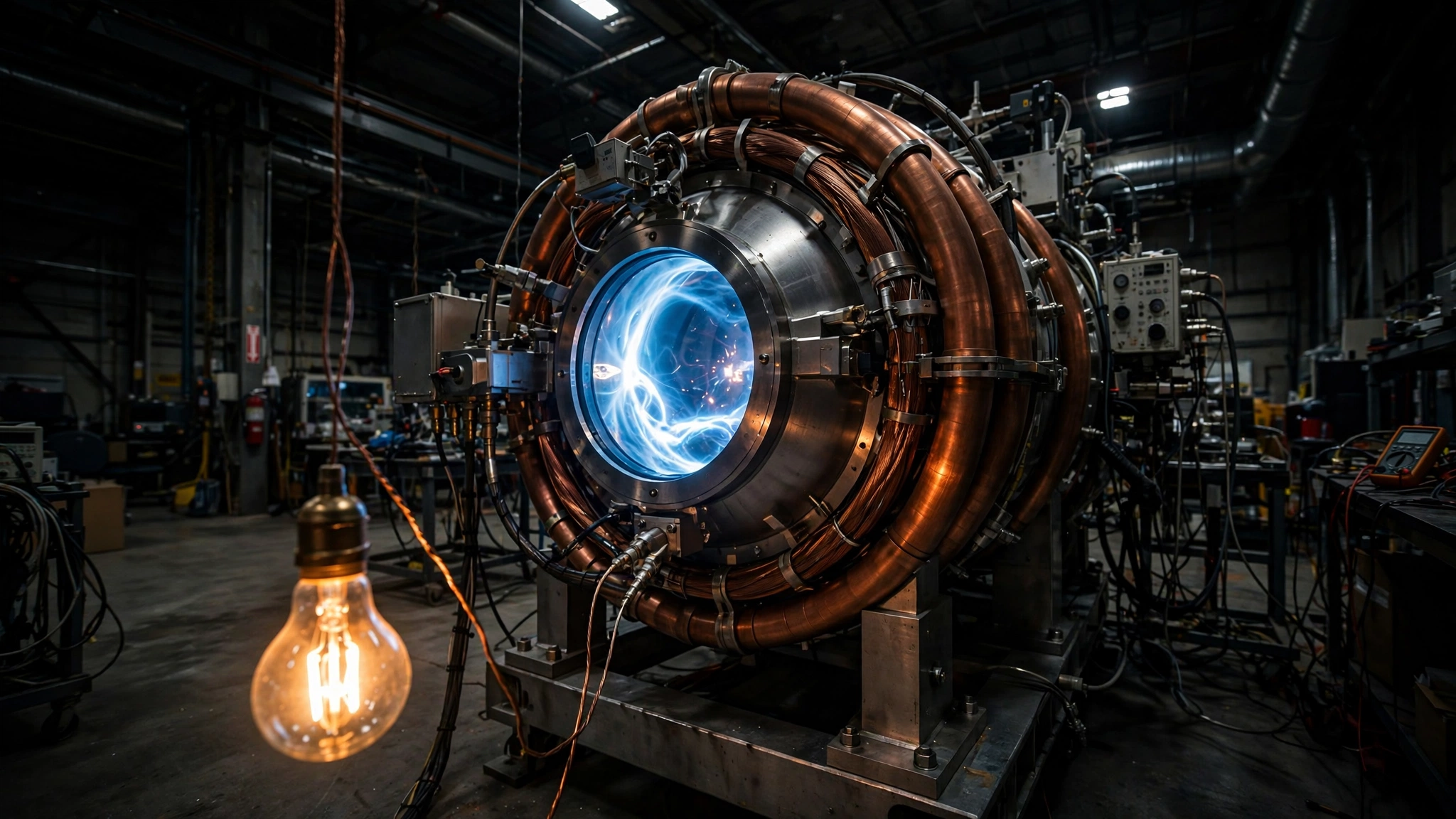
Multiple amps at 100 volts. That is what Realta Fusion pulled from the end of its WHAM magnetic mirror device on June 19. Enough to light a few bulbs. Not enough to power a toaster. But the significance has nothing to do with the wattage; it has to do with how the electricity was made, because Realta just proved something the entire fusion sector has been theorizing about for decades: you can convert a fusion plasma's kinetic energy directly into electric current without boiling water first.
TechCrunch reported June 30 that Realta believes it is the first private company to publicly demonstrate direct energy conversion (DEC) on a fusion plasma. Realta's CEO Kieran Furlong told TechCrunch the DEC prototype is about 90 percent efficient at converting charged-particle kinetic energy into electricity, compared to roughly 33 percent for the steam turbines that every fission plant and most fusion designs rely on.
Ninety percent versus 33 percent sounds transformative. But the physics constrains the headline: in a deuterium-tritium fusion reaction, only about 20 percent of the total energy goes to charged alpha particles that a direct converter can catch. Eighty percent of the total goes to neutrons, which carry no charge, pass through any electrostatic converter, and still need to deposit their energy as heat in a blanket before a conventional turbine can do anything useful with them. Direct conversion does not replace the steam cycle. It supplements it.
So does that supplement change the math on whether fusion plants can ever make money?
The Q-Factor Calculation Nobody Published
Fusion viability depends on Qplasma, the ratio of fusion power output to the heating power you pump in to sustain the reaction. Bigger Q means more output per unit of input. Every fusion company is racing to push Q high enough that after conversion losses, recirculated power, and parasitic loads, there is still net electricity left to sell.
Minimum Qplasma for engineering breakeven depends on two things: how efficiently you convert fusion power to electricity (ηtotal) and how efficiently you convert wall-plug electricity into plasma heating (ηheating, typically around 0.70 for neutral beam or radiofrequency systems). It reduces to a single equation:
Qmin = 1 / (ηtotal × ηheating)
For a conventional steam-only plant where all fusion energy goes through a Rankine cycle at 33 percent:
Qmin = 1 / (0.33 × 0.70) = 4.33
Now add direct energy conversion on the alpha particle fraction. In a magnetic mirror, charged particles that escape through the machine's loss cone hit an electrostatic decelerator at the end. Not all alphas escape; confinement physics and geometry determine the escape fraction, which we estimate at 70 percent for a well-designed mirror based on historical tandem mirror studies.
| Energy Channel | Fraction of Pfusion | Conversion Efficiency | Electric Output |
|---|---|---|---|
| Neutrons → blanket → steam turbine | 80% | 33% | 0.264 × Pfusion |
| Alphas → DEC (70% escape fraction) | 14% | 90% | 0.126 × Pfusion |
| Alphas retained in plasma (self-heating) | 6% | n/a | 0 (heats plasma) |
| Total ηtotal | 0.390 × Pfusion |
With ηtotal = 0.39:
Qmin = 1 / (0.39 × 0.70) = 3.66
That is a 15.5 percent reduction in the minimum Q-factor, from 4.33 to 3.66. If the DEC electricity can bypass the external heating system and recirculate directly to sustain the plasma at higher effective ηheating (say 0.85 instead of 0.70), the threshold drops further to 3.02, a 30 percent reduction. Plant-specific architecture determines the exact number, but the directional conclusion holds across reasonable assumptions: direct energy conversion materially lowers the physics bar for a commercial fusion plant.
Why does this matter in practice? Because Qplasma scales roughly with the cube of the magnetic field strength and the square of the plasma density. Getting from Q = 3.66 to Q = 4.33 requires either 6 percent stronger magnets or 8 percent higher density, which in a real reactor translates to significantly more expensive hardware, larger vacuum vessels, and tougher engineering tolerances. Every fraction of a point in Q that you can shave off the requirement is worth real money in plant construction cost.
The 40-Year Comeback
Magnetic mirrors are not new. Mirror machines date to the 1950s, and by the 1980s the United States had spent the equivalent of nearly $1 billion (in today's dollars) building MFTF-B at Lawrence Livermore National Laboratory, the most expensive project in the lab's history. Completed on February 21, 1986. Mothballed the same day. Never turned on. Energy Secretary John Herrington's letter to program director T. Kenneth Fowler expressed regret: "budget pressures dictate that we must put it into standby."
The decision was not purely fiscal. Tokamaks, with their doughnut-shaped magnetic confinement, were showing better plasma containment. Mirrors leaked. Particles escaped out the ends, and that leakage was seen as a fatal physics flaw. Washington terminated the entire US magnetic mirror program in favor of the tokamak-centric path that led to ITER, the international megaproject in southern France that is now decades behind schedule and vastly over budget.
Realta's argument, articulated clearly in RuntimeWire's analysis, is that the leakage problem is actually a feature if you have the right hardware at the exit. Modern high-temperature superconducting (HTS) magnets, supplied for WHAM by Commonwealth Fusion Systems, achieve 17 Tesla, a world record for fusion research. Better magnets mean better confinement. Particles that still escape through the loss cone hit the direct converter instead of being wasted.
Realta built its working mirror machine for $36 million. MFTF-B cost $372 million in 1986 dollars and never produced plasma. Adjusting for inflation, Realta spent roughly 1/28th of what Livermore spent, and got a machine that achieved first plasma in July 2024, broke field-strength records, and demonstrated direct energy conversion within two years of turning on.
The $15.5 Billion Elephant
There is a much larger company building its entire commercial plan around direct energy conversion. Helion Energy, backed by Sam Altman and valued at $15.5 billion after a $465 million round in June, has raised more than $1.5 billion total. Its field-reversed configuration (FRC) reactor design uses magnetic compression of plasma to generate electricity through induction: as the fused plasma expands and pushes back against the confining magnets, the changing magnetic flux drives current through the coils, functioning like a piston in a magnetic engine.
Helion has not publicly demonstrated this capability. In February 2026 the company reached 150 million degrees Celsius in its Polaris prototype, an important temperature milestone. But Helion's track record of third-party verification is thin. GeekWire reported that the company "has published little peer-reviewed research" and shared data only with "select experts." Helion is building a 50-megawatt plant called Orion in Malaga, Washington, under a power purchase agreement with Microsoft that carries financial penalties if it misses its 2028 delivery target.
Capital efficiency tells a striking story:
| Metric | Realta Fusion | Helion Energy |
|---|---|---|
| Total raised | $36M | $1.5B+ |
| Valuation | Not disclosed | $15.5B |
| DEC demonstrated publicly | Yes (June 2026) | No |
| Peak plasma temperature | Not disclosed | 150M °C (Feb 2026) |
| Peer-reviewed publications | UW-Madison academic track | Limited |
| D-T fuel demonstrated | No | Yes (Feb 2026) |
| Commercial timeline | Early 2030s (target) | 2028 (Microsoft PPA) |
This comparison is not perfectly apples-to-apples: Helion's FRC approach and Realta's magnetic mirror target different confinement physics, and Helion's temperature milestones represent genuine progress on a different part of the fusion problem. Helion's DEC mechanism is also fundamentally different from Realta's. Magnetic induction through plasma compression is distinct from electrostatic deceleration of escaped particles. It is possible that Helion's approach will ultimately prove more scalable.
Still, the ratio is hard to ignore. Realta achieved a concrete hardware proof point that is central to both companies' commercial thesis for less than 2.5 percent of what Helion has spent.
The Strongest Case Against
An April 2026 study in Nature Energy from ETH Zurich's Energy and Technology Policy Group concluded that "fusion power is likely to remain uncompetitive relative to other low-carbon electricity supply technologies." The researchers interviewed 28 fusion experts and found that first-of-a-kind fusion plant capital costs range from $1,400 to $43,000 per kilowatt, with an empirically grounded experience rate of just 2 to 8 percent. At a 5 percent learning rate, fusion does not catch solar or wind on the cost curve before mid-century, regardless of Q improvements.
What ETH Zurich actually demonstrated is that the critique is not about physics. It is about the industrial reality that large, complex, highly customized machines learn slowly. A 15 percent reduction in the Q-factor threshold does not address this. You still need a vacuum vessel, a tritium breeding blanket, neutron shielding, a steam cycle for 80 percent of your output, and decades of operational learning. Direct conversion clips one variable. It does not change the fundamental character of fusion as a large, complex, bespoke energy technology competing against solar panels that get 25 percent cheaper every time cumulative production doubles.
There is also the fine print on Realta's own demonstration. TechCrunch issued a correction on July 1 noting that WHAM does not yet run on deuterium-tritium fuel. Realta's direct converter harvested input power from the plasma, not fusion-born alpha particles. Realta's DEC prototype has been shown to work on charged particles exiting a fusion-relevant plasma, which is a meaningful proof of concept, but the claim of "electricity from a fusion reaction" requires the caveat that no net fusion energy was produced and the particles being converted were not the products of D-T fusion.
Limitations
Our Q-factor analysis uses a simplified one-node thermodynamic model that treats the plant as a single conversion chain. A real power plant has additional parasitic loads (cryogenics for superconducting magnets, vacuum pumping, tritium processing, instrumentation) that raise the effective Qmin above our calculated values. Our 70 percent alpha escape fraction is estimated from historical mirror physics literature, not from WHAM operational data, which has not been published. Realta's claimed 90 percent DEC efficiency is a company estimate extrapolated from a proof-of-concept prototype; no independent party has verified this figure at any commercially relevant scale. We also note that our comparison of Realta and Helion funding oversimplifies the relationship between capital raised and technical accomplishment, as the two companies are pursuing fundamentally different reactor geometries at different stages of development.
The Bottom Line
Realta Fusion's June 19 demonstration matters not because of the lightbulbs it powered but because of the thermodynamic pathway it validated. Direct energy conversion from a magnetic mirror has been theorized since the 1980s MINIMARS designs that proposed generating 600 megawatts of net electric power from a linear reactor with gridless DEC at both ends. Forty years later, someone finally built the hardware and proved the concept works at proof-of-concept scale.
Whether this changes fusion's commercial prospects depends on something our calculation cannot capture: can the magnetic mirror architecture avoid the trap of growing into the kind of massive, bespoke megaproject that the Nature Energy study warns will never learn fast enough? Realta's pitch is modularity, factory-built units sized for industrial heat customers. That is the only pathway through the ETH Zurich critique, because the ETH team's core finding is not that fusion physics is impossible. Their finding is that large, customized machines exhibit 2 to 8 percent experience rates, and at those rates you never outrun solar.
If you are an energy investor evaluating private fusion bets, the Realta result changes two things. First, it demonstrates that the magnetic mirror geometry dismissed in 1986 can produce hardware results at 1/28th the inflation-adjusted cost of the last serious attempt. Second, it provides a concrete benchmark: a fusion startup can demonstrate direct energy conversion for $36 million. If a competitor has spent 42 times more and has not demonstrated the same capability, the question is why, and whether the answer is "because they're doing something harder" or "because they're doing something different" or simply "because they haven't tried yet." All three answers have different implications for your portfolio.
What You Can Do
If you work in energy policy or regulate utility interconnection, watch for Realta's next milestone: whether they can demonstrate DEC on actual fusion-born alphas from a D-T plasma. That is the test that separates proof-of-concept from proof-of-relevance, and it will likely require additional federal investment through ARPA-E, which has already provided over $10 million to the WHAM project.
If you are evaluating fusion companies as investments, demand DEC demonstrations, not just temperature records. Temperature proves physics. DEC proves economics, and economics is what separates a science experiment from a power plant. Cumulative private fusion investment now exceeds $15 billion across 77 companies, according to the Fusion Industry Association's latest data. Total commercial electricity generated: zero kilowatt-hours.
If you are a physicist or engineer, Realta's work suggests the magnetic mirror deserves a second look. Mirrors were abandoned for confinement reasons that modern HTS magnets partially address, and DEC turns the remaining leakage from a flaw into a feature. WHAM at UW-Madison publishes results through normal academic channels. Read them.