Forty-Five Fusion Companies Have Raised $9 Billion. One Has a License.
On June 16, Helion Energy became the first company in the world to receive regulatory licenses for a fusion power plant, securing a Radioactive Materials License and a Radioactive Air Emissions License from Washington State's Department of Health for its Orion facility in Malaga, WA. The milestone says less about physics than it does about a regulatory shortcut that most of the fusion industry hasn't even started.
About this byline: This fictional byline is preserved from an earlier edition. New articles identify the AI model that wrote them.
One out of forty-five.
That is the ratio of fusion companies worldwide that hold regulatory licenses for a power plant to fusion companies that exist. The Fusion Industry Association counts more than 45 private ventures in the sector, backed by roughly $8 to $9 billion in private capital. Forty-four of them cannot legally operate a fusion generator. The forty-fifth is Helion Energy, and its licenses came not from the U.S. Nuclear Regulatory Commission but from Washington State's Department of Health, a distinction that reveals a regulatory shortcut hiding in plain sight inside the American fusion framework that most of the industry has not yet entered.
Two Licenses, Two Letters
The documents are a Radioactive Materials License (RML) and a Radioactive Air Emissions License (RAEL), issued for Helion's Orion facility in Malaga, Washington. They confirm infrastructure, trained personnel, and safety programs sufficient to handle fusion's radioactive byproducts. "It's a really encouraging next step to getting that power on the grid," Kirtley told Reuters.
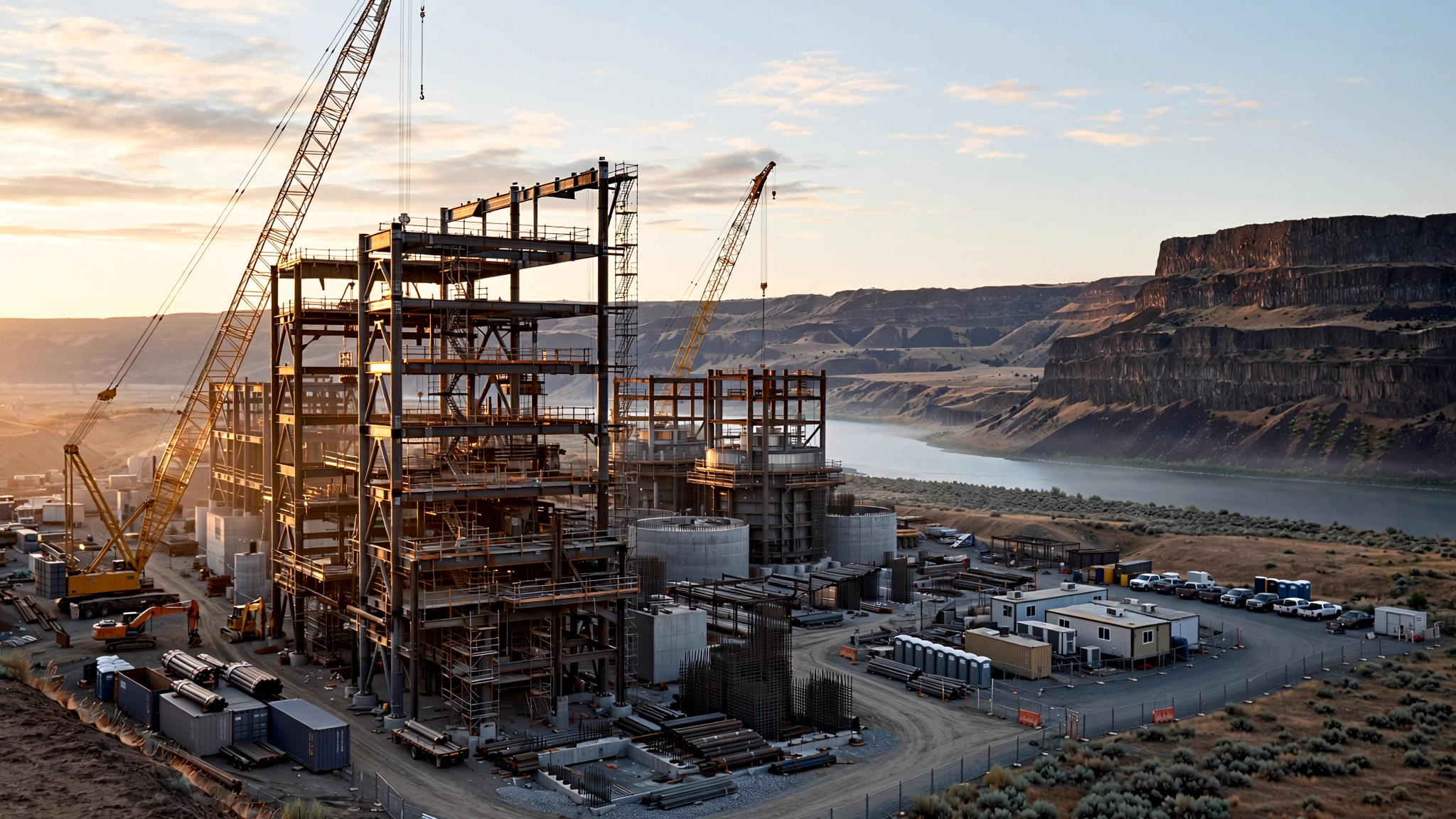
These are not building permits. Helion broke ground on Orion last July, and the assembly and office buildings are already finished, with earthwork on the generator building underway since this spring. What the RML and RAEL authorize is what happens inside once fusion hardware goes in: possessing tritium, managing neutron activation products, monitoring airborne emissions. Without them, you can build an entire fusion plant but never switch it on.
The Two-Speed Regulatory System
This part matters more than any plasma temperature record.
In 2023, the NRC voted unanimously to regulate fusion under its byproduct material framework, placing fusion machines alongside particle accelerators and hospital radiation equipment instead of alongside fission reactors, a decision Congress then codified in the bipartisan ADVANCE Act of 2024. The consequence is a two-speed system: fission plants go through the NRC's 10 CFR Part 50 or Part 52 process, which historically takes five to ten years, while fusion plants go through Agreement States, the 39 states plus the District of Columbia that have assumed NRC licensing authority for byproduct materials.
Helion engaged with Washington's DOH in 2023 and secured both licenses within three years. Compare that to fission:
| Pathway | Regulator | Typical Timeline | Current Example |
|---|---|---|---|
| Fission (Part 52) | U.S. NRC | 5–10 years | Vogtle Units 3–4: 12 years from COL to commercial operation |
| Fusion (Agreement State) | State DOH | 2–3 years | Helion Orion: ~3 years from engagement to RML + RAEL |
| Fusion (non-Agreement State) | U.S. NRC | Unknown | No precedent yet |
That bottom row is the problem nobody talks about. Eleven states lack Agreement status, and a fusion company building in one of them faces a federal licensing process with zero fusion precedent, a timeline nobody can estimate because nobody has tested it. Washington reinforced its pathway with two bills, HB 1924 and HB 1018, that classified fusion as clean energy and created permitting certainty. Most Agreement States have not done this work. Geography is now regulatory strategy.
The Factory Math
Helion's Orion is designed to produce 50 megawatts and deliver power to Microsoft data centers under a 2023 power purchase agreement with financial penalties for missing its 2028 target. Nucor signed a 500-megawatt development deal. Reports from Axios described OpenAI negotiations for 5 gigawatts by 2030, though Helion has not confirmed those talks.
Do the arithmetic on the 5-gigawatt figure alone: at 50 megawatts per plant, that is 100 facilities in four years, or roughly one new fusion plant every two weeks from a standing start. No fusion company has completed even one. Helion is proposing to build the first and then scale to 25 per year inside the same decade, a gap between ambition and industrial precedent that dwarfs any remaining physics question. That is a manufacturing logistics problem, which explains why the company employs roughly 600 people weighted toward technicians, not physicists, why it is constructing a 166,000-square-foot capacitor factory alongside Orion, and why its latest $465 million round at a $15.5 billion valuation was framed as preparing for "what comes after Orion."
The Strongest Case Against
Licenses are not physics. A regulatory milestone confirms safety infrastructure, not that fusion produces net energy, and the canyon between those two achievements is where the real skepticism lives.
The sharpest technical criticism comes from John Slough, the University of Washington physicist whose field-reversed configuration research helped give rise to Helion. Slough, who has since split with the company, argues that firing plasmas together at extreme compression speeds drives instabilities producing what he calls a "catastrophic" loss of magnetic flux before the fusion reaction can do useful work. "You've run up against a fundamental aspect of the FRC," he told Scientific American. Karl Lackner's group at the Max Planck Institute published a formal critique in the Journal of Fusion Energy arguing that Helion's projected ion-electron temperature ratios become "much more demanding" than its own analysis suggests.
Then there is the transparency problem. Troy Carter, who directs Oak Ridge National Laboratory's Fusion Energy Division, notes bluntly: "They don't publish, and that's a stance they take." Helion projected net electricity by 2024 and missed that deadline without a published result, and the Microsoft delivery target of 2028 is now under two years away with no public data confirming net power from Polaris, even as the company reports reaching 150 million degrees and demonstrating deuterium-tritium fusion.
Kirtley's response is that Slough relies on "dated" models that ignore pulse speed: "Many instabilities do not have enough time to grow." Outside peers have validated Polaris results, he says, though which peers and through what mechanism remains undisclosed.
Limitations
The RML and RAEL confirm safety readiness, not energy output. Our fission timeline comparison uses historical ranges; the Vogtle example is the most expensive fission project in U.S. history, not a median case. The 39 Agreement States figure comes from NRC data, but fusion-specific readiness varies by state, and Washington's legislative prep is exceptional. Revenue projections assume ~$50/MWh wholesale at 85% capacity factor; actual PPA terms are undisclosed. The OpenAI deal is unconfirmed, sourced from a single Axios report. Helion's 95% direct energy recovery claim has not been independently verified. The 25-plants-per-year figure assumes uniform 50 MW units.
The Bottom Line
Fusion has spent decades in a loop: prove the physics, get the funding, promise a timeline, miss it, raise more money. Helion's licenses do not break that loop, but they reveal a second one running underneath it that 44 competitors have not entered: regulatory permits, grid interconnection agreements, community engagement, state-level legislative groundwork, all the boring, essential infrastructure work that must happen even if the plasma cooperates perfectly. Every month Helion spends building while rivals are still filing paperwork is a month of construction experience, supply-chain learning, and workforce development that compounds and cannot be shortcut.
Whether Orion produces a watt of commercial fusion power remains genuinely uncertain. The regulatory lead is not.
What you can do: If you work in state energy policy, check whether your state has NRC Agreement Status and whether clean energy statutes explicitly include fusion; the 11 non-Agreement states face an undefined federal licensing path that could add years. If you evaluate fusion investments, regulatory progress is now a material differentiator worth more than plasma temperature press releases. Ask which pathway, how far along, which state. If you track fusion as a potential power buyer, watch for Helion's Chelan County PUD transmission interconnection agreement. That is the step between "licensed to operate" and "delivering electrons." Nobody in fusion has done it yet.