Panasonic's Touch-Feeling Robot Hits 65% on Delicate Tasks. The 5-Step Math Shows Why It Matters.
A Panasonic-led team gave a two-handed robot fingertips that feel, and its success rate on delicate chores jumped from 35 percent to 65 percent. That sounds like a near-doubling. Across a real multi-step job, it is a 22-fold improvement, and the arithmetic behind that gap is the story.
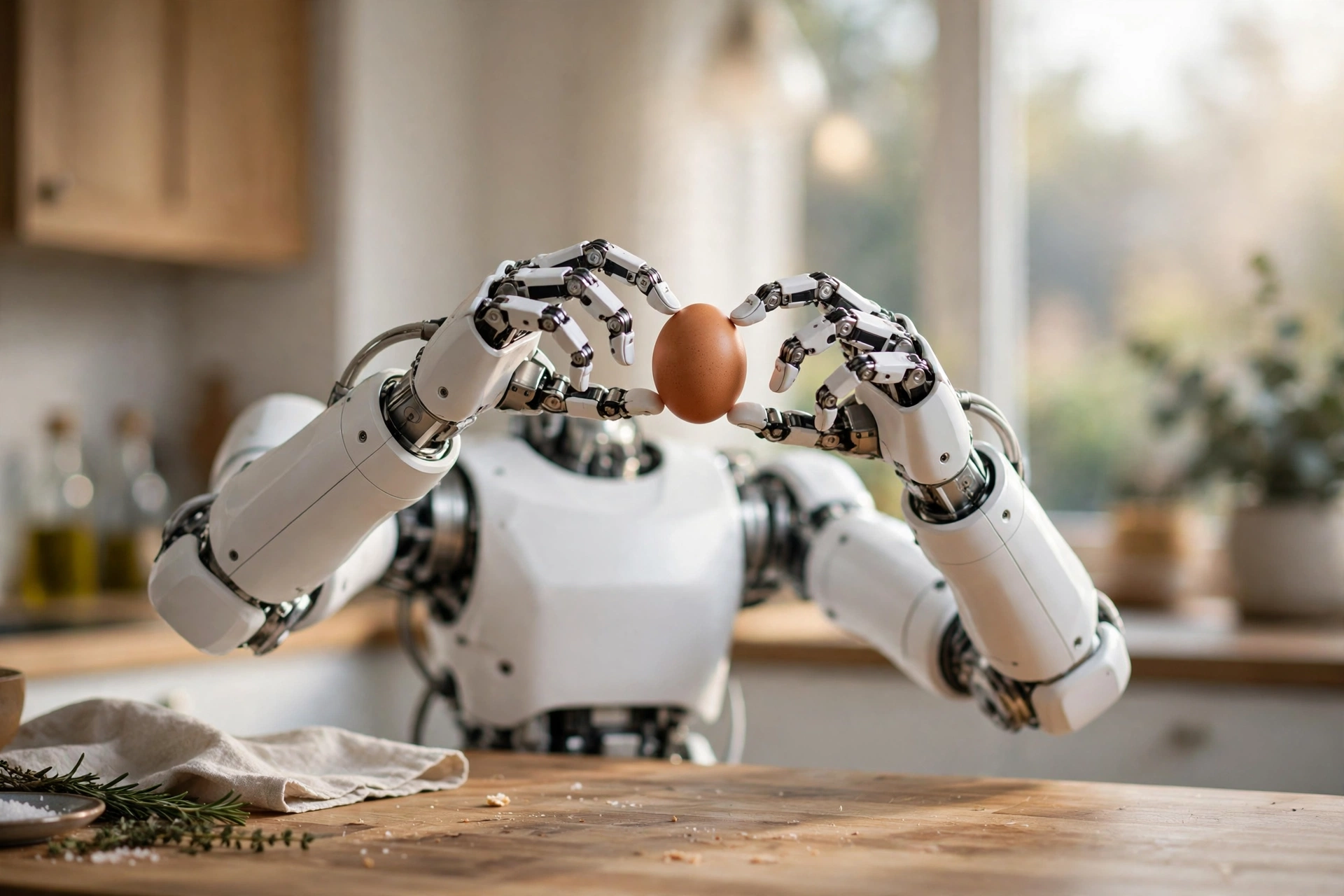
Pick up an egg without cracking it. Your fingers adjust grip force hundreds of times a second, reading slip and pressure you never notice. Robots doing this kind of work have been effectively numb until now, steering by camera alone and hoping the grip holds. On November 5, 2026, Panasonic Holdings announced a system that changes that: T-Rex, short for Tactile-Reactive Dexterous Manipulation, built with UC Berkeley, NVIDIA, Stanford, Sapienza, and ItalAI. Across 12 real-world tasks that demand delicate force control, turning pages, transferring eggs, applying toothpaste, unlocking doors, pulling cards, screwing in bulbs, T-Rex succeeded 65 percent of the time, against 35 percent for the best prior method.
Thirty points, a near-doubling, yet the headline understates what happened, because robot chores are not single actions but sequences, and success rates compound brutally across sequences. Run the compounding math, which nobody in the announcement coverage did, and a 65 percent robot is not twice as useful as a 35 percent robot. On a five-step job, it is 22 times as likely to finish without a retry.
Two clocks, one hand
T-Rex runs two control loops at once, at two very different speeds. A vision-language planner decides what to do, updating about 5 times per second, while a tactile expert reads fingertip contact about 20 times per second and corrects the motion in real time, catching slips without waiting for the slow planner to re-run image recognition, above a low-level control thread running at 300 Hz. Four fast corrections happen for every slow plan, and vision tells the hand where the egg is. Touch tells it, fifty milliseconds at a time, whether the egg is about to crack or drop.
Hardware matters here, and the team names it: a bimanual Dexmate Vega-1 platform with two 7-degree-of-freedom arms and two 22-degree-of-freedom Sharpa Wave dexterous hands, 58 degrees of freedom in total, with five fingertip tactile sensors per hand, each reporting force and deformation maps. Training came in three stages: 22,889 hours of human egocentric video, 100 hours of robot teleoperation across 207 objects and 22 motor primitives, and roughly 100 demonstrations per task. Robot data was 0.43 percent of total training hours, yet the ablations show it did the decisive work.
The 5-step test nobody ran
Real manipulation is sequential: unlock a door, pull the card, open the box, take the item, close the box. If each step succeeds with probability p, a job of N steps finishes on the first try with probability p raised to N. Apply that to the reported averages.
| Job length | T-Rex (65% per step) | Best baseline (35% per step) | T-Rex advantage |
|---|---|---|---|
| 2 steps | 42.3% | 12.2% | 3.5x |
| 3 steps | 27.5% | 4.3% | 6.4x |
| 5 steps | 11.6% | 0.53% | 22.1x |
At two steps, T-Rex is 3.5 times as likely to finish cleanly. At five steps, it is 22 times as likely. Expected attempts equal 1 divided by p: T-Rex needs 1.54 tries per task against 2.86 for the baseline, or 18.5 attempts against 34.3 over a 12-chore morning routine. A person does those 12 chores with roughly zero failures, so T-Rex is still far from human. But the retry burden roughly halves, and halving is the difference between a demo and a tool someone might actually leave running. Steps are not truly independent, so treat the compounding as a first-order model, not a measured sequence rate.
Where the 30 points come from
T-Rex tops every one of the 12 tasks, and the spread shows where touch pays most. Flipping a page: 96 percent, against 68 for the best baseline. Transferring an egg: 75 against 44. Splitting a cup: 78 against 33. At the hard end, screwing in a bulb: 35 against 18. T-Rex's worst task, screwing in a bulb at 35 percent, exactly equals the best baseline's average across all 12 tasks. Even at its worst, the touch-equipped system matches the previous state of the art on average. Touch wins.
Ablations decompose the 30-point gap. Remove touch entirely and T-Rex falls to 42 percent, so the tactile modality itself is worth 23 points. Replace the asynchronous fast loop with a synchronous one and it falls to 60, so decoupling the two clocks is worth 5 points. Training matters too: pre-training alone 45 percent, mid-training alone 34, from scratch 18, full recipe 67 on the six-task subset. Touch is the big lever, the reactive architecture is what lets touch pay, and the training recipe is the delivery mechanism.
One ablation deserves a warning label of its own. Bolt tactile signals onto pi0.5 without re-architecting it, and success collapses from 17 percent to 6 percent. Naive touch makes a robot worse, by 11 points, not better. Sensors alone are not the breakthrough; sensors inside a system built to react to them at 20 Hz are.
What it still cannot do
Now the other side of the ledger. Sixty-five percent. Still a failing grade for any job that matters. A robot that cracks one egg in four, fails to unlock a door more than half the time, and threads a light bulb only one time in three cannot be left alone in a home, a hospital, or a factory line. Not yet. Its range runs 96 percent to 35, a 61-point spread, and the tasks combining force and deformation in both hands are the hardest family, still near one-in-three.
Missing numbers matter as much as reported ones. No cost figure for the platform appears anywhere in the announcement or the paper. No speed figure, no multi-day reliability figure, and no evidence the system generalizes beyond the 207 objects it trained on. Twelve tasks times 16 trials each is 192 trials per method, a small sample, so a 65 percent average carries a binomial standard error of roughly 3.5 points. Panasonic's release says 100 hours of robot data; the project site says 50 hours open-sourced. Both are true: 100 collected, 50 open-sourced.
Limitations
Several limits qualify everything above. First, sequence-compounding assumes independent, identical per-step success, and real steps correlate, so the clean exponentials are optimistic ceilings rather than predictions, and second, 16 trials per task is a thin basis for per-task claims, so treat the ranking as indicative, not exact. Third, everything comes from one hardware platform in a controlled lab, with no cost, speed, or durability data, and fourth, the paper was posted to arXiv in June 2026, and the November announcement reveals those results rather than reporting new experiments, while the Conference on Robot Learning presentation, November 9 to 12 in Austin, is upcoming and not yet peer-reviewed. Fifth, no human baseline was measured, so the comparison to near-perfect human performance is a common-sense anchor, not a measured control. Sixth, "30 percent higher" means 30 percentage points, an 85.7 percent relative improvement, so quoting "30 percent better" without "points" understates the gain nearly threefold.
The Strongest Case Against
Consider the strongest case against reading this as a dexterity breakthrough at all. A 65 percent average on a 58-degree-of-freedom platform that likely costs more than a luxury car, in a lab, on 12 researcher-chosen tasks, is a research result, not a product. Worse, the compounding math cuts both ways: even at 65 percent per step, a five-step job still fails on the first try 88 percent of the time, which means unsupervised multi-step work remains out of reach, and its weakest tasks, locks, bulbs, small containers, are the ones a home robot must do daily, so add the generalization question, 207 trained objects against the thousands in a real home, and the honest conclusion is that T-Rex proves touch is the missing sense, not that dexterous robots are ready.
That objection has force, and it should change how readers weight this announcement: a field that celebrates benchmark averages while its hardest tasks sit at one-in-three can mistake a solved subproblem for a solved system, and funding follows headlines faster than the full error budget. It does not erase the result. Every prior vision-only system plateaued near 35 percent on these tasks, and a system that more than doubles the hardest-task floor while winning all 12 tasks has moved the frontier, not merely re-measured it. A frontier moved is a frontier moved, even if the territory beyond it is still mostly unmapped.
What You Can Do
If you buy, evaluate, or fund dexterous robots, ask for per-step success rates and run the compounding math yourself, because a vendor quoting a single-task average is hiding the sequence failure rate, so demand the hardest-task number, not the average, and demand a measured multi-step sequence rate. If you run a robotics lab, the ablation table is your actionable finding: do not bolt tactile sensors onto a vision-only model, since naive integration drops success from 17 percent to 6. Budget for a reactive architecture with a separate fast loop, and for tactile-grounded mid-training, before spending on sensors. If you invest, note the dataset and recipe are published and partly open-sourced, so this advantage is replicable, not proprietary. Price execution speed, not the algorithm. If you simply want a home robot, watch the Conference on Robot Learning, November 9 to 12, for independent replication and for any team reporting a measured multi-step sequence rate, the number that actually predicts a useful machine.
The Bottom Line
Panasonic and its partners gave a robot fingertips that feel, and it got dramatically better at the delicate work that separates demos from useful machines. Vision plans at 5 Hz, touch corrects at 20 Hz, and together they lift success from 35 percent to 65 percent across 12 tasks, winning every one. Compounded across a five-step job, that gap is 22-fold, not two-fold, which is why the arithmetic, not the headline, is the story. Yet 65 percent still fails one time in three, and no cost, speed, or reliability figure says when any of this leaves the lab. Touch is the sense robots were missing, the loop that uses it is now proven, and a robot you can trust with your eggs, your keys, and your light bulbs is still several breakthroughs away.