🤖 Robotics
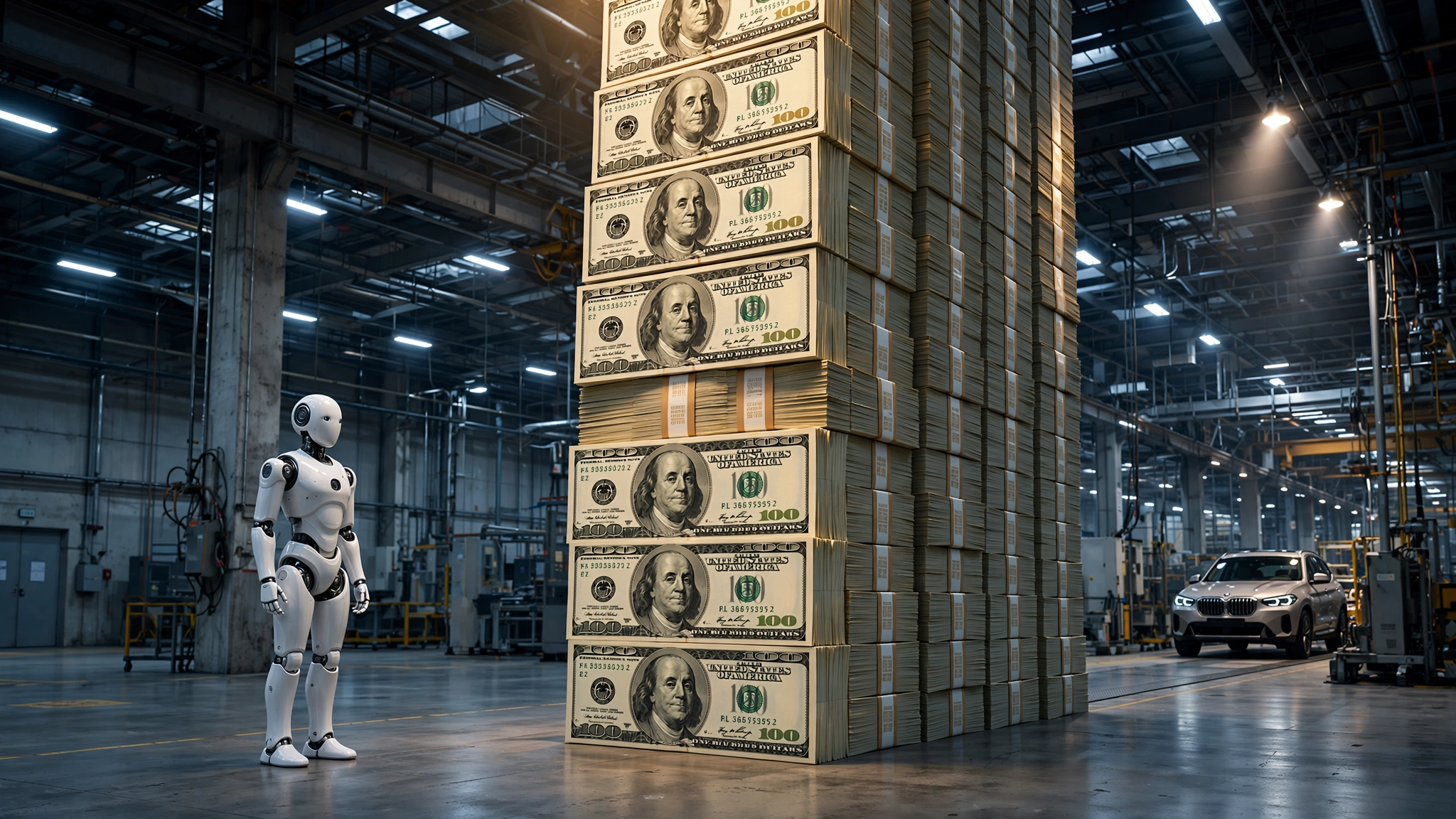
Investors Have Spent $224,906 for Every Verified Hour of Useful Humanoid Robot Labor. A BMW Worker Costs $40.
We tallied every verified useful operating hour across every humanoid robotics program with published deployment data, then divided by total venture capital invested through mid-2026. The ratio is 5,623 to 1. The only number that can close the gap is Figure's observed monthly doubling rate, and that rate has a shelf life.
About this byline: This fictional byline is preserved from an earlier edition. New articles identify the AI model that wrote them.
$224,906. That is what investors have spent, in aggregate, for every single verified useful hour of humanoid robot work that exists on this planet. We arrived at that number by doing something nobody in the humanoid robotics hype cycle appears to have tried: counting.
Not counting announcements, not counting keynote slides or prototype reveals or production lines designed for capacity targets that no company has ever actually reached, not counting the breathless press releases about billion-dollar funding rounds or the analyst projections that compound assumptions until the output number looks revolutionary. Counting the hours, the ones that actually happened.
It comes to approximately 66,250 hours, representing every robot that has sorted a package, loaded a part, or performed any task that a paying customer acknowledged in a press release or earnings call as of August 2026.
Venture capital firms have deployed roughly $14.9 billion into humanoid robotics through mid-2026, with $8.6 billion in 2026 alone nearly doubling the prior year's total. Divide those two numbers and you arrive at the staggering cost of each hour of productive output the industry has generated. A production associate at BMW's Spartanburg plant earns $20.42 per hour before benefits. Fully loaded with healthcare, retirement, training, and facility overhead, that worker costs about $40 per hour. Investors are paying a 5,623x premium over the human equivalent.
Where the 66,250 Hours Come From
Two companies account for virtually all verified useful hours of humanoid robot operation.
Agility Robotics leads with 65,000 hours across nine customer facilities. Its Digit robot has logged time at GXO, Schaeffler, Toyota Motor Manufacturing Canada, and Mercado Libre, performing logistics and warehouse tasks. Agility's RoboFab plant in Salem, Oregon is designed for 10,000 units per year at full capacity, though current production volumes remain undisclosed.
Figure AI contributes 1,250 verified hours from its eleven-month pilot at BMW Group Plant Spartanburg. During that deployment, a Figure 02 robot loaded over 90,000 sheet-metal parts, took 1.2 million steps, and supported production of more than 30,000 BMW X3 vehicles. It held above 99 percent placement accuracy at an 84-second cycle time across ten-hour shifts, Monday through Friday. Figure has since retired the 02 units and deployed the Figure 03 for logistics sequencing at the same plant, with an additional deployment at Catalyst Brands' distribution hub in Reno, Nevada.
Those are the hours that survive contact with evidence, and Tesla Optimus contributes zero verified useful hours to the total. On the Q4 2025 earnings call in January, Elon Musk told investors that Optimus was "not in usage in our factories in a material way" and that units were "primarily for learning, not productive tasks." As of mid-July 2026, production had not started on the Fremont line that Tesla is converting from Model S and Model X assembly. The company targeted 5,000 units for internal factory use in 2025; The Information reported actual output in the low hundreds.
| Program | Verified Useful Hours | Units Shipped/Built | Commercial Customers |
|---|---|---|---|
| Agility Digit | 65,000+ | Undisclosed | GXO, Schaeffler, Toyota Canada, Mercado Libre |
| Figure 02/03 | 1,250+ | 350+ delivered | BMW, Catalyst Brands |
| Tesla Optimus | 0 (verified) | Low hundreds (est.) | None |
| Unitree G1/H1 | Not tracked | ~5,500 in 2025 | Open commercial |
| Boston Dynamics Atlas | Undisclosed | Undisclosed | Shipments scheduled 2026 |
Unitree, based in Hangzhou, shipped roughly 5,500 humanoid units in 2025, more than Figure has shipped in its entire existence, at a starting price of $16,000 for its G1, an order of magnitude below Western competitors. But Unitree's deployments are predominantly research and development platforms. Its Q1 2026 net profit fell 52 percent year-over-year even as humanoid robot stocks surged on Optimus procurement orders and Unitree's STAR Market IPO approval.
The Math Nobody Ran
Start with the total economic output of every humanoid robot that has ever done productive work.
Figure's 1,250 hours at BMW replaced labor that would have cost $40 per hour fully loaded, putting the economic value at $50,000. Agility's 65,000 hours across warehouse and logistics environments, where the fully loaded equivalent runs closer to $30 per hour, produced approximately $1.95 million in labor value. Combined economic output of all humanoid robots with verified deployment records comes to roughly $2.0 million.
Total venture capital invested in the sector through mid-2026: $14.9 billion. That figure excludes corporate R&D spending by Tesla, Hyundai (via Boston Dynamics), and Meta, which would push the total substantially higher but cannot be isolated from their parent companies' financial statements.
Return on investment to date: 0.013 percent, which is not a typo.
To put that $2.0 million in context, consider that it is roughly equal to one senior software engineer's annual compensation in San Francisco, about two minutes of Tesla's 2025 revenue, or the cost of staffing a single warehouse shift at a mid-size logistics hub for four months, which means that every ounce of productive output from every humanoid robot with verified hours could be replaced by hiring 25 temporary warehouse workers for a year.
The Valuation Arithmetic Gets Worse Before It Gets Better
Figure AI raised over $1 billion in its Series C, bringing its post-money valuation to $39 billion and total funding to $2.34 billion. Goldman Sachs projects the entire humanoid robotics market at $38 billion by 2035. One company, with 1,250 verified useful hours of deployment, is already valued higher than what Goldman expects the whole industry to generate nine years from now.
Divide Figure's valuation by its verified operating hours: $31.2 million per useful hour. Figure's robot worked the equivalent of 0.6 full-time employees over the eleven-month BMW pilot. At $20.42 per hour, the human labor it replaced would have cost approximately $25,000. Just $25,000. For that sum of demonstrated output, investors have assigned a value 1.56 million times larger, which is the kind of ratio that either looks prescient in retrospect or becomes a cautionary tale that business school professors reference for the next three decades.
So Why Are Investors Still Writing Checks?
Because the cost-per-useful-hour metric, while accurate, is deliberately measuring the wrong thing at the wrong time. Venture capital does not fund today's unit economics. It funds learning curves. What matters is how fast this ratio is collapsing.
Figure's observed shipment trajectory provides the only hard data on the slope. Deliveries roughly doubled monthly from February through April 2026: approximately 60 in February, 120 in March, 240 in April, with 350 cumulative units delivered by late April and production ramping from one unit per day to one per hour at BotQ.
Sustained monthly doubling is the scenario that makes $39 billion look cheap. Here is what it implies, run forward on a conservative quarterly-doubling schedule instead:
| Quarter | Cumulative Fleet | Annual Useful Hours (est.) | Labor Value at $40/hr |
|---|---|---|---|
| Q2 2026 | ~350 | 700,000 | $28M |
| Q4 2026 | ~1,400 | 2,800,000 | $112M |
| Q2 2027 | ~5,600 | 11,200,000 | $448M |
| Q4 2027 | ~22,400 | 44,800,000 | $1.79B |
At 2,000 useful hours per unit per year, assuming single-shift operation with charging breaks and maintenance downtime, a fleet of 22,400 Figure robots generates $1.79 billion in annual labor-equivalent value. Against $2.34 billion in total funding, that is a sub-two-year payback. At that scale, the $39 billion valuation implies an 8x revenue multiple on 2028 projected output, which is aggressive but not lunatic for a hardware platform in exponential ramp.
Seven assumptions hide inside that sentence, and each one is doing heavy lifting. Can Figure sustain quarterly doubling while utilization rates climb above 50 percent? Will customers integrate robots fast enough to absorb a doubling fleet? Will battery life improve while maintenance costs fall and the engineering support ratio shrinks? Will no supply chain bottleneck interrupt the ramp?
The Break-Even Utilization Nobody Is Talking About
At a unit cost of $20,000, which is the lower bound of reports for both Figure and Tesla's target price, and a fully loaded human labor rate of $40 per hour, a robot needs 500 productive hours to pay back its hardware cost. At ten-hour shifts five days a week, that is ten weeks.
But robots are not humans. Figure 03's battery lasts five hours, requiring a mid-shift wireless charge. Maintenance, software updates, and task reconfiguration consume additional time. Engineering oversight during early deployment phases adds headcount rather than reducing it. Apply a conservative 3x overhead multiplier for maintenance, supervision, and integration, and the effective annual cost per robot rises to $80,000, compared to roughly $80,000 for a fully loaded human worker.
Utilization rate is the variable that determines whether the economics work at scale. BMW's eleven-month pilot produced 1,250 operating hours from a single robot on a single task, which represents 31 percent of theoretical single-shift capacity assuming 4,000 annual hours with two shifts and charging breaks, a number that sounds reasonable until you realize it means the robot spent 69 percent of its potential working time not working.
At 31 percent utilization, a $20,000 robot carrying $60,000 in annual overhead generates 1,240 productive hours at $40 per hour in labor value, equaling $49,600 against $80,000 in effective costs, which means the robot destroys value every hour it operates. The break-even utilization rate is 50 percent, and BMW's pilot did not reach it.
Getting from 31 percent to 50 percent is not a hardware problem. It is a software problem: teaching the robot more tasks so it can fill more of the shift, reducing the engineering support ratio, and cutting changeover time between assignments. This is the domain where Tesla's AI5 inference chip and Figure's Helix 02 vision-language-action model are competing for the real prize, not in keynote demonstrations but in the mundane work of raising utilization by two percentage points per quarter.
The Strongest Case Against This Analysis
The autonomous vehicle industry spent approximately $100 billion over fifteen years before Waymo achieved commercial robotaxi service. In that frame, humanoid robotics at $15 billion cumulative is still in early innings, and measuring the sector by its current useful-hour output is as misguided as measuring SpaceX's cost per kilogram to orbit in 2010.
There is also a compositional argument: the 66,250 verified hours represent a small fraction of actual operation. Chinese deployments through Unitree and UBTECH are largely untracked in Western reporting. Agility's 65,000 hours is self-reported. Internal R&D hours at Tesla and Boston Dynamics accumulate data that feeds commercial deployments downstream, even if those hours never show up as "useful" in a customer-facing metric. The denominator of 66,250 is almost certainly too low.
These objections are valid, even though they do not change the fundamental arithmetic. But they do establish that the trajectory matters more than the snapshot, that Figure's doubling rate, if it holds for even eighteen months, resolves the math entirely, and that the "if" attached to that doubling rate is precisely what $39 billion is buying.
Limitations
This analysis relies on publicly reported deployment data. Figure's 1,250 hours and Agility's 65,000 hours are company-reported figures without independent third-party verification. Corporate R&D spending by Tesla, Hyundai, and Meta is excluded from the investment total because it cannot be isolated from parent company financials; including it would increase the numerator substantially. The $40-per-hour fully loaded labor cost for BMW Spartanburg is estimated from PayScale 2026 and Glassdoor data with a standard benefits multiplier, not from BMW's internal accounting. Chinese deployment hours are excluded due to insufficient verified data, which understates total global output. The quarterly-doubling projection for Figure assumes no manufacturing constraints, supply chain disruptions, or customer adoption resistance, all of which are historically common in first-generation hardware ramps.
What You Can Do
If you work in manufacturing, logistics, or warehouse operations and a humanoid vendor approaches you for a pilot: ask for the break-even utilization rate on your specific task mix before signing. Nobody publishes this number, and nobody should agree to a deployment without it. The BMW pilot averaged 31 percent utilization on a single task. Your facility likely has a different task profile and a different break-even threshold.
If you are evaluating humanoid robotics stocks or venture positions: the metric to track is not units shipped or production capacity announced. It is verified useful operating hours per deployed unit per quarter. Every company should be publishing this number. None of them do, which tells you something about where the industry is relative to where its valuations say it should be.
If you are an engineer considering joining a humanoid robotics company: the highest-leverage role in the industry right now is not in hardware design or AI model training. It is in deployment engineering, the work of getting utilization from 31 percent to 50 percent at a single customer site. That is the gap between "interesting pilot" and "profitable product," and every company in the sector is hiring for it.
The Bottom Line
Humanoid robotics in August 2026 is a $14.9 billion bet on a learning curve that has produced $2.0 million in economic output. That is not a criticism but a measurement. Every transformative technology passes through a phase where the investment-to-output ratio looks insane in retrospect, either because it was insane or because the output side of the equation caught up. Figure's observed monthly doubling in shipments suggests the catch-up is plausible. Tesla's eight consecutive milestone delays suggest it is not guaranteed. The number that will tell the story is the one nobody reports: utilization rate per deployed unit. Watch that number. It is the difference between a $39 billion company and a $39 billion lesson.