One GPU, 3 Hours, 129,514 Moves: Humanoid Training Just Got 7,168 Times Cheaper
UC Berkeley's SuperMimic trains a humanoid whole-body controller in 3 hours on one GPU, versus 7 days on 128 GPUs for the previous best system. The exact ratio is 7,168 to 1, and the energy math is even more lopsided.
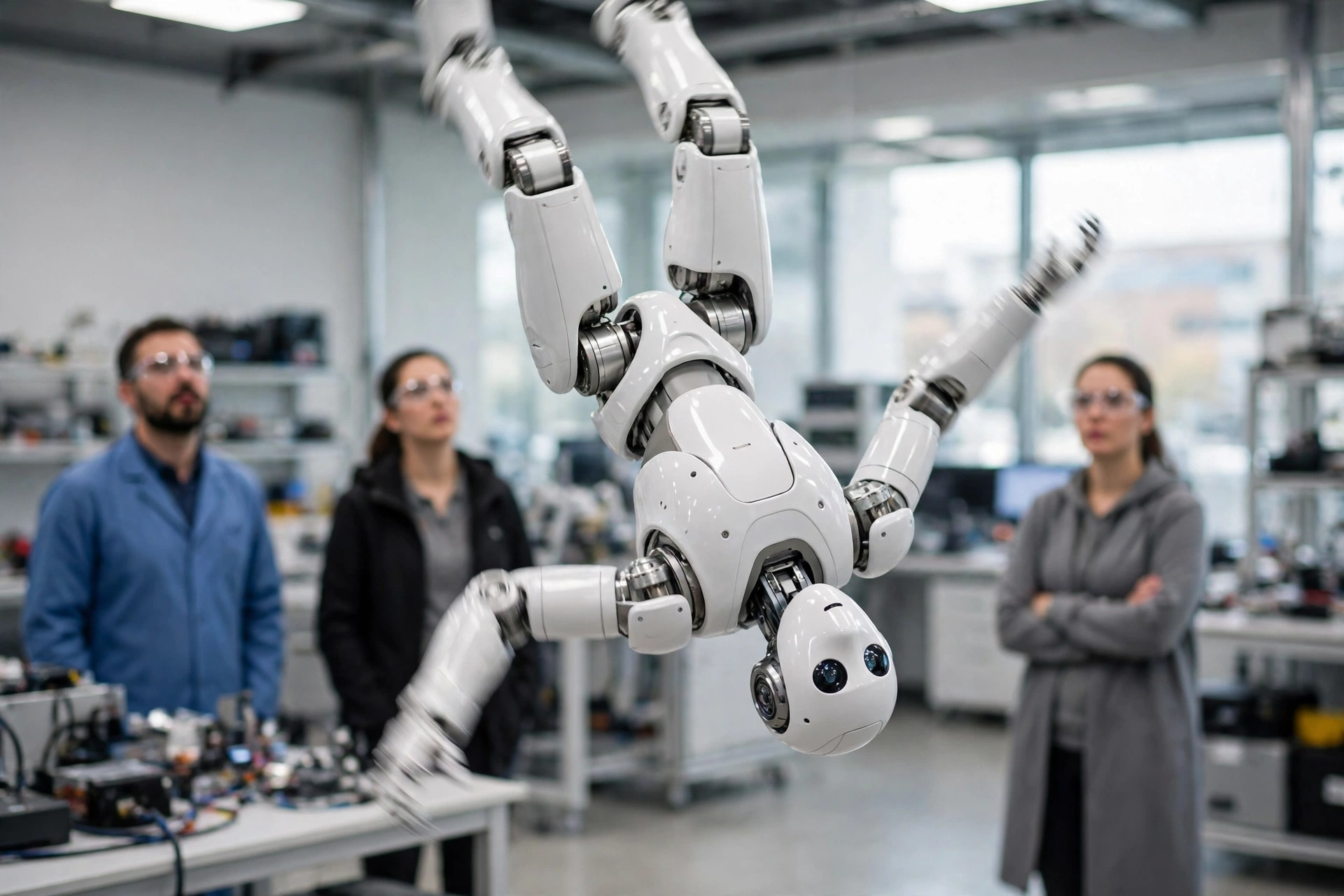
21,504 GPU-hours. That was the price of teaching a humanoid robot to move like a person, as of last month. Today it is 3. A team at UC Berkeley led by Qiayuan Liao, with Pieter Abbeel and Koushil Sreenath among the co-authors, published SuperMimic on October 20, 2026, and its headline number deserves to be stated exactly, because the paper itself rounds it down to a vague "more than 1,000 times" that understates the achievement by a factor of seven: 128 GPUs running for 7 days is 21,504 GPU-hours, and 21,504 divided by 3 is 7,168. Not "more than 1,000 times," as the abstract modestly puts it. Seven thousand one hundred and sixty-eight times.
Whole-body control is the hard part of humanoid robotics, and it is hard for a reason that has nothing to do with motors. Every motion couples to every other: an arm swing shifts balance, a step changes reach, a crouch moves the center of mass. Traditional training attacks this with model-free reinforcement learning, which means millions of trial-and-error rollouts in a physics simulator, with the policy learning only from whether each attempt scored better or worse. SuperMimic changes where the robot practices. It first learns one differentiable model of the humanoid's shared dynamics, fit from logged transitions of a standard rigid-body simulator, and then trains the tracking policy inside that learned model, where backpropagation through time over short imagined rollouts gives analytic gradients. Instead of guessing which joint twitch helped, the policy can compute it.
Three mechanisms do the work. Fast imagined rollouts inside the learned model run far quicker than stepping a full physics simulator. Analytic gradients replace random trial-and-error inference about what to change. And one shared world model amortizes learning across all motions, so the physics learned for a backflip transfers to a side roll instead of being rediscovered per motion. Training policy and world model together in one loop keeps the model honest as the policy improves.
The Headline Numbers, Audited
Before celebrating, it is worth checking the comparison the way an auditor would, because the authors' own project page invites it. Their accounting note states the comparison plainly: SONIC's reported 128 NVIDIA L40 GPUs for 7 days, about 21,000 GPU-hours, against 3 hours on one NVIDIA H100, with ratios of about 7,200x in GPU-hours and 56x in wall-clock time. My arithmetic lands at 7,168x and exactly 56x. Close enough that the rounding is honest, not flattering.
| Measure | SONIC (baseline) | SuperMimic |
|---|---|---|
| Training compute | 21,504 GPU-hours | 3 GPU-hours |
| Wall-clock time | 168 hours (7 days) | 3 hours |
| GPUs | 128 NVIDIA L40 | 1 NVIDIA H100 |
| Motion data | 555.6 hours (100M frames at 50 fps) | 264 hours |
| Benchmark failures | 179 of 129,514 motions | 25 of 129,514 motions |
| Failure rate | 0.1382% | 0.0193% |
Two rows in that table are my own calculations, not the paper's, and both cut in SuperMimic's favor. SONIC's 100 million frames at 50 frames per second is 555.6 hours of motion, which means SuperMimic beat the baseline while training on 47.5% of the motion data. And the failure rates: 25 failures out of 129,514 motions is 0.0193%, versus 0.1382% for SONIC, so SuperMimic fails 7.16 times less often, an absolute gap of 154 fewer failed motions. After 9.8 hours on two GPUs, SuperMimic reaches zero failures on the whole benchmark. That run costs 19.6 GPU-hours for 129,514 motions. Half a second of compute per motion mastered.
The Energy Bill Nobody Quoted
GPU-hours understate the gap, because the two runs did not use the same hardware. An NVIDIA L40 carries a 300-watt thermal design power; an H100 SXM draws up to 700 watts. Multiply those ceilings by the runtimes and the energy story gets stranger: 21,504 GPU-hours at 300 watts is 6,451 kilowatt-hours, while 3 GPU-hours at 700 watts is 2.1 kilowatt-hours. That is a 3,072-fold energy reduction, and if SuperMimic ran on the 350-watt PCIe H100 instead, the ratio doubles to 6,144-fold. At the US grid average of about 0.39 kilograms of CO2 per kilowatt-hour, the old run emitted roughly 2.5 metric tons of CO2. The new one emits under a kilogram, about one load of laundry.
Money tells the same story in rounder numbers. At an illustrative uniform rate of $2 per GPU-hour, SONIC's run cost $43,008, and SuperMimic's cost $6. The ratio is the same 7,168x at any uniform rate; the absolute dollars are illustrative, not a cloud invoice. And here is the number that reframes what a robotics lab should do next: SONIC's single-run budget of 21,504 GPU-hours buys 7,168 SuperMimic runs. A lab could retrain from scratch every single day for 19.6 years on what one baseline run used to cost.
It works on real hardware, not just in simulation. One policy, with no per-motion tuning, runs on a physical Unitree G1 across diverse and acrobatic motions, including side rolls and 360-degree flips, according to the authors' project page. That transfer matters because learned-model methods carry an obvious suspicion: a policy trained inside a hallucinated physics model may fall apart the moment real contact forces disagree with the model. G1 footage does not settle that question for every motion. It rules out the version where the method only works inside its own dream.
The Strongest Case Against the Headline
Now the case for skepticism, stated at full strength. The 7,168x is not a controlled experiment, and three differences favor SuperMimic in ways the ratio hides. First, hardware generations differ: an H100 is a newer, faster chip than an L40, so part of the speedup is silicon progress, not algorithmic insight. Second, SuperMimic trained on less than half the motion data, which helps its compute bill while raising the question of whether the comparison is apples to apples.
Third, and most important, the benchmarks differ in kind. SuperMimic's headline numbers replay its own training motions, 129,514 clips from the filtered BONES-SEED training set, while SONIC proved itself on held-out sets, including 7,016 clips across 182 motion sub-categories entirely absent from training. A controller that memorizes its training set is not yet proven to generalize, and motion tracking is only one layer of a useful robot: this paper shows no terrain handling, no object interaction, no long-horizon tasking. Nomura's analysts, writing about the paper days after release, flagged the same caveats and drew the investment conclusion anyway. As training software gets cheap, the moat moves to hardware consistency. Specifically, which manufacturer can hold joint precision across mass production.
That caveat does not kill the result; it locates it. SuperMimic collapses the cost of the training-coverage problem. It does not claim to solve humanoid robotics, and anyone quoting 7,168x as though it measures full robot capability is misreading the paper. What it does mean is that the next publishable result in this line of work is no longer gated by cluster access, because a graduate student with one good GPU can now run the scaling experiment that used to require a corporate lab, and the field's bottleneck moves to the two things money cannot shortcut as easily: diverse motion data and precise hardware.
What This Analysis Did Not Prove
Honest boundaries. Checkpoint evaluation time is excluded from the 3-hour figure, per the authors' own footnote, so end-to-end time to a verified controller is slightly longer than the headline. Only one robot platform is demonstrated, the Unitree G1, so multi-embodiment transfer is unproven. Energy figures use TDP ceilings, not metered power, and dollar figures use an illustrative uniform rate. Versions of the SONIC paper disagree on its own GPU-hours, with one stating 21,000 and another 32,000; I used the 21,000 figure the SuperMimic authors used for their comparison. Held-out generalization at SuperMimic's cost remains the experiment that matters most, and it has not been run yet.
What You Can Do
If you run a robotics team, stop budgeting a GPU cluster for motion tracking. Budget one H100-class card, and redirect the savings to motion-data diversity and actuator precision, because those are the constraints that survive this paper. If you do research, the scaling-law experiment on motion tracking is now cheap enough to run weekly, so the high-value result is held-out generalization at this cost, not another training-set record. If you evaluate humanoid vendors or invest in them, ask about joint precision at manufacturing volume before asking about training software, since training software just got roughly free and hardware consistency did not.
The Bottom Line
A week of cluster time became an afternoon on one GPU, failures fell from 179 to 25 across 129,514 motions, and the energy bill dropped from 2.5 tons of CO2 to under a kilogram. SuperMimic does not make humanoid robots generally capable, and its headline benchmark replays training data rather than proving generalization. But it removes compute as the excuse for why a lab cannot study whole-body control at scale, and that removal is permanent, because once a result like this exists, nobody will ever again need to justify a 128-GPU run to learn what one GPU can now teach in 3 hours, and every future proposal that budgets a cluster for motion tracking will have to explain why it needs one.