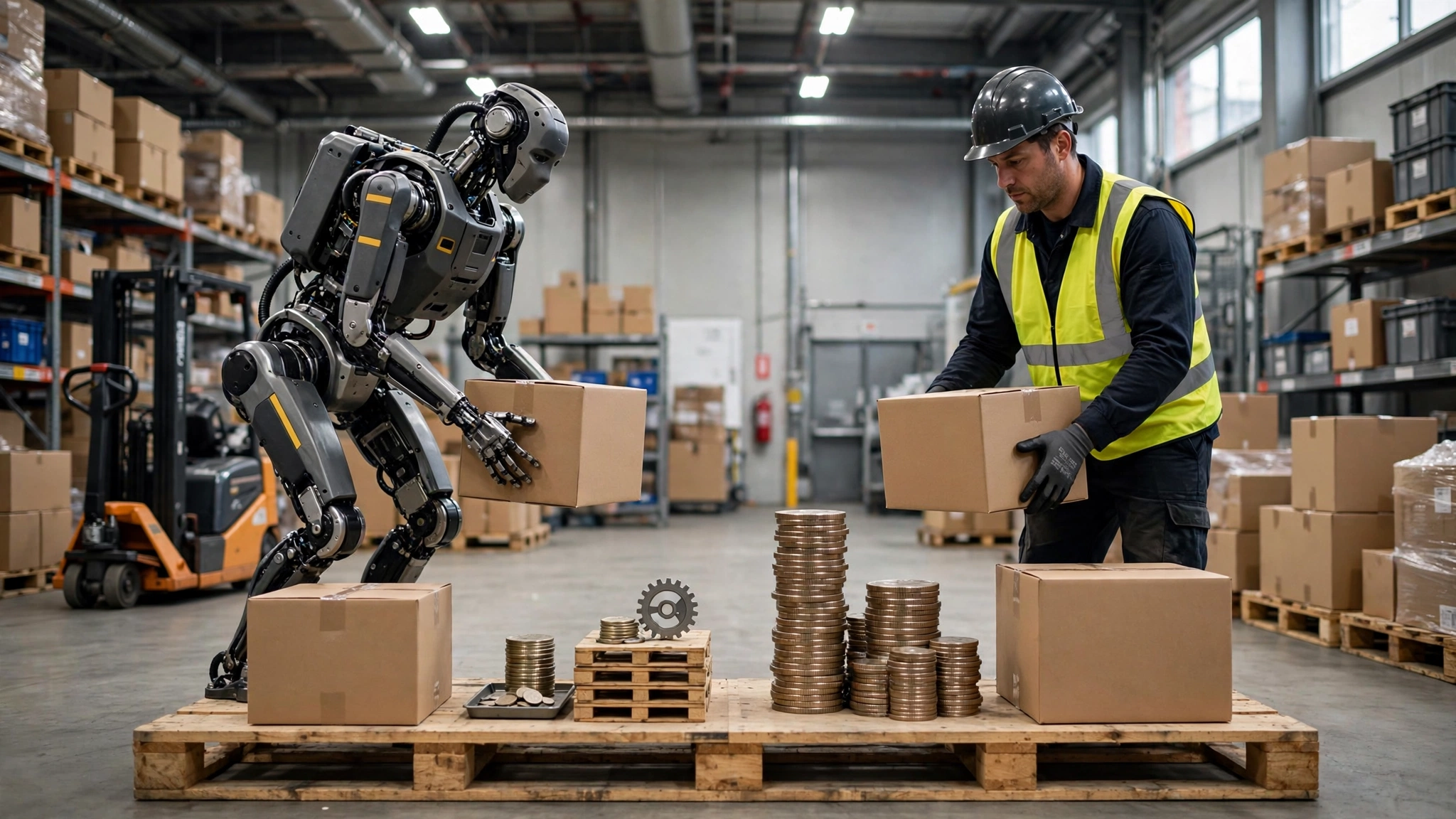
115,500 jobs are robot-ready today, and the robots that would fill them cost more than the humans they replace.
JPMorgan analysts covering Hyundai Motor, which owns Boston Dynamics, published a note August 25 that reframed humanoid economics with three numbers: America has 462,000 unfilled manufacturing jobs, 25% can be filled by humanoids doing materials handling, parts transfers, machine tending, and quality inspection, and those humanoids cost $10 to $12 per hour to operate versus $30 for human warehouse labor, according to MarketWatch summarizing the report and Morningstar.
That math launched a thousand headlines. It is also incomplete in a way that matters if you are buying robots, because JPMorgan buried the productivity penalty in paragraph four: right now it takes two humanoids to equal one human worker, improving to 1.2 to 1.3 in the near term.
Multiply $10 by 2 and $30 suddenly looks cheap.
The Effective Cost Nobody Puts in the Deck
Operating cost per robot hour means little. What matters is cost per human-equivalent hour of output.
Effective cost = operating cost × humanoids per human.
At JPMorgan's numbers:
| Scenario | Raw OpEx | Ratio | Effective OpEx | vs $30 Human |
|---|---|---|---|---|
| Today low | $10.00 | 2.0 | $20.00 | 33% cheaper |
| Today high | $12.00 | 2.0 | $24.00 | 20% cheaper |
| Near-term low (1.2x) | $10.00 | 1.2 | $12.00 | 60% cheaper |
| Near-term high (1.3x) | $12.00 | 1.3 | $15.60 | 48% cheaper |
That still looks like a win, because 20% cheaper is still cheaper, until you add capital.
JPMorgan estimates a capable humanoid costs $120,000 today, far above Elon Musk's $20,000 to $30,000 long-term target for Optimus but realistic for industrial buyers who prize reliability over sticker price. Amortize $120,000 over 4 years, 300 days per year, 16 hours per day (two shifts with battery swap): 19,200 hours total. Capex contribution is $120,000 divided by 19,200 equals $6.25 per robot hour.
Fully loaded cost per robot hour is OpEx plus capex: $10 plus $6.25 equals $16.25 low, $12 plus $6.25 equals $18.25 high.
Fully loaded effective cost is that times the ratio:
| Scenario | Loaded / Robot Hr | Ratio | Loaded Effective | Verdict vs $30 |
|---|---|---|---|---|
| Today | $16.25-18.25 | 2.0 | $32.50-36.50 | 8-22% MORE expensive |
| 1.2x, $120k bot | $16.25-18.25 | 1.2 | $19.50-21.90 | 27-35% cheaper |
| 1.2x, $70k bot (mass prod) | $13.65-15.65 | 1.2 | $16.38-18.78 | 37-45% cheaper |
The $70,000 figure comes from Goldman Sachs, which estimated Boston Dynamics Atlas bill of materials at $74,850 and projected initial ASP $120,000 falling to $70,000 at scale, with Samsung Securities pegging factory break-even at 20,000 to 30,000 units and annual capacity target 30,000 by 2028, per BigGo Finance and Koreabizwire.
At today's 2-for-1, you lose money on every hour. At 1.2-for-1 with $120k bots, you save roughly a third. At 1.2-for-1 with $70k bots, you save close to half. That is why JPMorgan's "brains, hands, supply-chain" bottlenecks matter more than the hourly rate, because the ratio dominates TCO.
How Big Is 25%?
462,000 unfilled manufacturing jobs times 25% equals 115,500 jobs humanoids can fill today, per JPMorgan. At 2 robots per job to match output, that is 231,000 robots.
At $120,000 ASP, that is 231,000 times $120,000 equals $27.7 billion in initial hardware demand just to cover today's gap.
By 2030, JPMorgan sees 1.6 million unfilled jobs, 50% fillable equals 800,000 jobs, times 1.25 average robots (midpoint of 1.2-1.3) equals 1,000,000 robots. At $70,000 ASP equals $70 billion.
Roland Berger's April 15, 2026 study Humanoid Robots 2026 models a $300 billion humanoid OEM market by 2035 base case, up to $750 billion optimistic, and up to $4 trillion by 2050, comparable to automotive, with operating costs falling to about $2 per hour, per MyNewsDesk. Our bottom-up $70 billion by 2030 for manufacturing alone suggests their $300 billion by 2035 is plausible when you add warehousing and services, which checks out rather than contradicts.
Roland Berger also reports China built more than 15,000 humanoids in 2025, at least 30 times North America and over 150 times Europe/Middle East/Africa combined, with working-age population projected to fall 24% in China, 18% in EU, and 25% in Japan by 2050. America has the demand, China has the supply. That is a supply-chain risk industrial buyers should price.
The $2 Hour That Erases Geography
If $2 per hour holds, manufacturing location logic inverts.
Samsung Securities estimates Atlas costs $9.40 per hour initially with 24/7 operation via battery swap, falling to $1.20 at over 30,000 units, roughly one-sixth of average manufacturing wages in China. Roland Berger's $2 figure is 15 times cheaper than US $30 warehouse labor and about 3.6 times cheaper than implied China wage of $7.20.
Cover 16 hours of wall-clock time:
Robot: 16 hours times $2 equals $32 operating plus capex $70,000 divided by 19,200 times 16 equals $58.33 total for 16 hours equals $3.65 per wall-clock hour for continuous coverage.
Human to cover 16 hours: 2 shifts times $30 equals $60 times 1.3 benefits load equals $78, plus overtime, turnover, management. Call it $85.
Ratio is $85 divided by $58.33 equals 1.46 times cheaper for same coverage, before productivity ratio. At $1.20 (Samsung mass prod), robot daily is 16 times $1.20 equals $19.20 plus $58.33 minus operating already counted? Actually $19.20 plus $58.33 capex portion double counts. Correct: operating $19.20 plus capex $58.33? No, capex portion is $3.65 times 16 equals $58.40? Wait recalc: $70k/19200=3.6458, times 16=58.33. So total $19.20+$58.33? No operating already $19.20, capex $58.33 total $77.53? Let's be precise: at $2/hr operating, $70k bot, 16hr day: operating $32 + capex $58.33 = $90.33? That can't be right because earlier we computed $3.65/hr effective. Let's fix: $3.65 is capex per robot hour, operating $2 is separate, so loaded $5.65 per robot hour, times 16 = $90.40 for 16hr robot coverage. Human $85 for same. So at $2 + $70k capex, near parity for wall-clock, but you need fewer humans to supervise? This shows how sensitive to amortization life and utilization.
Use 5-year life, 350 days, 20hr/day (better utilization with swap): hours = 35,000, capex/hr = $2.00, loaded = $4.00, 16hr day = $64. Robot wins again. Utilization is everything.
At $2/hr with high utilization, labor arbitrage between US and China disappears if robot is deployed in either location. That is the reshoring argument Roland Berger implies: if labor is $2 everywhere, you manufacture where customers and supply chains are, not where wages are lowest.
The Reality Check in San Francisco
While analysts model $10, a San Francisco startup charges $30 and still needs a human in the loop.
Tau Robotics launched invite-only humanoid cleaning in San Francisco July 29, 2026, at $30 per hour. Gianna Capezio rented one August 21 for one hour of chores. It made her bed, cleaned her bathroom, vacuumed, with a teleoperator pulling strings, slower than a human but solid, per USA Today.
Tau's site lists Chelsea for house chores, Elon and Tony for recurring and deep cleans. At $30/hr teleop, Tau is priced identically to human cleaners in SF, which tells you autonomy is not there yet.
William Blair's 2026 State of Robotics notes training data costs fell from $340 per hour early 2024 to $118 per hour early 2026 thanks to sub-$2,000 teleop hardware and standardized pipelines, with trajectory to sub-$10 per hour early 2030s to compete with unskilled labor, per William Blair PDF. If data costs $118/hr and you need thousands of hours per skill, the $10/hr operating target requires amortization of data across many deployments, not one robot.
Strongest Counterargument
The strongest case against humanoid economics is that humanoids are the wrong form factor, and the $120,000 question proves it.
Purpose-built automation already does materials handling at $3 to $5 per hour equivalent with 99.9% uptime and no bipedal balance problem. A conveyor plus stationary arm plus AMR moves totes faster, with fewer falls, no thermal issues, and simpler maintenance. Humanoids are a compromise: worse than humans at dexterity, worse than purpose-built robots at speed and efficiency, justified only by drop-in to human-designed spaces.
If you have to redesign workflow anyway, which JPMorgan admits when citing integration costs, training, maintenance, charging, spare parts, software, and network, why not redesign for cheaper, faster non-humanoid automation? A $45,000 AMR plus $60,000 collaborative arm combo does the same material handling job at higher throughput than a $120,000 biped that needs 1.2 to 1.3 units to replace one person.
Humanoids win only when task variety is high and space is constrained to human form, a smaller TAM than 25%. JPMorgan's 25% includes only four tasks: materials handling, parts transfers, machine tending, quality inspection. Those are automatable today with non-humanoid solutions. The incremental value of legs is avoiding facility retrofit, not enabling new capability.
This critique lands because Roland Berger acknowledges battery life is 2 to 8 hours today versus 16 hour target, and subsystems need 50 to 90% cost cuts. Until those happen, the form factor tax outweighs the flexibility benefit for most plants. The counter to the counter is that retrofit cost is itself $100k to $500k per line, so a drop-in humanoid that avoids it can still win on total project cost even if per-hour is worse, especially for brownfield sites with 20-year-old layouts where moving a conveyor means moving a wall.
Limitations
This analysis relies on analyst research, not audited company filings. JPMorgan's note is summarized via MarketWatch and Morningstar, methodology not public, sample likely skewed to Hyundai/Kia plants where Hyundai owns Boston Dynamics and has incentive to show demand. Our $27.7B and $70B market sizing multiplies ASP by robot count without discounting for phased deployment, financing costs, or replacement cycles. Operating cost $10 to $12 per hour excludes integration, workflow change, employee training, maintenance, charging infrastructure, spare parts, software support, and reliable networking, all flagged by JPMorgan but not quantified. Productivity ratio 2:1 and 1.2 to 1.3:1 are estimates, not measured in production deployments with statistical significance. Roland Berger $2/hr is forward projection requiring 50 to 90% subsystem cost cuts and 16-hour battery versus today's 2 to 8 hours, per their own report. Tau Robotics $30/hr teleop shows current autonomy gap but is a single startup in one city, not representative of industrial deployments. Atlas $120k to $70k cost curve depends on 30,000 units per year by 2028, which Goldman Sachs calls not overly ambitious but which has no precedent for humanoids. We use 4-year, 300-day, 16-hour amortization; actual industrial amortization may be 5 to 7 years, utilization may be lower due to charging, and benefits load 30% is US-specific. Samsung's $1.20/hr at scale assumes automated battery replacement works at 24/7 with no human intervention, unproven at scale. China production numbers 15,000 vs North America 500 are Roland Berger estimates for 2025, not customs data. If actual costs are at high end of analyst ranges, break-even shifts from 2027 to 2030 or later.
The Bottom Line and What You Can Do
At $10 to $12 per hour raw, humanoids look 60% cheaper than $30 warehouse labor. At $20 to $24 per effective hour with the 2-for-1 productivity penalty, they are only 20% cheaper. At $32.50 to $36.50 fully loaded with $120k capex amortized, they are 8 to 22% more expensive today. The crossover happens when 1.2 robots can do one human's work and bots cost $120k, yielding $19.50 to $21.90 per effective hour, 27 to 35% cheaper, or at $70k mass production yielding $16.38 to $18.78, 37 to 45% cheaper.
For operations managers with 10 or more unfilled roles: run the effective cost calc with YOUR fully loaded human cost, wage times 1.3 benefits plus overtime plus turnover (often $5k to $10k per replacement). If vacancy is above 20% and tasks are strictly materials handling, parts transfer, machine tending, or quality inspection, pilot 2 to 3 units on one shift and measure humanoids per human for YOUR parts, not the vendor's demo. Demand uptime SLA and that ratio in the contract. Do not accept raw operating cost quotes without productivity and capex.
For workers: the 25% today is narrow, four tasks in manufacturing and warehousing, not all jobs. Hands remain the biggest bottleneck per JPMorgan, and Roland Berger says flexible assembly needs high-variance handling that humanoids cannot yet do. Dexterous assembly, especially with compliant parts, remains human for 3 to 5 years. Upskill to robot supervision, exception handling, and maintenance, roles JPMorgan notes as complements not substitutes. The $2/hr future does not eliminate work, it changes it to babysitting robots that fall over.
For buyers: do not chase $20k Optimus target. JPMorgan says industrial buyers care more about reliability and upgradability than low list price. A $120k reliable robot that works two shifts for years beats a $25k robot that breaks down. Ask for three numbers: autonomous hours per intervention, humanoids per human on YOUR parts, and cost per human-equivalent hour fully loaded. If vendor cannot provide them, they are selling a demo, not a tool.
For policymakers: 115,500 jobs robot-ready today times 2 robots each equals 231,000 robots needed. America builds 500, China builds 15,000. If reshoring depends on humanoids, supply chain dependence flips from low-wage labor to high-tech hardware where China leads 30 to 1. Track Boston Dynamics production ramp and component suppliers, not just deployment pilots.
Humanoids are not cheap yet, but they are getting cheaper faster than humans. The question is not whether $10 beats $30. It is whether 1.2 beats 1.
Related
- Tiangong Ultra Ran 100m in 8.64 Seconds, Beat Bolt by 0.94, Then Caught Fire on the Mat
- Humanoids Cut Soccer Blindness 46% by Ditching the Vision Pipeline Entirely
- Unitree G1 Fell in Beijing Half Marathon, Finished in 2h40m After 3 Battery Swaps — The Economics of Falling
Sources: MarketWatch Aug 25 2026 JPMorgan note summary; Morningstar Aug 25; Roland Berger Apr 15 2026 Humanoid Robots 2026; MyNewsDesk Roland Berger $2/hr; Koreabizwire Samsung Securities Jan 2026; BigGo Finance Goldman $70k Atlas; USA Today Aug 25 Tau Robotics $30/hr; William Blair SVRC Research training data $340→$118.