🤖 Robotics
Shanghai Wants 8,000 Humanoid Robots in Its Factories by 2028. That's 57% of All China Shipped Last Year.
Shanghai's new smart-manufacturing plan targets 8,000 factory humanoids by 2028 and robot density of 600 per 10,000 workers. The arithmetic checks out against shipment forecasts. The economics demand a 3x price drop buyers say must reach ¥200,000 per unit.
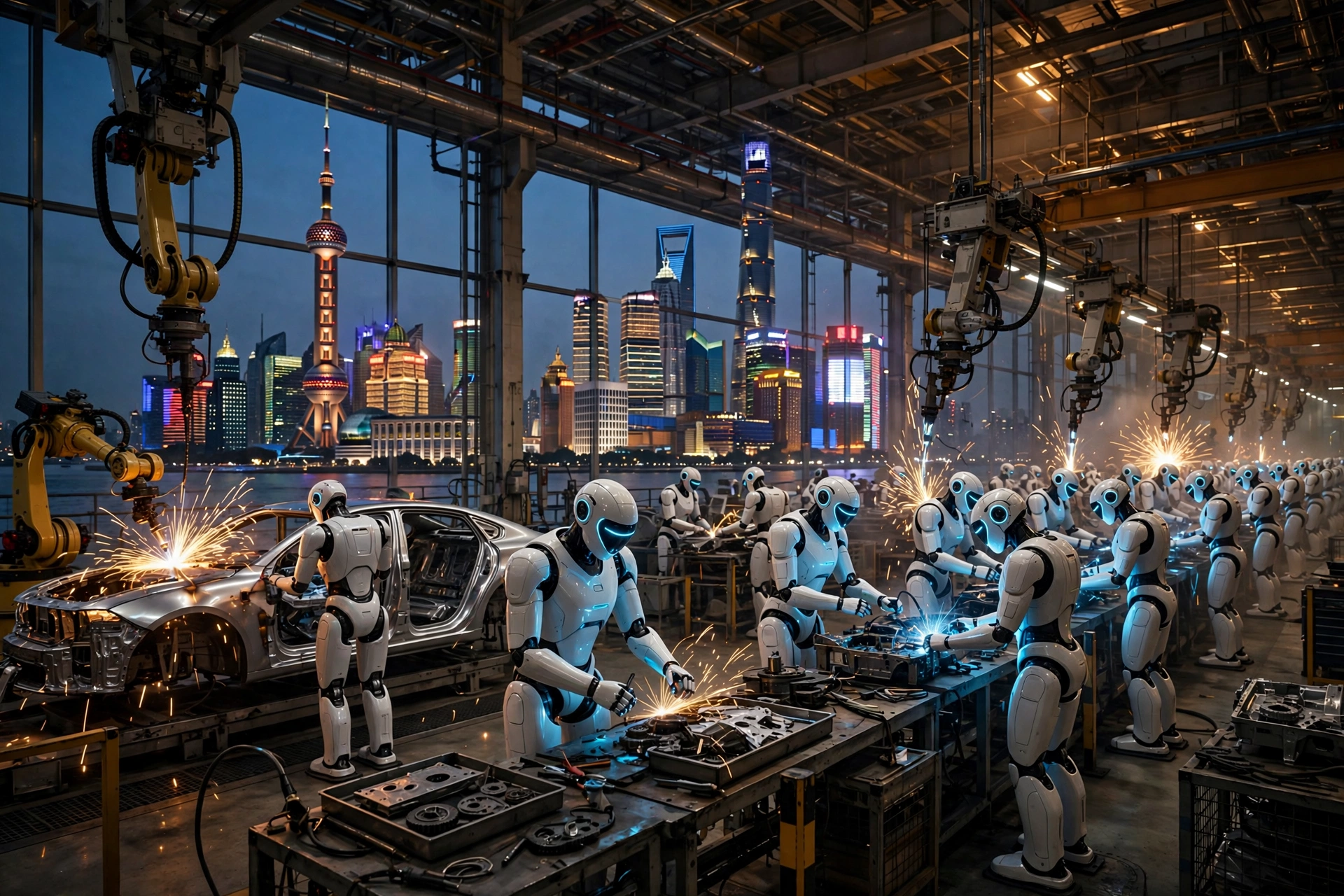
Eight thousand is the number in Shanghai's announcement, and it is bigger than it sounds. On October 12, at the 26th China International Industry Fair, Shanghai authorities unveiled an "Accelerated Action Plan for the Development of Next-Generation Smart Manufacturing" with a headline target: 8,000 humanoid robots working on actual factory production lines by 2028. Morgan Stanley's survey of the Chinese humanoid market counts roughly 14,000 units delivered across all of China in all of 2025. Divide the two and Shanghai's target equals 57 percent of one nation's entire annual output, concentrated in a single city over about two years.
Robots are only part of the plan. It calls for industrial robot density of 600 per 10,000 people, 500 advanced smart factories, more than 2,000 AI application scenarios in manufacturing, 10 industry-specific large language models, and 300 high-level industrial AI agents, all by 2028. Projected payoff: a new smart-manufacturing equipment industry worth 200 billion yuan (about $28 billion at 2026 rates) and an integrated smart-manufacturing systems industry of 100 billion yuan. Unitree chairman Wang Xingxing used the occasion to say the "critical point" for physical AI could arrive within one to two years.
Scale in context
Two readings are both true, and the table shows why. Against Morgan Stanley's 50,000-unit 2026 forecast, 8,000 is 16 percent, a plausible procurement share for a city that functions as China's manufacturing capital. Against the 14,000 actually delivered in 2025, it is 57 percent, a bet that the curve bends violently upward starting now.
| Context | Units | Source |
|---|---|---|
| Shanghai 2028 target (factory humanoids) | 8,000 | Shanghai action plan, Oct 2026 |
| China delivered, 2025 | ~14,000 | Morgan Stanley buyer survey |
| Global shipped, 2025 (all humanoids) | ~13,000 | Omdia |
| Global full-size sold, 2025 | ~7,000 | IFR |
| China forecast, 2026 | 50,000 | Morgan Stanley (revised) |
| China shipped, H1 2026 | ~19,100 | Smart Analytics Global |
A reading note for the table: the IFR figure of about 7,000 is full-size units only. Omdia's remaining units were smaller research, education, and entertainment machines. Shanghai wants 8,000 factory machines specifically, a category that barely exists in the sales record. Most of 2025's volume was government procurement, research deployments, and entertainment, not factory work.
A density above Germany's
Shanghai's 600-per-10,000 target deserves its own arithmetic. China sits at 166 robots per 10,000 manufacturing employees in 2024, per the International Federation of Robotics, ranking 22nd in the world. Six hundred is 3.6 times that. It would place one city above Germany (449) and Japan (446) as whole economies, while still trailing South Korea (1,220) and Singapore (818).
| Economy | Robots per 10,000 manufacturing employees (2024) | Source |
|---|---|---|
| South Korea | 1,220 | IFR World Robotics 2025 |
| Singapore | 818 | IFR |
| Shanghai target (2028) | 600 | Action plan |
| Germany | 449 | IFR |
| Japan | 446 | IFR |
| United States | 307 | IFR |
| China | 166 | IFR |
That is the number that should make factory owners elsewhere pay attention: it is a density target, not a demo count, and it implies retrofitting existing lines rather than just showcasing new ones. One caution belongs here. IFR's density figure counts all industrial robots, and the 600 target does too. Those 8,000 humanoids would be a sliver of whatever robot stock a 600 density implies. Keep the two numbers separate, or the story becomes "8,000 robots equals 600 density," which the arithmetic does not support.
A half-billion-dollar price gap
Here is the number that decides whether 2028 is a plan or a wish. Morgan Stanley's buyer survey found that 92 percent of Chinese corporate buyers need unit prices below ¥200,000, roughly $28,000, before mass-adoption math works. Multiply: 8,000 × $28,000 = $224 million for the fleet at the price buyers say is viable. Now price today's hardware: a Unitree H1 lists at $90,000, UBTECH's Walker S runs about $90,000 to $130,000, AgiBot's A2 about $80,000 to $120,000. At $90,000 a unit, the same fleet costs $720 million. That gap runs roughly half a billion dollars, or equivalently a required price drop of nearly 3x in 26 months.
| Model | Class | Listed price |
|---|---|---|
| Unitree H1 | Full-size, research/industrial | ~$90,000 |
| UBTECH Walker S2 | Smart factory | ~$90,000–$130,000 |
| AgiBot A2 | Industrial assembly | ~$80,000–$120,000 |
| Unitree H2 | Mid-range full-size | $29,900 |
| Unitree G1 | Small (127 cm), research | $13,500 |
One row in the table is more interesting than the rest: the H2 at $29,900. It is the first full-size machine listed near the buyer threshold, unveiled in October 2025 with deliveries from April 2026. If the fleet standardizes on machines like it, the price gap narrows to almost nothing. If it standardizes on $90,000-class machines, the plan needs subsidies of several hundred million dollars, or it needs the hardware cost curve to do something it has never done at this speed.
Delivery rate
October 2026 to December 2028 is about 26 months. 8,000 units over 26 months is roughly 308 a month, about 3,700 a year. Smart Analytics Global counts roughly 19,100 humanoids shipped in China in the first half of 2026. Shanghai would need to absorb about one-fifth of the country's entire output, every month, for more than two years. That is conceivable in a country where AgiBot alone shipped over 5,100 units in 2025 and Unitree about 4,200. It is not conceivable on autopilot, given where last year's units actually went.
The strongest case against
Morgan Stanley's own analysts frame 2026 as "a critical year" and warn of a shakeout as IPOs and venture capital outpace actual end-customer demand. Survey numbers back the warning: 62 percent of buyers say they will likely adopt within three years, but only about 10 percent are currently evaluating or running pilots, and of those who have actually used the products, only 23 percent report satisfaction. Shipments are not deployments. An announced target of 8,000 could arrive as pilot cells, government showcase lines, and research fleets that never run a full production shift. Shanghai's plan is a policy target with subsidy backing, not an audited delivery commitment, and Chinese municipal plans have a long history of announcing first and reconciling later. $5.1 billion flowed into humanoid startups in the first half of 2026, against roughly $235 million in disclosed revenue at two major Chinese issuers: the shape of a bubble wearing a factory uniform.
Limitations
What this analysis did not prove starts with the plan itself: its full text was not independently reviewed, so this account rests on announcement-day coverage of the fair, itself one step removed from the document. Shipment figures come from research firms with different counting rules (Omdia's ~13,000 global units versus IFR's ~7,000 full-size sales), so the denominator changes with the definition. Enterprise hardware pricing is partly quote-based; the $90,000 floor is list pricing, and volume deals will differ. "Deployed on production lines" has no published definition; a robot in a pilot cell and a robot replacing a shift are both deployments in announcement language. Morgan Stanley's 2026 forecast of 50,000 Chinese shipments is its second upward revision this year, which is either prescience or momentum.
What to do about it
First, if you run a factory: pilot one cell before committing to a fleet, and write the contract around uptime and mean time between interventions, not demo videos. A 23 percent satisfaction figure is the market telling you the demos lie. Second, if you supply components: Morgan Stanley's own note says component revenue arrives before integrator revenue, so the supplier book fills while the integrators fight the shakeout. Third, if you invest: price the shakeout, not the plan, and ask every founder for cost per useful hour, because Figure's own claim of about $25 an hour at BMW is the benchmark everything else must beat. Fourth, if you compete with Shanghai: the 600-density target is the number that matters, and it implies your competitor's cost base is about to move whether or not any single humanoid works.
The Bottom Line
Shanghai's 8,000-humanoid target is arithmetically serious and economically unresolved. Under the plan, the city would absorb roughly one-sixth of China's projected 2026 humanoid output, automate denser than Germany, and do it at hardware prices that do not exist yet. Watch a different number: not 8,000. It is ¥200,000: if full-size factory-grade machines do not clear the buyer price wall by 2028, the plan's most quoted number becomes its most expensive footnote.
Sources
- Aju Press, "China to Deploy 8,000 Humanoid Robots in Shanghai Factories by 2028" (Oct 13, 2026) (announcement at the 26th China International Industry Fair, Oct 12: "Accelerated Action Plan for the Development of Next-Generation Smart Manufacturing," 4 key projects, 19 priority tasks; targets by 2028: 8,000 humanoids on production lines, 600 robots per 10,000 people, 500 smart factories, 2,000+ AI scenarios, 10 industry LLMs, 300 industrial AI agents; 200B yuan equipment industry, 100B yuan systems industry; Unitree chairman Wang Xingxing on the "critical point" for physical AI)
- IFR World Robotics 2025 via Business Wire (Apr 8, 2026) (robot density 2024: China 166 per 10,000 employees, 22nd worldwide, +17% YoY; China operational stock ~2 million, largest in world, ~4.5x Japan; 295,000 installations in 2024 = 54% of global; Korea 1,220, Singapore 818, Germany 449, Japan 446, US 307; Western Europe 267, North America 204, Asia 131; global average 132)
- Morgan Stanley China humanoid survey via LostJobs.ai (May 2026) (~14,000 units delivered in China in 2025; 2026 forecast 28,000; 150+ Chinese humanoid companies; 62% of buyers likely to adopt within 3 years vs. ~10% currently piloting; only 23% of users satisfied; 92% require unit price below ¥200,000; "critical year" shakeout warning as capital outpaces end-customer demand)
- Morgan Stanley forecast revision via Briefly (2026) (China humanoid shipment forecast doubled to 50,000 units for 2026; $2B market in 2026 rising to $15B by 2030; 446,000 annual shipments by 2030; global market ~$3B in 2025 to $28B by 2030; ~13,000 humanoids shipped globally in 2025)
- Morning Tick (Oct 2026) (Omdia: ~13,000 humanoids shipped worldwide in 2025, >5x 2024; AgiBot 5,100, Unitree 4,200, UBTECH ~1,000; H1 2026 shipments ~19,100 with Chinese makers over 97%; Goldman Sachs 6.5M humanoids by 2035; Morgan Stanley ~1B by 2050)
- Robotsourced humanoid price board (July 2026) (Unitree H1 ~$90,000; Unitree H2 $29,900; Unitree G1 from $13,500; UBTECH Walker S ~$90,000–$130,000; AgiBot A2 ~$80,000–$120,000; Agility Digit ~$250,000; Kepler K2 ~$34,500)
- WebProNews (Oct 12, 2026) (IFR: ~7,000 full-size humanoids sold worldwide in 2025; Axis Intelligence: ~$235M disclosed revenue at two major Chinese issuers on 6,579 units; humanoid startups raised ~$5.1B in H1 2026; Figure AI $39B valuation; Unitree targeting ~$9B IPO; Figure claims ~$25/hour at BMW)