STRATOS Will Remove 500,000 Tons of CO2 Per Year. The Planet Emits 40 Billion. Here's the Math Nobody Wants to Do.
The world's largest direct air capture plant opens in Texas at 125 times the scale of the first commercial DAC facility. An original learning-curve analysis reveals DAC must double capacity every 2.2 years, match solar's best decade of cost decline, and consume 7% of global electricity to hit the IEA's 2050 target.
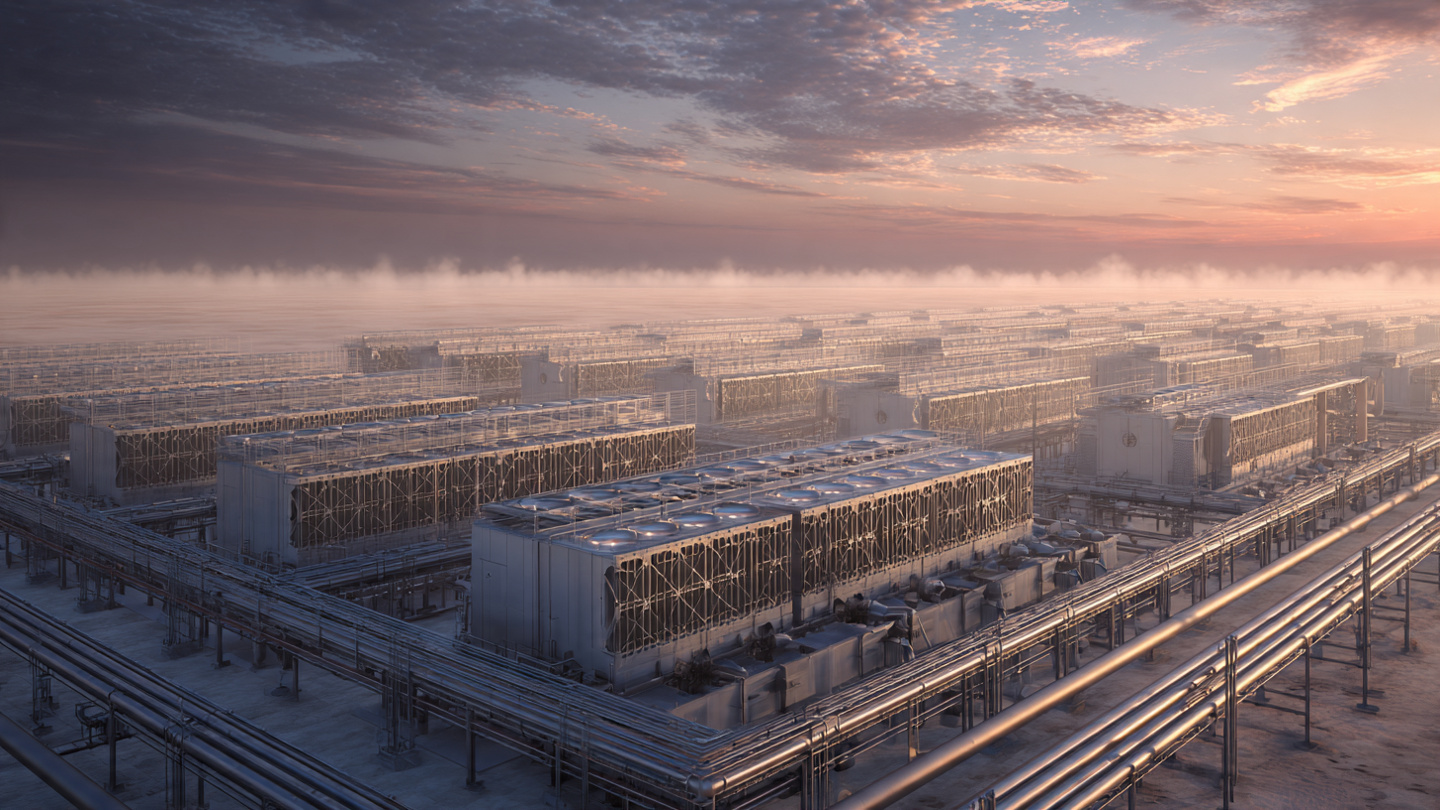
One hundred and twenty-five. That is the ratio between the world's first commercial direct air capture plant and the one about to switch on in West Texas, measured in tonnes of CO2 removed per year, and it represents five years of scaling from a technology that most energy analysts dismissed as a laboratory curiosity when Climeworks opened Orca in Hellisheiði, Iceland, in September 2021 at a capacity of 4,000 tonnes per year. Occidental Petroleum's subsidiary 1PointFive expects Phase 1 of STRATOS to come online in Q2 2026 in Ector County, Texas, designed to capture up to 500,000 tonnes of CO2 annually. It will be, by a wide margin, the largest direct air capture facility ever built. The number sounds enormous until you divide it by global annual CO2 emissions of roughly 40 billion tonnes. Then it becomes 0.00125 percent, a rounding error on a rounding error.
Nobody disputes that DAC needs to get much bigger. What nobody has done is calculate exactly how much bigger, how fast, at what cost trajectory, and how much energy the planet must dedicate to the task, then compare those requirements against the only technology that has actually achieved a similar scaling arc in the energy sector within living memory. Solar did it, exactly once. Can DAC?
Five Years, Three Plants, Three Orders of Magnitude
The scale-up from Orca to STRATOS looks like a technology in hypergrowth. It is worth pausing on the actual numbers, because the trajectory from Plant 1 to Plant 3 sets the denominator for every projection that follows.
| Plant | Location | Year | Capacity (tonnes CO2/year) | Scale-up Factor |
|---|---|---|---|---|
| Orca | Iceland | 2021 | 4,000 | Baseline |
| Mammoth | Iceland | 2024 | 36,000 | 9x Orca |
| STRATOS | Texas | 2026 | 500,000 | 14x Mammoth |
Three plants in five years. From a shipping container's worth of CO2 removal to half a million tonnes. Impressive, and also irrelevant to the question that matters. Now for the part that keeps climate scientists awake at 3 a.m., staring at spreadsheets.
The IEA's Demand, and the Doublings Required to Get There
The International Energy Agency's Net Zero by 2050 roadmap calls for DAC to reach 85 million tonnes per year by 2030 and 980 million tonnes per year by 2050. These are not aspirational stretch goals from an environmental advocacy group. They are the IEA's modeled requirements for keeping global warming below 1.5 degrees Celsius, embedded in a scenario that already assumes aggressive emissions reductions across every sector of the global economy. DAC is the cleanup crew for the residual emissions that cannot be eliminated: long-haul aviation, cement production, steel, chemical feedstocks. Cut everything else to zero and you still need DAC for the last 2.45 percent.
Once STRATOS is online, global DAC capacity will sit at roughly 0.55 million tonnes per year, including the combined output of Orca, Mammoth, and a handful of smaller pilot facilities worldwide. The math from 0.55 Mt to the IEA targets is straightforward and unforgiving.
Reaching 85 Mt by 2030 from a 0.55 Mt starting point requires log2(85/0.55) = 7.3 doublings in approximately four years. That is one doubling every 6.6 months, a pace no energy technology in history has sustained. Not solar, not wind, not natural gas, not nuclear. The 2030 target is, by any honest assessment, already unreachable through DAC alone.
Reaching 980 Mt by 2050 requires log2(980/0.55) = 10.8 doublings over 24 years. That is one doubling every 2.2 years, ambitious but not physically impossible, because a precedent exists.
Solar Did This, Exactly Once
Global installed solar capacity grew from approximately 40 gigawatts in 2010 to roughly 1,600 gigawatts by 2024, according to Our World in Data. That is 5.3 doublings in 14 years, or one doubling every 2.6 years. Solar's actual pace is close to what DAC needs but slightly slower, and solar had advantages DAC currently lacks: a modular technology that could be deployed on any rooftop or field, massive manufacturing economies concentrated in China, and policy tailwinds including feed-in tariffs, renewable portfolio standards, and the U.S. Investment Tax Credit.
DAC needs to double faster than solar did during solar's greatest growth decade, not by a little but by 18 percent measured in doubling frequency. And it must do so while building chemical plants, not bolting panels to racks, which means longer construction timelines per unit of capacity, higher capital intensity per installation, and a supply chain for sorbents, heat exchangers, and industrial-scale air contactors that does not yet exist at the required volume.
The Cost Curve That Must Bend
Cost is where the learning-rate comparison becomes most instructive and most uncertain. Solar achieved a learning rate of roughly 20 percent per doubling of cumulative capacity, meaning every time global installed solar doubled, the cost per watt dropped by one-fifth. Over roughly 10 doublings from the early 2000s to the mid-2020s, this compounded to a 90 percent decline in module cost, from over $4 per watt to under $0.30.
Current DAC costs sit above $600 per tonne of CO2 for small-scale plants under 50,000 tonnes per year, according to a range of IEA and academic estimates. STRATOS, at vastly larger scale, is projected to operate somewhere between $250 and $400 per tonne, though neither Occidental nor 1PointFive has disclosed a precise figure. If DAC achieves a 20 percent learning rate identical to solar's, starting from $400 per tonne at 0.55 Mt cumulative capacity, the cost trajectory looks like this:
| Cumulative Doublings | Global DAC Capacity | Projected Cost per Tonne | Notes |
|---|---|---|---|
| 0 (today) | 0.55 Mt/year | $400 | STRATOS-era baseline |
| 3 | 4.4 Mt/year | $205 | Below 45Q tax credit ($180/t) |
| 5 | 17.6 Mt/year | $131 | Approaching EU ETS price |
| 8 | 141 Mt/year | $67 | Competitive with compliance markets |
| 10.8 | 980 Mt/year | $39 | IEA 2050 target scale |
At $39 per tonne, DAC becomes cheaper than most compliance carbon prices worldwide and competitive with nature-based offsets. The $180-per-tonne Section 45Q tax credit for DAC with permanent geological storage, created by the Inflation Reduction Act, subsidizes the first three to four doublings almost entirely. The tax credit was designed for exactly this purpose: bridging the gap between first-of-a-kind costs and the point where learning-curve economics take over.
Here is the problem with projecting solar's success onto an entirely different technology. Solar's 20 percent learning rate was not inevitable. It was the product of Chinese manufacturing scale, decades of materials science research, a technology whose core component (silicon wafers) happened to benefit from semiconductor industry spillovers, and a political consensus across dozens of countries that solar deserved subsidy. DAC's actual learning rate is unknown, because the technology does not yet have enough data points to calculate a meaningful rate. Chemical process plants historically achieve learning rates of 10 to 15 percent per doubling, not the 20 percent that made solar's revolution possible. If DAC follows chemical-plant precedent rather than solar's trajectory, the math changes dramatically.
At a 10 percent learning rate, cost after 10.8 doublings drops to only $124 per tonne, not $39. DAC would still be three times more expensive than the solar-parity scenario. At 15 percent, the endpoint is $69 per tonne, workable but requiring sustained carbon prices or subsidies at a level no major economy has maintained for more than a few years.
The Energy Bill: 7 Percent of Global Electricity
Cost is not the only constraint. DAC is energy-intensive in a way that solar panels, once manufactured, are not. Each tonne of CO2 captured requires roughly 1,500 to 2,000 kilowatt-hours of thermal energy plus 300 to 500 kilowatt-hours of electrical energy, according to World Resources Institute estimates and academic literature reviewed by the IEA. Call it 2,000 kWh total per tonne as a conservative midpoint.
At the IEA's 2050 scale of 980 million tonnes per year, the calculation is simple multiplication that produces a staggering result: 980,000,000 tonnes multiplied by 2,000 kWh equals 1,960 terawatt-hours per year. Global electricity generation in 2024 was approximately 29,000 terawatt-hours. DAC at IEA scale would consume 6.8 percent of current global electricity output. That is more electricity than the entire continent of Africa used in 2023.
If that energy comes from fossil fuels, the exercise is self-defeating, because burning gas to power CO2 removal releases CO2. STRATOS plans to use a combination of natural gas with carbon capture and renewable energy. At 2050 scale, the energy must be overwhelmingly zero-carbon, which means the electricity grid must grow enough to power everything it already powers plus an additional 1,960 TWh for DAC alone, all from clean sources. This is not a technical impossibility. Global electricity generation is projected to grow substantially by 2050 regardless of DAC. But it is a resource claim that competes directly with electrification of transport, heating, and industrial processes, all of which are also required by the IEA's net-zero scenario.
1,960 Plants, $2 Trillion, 24 Years
Translating the capacity target into infrastructure: 980 million tonnes per year divided by 0.5 million tonnes per plant equals 1,960 STRATOS-scale facilities. At a rough capital cost of $1 billion per plant, based on estimates derived from Occidental's partnership with BlackRock to develop STRATOS, the total capital expenditure comes to approximately $2 trillion over 24 years, or about $83 billion per year. For context, global investment in solar energy reached roughly $350 to $400 billion in 2024, according to the IEA. DAC investment at the required scale would run at roughly one-quarter of current solar investment. Large but not inconceivable, provided the economics work.
The Oil Company in the Room
STRATOS is funded and operated by Occidental Petroleum, the 12th-largest oil and gas producer in the United States. The captured CO2 is destined for two uses: permanent geological sequestration in deep saline formations, which counts as genuine carbon removal, and enhanced oil recovery, which uses pressurized CO2 to push additional crude oil out of depleted wells. Occidental holds Class VI injection permits for permanent storage at the STRATOS site, secured in April 2025, which means not all captured CO2 goes back underground to liberate more oil. But the dual-use model is baked into the economics.
The counterargument writes itself: a fossil fuel company capturing CO2 from the air with one hand while extracting oil with the other, using the captured carbon to extract more of the product that created the need for capture in the first place. This is a closed loop of the wrong kind. The strongest version of this critique holds that DAC funded by oil majors functions primarily as a license to continue extraction, providing a technology fig leaf that delays the emissions reductions the IEA scenario assumes as its primary mechanism, and that every dollar Occidental spends on STRATOS is a dollar not spent retiring fossil fuel production capacity.
That critique has force, but it also has a limit. The atmospheric CO2 concentration does not care who removes it or what their motives are. If STRATOS permanently sequesters 500,000 tonnes per year and that CO2 stays underground for millennia, the climate benefit is real regardless of whether Occidental's board approved the project because they genuinely want to decarbonize or because they see a profitable business in selling carbon removal credits while maintaining their oil business. Both things can be true simultaneously, and often are in the energy industry, where every major transition has been funded by incumbents hedging against their own obsolescence.
What This Analysis Does Not Know
The learning-rate projections above assume DAC follows a Wright's Law cost curve, which is an empirical pattern observed in manufacturing industries, not a physical law. DAC might hit cost floors imposed by thermodynamics: the minimum energy required to separate 420 parts per million of CO2 from air is set by the second law of thermodynamics at roughly 250 kWh per tonne, and real-world systems operate at 8 to 10 times that theoretical minimum due to engineering losses that may resist reduction. The 20 percent learning rate used for comparison is solar's rate, not DAC's measured rate, because DAC does not yet have enough data points to calculate a meaningful rate. If the first three doublings show a rate closer to 10 percent, the entire cost trajectory shifts upward and the timeline to economic viability extends by a decade or more.
The energy footprint calculation uses a midpoint of 2,000 kWh per tonne. If next-generation sorbent technologies, several of which are in laboratory development, reduce energy requirements to 1,000 to 1,200 kWh per tonne, the grid burden drops to 3.4 to 4.1 percent of current global electricity rather than 6.8 percent. Conversely, if STRATOS's operational data reveals energy consumption at the high end of current estimates, around 2,500 kWh per tonne, the grid claim rises to 8.5 percent. The plant's first year of operating data will narrow this range substantially, and that data will be among the most consequential energy datasets published in the next two years.
This analysis also cannot determine what percentage of STRATOS's captured CO2 will go to enhanced oil recovery versus permanent storage. Occidental has permits for both. The ratio will determine whether STRATOS is a net carbon removal operation or a marginally carbon-positive oil extraction subsidy, and Occidental has not disclosed the planned split.
The Bottom Line
If you are a climate policymaker, the 2030 DAC target of 85 Mt per year is already dead. Acknowledge it. Redirect near-term policy toward emissions reduction, which remains dollar-for-dollar more effective than removal at current costs, and protect the 45Q tax credit that bridges DAC through its first three doublings. If you run a corporate sustainability program buying voluntary carbon removal credits, demand audited data on the percentage of captured CO2 going to permanent storage versus enhanced oil recovery, because only permanent storage counts as removal and the distinction determines whether your offset is real or an accounting fiction. If you are an energy investor evaluating DAC companies, watch three numbers from STRATOS over the next 18 months: actual operating cost per tonne (the disclosed figure will reset every projection in this article), actual energy consumption per tonne (which determines the grid-burden math), and the ratio of permanent storage to EOR. Those three numbers will tell you whether DAC can follow solar's arc or whether it is stuck in chemical-plant learning-rate territory, which is the difference between a $39-per-tonne industry in 2050 and a $124-per-tonne industry that still needs subsidies to survive.
Sources
- 1PointFive (2026). "Ector County DAC - STRATOS." Plant specifications, 500,000 tonnes/year design capacity. 1PointFive
- Oil & Gas Journal (January 2026). "Occidental, 1PointFive expects STRATOS online Q2 2026." Phase 1 startup timeline. OGJ
- Climeworks (2024). "Mammoth: our newest direct air capture and storage facility." 36,000 tonnes/year capacity, Iceland operations. Climeworks
- IEA (2021). "Net Zero by 2050: A Roadmap for the Global Energy Sector." DAC targets: 85 Mt by 2030, 980 Mt by 2050. IEA
- Our World in Data (2024). "Solar energy capacity and learning curve." Installed solar from 40 GW (2010) to ~1,600 GW (2024), ~20% learning rate. Our World in Data
- World Resources Institute (2023). "Direct Air Capture: Resource Considerations and Costs for Carbon Removal." Energy requirements: 1,500-2,000 kWh thermal + 300-500 kWh electrical per tonne CO2. WRI
- IEA (2024). "Direct Air Capture." Current costs and technology status. IEA DAC
- 1PointFive (April 2025). "Occidental and 1PointFive Secure Class VI Permits for STRATOS." Permanent geological storage permits for Ector County. 1PointFive
- IRS. "Section 45Q Credit for Carbon Oxide Sequestration." $180/tonne credit for DAC with permanent storage under the Inflation Reduction Act. IRS
- IEA (2025). "World Energy Investment 2025." Global solar investment $350-400B in 2024. IEA