383 Tons Removed, 36,000 Promised: Direct Air Capture Gets Its First Report Card
Five companies are building machines to suck CO2 from the sky. Their certified removal credits, not their press releases, tell you how it is going.
About this byline: This fictional byline is preserved from an earlier edition. New articles identify the AI model that wrote them.
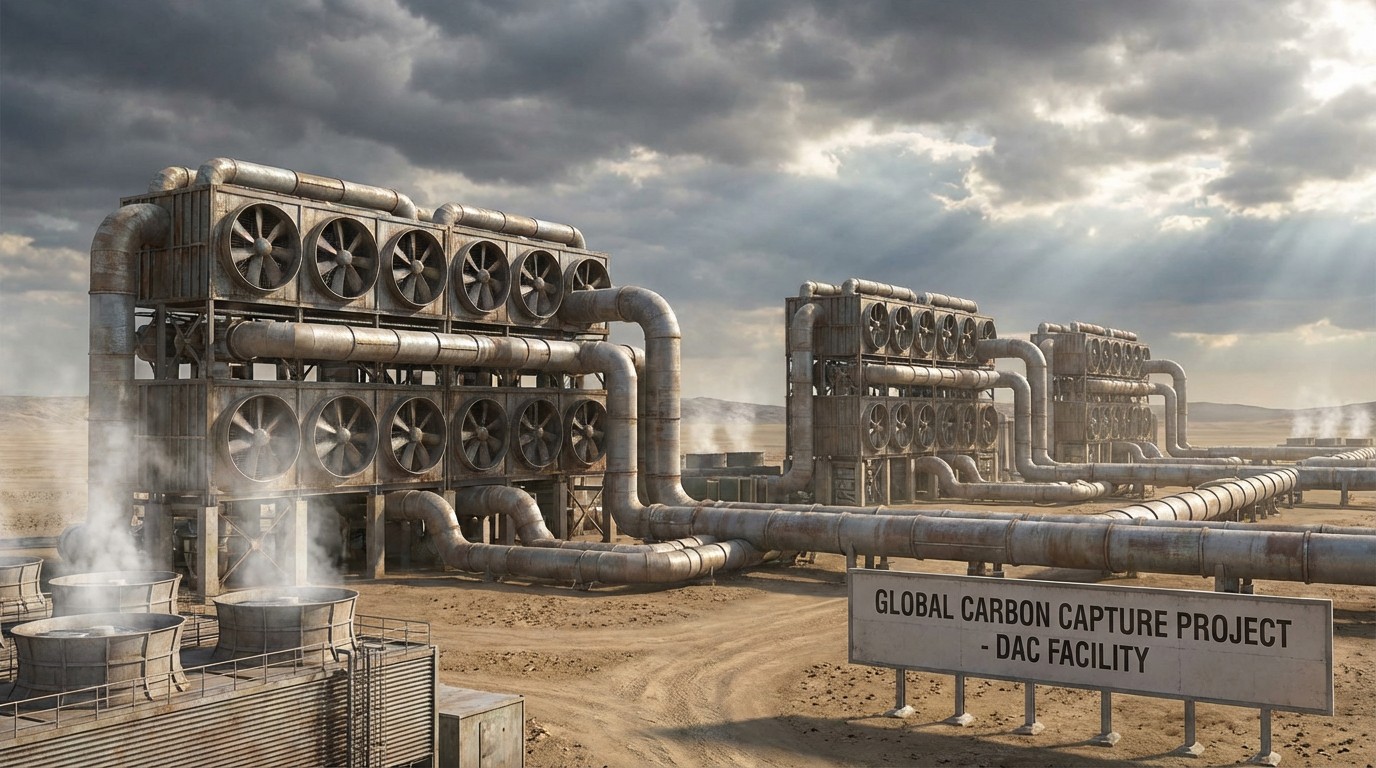
383. That is how many certified carbon removal credits Climeworks' Mammoth facility has issued since it began operations in Iceland. Mammoth was designed to capture 36,000 metric tons of CO2 per year. At 383 credits, the world's most famous direct air capture plant is running at roughly 1% of nameplate capacity. Atmospheres do not grade on a curve.
Direct air capture spent the last five years accumulating the two things every emerging technology needs: money and promises. Over $4 billion in public and private capital has flowed into DAC companies since 2021, backed by DOE grants, corporate pre-purchases, and venture rounds denominated in climate optimism. In 2026, we finally have enough operational data to do something the industry has avoided: check the receipts.
Five Companies, One Table
| Company | Technology | Design Capacity (t/yr) | Verified Delivery | Cost/Ton | Status |
|---|---|---|---|---|---|
| Climeworks (Mammoth) | Solid sorbent | 36,000 | 383 credits | ~$1,000+ | Operating, Iceland |
| Climeworks (Orca) | Solid sorbent | 4,000 | <2,000 credits (total) | ~$1,000+ | Operating since 2021 |
| 1PointFive STRATOS | Liquid solvent | 500,000 | 0 | Undisclosed | Commissioning Q2 2026 |
| Airhive (Deep Sky Alpha) | Proprietary | 1,000 | Operational (uncertified) | <$500 | Operating, Alberta |
| Prometheus Fuels | DAC + electrolysis | 200 (under construction) | 16 t/yr pilot | $50 (claimed) | Pilot, California |
| Heirloom Carbon | Limestone looping | TBD (new facility) | Operational (Tracy, CA) | Mid-$100s (est.) | Scaling, Louisiana |
Prometheus claims $50 a ton. Climeworks operates above $1,000. If both numbers are accurate, one company has solved carbon removal and the other is building a monument to sorbent chemistry. Reality, predictably, lives somewhere messier.
Climeworks: First Mover, Slow Ramp
Climeworks deserves credit for being first. Its Orca plant, operational since September 2021, was the first commercial DAC facility to permanently store captured CO2. But Orca's 4,000 tons/year design capacity has produced fewer than 2,000 certified credits across four years. Cumulative utilization: below 12%.
Mammoth, ten times larger, started in 2024. Its most recent audit, filed with the Puro.earth registry in December 2025, identifies May 2029 as the expected date for full-scale ramp-up. Three more years. Climeworks has pre-sold nearly 400,000 credits to Schneider Electric, SAP, and NGK. Those buyers are waiting. Cost targets: $400-$600/ton by 2030, $200-$350 by 2040. Both assume learning curves that Orca has not yet demonstrated.
STRATOS: Oil Money, CO2 Pipeline
Occidental Petroleum's subsidiary 1PointFive is building STRATOS in the Permian Basin: 500,000 tonnes of CO2 per year. If it works, STRATOS becomes the largest DAC facility in the world by an order of magnitude. Phase 2 commissioning begins Q2 2026.
Here is what nobody in the press releases mentions: STRATOS connects to Occidental's existing CO2 pipeline network, built for enhanced oil recovery. Captured carbon goes underground to push more petroleum out of aging wells. An oil company capturing CO2 to extract more oil is either the cleverest decarbonization strategy or the most elaborate greenwashing project in industrial history. Lifecycle accounting, not yet published, will determine which. Industry analysts estimate $400-$800 per ton, depending on how you allocate EOR revenue against capture costs.
Prometheus at $50, With an Asterisk
Prometheus Fuels says it has achieved DAC at under $50 per ton, validated by Ramboll. Its approach bypasses conventional gas purification, capturing CO2 directly into water and processing it through a patented Faraday Reactor.
Scale is the asterisk. Prometheus captures 16 tons per year. Its 200 ton/year system is under construction. Global emissions run 37 billion tons. Achieving $50/ton at 16 tons/year is like claiming you can build a house for $10,000 because you built a birdhouse for $3. Scaling electrochemical systems by four orders of magnitude almost always introduces costs that laboratory demonstrations cannot predict.
Airhive and Heirloom: Middle of the Spread
Airhive's 1,000 tonne/year system at Deep Sky Alpha in Alberta broke below $500 per ton in 2026, a first for any operational commercial facility at meaningful scale. Heirloom Carbon uses limestone looping: heat limestone, release CO2, expose it to air where it reabsorbs carbon as it re-forms. Low-tech compared to sorbent chemistry, which is either its greatest strength or its ceiling. Heirloom secured $475 million for a Louisiana facility and a 500,000-ton purchase agreement with United Airlines.
Math Nobody Wants to Do
Total DAC capacity deployed or under construction worldwide: approximately 544,000 tons per year. Net-zero by 2050, per IPCC estimates, requires removing roughly 10 billion tons of CO2 annually. Current capacity: 0.005% of that target.
Even assuming DAC capacity doubles every two years (faster than solar's historical growth), 10 billion tons is 24 doublings away. That is 48 years, arriving in 2074, two and a half decades past the deadline. At $1,000/ton, removing 10 billion tons costs $10 trillion per year, roughly 10% of global GDP. At $50/ton, $500 billion, comparable to global military spending. Between those numbers sits the entire argument for whether DAC is a climate solution or a climate distraction.
One breakeven matters more than the rest. EPA's social cost of carbon: approximately $51/ton. Resources for the Future: closer to $185/ton. Only Prometheus claims to operate below the EPA figure. Until capture costs fall below the social cost of carbon, DAC is economically irrational without subsidies, mandates, or carbon markets that do not yet exist at scale.
Limitations
Certified removal credits likely undercount actual CO2 captured; verification lags operations by months. Climeworks may have removed substantially more than 383 tons at Mammoth. Prometheus's $50/ton comes from a 16 ton/year system with no independent cost audit at commercial scale. STRATOS has not started operations, so its entire column is projections. Heirloom's "mid-$100s" estimate is derived from DOE grant materials and analyst reports, not company disclosures. Airhive's "below $500" is unverified by third parties. Enhanced oil recovery revenue changes STRATOS economics in ways this analysis cannot quantify without lifecycle data Occidental has not released.
Strongest Case Against
Every energy technology in history has followed a cost curve. Solar photovoltaics: $76/watt in 1977, $0.20/watt today. Lithium-ion batteries: $1,200/kWh in 2010, $139 in 2023. Judging DAC by its 2026 cost-per-ton is like judging solar in 1985: a rounding error in global electricity, wildly uneconomical without subsidies. Mammoth's 1% utilization is exactly what you would expect from a first-of-its-kind facility undergoing phased ramp-up. Orca improved substantially from year one to year four. Trajectory matters more than snapshot. But the strongest version of the counterargument is not that DAC is expensive today. It is that investing in DAC diverts capital from emission reduction, which runs $20-$100 per ton of CO2 avoided. Insulation, electrification, renewable deployment. Spending $1,000/ton on removal before exhausting $50/ton avoidance options is, by any rational allocation framework, backwards.
Bottom Line
Direct air capture in 2026: $4 billion in capital, half a million tons of design capacity, fewer than 2,500 verified tons permanently removed. A 20x cost spread between cheapest claim ($50/ton, Prometheus) and most expensive operational reality ($1,000+, Climeworks). That spread will narrow. If costs converge toward $100/ton, DAC becomes a legitimate wedge in decarbonization. If they converge toward $500, it remains a luxury good for corporations buying offsets. Last year, Mammoth removed 383 certified tons. Humanity emitted 37 billion. Scoreboard is not close.