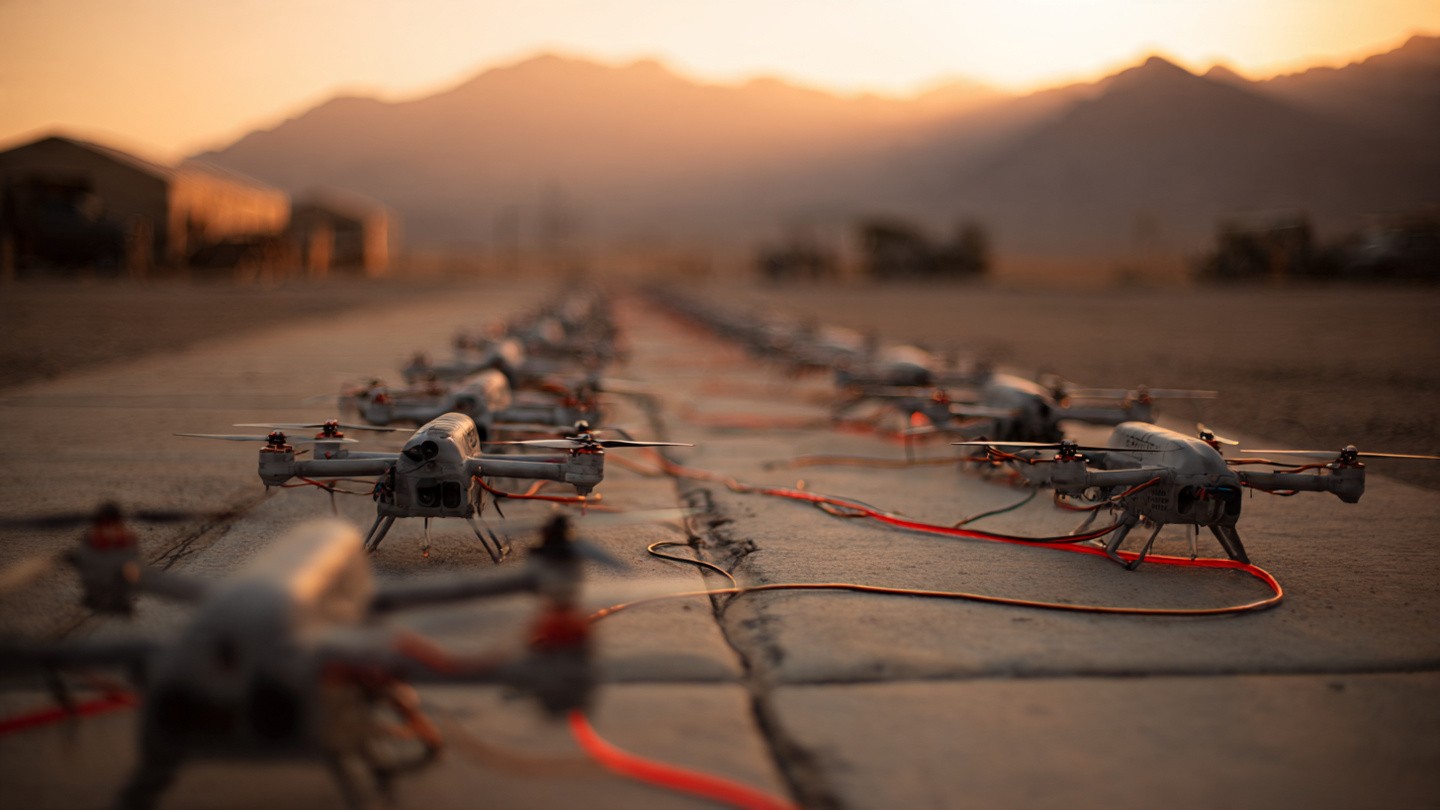
244. That is the multiplier the Pentagon just applied to its drone budget. In fiscal year 2026, the Department of Defense spent $225 million on drones and autonomous warfare. The FY2027 budget request, released this week alongside Defense Secretary Pete Hegseth's testimony before Congress, asks for $55 billion. A two-hundred-and-forty-four-fold increase, not a rounding error and not a gradual ramp, baked into a $1.5 trillion total defense budget that itself represents a 40 percent jump from the prior year.
Staggering enough as a headline, but underneath it the math is considerably worse.
What $55 Billion Buys (and What Ukraine Buys for Less)
Hegseth's budget establishes a new Defense Autonomous Warfare Group and funds the Drone Dominance Program, which ran its first competitive evaluation, Gauntlet I, at Fort Benning from February 17 through March 4, 2026. Twenty-five vendors submitted first-person-view attack drones for evaluation. First place, at 99.3 out of 100, went to the Shrike 10 Fiber, a fiber-optic guided FPV drone built by SkyFall/Skycutter.
It is Ukrainian-designed, which means Pentagon officials ran a competition to find the best attack drone America could field, and the answer came from Kyiv.
Production schedules following Gauntlet break into escalating phases: 30,000 units at $5,000 each in Phase I, 60,000 at $5,000 in Phase II, and 150,000 at a reduced $2,300 in Phase IV, totaling 240,000 drones through the end of 2027. Set that against Ukraine's current consumption of 200,000 unmanned systems per month, which amounts to 2.4 million per year, drawn from a domestic production base that Aviation Week reports reached 4.5 million annual capacity in 2025.
In total, the multi-year procurement target equals 5.3 percent of what Ukraine produces in a single year, a disparity that would be less alarming if the Pentagon were building fundamentally different vehicles rather than buying the same class of FPV drones that Ukraine already manufactures at industrial scale. One month of Ukrainian drone deliveries matches what the Pentagon plans to buy across multiple years and multiple Gauntlet phases combined.
The Exchange Ratio Problem
Volume is only half the crisis. Cost asymmetry is the other half, and it explains why the Pentagon's $55 billion request reads less like a strategic investment and more like a confession that the existing weapons inventory cannot sustain economically viable engagements against adversaries who deploy drones costing less than a used car.
Between October 2023 and January 2025, the U.S. Navy fired 220 interceptor missiles in the Red Sea against Houthi drones and cruise missiles. SM-6 interceptors cost approximately $4.3 million per round. ESSM Block II rounds cost roughly $2.3 million. PAC-3 MSE interceptors, deployed from Arleigh Burke destroyers operating in the region, run $4 to $5 million each. Using a blended average of $3 million per shot across the 220 rounds, the Navy spent approximately $660 million in interceptor costs alone to defend against threats that, in the case of Houthi drones, cost between $2,000 and $20,000 per unit to build.
| Interceptor | Unit Cost | Target Cost (Houthi Drone) | Exchange Ratio |
|---|---|---|---|
| SM-6 | ~$4.3M | $2K–$20K | 215:1 to 2,150:1 |
| ESSM Block II | ~$2.3M | $2K–$20K | 115:1 to 1,150:1 |
| PAC-3 MSE | ~$4–5M | $2K–$20K | 200:1 to 2,500:1 |
Those ratios are inverted. In every conventional weapons calculus since the invention of the crossbow, the defender wants to spend less per engagement than the attacker. When a $4.3 million SM-6 destroys a $10,000 drone, the attacker is winning the economic war by a factor of 430 regardless of whether the drone reached its target. Multiply that across 220 shots and the arithmetic reaches a conclusion that no amount of procurement reform can obscure: the United States cannot afford to fight drone warfare with missiles originally designed to kill supersonic anti-ship threats. Sustained operations at that rate would deplete the Navy's entire SM-6 inventory within two years of sustained operations, assuming no production increase.
What $55 Billion Could Actually Produce
Start with the Pentagon's own Gauntlet pricing. At Phase I cost of $5,000 per drone, $55 billion buys 11 million units. At the Phase IV target of $2,300, it buys 23.9 million, a figure that sounds immense until you apply Ukrainian FPV pricing, which reflects the cost floor of an industrial base operating at wartime scale and producing battle-tested designs: $400 to $500 per unit. At those prices, $55 billion buys between 110 million and 137.5 million drones, which exposes the uncomfortable reality that American procurement overhead consumes somewhere between 80 and 95 percent of the theoretical production capacity available at wartime pricing.
| Unit Price | Drones Per $55B | Context |
|---|---|---|
| $5,000 (Gauntlet Phase I) | 11 million | Pentagon current price |
| $2,300 (Gauntlet Phase IV) | 23.9 million | Pentagon 2027 target |
| $400–$500 (Ukrainian FPV) | 110–137.5 million | Wartime production cost floor |
Yet the Drone Dominance Program plans to buy only 240,000 through 2027. Even at $5,000 per unit, that is $1.2 billion of procurement out of a $55 billion budget line, which means the other $53.8 billion is going somewhere that has nothing to do with putting flying machines into the sky. Where does the remaining $53.8 billion go, then? Budget documents do not itemize at that resolution, but the gap between the DDP's stated unit targets and the topline allocation suggests that most of the money flows into autonomous systems research, classified programs, counter-drone development, and the institutional overhead of standing up the Defense Autonomous Warfare Group itself. Per-unit production commitment inside the headline figure is roughly 2.2 percent of the total, a ratio that would puzzle any manufacturing executive asked to evaluate a company that called itself a drone program while allocating 97.8 percent of its budget to activities other than buying drones.
The Shrike Paradox
SkyFall, the company behind the Gauntlet-winning Shrike 10 Fiber, operates under the brand Skycutter and builds fiber-optic guided FPV drones that use a physical wire connection between operator and vehicle rather than radio frequency links. According to Barron's reporting on the Gauntlet results, the fiber-optic guidance makes the Shrike unjammable in contested electromagnetic environments where Russian electronic warfare systems routinely disable RF-dependent drones. That advantage is not marginal, not when the stakes involve territorial control in an electromagnetic battlespace where Russian Krasukha-4 and Pole-21 systems routinely disable RF-guided drones before they reach lethal range. In eastern Ukraine, EW countermeasures render approximately 30 to 40 percent of RF-guided FPV drones ineffective before they reach their targets, a figure consistent with RUSI's 2024 battlefield analysis of Russian electronic warfare effectiveness.
It is structural, rooted in the divergent conditions under which Ukrainian and American engineers build drones. Ukraine developed this technology under the pressure of a war where drone operators had to solve jamming problems daily or watch their units die, and the solution they found was a return to the oldest form of guided communication: a physical wire that no jammer can disrupt because it does not radiate a signal to intercept. The United States, with a defense R&D budget that exceeded $140 billion in FY2025, ran a formal competition and discovered that the best answer had already been built on the other side of the world by engineers whose entire development budget was a fraction of what Boeing charged for a single Orca XLUUV.
This is not an indictment of American engineering. It is a demonstration of what wartime iteration produces that peacetime procurement cannot: thousands of design cycles compressed into months, each one tested against an adversary who shoots back, with the penalty for failure measured in casualties rather than contract renegotiations. Replicator, the Pentagon's previous attempt to field autonomous systems at scale, budgeted $500 million per year and fell short of its deployment goals by September 2025. DDP is Replicator with a budget multiplied by 110, and nobody in the Pentagon has publicly explained whether the multiplier reflects genuine strategic learning from Replicator's failures or simply the fiscal inertia of a defense establishment that responds to procurement shortfalls by writing larger checks.
The Strongest Case for $55 Billion
A skeptic reading the numbers above might conclude that the Pentagon is overspending by an absurd margin, buying 240,000 drones when Ukraine fields millions per year at a tenth the unit cost. That skeptic would be wrong about what the money is for, even if right about the production gap, because FPV drones are the visible fraction of a much larger autonomous warfare infrastructure that the United States has barely begun to build.
FPV attack drones are the most visible layer of autonomous warfare, but they are not the most consequential, and conflating the two leads to exactly the kind of misleading production-gap analysis that skeptics deploy when arguing the $55 billion is wasted. Included in that $55 billion: autonomous logistics vehicles, AI-driven targeting systems, swarm coordination software, electronic warfare integration, counter-UAS defenses, and the command-and-control architecture required to operate autonomous systems across five geographic combatant commands simultaneously. Ukraine fights a single-front land war with drones that an operator guides via video feed, where the primary engineering challenge is building a device that survives long enough to reach its target through electronic warfare countermeasures. The Pentagon is building infrastructure to deploy autonomous systems across air, sea, subsurface, space, and cyber domains against a peer adversary with nuclear weapons and its own autonomous programs. Those are different engineering problems at different scales, and the cost difference reflects the scope difference, which is precisely the argument that defenders of the $55 billion request would make if pressed.
Fiber-optic guidance solves jamming, but it does not solve autonomous navigation over 500 nautical miles of open ocean, swarm deconfliction among 10,000 simultaneous vehicles, or the legal and ethical architecture required to authorize lethal autonomous engagement without a human operator holding a joystick. Those capabilities cost more than $500 per drone because they do not yet exist at production readiness, and building them is what most of the $55 billion is actually funding.
What This Analysis Does Not Prove
Budget request is not budget appropriation. Congress has not approved the $55 billion figure, and defense appropriations routinely diverge from presidential requests by 5 to 15 percent. The $225 million FY2026 figure is the autonomous warfare line item specifically; other drone-adjacent spending across the services may push the actual prior-year figure higher, narrowing the real multiplier below 244. Ukrainian FPV unit costs of $400 to $500 reflect wartime economy-of-scale pricing with subsidized labor and materials, conditions that do not apply to U.S. defense procurement subject to Davis-Bacon wage requirements, Buy American provisions, and ITAR compliance costs. The Shrike 10 Fiber's 99.3 score comes from the Gauntlet I evaluation, whose scoring methodology and weighting criteria have not been publicly disclosed. Exchange ratios in the Red Sea table assume each interceptor engaged a single target, which may overstate costs if some engagements used salvo fire against higher-value cruise missile threats rather than individual drones.
The Bottom Line
If you work in defense, three numbers should keep you awake tonight. First: 240,000, the Pentagon's multi-year drone target, measured against Ukraine's monthly throughput of 200,000. Second: 99.3, the score earned by a Ukrainian-designed drone in the Pentagon's own competition, demonstrating that wartime iteration already out-engineers peacetime procurement. Third: 430, the cost exchange ratio when an SM-6 intercepts a cheap drone, a ratio that makes every future naval engagement an economic defeat regardless of tactical outcome. For defense contractors, the signal is unambiguous: invest in high-volume, low-cost manufacturing or watch the contracts flow to companies that already produce at Ukrainian scale. For policymakers evaluating the $55 billion request, demand granular production targets beyond 240,000 units, because a budget that allocates 97.8 percent of its topline to something other than buying drones is not a drone budget. For anyone watching the next conflict: the country that builds 4.5 million drones per year has already solved the problem the Pentagon just noticed it has.
Sources
- Fox News (April 29, 2026). Pentagon FY2027 budget: $55B drone/autonomous warfare allocation, $1.5T total defense, Defense Autonomous Warfare Group. Fox News
- Barron's (April 2026). "The Best War Drones Aren't Made in the U.S.A." Shrike FPV Gauntlet I winner; Ukrainian technology dominance. Barron's
- debugliesintel.com. Gauntlet I forensic analysis: 25 vendors, Fort Benning Feb 17-Mar 4, Shrike 10 Fiber score 99.3/100, fiber-optic guidance, production schedule. debugliesintel
- Aviacionline (2025). Ukraine's defense forces receive 200,000 unmanned systems per month. Aviacionline
- Aviation Week (March 2025). Ukraine expands annual drone production to 4.5 million. Aviation Week
- Reuters (March 10, 2025). Ukraine to sharply raise FPV drone purchases; $400-$500 per unit pricing. Reuters
- Military.com (January 15, 2025). Navy fired 220 interceptor missiles in Red Sea over 15 months. Military.com
- U.S. Army (November 2024). PAC-3 MSE contract: up to $368.6 million. U.S. Army
- Reuters (March 2024). Replicator drone program to cost $500M/year. Reuters
- Reuters (September 2025). Replicator program fell short of deployment goals. Reuters