The Navy Spent $489 Million on Two Underwater Drones. Now DARPA Wants to Build Dozens for the Same Price.
Four actions in five days reveal the U.S. Navy's underwater drone strategy has pivoted from giant single platforms to swarms of miniature autonomous vehicles. Run the cost-per-ocean-coverage math, and the pivot makes brutal sense.
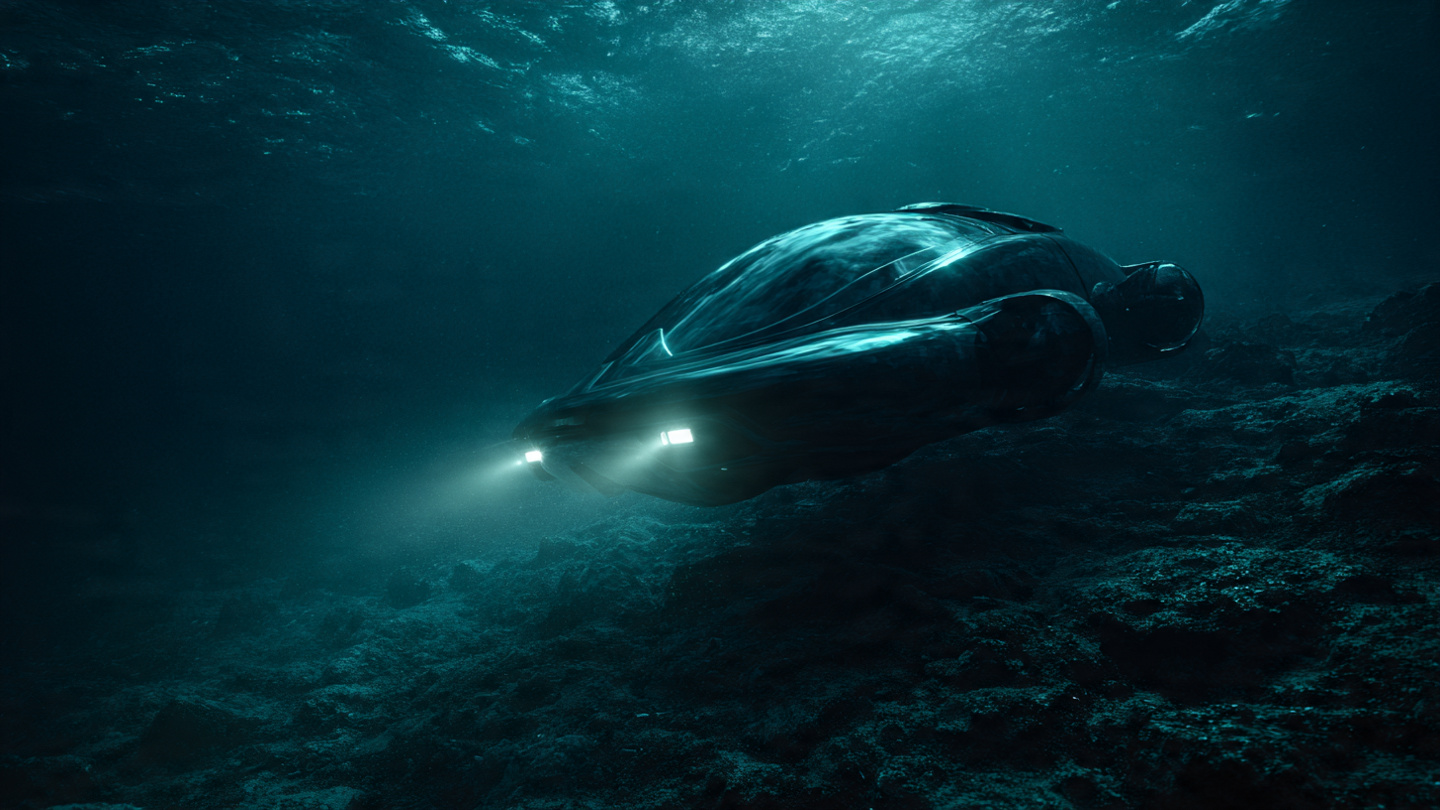
Two. After seven years and $489 million in contract costs, Boeing's Orca Extra-Large Unmanned Undersea Vehicle program has delivered exactly two operational units to the U.S. Navy. A draft cancellation memo dated October 27, 2025, recommends killing the program and redirecting its funding. Boeing christened the second Orca in March 2026, a ceremony that now reads less like a milestone and more like a eulogy.
Between April 20 and April 24, 2026, the Navy executed what amounts to the most concentrated strategic pivot in modern undersea warfare acquisition. Four separate actions, announced across four days at the Sea-Air-Space conference and through a DARPA solicitation, collectively dismantle the old model of building a few exquisitely expensive underwater robots and replace it with something faster, smaller, and far cheaper per unit of ocean covered.
Four Days, Four Signals
On April 20, Chief of Naval Operations Adm. Daryl Caudle announced the creation of a new Warfighting Development Center dedicated exclusively to robotic and autonomous systems, not a task force or a study group but a permanent institutional home carrying the same organizational weight as existing warfare centers for surface, submarine, and aviation combat. Caudle described a "Golden Fleet" concept blending manned and unmanned assets, and confirmed that the first Medium Unmanned Surface Vehicle had already deployed with the Theodore Roosevelt Strike Group. His framing was blunt: "Challenges we face demand more than incremental improvement."
Two days later, Nick Bergeron, the deputy Principal Acquisition Executive for Robotic and Autonomous Systems, revealed a marketplace roadmap that consolidates roughly 200 separate drone programs previously scattered across six Program Executive Offices and 25 program offices into a single accountable acquisition authority. Bergeron asked a question that should terrify every defense prime contractor bidding on bespoke platforms: "Do we always need to flat out procure them?" He described moving toward a model where the Navy buys data services and leases autonomous capability rather than owning and maintaining custom hardware that becomes obsolete before it reaches initial operating capability.
On April 23, DARPA posted solicitation DARPA-PS-26-05 for a program called Deep Thoughts, a 24-month effort to build miniature autonomous underwater vehicles capable of operating at full ocean depth, and the solicitation demanded functional prototypes delivered under Other Transaction Agreements rather than studies or concept papers, with abstracts due May 21, oral proposals by July 20, and contracts starting November 2026. Two technical areas span Controlled Unclassified and SECRET domains. DARPA's stated objective: "Revolutionary advances in uncrewed access to full-ocean depths at a fraction of the size and cost" of current platforms, achieved through novel materials, structural geometries, and advanced manufacturing techniques that compress development timelines from years to weeks.
Nobody has connected these four actions into a single narrative because DefenseScoop reported each event individually, as press outlets do when beat reporters cover conferences day by day without stepping back to ask whether five days of separate announcements might constitute a single strategic decision communicated in four pieces. Read them together, though, and the strategic logic is unmistakable: the Navy is abandoning the paradigm of few, large, expensive underwater platforms and replacing it with many, small, cheap ones, and it built the institutional infrastructure to execute that replacement in under a week.
What $489 Million Bought vs. What It Could Buy
Boeing's original Orca XLUUV contract called for five vehicles at $274.4 million, or $54.9 million per unit, and a 2022 GAO report found the program had experienced 64 percent cost growth pushing the total to approximately $489 million, which works out to $97.8 million for each vehicle that Boeing managed to deliver across a development timeline that stretched roughly seven years from contract award to operational hardware. Two vehicles exist. Former CNO Adm. Lisa Franchetti toured Boeing's Orca facility on December 6, 2024, and praised the program; less than a year later, her Navy drafted a memo to cancel it.
Now consider the alternative universe where that money bought quantity instead of bespoke complexity. Commercial autonomous underwater vehicles capable of deep-ocean operations already exist at dramatically lower price points. Kongsberg's HUGIN Superior sells in the $3 million to $5 million range. General Dynamics' Bluefin-21 runs $1 million to $4 million. If DARPA's Deep Thoughts achieves even 10 percent of Orca's per-unit cost, each miniature AUV would cost roughly $9.8 million, meaning the Navy could field approximately 50 vehicles for what it spent on two Orcas.
Drop that further and the numbers become stark. If advanced manufacturing and miniaturization push costs to the $3 million to $5 million range that commercial deep-ocean AUVs already occupy, $489 million buys 98 to 163 vehicles. Even at $10 million per unit, you get 49 platforms covering 49 separate patches of ocean floor simultaneously, compared to two Orcas that can be in exactly two places at once.
| Scenario | Cost Per Unit | Units for $489M | Coverage Multiple vs. Orca |
|---|---|---|---|
| Boeing Orca (actual) | $97.8M | 2 (delivered) | 1× |
| Deep Thoughts at 10% of Orca | ~$9.8M | ~50 | 25× |
| Commercial AUV range | $3-5M | 98-163 | 49-82× |
| DARPA aggressive target | $1-2M | 245-489 | 123-245× |
Coverage multiplication is not just an arithmetic exercise. Undersea warfare operates on the principle that you cannot attack, defend, or monitor what you cannot sense, and sensing underwater requires physical presence because electromagnetic waves do not propagate through seawater at useful ranges. Every additional autonomous vehicle expands the Navy's sensory footprint by its detection radius, and the relationship between fleet size and coverage area is roughly linear for distributed sensor networks. Two Orcas patrolling the South China Sea leave approximately 3.5 million square kilometers unmonitored. Two hundred miniature AUVs change that equation fundamentally.
Why Orca Failed and Miniaturization Might Not
Orca was a 51-foot, 50-ton vehicle designed primarily for mine warfare, carrying the Hammerhead mine as its primary payload. Size was not a design flaw but a requirements choice, driven by the need to deploy large weapons and operate for extended periods without recovery. Building something that big to survive deep-ocean pressure while maintaining acoustic stealth and autonomous navigation turned out to be an engineering problem that cost 64 percent more than Boeing estimated and took years longer than scheduled.
Miniaturization inverts the engineering problem entirely. Smaller pressure hulls are exponentially easier to engineer because the stress on a sphere decreases with the cube of the radius for a given depth rating. A vehicle one-fifth the length of an Orca faces roughly 1/125th the structural load at equivalent depth, allowing the use of cheaper materials and simpler manufacturing. DARPA's solicitation specifically calls for "novel materials, alloys, and structural geometries" and emphasizes "advanced manufacturing" and "producibility," language that reads as a direct repudiation of Orca's bespoke, slow, expensive fabrication approach.
Smaller vehicles also fail more gracefully, a property that military planners call "graceful degradation" and that anyone who has lost a phone charger instead of a laptop understands intuitively. Losing one $3 million AUV out of a fleet of 100 degrades capability by 1 percent, while losing one of two Orcas eliminates half the fleet overnight. Distributed architectures treat individual unit loss as a statistical expectation rather than a mission-ending catastrophe, which is why every domain of modern warfare, from aerial drones to satellite constellations, has been moving toward mass and expendability for the past decade.
What Miniature AUVs Cannot Do
Small vehicles carry small payloads, and that limitation defines where miniaturization stops being an advantage. A miniature AUV cannot deploy a Hammerhead mine, tow a large sonar array, or carry the battery capacity for multi-month autonomous missions. Orca's 51-foot hull exists because certain missions require large payloads delivered covertly over long distances, and no amount of miniaturization eliminates the physics of energy storage and weapon volume.
DARPA has not disclosed Deep Thoughts' budget, target unit cost, or specific performance requirements beyond full-ocean-depth capability and reduced size. We are comparing a flawed program that exists with a promising program that does not yet. Every dollar figure in the cost comparison above except Orca's actual expenditure is an estimate based on commercial analogues and reasonable assumptions about cost reduction curves. If DARPA's timeline slips or its manufacturing breakthroughs fail to materialize, the Navy may find itself with neither Orca nor Deep Thoughts, having canceled the former before proving the latter.
Bergeron's marketplace model is also untested at this scale. Consolidating 200 programs under one authority sounds efficient. It also concentrates bureaucratic risk: if the PAE for RAS makes bad acquisition decisions, there is no competing office running a better approach in parallel. Consolidation eliminates redundancy, and sometimes redundancy is what catches errors.
What This Analysis Does Not Prove
Orca's cancellation memo is a draft, and the program's final disposition remains undetermined as of this writing. DARPA Deep Thoughts has no disclosed budget, so the cost-per-unit comparisons above rely on commercial AUV pricing and percentage-of-Orca extrapolations rather than actual DARPA targets. Coverage multiplication assumes miniature AUVs will carry sensors with comparable detection ranges to larger platforms, which may not hold if sensor packages must shrink proportionally. Navy FY2027 budget documents include record RAS investment but do not itemize Deep Thoughts specifically. Commercial AUV cost figures ($1M-$5M) come from published manufacturer pricing for civilian survey and inspection vehicles, which lack military-grade acoustic stealth, hardened communications, and weapons integration.
The Bottom Line
If you work in defense acquisition, the signal from last week is unambiguous: institutional support for large, bespoke unmanned underwater vehicles is collapsing, and the replacement model favors mass-produced, expendable, miniature platforms bought through flexible procurement rather than decade-long development contracts. Watch three things over the next 12 months. First, whether the Orca cancellation memo becomes a final decision. Second, which companies win Deep Thoughts contracts when awards are announced in late 2026, because the winners will define the Navy's underwater drone industrial base for a generation. Third, whether Bergeron's marketplace model produces actual lease-versus-buy contracts for autonomous capability, or stalls in the acquisition bureaucracy that killed Orca's schedule in the first place. For defense contractors still building business cases around single large platforms: the Navy just told you, in four separate announcements across five days, that it wants something else entirely.
Sources
- DefenseScoop (April 20, 2026). Adm. Caudle announces Warfighting Development Center for robotic and autonomous systems; "Golden Fleet" concept; first MUSV deployment. DefenseScoop
- DefenseScoop (April 22, 2026). Nick Bergeron on PAE for RAS marketplace roadmap; consolidation of 200+ programs across 6 PEOs and 25 offices. DefenseScoop
- DefenseScoop (April 24, 2026). DARPA Deep Thoughts solicitation (DARPA-PS-26-05): 24-month program for miniature full-ocean-depth AUVs; OTA prototyping. DefenseScoop
- Defense Daily (October 27, 2025). Draft Navy memo recommending cancellation of Orca XLUUV and GARC programs; redirect funding to alternatives. Defense Daily
- GAO (September 2022). Boeing Orca XLUUV: 64% cost growth from $274.4M to ~$489M; 3+ years schedule delay. USNI / GAO
- Naval News (March 2026). Boeing christening of second Orca XLUUV vehicle. Naval News