NASA's Moon Base Plan Requires 77 Missions in a Decade. The Lunar Delivery Industry Has Finished Four.
NASA awarded nearly $1 billion in contracts on May 26 to begin building humanity's first permanent lunar outpost. The agency's own Commercial Lunar Payload Services program has completed four launches in seven years, with exactly one full success. Closing that gap requires a 13.5× acceleration in mission tempo that the commercial space industry has never demonstrated for lunar operations.
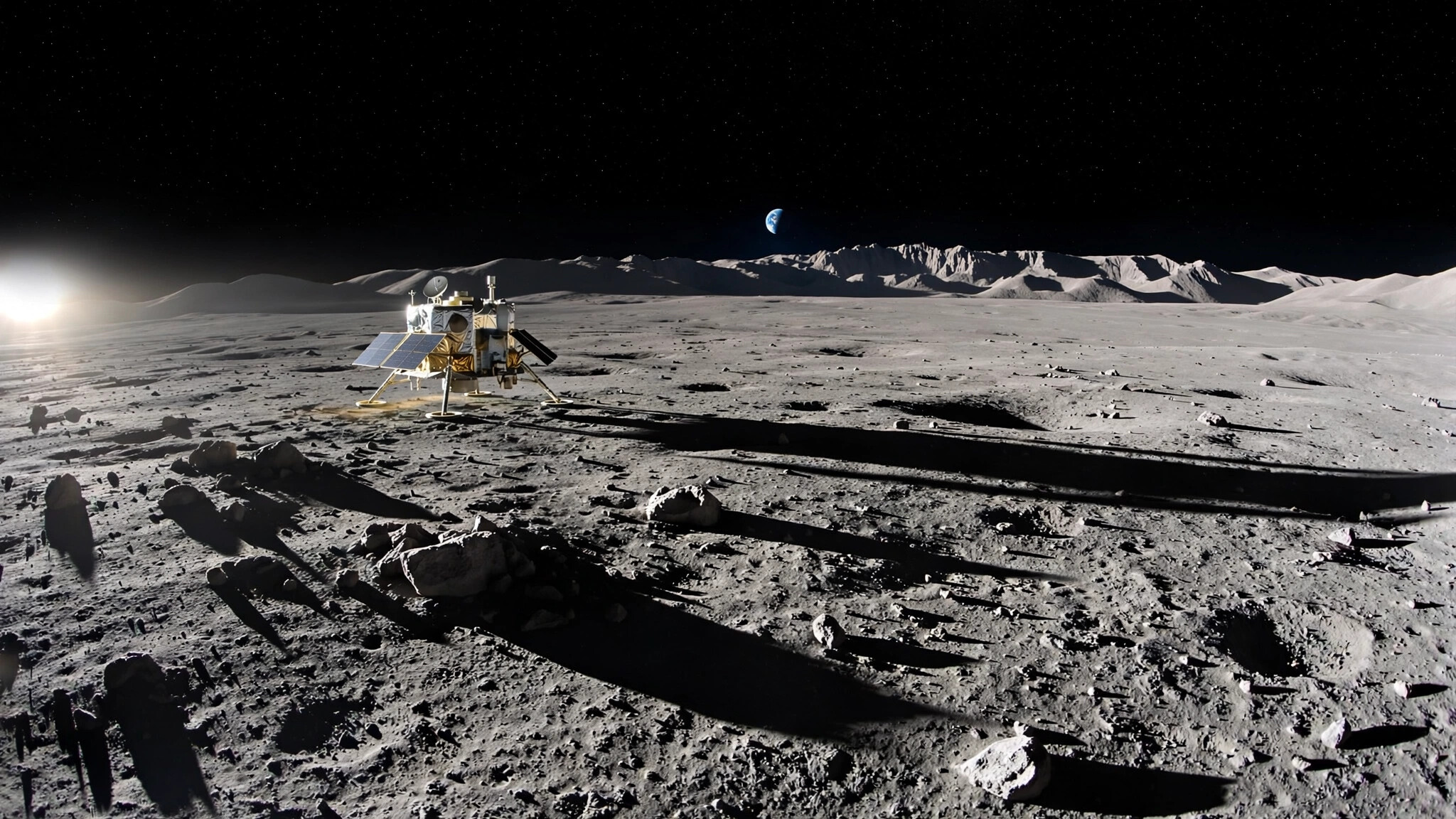
Here is a number that should keep NASA's Moon Base program managers awake: 0.57, which is how many commercial lunar missions the agency's Commercial Lunar Payload Services program has launched per year since the initiative began in 2018. Four missions in seven years, one of them landing successfully and completing all objectives, and now NASA needs 77 more in the next ten.
On May 26, Administrator Jared Isaacman announced nearly $1 billion in contracts: Astrolab received $219 million for a crewed lunar vehicle, Lunar Outpost got $220 million for its Pegasus rover built with General Motors and Goodyear, Blue Origin's Blue Moon Mark 1 Endurance was named for the inaugural mission, and Firefly Aerospace won the drone reconnaissance contract.
Two days later, Blue Origin's New Glenn rocket exploded on its only launch pad.
Three Phases, One Decade
NASA's Moon Base plan, first outlined in March as part of President Trump's National Space Policy and detailed at the May 26 press conference, envisions a permanent human presence on the Moon by 2032 at a cost of approximately $30 billion over the next decade, canceling the long-proposed Lunar Gateway orbital station and redirecting those resources to the surface in a three-phase buildout.
Phase One runs through 2029 and consists of robotic scouts, technology demonstrations, and short crewed visits, with at least 25 missions and 21 landings. Phase Two, from 2029 to 2032, layers on infrastructure: solar arrays, communications towers, a JAXA-built pressurized rover for two astronauts, all delivered across 24 landings totaling 60 tons. Phase Three, starting around 2032, is permanent occupation: habitat modules, fission reactors, water ice extraction, and 8,000 kilograms of cargo every four weeks. CLPS 2.0, the upgraded contracting framework, calls for 77 missions over the decade at roughly $91 million each, down from $129 million under CLPS 1.0.
A Delivery Gap No One Is Talking About
CLPS 1.0 launched four missions in seven years, a tempo of 0.57 missions per year, and CLPS 2.0 needs 77 in ten years, which is 7.7 per year. That acceleration factor, 13.5 times the demonstrated rate, is the number that separates ambition from logistics.
But launch tempo is only half the problem, because the success rate tells a grimmer story. Of the four CLPS missions that reached a launch pad, the outcomes were:
| Mission | Vendor | Year | Outcome |
|---|---|---|---|
| Peregrine | Astrobotic | 2024 | Propellant failure; never reached the Moon |
| Odysseus (IM-1) | Intuitive Machines | 2024 | Reached surface but tipped over on landing, partial success |
| Blue Ghost | Firefly Aerospace | 2025 | Full success with all objectives met |
| IM-2 | Intuitive Machines | 2025 | Landed successfully but drill deployment issues limited results |
One full success out of four, and a fifth vendor, Masten Space Systems, went bankrupt before building its lander. Average mission delay: 14 months, per the NASA Inspector General.
Here is the calculation that makes the gap tangible. If CLPS 2.0 matches its predecessor's 25% full-success rate, NASA would need 308 launch attempts for 77 successful missions, roughly 31 per year, which is physically impossible. At a dramatically improved 75%, you still need 103 attempts, or 10.3 per year, and even at 90% the number is 86, a pace exceeding what ISS assembly managed with the proven Space Shuttle at 2.85 flights per year.
What $30 Billion Buys at Lunar Distances
Context sharpens the ambition. Building and operating the ISS cost approximately $150 billion over 25 years for 388 cubic meters of pressurized volume, roughly $387 million per cubic meter, using proven launch vehicles with decades of flight history. NASA's Moon Base targets permanent lunar habitation for $30 billion, 20% of the ISS's cost, aimed 1,000 times farther away, using vehicles that have collectively completed one successful lunar landing. Launch costs have fallen by an order of magnitude since the 1990s, but that alone does not explain a required 7.7-missions-per-year cadence from an industry that has not sustained even the ISS's 2.85.
Apollo offers a different comparison but arrives at the same conclusion: from Kennedy's 1961 speech to Armstrong's 1969 landing, NASA spent $280 billion in today's dollars, consumed 4.4% of the federal budget at peak, and needed eight years to reach the surface. NASA's Moon Base program asks for roughly 0.5% of NASA's budget to go from no infrastructure to permanent occupation in six years, an ambition-to-resources ratio unprecedented in the history of spaceflight.
Blue Origin's Pad and the Domino Problem
Moon Base 1 was assigned to Blue Origin's Blue Moon Mark 1 Endurance on New Glenn, and on May 28, two days after the contract announcement, New Glenn exploded during a static fire test and destroyed its only launch pad, with rebuild estimates of 12 to 18 months and Isaacman acknowledging it "may not be restored until 2028." Moon Base 2 relies on Astrobotic's Griffin, which has never flown, from a company whose first lunar attempt ended in propellant failure. Moon Base 3 uses an upgraded Intuitive Machines Nova-C, whose predecessor tipped over on landing.
Why Optimism Is Not Irrational
CLPS 1.0 was explicitly designed as a learning phase: NASA accepted risk by buying cheap rides on unproven landers because the alternative was another decade and tens of billions for a government-built system. Firefly's Blue Ghost success proved the model works. Intuitive Machines landed twice, imperfectly, generating engineering data that improves each subsequent attempt. SpaceX's Falcon Heavy, carrying Moon Base 2, is a proven vehicle with no developmental risk.
Commercial incentives have also shifted dramatically: CLPS 2.0 represents over $7 billion in contracts, enough to attract serious capital investment in manufacturing quality absent when vendors built landers on sub-$100 million startup budgets.
ISS history also cuts both ways, favoring the optimists: that program survived the Columbia disaster, budget overruns that doubled the original estimate, and a two-year Shuttle stand-down, delivering continuous human presence for over 25 years.
What This Analysis Cannot Answer
Several critical unknowns limit this analysis. NASA has not disclosed habitable volume targets, making ISS comparisons approximate. Phase Three technologies, particularly lunar fission reactors and industrial-scale resource extraction, remain undemonstrated outside Earth laboratories, and the $30 billion budget spans at least two presidential administrations with potentially different space priorities.
The Bottom Line
NASA's Moon Base is the most ambitious construction project in the history of human spaceflight, and the gap between its requirements and the demonstrated capacity of its supply chain is the widest the agency has ever faced at the start of a major program. It needs 7.7 lunar missions per year from an industry that has managed 0.57. It needs a success rate above 75% from vendors who have collectively achieved 25%. It needs all of this at 30% lower cost per mission. Humanity's first permanent lunar outpost may eventually rise on the south pole's sunlit ridgelines. But the road there runs through a delivery pipeline that, as of today, does not exist at the scale the plan demands.
If you are watching this program, the metric to track is not astronaut landings or habitat deployments. Those are Phase Two and Phase Three milestones. Track the CLPS launch rate and success rate in 2026 and 2027. If the three Moon Base missions scheduled for this year all fly and two or more succeed, the 13.5x acceleration starts to look achievable. If they slip into 2027, or if another fails on approach, the timeline is not ambitious. It is fictional.