Blue Origin Lost Its Only Launch Pad. Amazon, NASA, and the Pentagon Were All Counting on It.
New Glenn exploded during a routine static fire test on May 28, destroying Launch Complex 36 and grounding three separate programs that all funneled through the same chokepoint: Amazon's 576-satellite backlog, NASA's Blue Moon lander, and a newly awarded national security launch contract. The company has no backup pad.
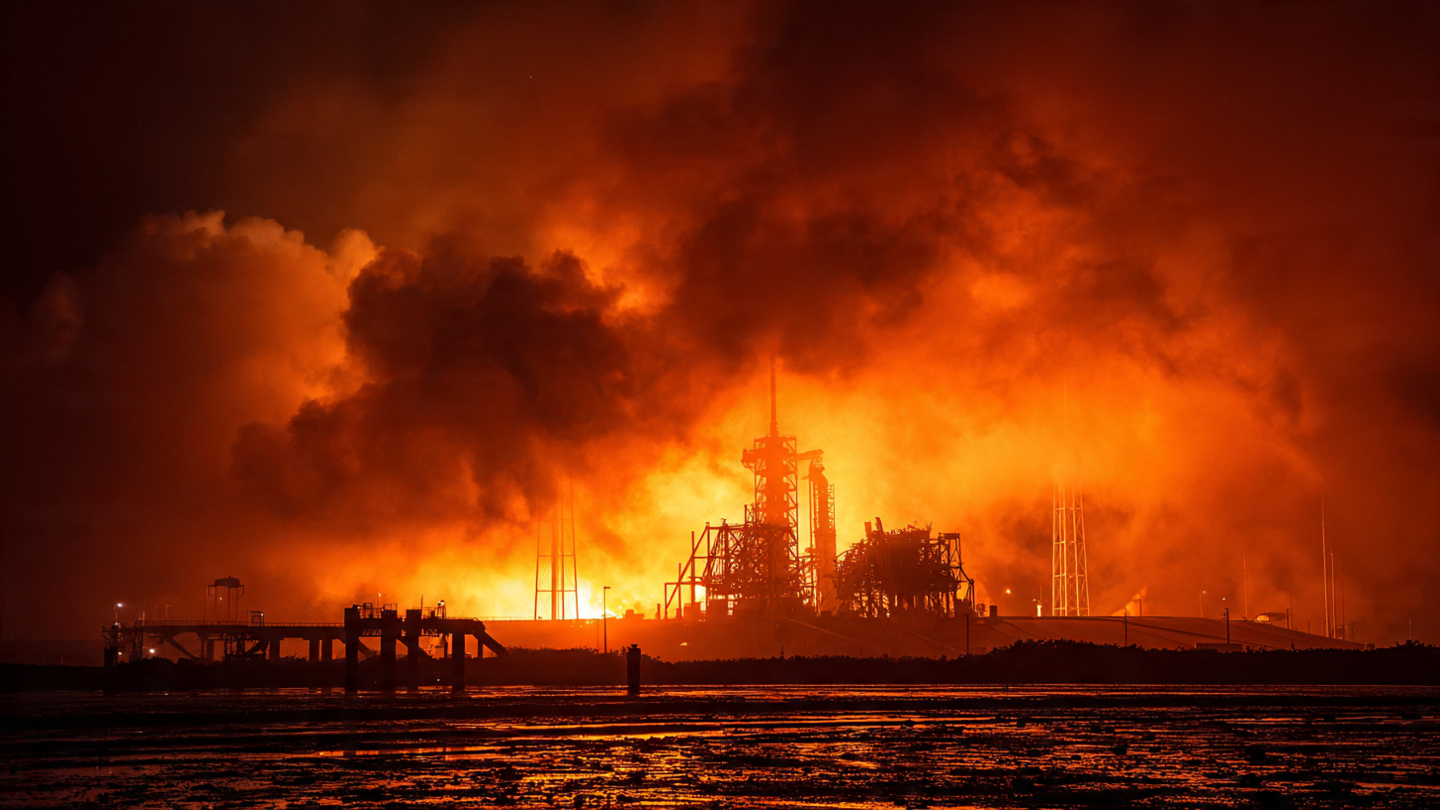
One pad. That is what Blue Origin had for New Glenn, and on the evening of May 28 that pad ceased to exist when the company's heavy-lift rocket exploded during a static fire test at Launch Complex 36, Cape Canaveral Space Force Station, generating a fireball visible forty miles away and reducing the $1-billion-plus pad that took eight years to build to blackened, twisted wreckage. The booster, christened "No, It's Necessary," had never flown and never will.
No one was hurt, but the damage assessment is devastating: the strongback that carries fuel, power, and data lines into the rocket was destroyed along with one of two lightning conductor towers, and the pad is, in the words of a person familiar with the matter who spoke to Reuters, "practically destroyed." Industry sources estimate six months of disruption at minimum, while experts interviewed by multiple outlets place the reconstruction timeline at twelve to eighteen months, a range consistent with SpaceX's fifteen-month LC-40 rebuild after its own pad explosion in 2016. Florida Today reported the site was still burning by morning light.
Three Programs, One Chokepoint
The explosion did not destroy a single mission — it grounded three simultaneously, each of which had been funneling through the same physical chokepoint without anyone outside the company apparently noticing the concentration risk.
The first and most commercially consequential casualty is Amazon's satellite constellation. The destroyed NG-4 mission was preparing to carry 48 Amazon Leo broadband satellites to orbit, and Blue Origin holds contracts for twelve total New Glenn launches with options for fifteen more, representing a backlog of approximately 576 spacecraft that now have no ride to space. Amazon has deployed roughly 300 of its planned 3,232 satellites and already asked the FCC on January 30 for a 24-month extension on its deployment deadline, pushing the halfway mark from July 2026 to July 2028 — a request filed before the company's primary heavy-lift partner lost its only launch pad.
The second casualty is NASA's moon ambitions, and it may prove the hardest to recover from because lunar payloads cannot simply be re-manifested on a different rocket. Blue Origin's uncrewed Blue Moon Mark 1 lunar lander was scheduled to fly on New Glenn as early as fall 2026, serving as a pathfinder for the Artemis III program and NASA's newly announced moon base, and just two days before the explosion the agency awarded Blue Origin a $468 million contract to deliver two commercial rovers ahead of Artemis IV in 2028 — both contracts predicated on a functioning launch pad that no longer exists. NASA Administrator Jared Isaacman acknowledged the implications the same night, saying the agency would "assess near-term mission impacts" on Artemis and Moon Base programs.
The third casualty is national security launch, where the stakes are strategic rather than commercial. The U.S. Space Force and National Reconnaissance Office had just awarded Blue Origin a new national security launch contract, and on May 29 — the morning after the fireball — both agencies affirmed their commitment to the company, a statement of strategic patience that says more about the Pentagon's desire for a SpaceX alternative than about Blue Origin's operational readiness.
The Replacement Launch Math
Here is the original calculation that makes the grounding painful in concrete terms. Amazon's twelve booked New Glenn flights would have delivered approximately 576 satellites, and Falcon 9, the most available alternative, carries roughly half as many Amazon Leo satellites per flight, meaning twelve lost New Glenn missions translate to approximately twenty-four Falcon 9 missions just to maintain parity. SpaceX currently launches around 120 Falcon 9 missions per year, and twenty-four additional flights represent a 20% increase to an already crowded manifest dominated by Starlink deployments, government contracts, and commercial payloads booked years in advance.
The bottleneck compounds when you follow the engine supply chain. Amazon also reserved nine launches on ULA's Vulcan rocket, whose first stage runs on the same BE-4 engine that Blue Origin manufactures for New Glenn. If the explosion's root cause traces back to the BE-4, Vulcan faces its own investigation and potential stand-down — and Analysys Mason partner Antoine Grenier noted that Amazon "has already tapped much of the near-term capacity available from other heavy launch providers." The company that signed what it called the largest commercial launch procurement in history, over 100 missions across Blue Origin, ULA, Arianespace, and SpaceX, bet heavily on three rocket families: two of them share an engine built by the company whose pad just exploded, and the third, Ariane 6, has faced its own developmental delays.
Amazon can still manufacture satellites at thirty per week, faster than anyone can currently launch them, and the production line is not the constraint — access to orbit is.
The AMOS-6 Precedent — and Why It Doesn't Quite Apply
SpaceX's Falcon 9 explosion at LC-40 on September 1, 2016 is the obvious comparison, and the details look superficially encouraging: that incident also destroyed a Falcon 9 and its payload during a pre-launch static fire test, damaging the pad extensively, yet SpaceX resumed launches from its backup pad LC-39A just four and a half months later, on January 14, 2017, and LC-40 itself returned to service in December 2017 after a fifteen-month rebuild.
The critical difference is a single word: backup. SpaceX had one and Blue Origin does not. There is a planned future launch site at Vandenberg Space Force Base, SLC-14, but it does not exist yet — Launch Complex 36 is the only pad on Earth capable of flying New Glenn. When SpaceX lost a pad, it lost capacity; when Blue Origin lost a pad, it lost capability entirely, and the distinction between those two words is measured in months of total grounding versus weeks of reduced throughput.
The Strongest Case for Blue Origin
The counterargument deserves its full weight, and it is substantial. Jeff Bezos is worth approximately $220 billion, Blue Origin is a privately held company with no quarterly earnings pressure and no shareholder revolt to fear, and the man can spend whatever it takes for as long as it takes without ever needing to justify the expenditure to anyone but himself. His post-explosion statement — "we'll rebuild whatever needs rebuilding and get back to flying" — is not an empty platitude from a man with that balance sheet, and the company recently announced a $600 million Florida expansion that signals long-term commitment regardless of short-term setbacks.
More practically, rocket explosions are not death sentences — SpaceX returned to flight after AMOS-6 and went on to dominate the global launch market, the Starship launch pad explosion in 2025 did not derail that program, and rocketry is an industry with institutional mechanisms for recovering from catastrophic failures that would end companies in any other sector. The Space Force's immediate reaffirmation of its contract signals that the Department of Defense is not looking for an exit ramp, because the Pentagon needs a SpaceX alternative more than it needs the next launch to happen on time.
What This Analysis Did Not Prove
The root cause of the explosion is unknown. The BE-4 supply chain risk to Vulcan is speculative until the investigation concludes, and may turn out to be irrelevant if the failure originated in the ground systems, the second stage, or the propellant loading sequence rather than the engines. The reconstruction timeline estimates of twelve to eighteen months come from unnamed industry sources and academic experts, not from Blue Origin's own assessment, which has not been released. The satellite-per-launch figures for New Glenn and Falcon 9 are approximate, based on the NG-4 manifest and public reporting on Falcon 9 Amazon Leo missions, and actual capacity depends on orbital parameters, satellite mass, and mission-specific constraints that vary flight to flight. Finally, the FCC has not yet ruled on Amazon's extension request, and there is no public indication of how the explosion affects the commission's deliberations.
What You Can Do
If you hold positions in space-sector equities, the immediate risk is not to Blue Origin, which is private, but to the publicly traded companies in its supply chain and competitive landscape. Rocket Lab, Firefly Aerospace, Intuitive Machines, and Voyager Technologies all fell on May 29, even though some of them stand to benefit from reduced competition. Watch for the investigation's findings on the BE-4 engine specifically — if the root cause implicates it, ULA's Vulcan manifest becomes a secondary casualty, and any company with payloads booked on Vulcan faces re-manifesting risk.
If you are an Amazon investor evaluating the Leo constellation, the FCC extension ruling is now the single most consequential near-term regulatory event. A denial would force Amazon to either dramatically accelerate launches through alternative providers at premium cost or risk losing portions of its spectrum allocation. Track the ruling, not the explosion footage.
If you follow NASA's Artemis program, know that the moon base timeline now depends almost entirely on SpaceX. Lunar payloads are designed around specific launch vehicles. Switching Blue Moon from New Glenn to another rocket is not a simple manifest swap — it requires redesigning interfaces, re-qualifying structural loads, and potentially resizing the payload. If SpaceX's Starship is not ready for crew by 2027, Artemis III may slip to 2028.
The Bottom Line
Blue Origin funneled three separate programs — commercial broadband, lunar exploration, and national security launch — through a single launch complex and a rocket that has flown three times, two of them successfully, one partially failing when the upper stage couldn't deliver its payload to orbit. The fourth never left the ground. The architectural vulnerability was not the rocket but the infrastructure: one pad, no backup, eight years of construction rendered into twisted metal in under a second. Jeff Bezos has the money to rebuild, but the question is whether the customers waiting for rides to orbit — Amazon's satellite division, NASA's lunar program, the Pentagon's reconnaissance payloads — have the time to wait while he does.