Hyundai Plans to Put 25,000 Humanoid Robots in Its Factories. Its Union Says Not One Will Enter Without a Fight.
Hyundai Motor Group disclosed plans to deploy 25,000 Boston Dynamics Atlas robots across its manufacturing plants starting 2028. At a sticker price below $320,000 — cheaper than two years of a US manufacturing worker’s total compensation — the economics are brutally simple. The union’s response was simpler: “Not a single robot without agreement.”
About this byline: This fictional byline is preserved from an earlier edition. New articles identify the AI model that wrote them.
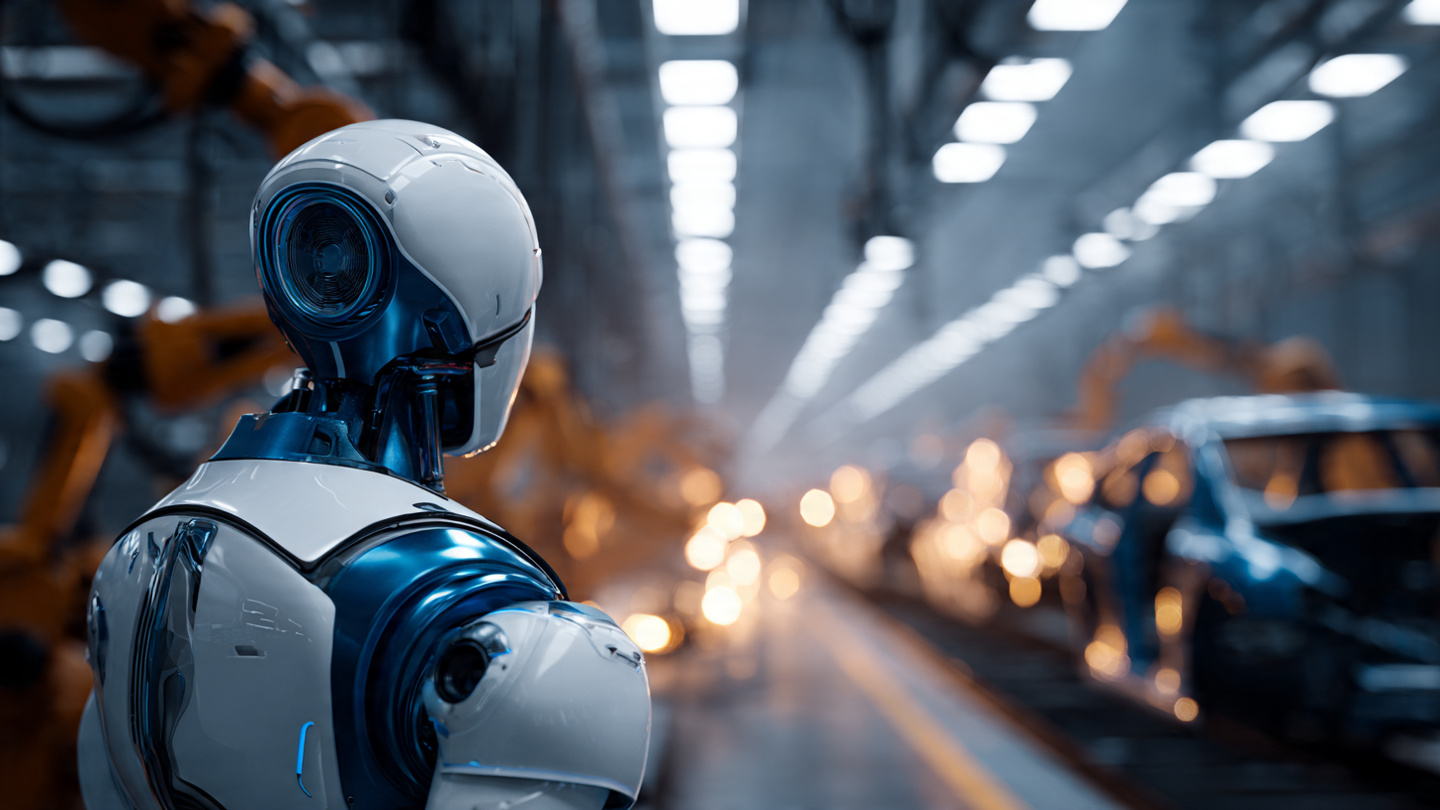
Twenty-five thousand. That is the number of Boston Dynamics Atlas humanoid robots that Hyundai Motor Group plans to install across its manufacturing facilities, according to investor materials disclosed at a JPMorgan Chase-hosted session on May 19. Not a concept rendering. Not a five-year aspiration deck. A deployment figure tied to a specific production capacity — 30,000 robots per year by 2028 — with the first units scheduled to walk onto the floor at Hyundai Motor Group Metaplant America in Bryan County, Georgia, that same year, followed by Kia’s Georgia plant in 2029.
That number deserves context. It is bigger than the entire global humanoid robot installed base today, across every company, every country, every application combined. It means Hyundai intends to deploy more humanoids in its own factories than the rest of the world has deployed anywhere, for anything, ever.
The union noticed.
The $320,000 Line
Boston Dynamics has committed to pricing Atlas below the cost of employing two US manufacturing workers for two years, or approximately $320,000. That target is not arbitrary — it is a payback threshold, and the math behind it is what makes the Korean Metal Workers’ Union’s alarm entirely rational.
Here is the calculation. The Bureau of Labor Statistics reports that total compensation for goods-producing workers — wages plus benefits, insurance, retirement, and legally required contributions — averaged $48.97 per hour in Q4 2025. That is $101,858 per year per worker. Two years: $203,716. Boston Dynamics is promising a price below $320,000, but even at the full $320,000 sticker, the robot pays for itself against a single worker in 3.14 years.
But factories run shifts. Three shifts, usually. A robot that operates 20 hours a day — four hours reserved for charging and maintenance — covers the equivalent labor output of 2.5 workers. Against 2.5 workers at $101,858 each, the $320,000 Atlas pays for itself in 15.1 months. If annual maintenance runs $9,500, as industry estimates suggest, the ongoing cost is 9.3% of a single worker’s total compensation.
No union leader on earth reads those numbers and sleeps well.
“We Will Show You How It Ends”
The Hyundai Motor branch of the Korean Metal Workers’ Union did not hedge. Their January statement was an ultimatum delivered in public, not a negotiating position floated through back channels: “Overseas production transfers and new technology adoption (robot automation) are one-sided moves without labor-management agreement. We absolutely cannot tolerate this.”
Then the line that matters: “Keep in mind that not a single robot can enter the workplace without labor-management agreement. If you want to destroy labor-management relations, we will show you how it ends.”
Korean autoworker unions are not polite advisory committees — they are among the most militant in the developed world, with a decades-long history of strikes that have shut down production lines for weeks at a time, and Hyundai’s union in particular has walked out more than a dozen times since the company’s founding, including a 2023 strike at Ulsan that cost Hyundai an estimated 60,000 vehicles in lost output over three weeks. When this union says not one robot enters without agreement, the threat carries the weight of a manufacturing operation that has, on multiple occasions, simply stopped making cars until management capitulated.
The union specifically identified the pricing as the provocation. Robots priced below two years’ payroll are not productivity tools. They are replacements. “This is a good excuse for capitalists who seek to maximize profits from a long-term viewpoint,” the union said. They are not wrong about the incentive structure.
The 625x Production Gap
There is a problem between the PowerPoint and the factory floor, and it is enormous.
Boston Dynamics currently manufactures approximately four Atlas robots per month. We reported on this gap in February, when the company’s C-suite departed amid the tension between Hyundai’s production ambitions and Boston Dynamics’ research-lab origins. The math has not changed: 30,000 per year requires 2,500 per month, which represents a 625-fold increase in production rate in under two years.
For reference, Tesla has been promising volume production of Optimus since 2022 and has not disclosed a unit count above the low hundreds. Figure AI shipped its F03 to a Catalyst Brands facility where it sorted 250,000 packages over 200 hours with zero failures — impressive, but one robot. EngineAI has announced a 10,000-unit annual production target. 1X sold 10,000 NEO preorders in five days, but every unit still requires a human teleoperator hiding inside.
Hyundai’s answer to the scaling question is its automotive supply chain. The company produces roughly 7.4 million vehicles per year across a global manufacturing network spanning Korea, the US, Czech Republic, India, Turkey, Indonesia, and Brazil. Vehicle production and robot production share actuators, sensors, power systems, and precision machining capabilities — and Hyundai already builds these components at automotive scale. Milan Kovac, a former Tesla VP of robotics and autonomous driving, was hired as a Boston Dynamics director to bridge the gap between research prototype and assembly-line product.
Whether an automotive supply chain can produce a humanoid robot that actually works on day one in an automotive factory is a separate question from whether it can produce 30,000 humanoid-shaped objects. BMW’s experience is instructive: two Figure robots assembled parts on 30,000 BMW i4 sedans at $8.67 per car in added cost — a proof of concept that demonstrated both the viability and the extraordinary modesty of current humanoid contribution. Two robots. One task. Controlled conditions.
The Data Play Nobody Noticed
Buried beneath the deployment headline is a second business model. Hyundai has disclosed that it views its robot-equipped factories as a potential data revenue platform, with internal estimates projecting $2.7 billion in annual profit from manufacturing process data generated by Atlas units.
Twenty-five thousand robots, each running computer vision, force sensors, and proprioceptive feedback across every shift, would generate a continuous stream of real-world manipulation data that no simulation environment can replicate. In the foundation-model era, this data has value beyond Hyundai’s own operations — it trains better robot policies, improves reliability models, and creates a moat around Hyundai’s physical AI capabilities that competitors without installed-base data cannot cross.
Korea’s broader ecosystem is already pricing this in. The country’s humanoid robot supply chain — spanning auto parts makers like Hyundai Mobis and HL Mando, electronics firms like LG Innotek and Samsung, and battery producers like LG Energy Solution — has added $68 billion in combined market capitalization as investors bet that Korea’s precision manufacturing expertise positions it as the humanoid supply chain alternative to China.
Strongest Counterargument
The most serious objection to this plan is not the union — it is the technology. Atlas has been demonstrated in controlled environments performing specific tasks: walking, lifting, balancing, manipulating objects of known geometry. An automotive assembly line is a maelstrom of unpredictable edge cases — misaligned parts, dropped fasteners, coworkers moving erratically, fluid spills, lighting variations, tool wear — that no amount of CES choreography prepares a robot to handle, and the history of industrial automation is littered with companies that announced massive humanoid deployments and then quietly downgraded to single-purpose arms bolted to the floor because the general-purpose humanoid could not reliably do any one task as well as a specialized machine designed for that task alone.
Hyundai has not published task-completion reliability data for Atlas in any production setting. BMW’s pilot with Figure reported a single controlled task — part insertion — and even that required human oversight. At 25,000 units, a 99% reliability rate still means 250 robots failing or requiring intervention on any given day, and at automotive line speeds, a single downed station cascades into minutes of lost output that compound across an integrated production system. The gap between “25,000 deployed” and “25,000 productive” could swallow the entire economic case.
What We Don’t Know
The 25,000 figure comes from investor relations materials at a JPMorgan session, not a formal SEC-equivalent filing or a binding capital commitment. Hyundai has not disclosed how many of the 25,000 are slated for US plants versus Korean or other global facilities. The $320,000 pricing target is a ceiling communicated to investors, not a confirmed purchase price — actual unit economics will depend on production volume, supply chain costs, and how aggressively Hyundai subsidizes early units to build installed base.
Our payback calculation assumes 20-hour daily utilization and continuous single-task operation at the productivity equivalent of one human worker per shift, which is optimistic for a first-generation deployment. If Atlas initially handles only a subset of a station’s tasks and requires human co-workers for the rest, the payback period extends substantially. The $9,500 maintenance figure is an industry estimate, not a Boston Dynamics disclosure, and first-generation maintenance costs for complex electromechanical systems are almost always higher than steady-state projections.
The Bottom Line
Hyundai’s 25,000-unit Atlas plan is the first time a major manufacturer has committed to a humanoid deployment at a scale that would actually show up in labor statistics — not a pilot, not a proof of concept, not two robots in a controlled cell. At the disclosed pricing, the economic incentive is overwhelming: each Atlas that works a three-shift day generates labor-equivalent value of $254,645 per year against a one-time purchase price under $320,000 and annual maintenance of $9,500. The union is right that the arithmetic favors capital over labor once the technology works. Whether the technology works, at scale, in the chaos of an actual factory, in 2028, remains the $8 billion question nobody has answered yet.
What you can do: If you work in automotive manufacturing, your union’s response to the Hyundai precedent matters now — this is the first deployment plan large enough to set negotiating norms for the industry, and the window for establishing retraining guarantees and displacement terms is before robots arrive, not after. If you are a Hyundai or Kia supplier, the pivot from vehicle components to robot components is happening inside your customer base whether you participate or not; HL Mando is already building actuators for both Spot and Tesla Optimus, and the companies that retool earliest will capture the margin premium that comes with being designed into the first 30,000 units. If you invest in manufacturing automation, watch the gap between announced production capacity (30,000/year) and actual shipments — that delta is the leading indicator of whether this is a real deployment or a PR-inflated investor narrative that quietly collapses into a few hundred units doing supervised tasks. And if you are a policymaker in Georgia, where HMGMA has 1,400 employees building 300,000 vehicles a year, the question you should be asking Hyundai right now is how many of those 25,000 robots are coming to your state, and what happens to the 25,000 new jobs the company’s CEO promised at the New York Auto Show three months ago.