Figure AI’s Robots Sorted 250,000 Packages in 200 Hours With Zero Hardware Failures. The Human Who Raced Them Broke His Forearm.
Three Figure F.03 humanoid robots completed a 200-hour autonomous warehouse endurance test—25 times longer than planned—sorting nearly 250,000 packages without a single hardware failure. In a separate man-vs-machine sprint, a human intern named Aime beat the F.03 by 1.5 percent over ten hours, averaging 2.79 seconds per package to the robot’s 2.83. He finished with a broken forearm. The robots kept going for another 190 hours. An original cost-per-package analysis shows the three-robot system already undercuts a fully loaded human workforce by 34 percent on multi-day operations.
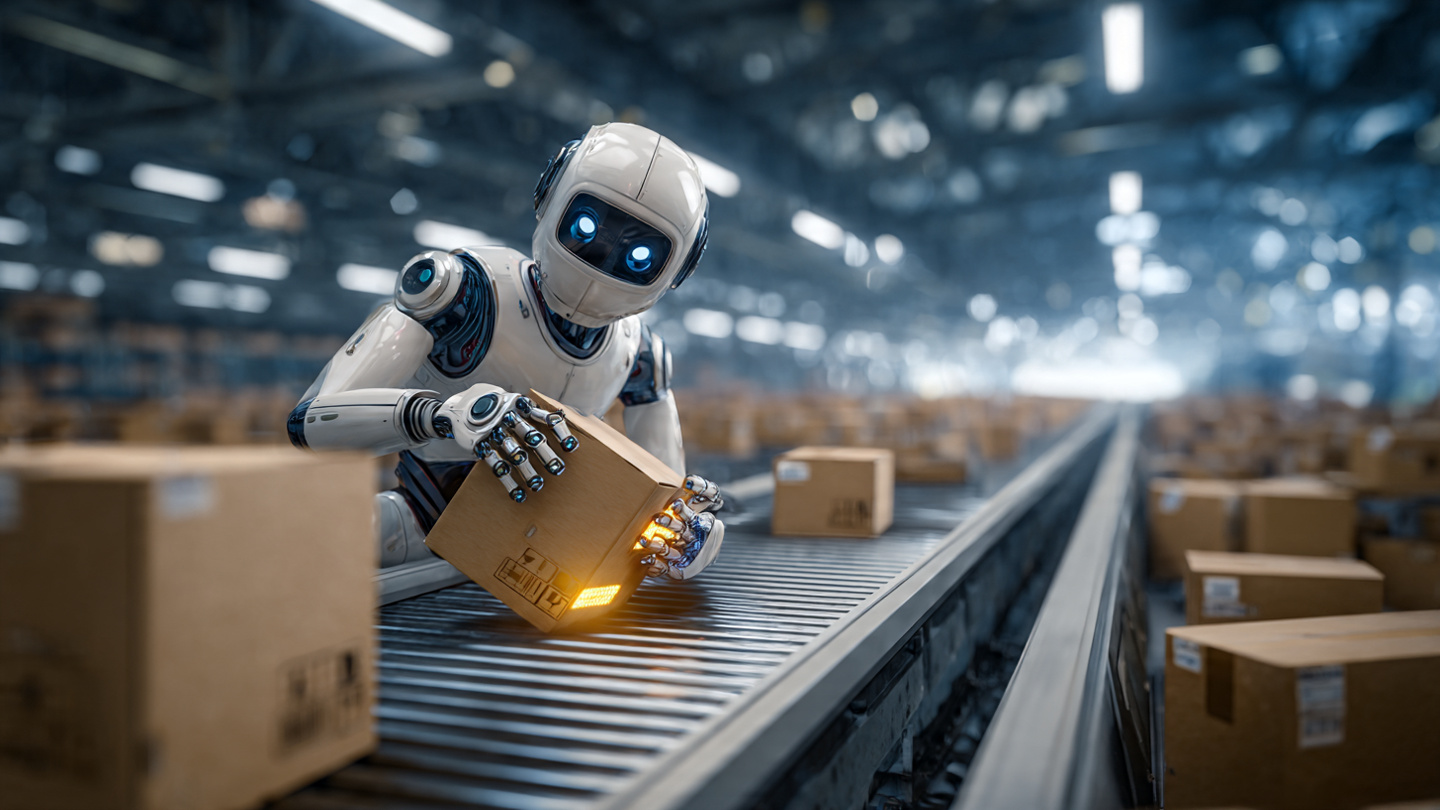
Two hundred hours. That is how long three humanoid robots ran autonomously in a warehouse, picking up small packages, reading barcodes, and placing items on a conveyor belt, before Figure AI finally stopped the test.
The original plan was eight hours.
When the robots hit the eight-hour mark without a reported failure, the company let the livestream keep running. Viewers tuned in, gave the robots names—Bob, Frank, and Gary—and Figure AI leaned into it by printing visible name tags. By the time the test ended around May 22, the three F.03 humanoid robots had sorted nearly 250,000 packages running on the company’s in-house Helix-02 AI system, with zero hardware failures across the entire run. No remote human control. No emergency interventions. Just three robots doing the most boring job in logistics, over and over, for more than eight consecutive days.
No choreography, no strategic camera cuts, just three bipedal machines doing tedious work in front of the whole internet. What makes this test structurally different from the hundreds of humanoid robot demo clips flooding social media is not the task itself—barcode scanning and conveyor belt placement is about as unglamorous as warehouse work gets—but the duration and the transparency. This was a public livestream with real-time viewer counts, not a 90-second sizzle reel. Anyone could watch the robots stumble, reset, or fail. They didn’t.
Man vs. Machine: The Sprint That Tells the Whole Story
Before the marathon, there was a sprint. On May 18, Figure AI staged a separate ten-hour “Man vs. Machine” contest pitting one of its interns, a college student named Aime, against an F.03 robot system. Same task: scan the barcode, identify the package, place it on the belt. Ten hours. Go.
Aime won.
| Competitor | Packages Sorted | Avg. Speed (sec/package) | Duration | Post-Shift Condition |
|---|---|---|---|---|
| Aime (human intern) | 12,924 | 2.79 | 10 hours | Broken forearm |
| Figure F.03 (robot) | 12,732 | 2.83 | 10 hours | Continued to hour 200 |
The margin was 192 packages—barely 1.5 percent. Aime averaged 2.79 seconds per package versus the robot’s 2.83, a gap of four hundredths of a second. But there is a detail that CEO Brett Adcock posted on X that reframes the entire result: “Congrats to Aime!! He said his left forearm is basically broken.” Then he added: “This is the last time a human will ever win.”
That reads like bravado until you look at what happened next. Aime went home. The robots didn’t. They went back to the 200-hour endurance test and kept sorting packages for another week and a half. The sprint showed the robot matches human speed. The marathon showed it obliterates human endurance. Guess which one warehouses actually pay for.
Original Analysis: The Cost-per-Package Crossover
Nobody has published what a 200-hour robot shift actually costs per package sorted versus a human crew, so we ran the numbers ourselves using Figure AI’s test data and Bureau of Labor Statistics wage benchmarks.
The robot side. Figure AI has not publicly disclosed the price of the F.03. Analysts tracking the humanoid market bracket current-generation units between $75,000 and $150,000, with Boston Dynamics’ Atlas at the high end ($140,000–$150,000) and Tesla’s Optimus targeting the low end ($20,000–$30,000). We use $100,000 per unit as a midpoint estimate for this analysis—three robots at $300,000 total, amortized over a conservative three-year useful life.
The human side. PayScale’s 2026 data puts the average package handler with sorting skills at $17.38 per hour. Add the standard 30 percent benefits loading (health insurance, payroll taxes, workers’ comp) and the fully loaded cost is $22.59 per hour. Running a single sorting station 24/7 requires roughly 4.2 full-time equivalents to cover three shifts plus vacation, sick days, and turnover.
| Metric | 3-Robot System | Human Crew (4.2 FTEs) |
|---|---|---|
| 200-hour throughput | 250,000 packages | ~212,700 packages* |
| Amortized hardware/labor (200 hrs) | $2,283 | $3,476 |
| Electricity/overhead | ~$160 | $0 (included in facility costs) |
| Maintenance reserve | ~$228 | $0 |
| Total cost (200 hrs) | $2,671 | $3,476 |
| Cost per package | $0.0107 | $0.0163 |
*Human throughput assumes 1,270 packages/hour at 80 percent effective utilization (breaks, fatigue, shift changeover). Robot throughput uses actual test data: 250,000 packages / 200 hours = 1,250/hour system-level average.
The three-robot system costs $0.0107 per package versus $0.0163 for the human crew—a 34 percent savings. Scale that to a full year of 24/7 operation and the gap widens further: the robot system produces roughly 10.95 million packages at an all-in cost of approximately $135,000, while a 4.2-FTE human crew produces roughly 8.9 million packages (accounting for realistic absenteeism and fatigue) at approximately $190,000. The robots sort 23 percent more packages for 29 percent less money.
Two caveats sharpen this picture. First, the $100,000 price estimate may be high. Figure’s BotQ factory now produces one robot per hour—a 24x throughput improvement in 120 days from one per day in January 2026. At 12,000 units per year, manufacturing cost compression becomes inevitable. If the production learning curve follows solar panel economics, where panel costs fell 89 percent over a decade once factories scaled, the cost-per-package advantage accelerates on a steepening curve. Second, the $100,000 estimate may be low for early commercial deployments that include integration, support, and service contracts. Our analysis uses hardware-only amortization; total cost of ownership will be higher but also declines faster at scale.
The Factory Behind the Robot
The 200-hour test did not happen in isolation. It is one data point in a broader industrial acceleration that separates Figure AI from the dozens of humanoid startups showing off choreographed demo reels at trade shows.
Figure AI’s BotQ manufacturing facility announced on April 29, 2026 that it had reached one Figure 03 unit per hour, up from one per day in January—a 24x throughput jump in under 120 days. Over 350 units have shipped. The facility runs more than 150 networked workstations with custom manufacturing software built specifically for humanoid assembly. The company targets 12,000 units annually as a near-term milestone and 100,000 units over four years.
The Figure 03 itself was redesigned from scratch for production, not demos. It features a 2x frame rate improvement, 60 percent wider field of view, palm-mounted cameras, and 3-gram tactile sensors. The Helix-02 AI platform—built entirely in-house after Figure ended its earlier partnership with OpenAI—handles vision, touch sensing, body awareness, and movement control through a single neural network running on the robot’s onboard hardware.
Enterprise validation is building. Before the 200-hour test, Figure’s earlier F.02 robots spent 11 months at BMW’s Spartanburg, South Carolina plant, contributing to the production of more than 30,000 BMW X3s and physically moving over 90,000 parts across 1,250-plus hours of continuous operation. BMW has now committed to deploying Figure robots at its Leipzig, Germany facility for summer 2026—the first humanoid deployment in a European automotive production environment.
| Company | Robot | Production Rate | Price Target | Valuation/Status |
|---|---|---|---|---|
| Figure AI | F.03 | 1/hour (12,000/yr) | Not disclosed | $39B valuation |
| Tesla | Optimus | 50,000 units (2026 target) | $20,000–$30,000 | Internal deployment first |
| Boston Dynamics | Atlas (electric) | Not disclosed | $140,000–$150,000 | Commercial launch 2026–2028 |
| Unitree | G1 | 5,500+ sold (2025) | $16,000 | Lowest-cost full-size humanoid |
| AGIBot (China) | Various | 10,000 units (target) | Enterprise-tier | Production ramp |
The $39 billion valuation looks rich until you multiply production capacity by contract value, and then the arithmetic flips. At 12,000 units per year, even a conservative $50,000 in annual contract value per robot implies a $600 million revenue run rate from BotQ alone. The company has raised $1.9 billion from NVIDIA, Microsoft, Jeff Bezos, Brookfield, Intel Capital, and Salesforce.
What the Endurance Test Does Not Prove
A 200-hour package-sorting run in a controlled environment is not the same as a 200-hour shift on a chaotic warehouse floor, and Figure AI knows this because the company has conspicuously avoided claiming otherwise. Several gaps remain between this demo and commercial viability at scale.
First, the test used small, uniform packages. Real warehouse floors handle irregularly shaped items, damaged boxes, unlabeled parcels, and items that defy standardized gripping. The endurance test proved the robots can repeat a structured task reliably; it did not prove they can handle the long tail of edge cases that make warehouse work genuinely difficult.
Second, the 250,000-package figure comes from Figure AI itself. No independent third party has audited the throughput, failure rate, or the claim of zero hardware failures. The livestream provided visual transparency, but viewers cannot verify internal system logs, reset counts, or what counts as a “failure” versus a successful automatic recovery. Until independent benchmarking exists for humanoid warehouse robots—nothing comparable to Euro NCAP for crash testing or SWE-Bench for coding agents—all endurance claims are self-reported marketing.
Third, our cost analysis relies on an estimated robot price of $100,000 because Figure has not disclosed pricing. If commercial deployments require integration fees, dedicated support engineers, or software licensing that pushes the effective annual cost above $80,000 per unit, the 34 percent savings shrinks or vanishes. Our human labor costs also use national averages; wages in tight labor markets like Southern California or the Northeast corridor run 20–40 percent higher, which would widen the robot’s advantage.
Strongest Counterargument
The most credible objection to reading this test as a warehouse automation inflection point is that endurance on a single task is not the same as competence across a job. A human package sorter does not just sort. They reroute mislabeled items, flag damaged goods, communicate with supervisors about equipment issues, step around forklifts, notice a wet floor, help a new hire, and make a dozen small judgment calls per hour that never appear in a throughput metric. Figure’s robots were tested on the most automatable slice of warehouse work—repetitive, standardized, and self-contained. The parts of the job that are genuinely hard, the messy contextual reasoning that fills the gaps between scan-and-place cycles, remain untested at scale. Amazon employs over 750,000 warehouse workers not because it cannot automate barcode scanning but because the full scope of warehouse operations involves a combinatorial explosion of edge cases that no robot has demonstrated it can handle. If the 200-hour test is a sprint-turned-marathon on the easy part, the hard part has not started yet.
What You Can Do
If you run warehouse or logistics operations: Start tracking your fully loaded cost per package sorted, including overtime, injury claims, turnover, and training for new hires. The Figure test established a public benchmark—1,250 packages per hour at $0.0107 each for a three-robot system. Even if that number doubles in commercial deployment, comparing your actual human cost per package against a credible robot baseline tells you how many years you have before the crossover hits your specific operation. Request a pilot from Figure or a competitor and insist on independent throughput verification before committing.
If you work in warehouse operations today: The 200-hour test is not a pink slip, but it is a signal. Package sorting is among the most automatable warehouse tasks precisely because it is repetitive and standardized. The tasks that are hardest to automate—exception handling, equipment troubleshooting, quality judgment calls, training other workers—are the ones worth leaning into. If your role is primarily scan-and-place, the economic case for your replacement just got a public, time-stamped data point. Upskill toward the parts of the job robots cannot do.
If you invest in robotics or adjacent sectors: Watch the BotQ production ramp closely. Manufacturing throughput, not demo performance, is the leading indicator for humanoid robotics companies. Figure’s 24x production improvement in 120 days mirrors early-stage factory scaling curves that preceded massive price compression in solar panels and lithium-ion batteries. The next catalysts to watch: pricing announcements below $75,000 per unit, a second tier-1 enterprise customer beyond BMW, and whether Tesla’s 50,000-unit Optimus target for 2026 materializes. Any two of those three signals arriving by Q3 2026 would suggest the industry has entered the commodity phase ahead of schedule.
The Bottom Line
The Figure AI endurance test did something no sizzle reel or choreographed demo can do: it let the internet watch three robots do boring work for eight straight days and find nothing to ridicule. Bob, Frank, and Gary did not dance, wave, or perform backflips. They picked up packages, found barcodes, and put them on a belt, 250,000 times, without breaking down. The human who raced them won the sprint by four hundredths of a second and left with a broken forearm. The robots went back to work for another week. At current estimated costs, the three-robot system already undercuts a human crew by 34 percent per package on extended operations, and Figure’s factory is now churning out one new robot every hour on a trajectory toward 12,000 per year. The humanoid robotics industry has been promising to move beyond demos for years. This time, the proof ran for 200 hours on a public livestream, and the most remarkable thing about it was how unremarkable the work looked. That is exactly when automation gets real.
Sources
- Figure’s F.03 Robot Completes 200-Hour Logistics Stress Test, Sorts 250,000 Packages (Crypto Briefing, May 2026)
- Humanoid Robots Work Nonstop in Package Test (Fox News / CyberGuy, May 2026)
- Last Time a Human Will Ever Win: College Intern Beats Humanoid Robot in Man vs. Machine Challenge (The Cool Down, May 2026)
- Figure’s 24x Production Jump in 120 Days (TechFastForward, May 2026)
- Brett Adcock on X: Man vs. Machine Results (May 18, 2026)
- PayScale 2026: Package Handler with Sorting Skills, Average Hourly Pay $17.38
- Forge Global: Figure AI Stock, $1.75B+ in Funding, $39B Valuation