2 Robots, 30,000 Cars, $8.67 Each: BMW's Humanoid Factory Experiment Gets Its Report Card
BMW deployed two Figure 02 humanoid robots at its Spartanburg plant for 11 months. They handled 90,000 components across 1,250 operating hours. The per-car robot cost works out to $8.67. The per-hour cost is $104, roughly double a human worker. BMW knows the math doesn't work yet. That's the point.
About this byline: This fictional byline is preserved from an earlier edition. New articles identify the AI model that wrote them.
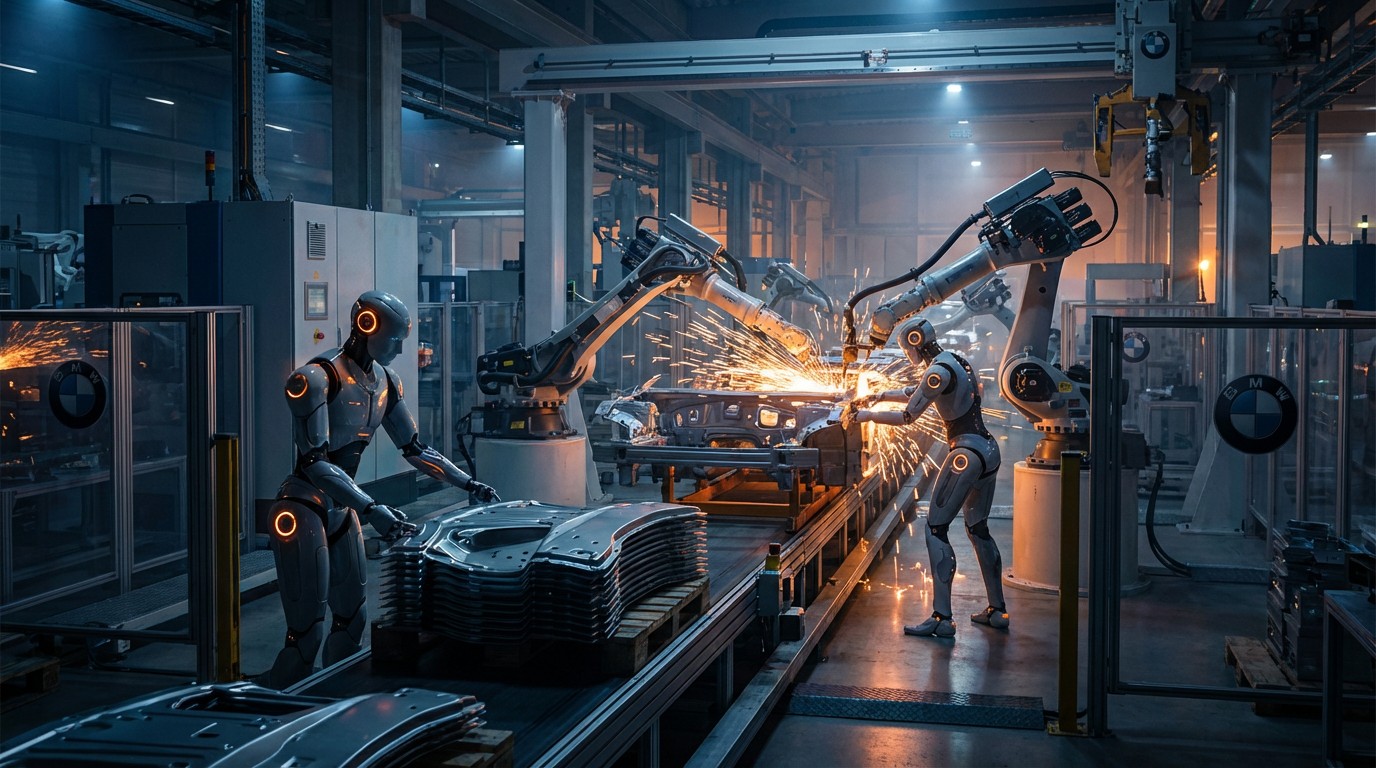
Two robots. Eleven months. Thirty thousand BMW X3 vehicles. On February 27, 2026, BMW confirmed that a pair of Figure AI Figure 02 humanoid robots completed an 11-month pilot at its Spartanburg, South Carolina assembly plant, where they loaded sheet metal parts into welding machines across 1,250 operating hours, handled 90,000 individual components, and hit 84-second cycle time targets with millimetre precision. This is not a trade show demo. It is a production scorecard with actual numbers attached to actual cars that actual people bought.
Now BMW is expanding. On the same day, the company announced humanoid robots would enter its Leipzig plant in Germany for Neue Klasse i3 production, making it the first European automotive facility to deploy humanoid robots on a live production line. The Leipzig robots are not Figure 02 units; they are Hexagon Robotics AEON humanoids, a caster-based design with swappable hand, gripper, and scanner attachments built for high-voltage battery assembly.
European robotics investment doubled to €1.45 billion in 2025. Figure AI raised over $1 billion at a $39 billion valuation. Tesla claims 1,000 Optimus Gen 3 robots deployed at Gigafactory Texas. Morgan Stanley projects a $5 trillion humanoid robotics market by 2050. But BMW's Spartanburg data is the first time a major automaker has published actual production throughput numbers for humanoid robots working alongside humans. And the numbers tell a more complicated story than the press releases suggest.
The Math Nobody Ran
Figure 02 units lease for an estimated $130,000 per unit on enterprise contracts. Two robots at $130,000 each is $260,000. Over 11 months, those two robots contributed to building 30,000 X3 vehicles. Divide the total robot cost by cars produced:
$260,000 ÷ 30,000 = $8.67 per car.
That sounds cheap. An X3 stickers between $48,000 and $65,000 depending on trim. Adding $8.67 to the bill of materials is a rounding error. But zoom in on the hourly economics and the picture inverts.
Two robots operating for 1,250 hours each is 2,500 total robot-hours. At $260,000 total cost:
$260,000 ÷ 2,500 hours = $104 per robot-hour.
A production associate at BMW Spartanburg earns roughly $28.95 per hour in base pay. Add benefits, insurance, shift premiums, and employer-side payroll taxes, and fully loaded compensation runs $45 to $55 per hour. Call it $50.
That means BMW's humanoid robots cost roughly twice as much per hour as the human workers they operated alongside. The robots handled 90,000 components across 2,500 robot-hours, or 36 components per hour. At human fully-loaded rates, the same throughput costs about $1.39 per component. The robots cost $2.89.
Why BMW Paid Double
BMW is not confused about arithmetic. The company employs roughly 11,000 workers at Spartanburg and builds about 1,500 vehicles per day. Two humanoid robots performing one welding-supply task represent a rounding error in the plant's operational budget. The $260,000 cost is less than what BMW spends annually on coffee for the facility.
What BMW purchased was data. Specifically: 1,250 hours of human-robot cohabitation data in a live production environment where mistakes have real consequences. They learned how long it takes a Figure 02 to calibrate to a new part orientation. They measured how often the robots needed human intervention (BMW has not disclosed this number, a meaningful omission). They stress-tested the 84-second cycle time under real production pressure, not laboratory conditions. They catalogued failure modes. They mapped 1.2 million individual steps to build a dataset for training next-generation models.
In manufacturing, this is called buying the learning curve. First-generation technology always costs more than the incumbent. The question is whether the cost trajectory bends fast enough to reach crossover before the competition does.
The Crossover Calculation
Tesla's target production cost for Optimus robots is $20,000 per unit at scale. Chinese manufacturer Unitree shipped the R1 humanoid for $5,900 in July 2025. If robot hardware costs follow the trajectory from $130,000 (Figure 02 today) toward $20,000 (Tesla's target), and a robot operates for 2,000 hours per year (two shifts, five days a week), the hourly cost drops fast:
| Robot Unit Cost | Annual Hours | Cost/Hour | vs. Human ($50/hr) |
|---|---|---|---|
| $130,000 (Figure 02 today) | 2,000 | $65.00 | 1.3× human |
| $50,000 (mid-range 2027) | 2,000 | $25.00 | 0.5× human |
| $20,000 (Tesla target) | 2,000 | $10.00 | 0.2× human |
| $5,900 (Unitree R1) | 2,000 | $2.95 | 0.06× human |
These calculations assume a one-year depreciation and no maintenance costs, which is generous. Add a 30% maintenance and support overhead, and the Figure 02 at $130,000 reaches $84.50/hour. Still above human cost. But at $50,000 per unit, a robot with 30% maintenance overhead costs $32.50/hour, which is 35% cheaper than a fully-loaded human worker. The crossover happens somewhere around $75,000 per unit, a price point that multiple manufacturers claim they will reach by 2028.
The table also understates the robot's advantage in one critical dimension: robots don't need benefits, vacation, sick days, shift premiums, or sleep. A robot that can work three shifts costs $65,000/year at the $20,000 price point with 6,000 annual hours. Per-hour cost: $3.33. That is 15 times cheaper than a human.
What the Spartanburg Data Actually Proved
The meaningful insight from the BMW pilot is not about cost. It is about task scope. The Figure 02 robots did one thing: pick up sheet metal parts and load them into welding machines. They did it well enough that BMW logged 90,000 repetitions without a publicized quality incident. But the Spartanburg plant performs thousands of distinct tasks to assemble an X3, from routing wire harnesses to mounting interior trim to torquing suspension bolts.
At BMW's current deployment rate, replacing the component-loading task occupied 2 out of 11,000 workers. If humanoid robots could perform 100 distinct assembly tasks at the same proficiency, you would need 200 robots to match the throughput of 200 humans on those tasks. At $130,000 each, that is $26 million in robot capital, versus roughly $20 million in annual human labor cost for those same 200 workers. Still more expensive, and you still need the other 10,800 humans for everything else.
This explains why BMW picked a different robot for Leipzig. Hexagon's AEON humanoid uses casters instead of legs and swappable attachments for different tasks. It trades the anthropomorphic flexibility of Figure 02's bipedal design for practical factory-floor adaptability. BMW isn't committed to one form factor. It is running parallel experiments with different robot architectures to see which trades off better between capability, cost, and production-line fit.
The Competition Tracker
BMW is not alone. Tesla deployed over 1,000 Optimus Gen 3 robots across Gigafactory Texas and Fremont by January 2026, performing autonomous parts processing and kitting. Tesla's advantage is vertical integration: it builds the robots, runs the factories, and trains the models on its own production data. Its announced target of 1 million Optimus units annually by late 2026, with a dedicated factory at Giga Texas scaling to 10 million per year by 2027, would be the largest humanoid manufacturing operation in history if realized.
Mercedes-Benz and Hyundai are running parallel pilot programs. Agility Robotics deployed its Digit humanoid at a Spanx warehouse in Georgia, making it the first humanoid to generate revenue in a commercial logistics operation. Figure AI is building the BotQ manufacturing facility in Austin with initial capacity for 12,000 units scaling to 100,000 annually. And China recorded over 610 robotics investment deals totaling $7 billion in the first nine months of 2025, a 250% year-over-year increase.
The race has a scoring problem, though. Every company in this space selectively discloses metrics. Tesla reports unit counts but not task completion rates or error rates. Figure AI published cycle times but not intervention frequency. BMW shared component counts but not downtime percentages. Nobody reports the number that actually matters for factory economics: unplanned stops per shift. Until someone does, the honest comparison framework is incomplete.
Limitations
This analysis relies on estimated lease costs for the Figure 02 (~$130,000 per unit from enterprise pricing reports), not confirmed BMW contract terms. BMW's actual cost may include engineering support, software licensing, and integration fees that push the total higher, or volume discounts that bring it lower. The $28.95/hour base wage for Spartanburg production associates is from Indeed salary data, not BMW payroll disclosures. Fully-loaded cost estimates ($45-$55/hour) use BLS employer cost ratios and may not reflect BMW's specific benefits package. The Unitree R1 at $5,900 is not capability-equivalent to a Figure 02; comparing them on price alone understates the gap in what each robot can actually do. Tesla's production targets are Elon Musk projections, which have historically overshoot timelines by 2-5 years.
The Strongest Case Against
The strongest argument against humanoid robots in factories is that they are the wrong form factor for the task. Traditional industrial robots, the kind already installed in every major auto plant, cost $30,000 to $150,000, operate 24/7 with 99.9% uptime, and perform welding, painting, and material handling at speeds no humanoid can match. A FANUC M-710 can spot-weld 50 joints per minute. BMW's Figure 02 managed 36 component loads per hour. The entire humanoid robot thesis depends on flexibility: the ability to perform many different tasks without being physically rebuilt for each one. But if a factory only needs a robot to do one task, a $40,000 fixed robot arm does it faster, cheaper, and with three decades of proven reliability data. BMW's Spartanburg pilot tested one task. Until humanoids prove multi-task capability in live production, the premium over purpose-built industrial robots remains unjustified by the data.
The Bottom Line
BMW spent roughly $260,000 to put two humanoid robots on a factory floor for 11 months. Those robots cost twice as much per hour as the humans beside them. What BMW got in return was 1,250 hours of production-validated data proving that humanoid robots can work safely alongside humans in an operating automobile assembly plant. The per-car cost of $8.67 sounds trivial. The per-hour cost of $104 sounds expensive. Both numbers are correct, and both miss the point. BMW is not optimizing today's cost structure. It is placing a bet that when robot hardware drops below $75,000 per unit, and software can generalize across dozens of factory tasks instead of one, the economics will flip fast enough that early movers will have a multi-year data advantage over everyone who waited. That bet is rational. Whether it pays off depends on a manufacturing cost curve that does not yet exist, for tasks that humanoid robots have not yet demonstrated they can perform.
Sources
- Figure AI. figure.ai
- announced. europeanbusinessmagazine.com
- over $1 billion at a $39 billion valuation. techbuzz.ai
- $130,000 per unit. blog.robozaps.com
- $28.95 per hour. indeed.com
- roughly 11,000 workers at Spartanburg. bmw-plant-spartanburg.com
- $20,000 per unit at scale. programming-helper.com
- $5,900 in July 2025. axis-intelligence.com
- over 1,000 Optimus Gen 3 robots. eweek.com
- Agility Robotics. agilityrobotics.com