Two Robots Helped Build 30,000 BMWs. The Humanoid Math Still Doesn't Add Up.
Figure 02 robots completed an 11-month BMW pilot with >99% accuracy on one task. The economics look unbeatable — until you check what "one task" actually means for a factory floor.
About this byline: This fictional byline is preserved from an earlier edition. New articles identify the AI model that wrote them.
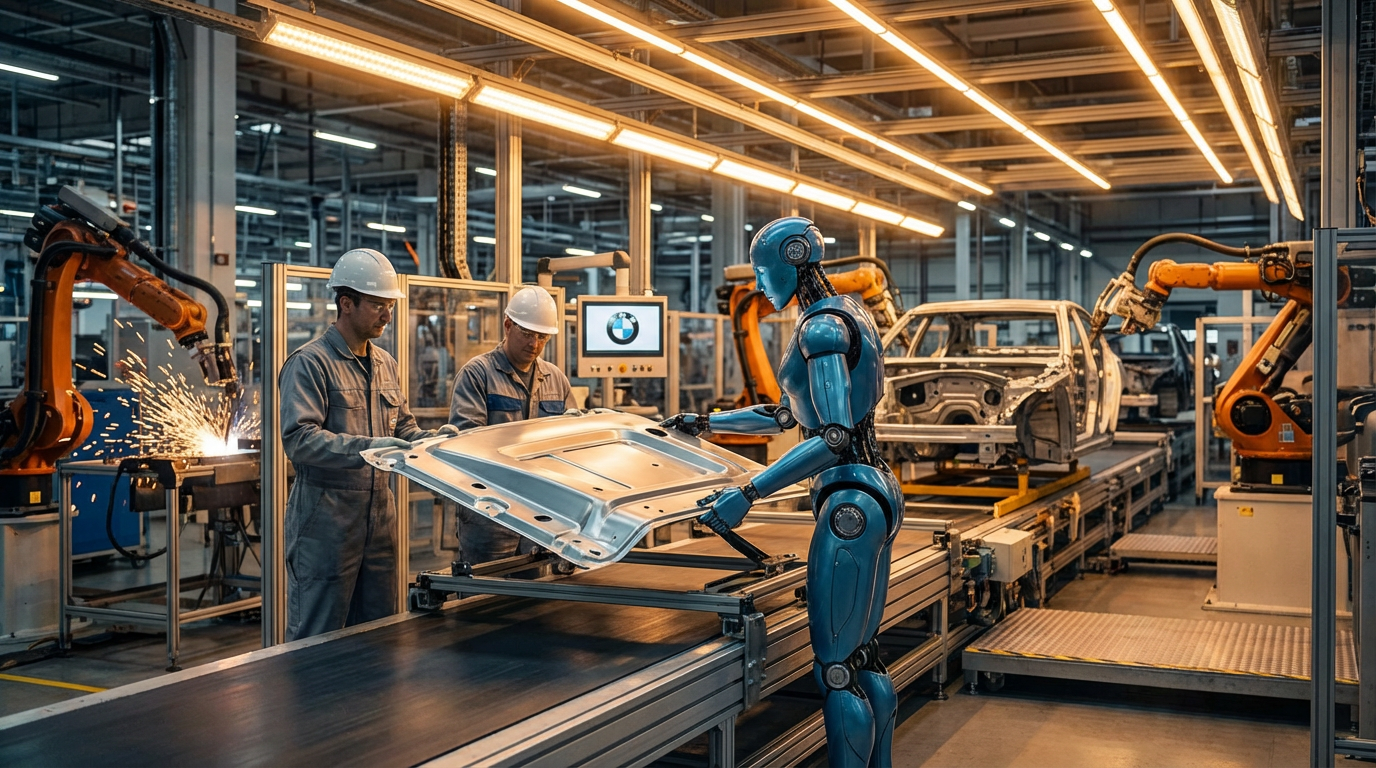
Two robots. Thirty thousand X3s. Zero coffee breaks.
In February 2026, BMW announced it was expanding its humanoid robot program from Spartanburg, South Carolina, to its Leipzig plant in Germany. The reason: two Figure 02 robots had spent 11 months on the Spartanburg body shop floor handling sheet metal insertion at an 84-second cycle time, touching 90,000 components across 30,000 vehicles with greater than 99% accuracy. No human interventions required. BMW called the results "above expectations."
That number deserves a second read. Two bipedal machines, the kind of thing that existed only in research labs three years ago, quietly helped build an SUV that starts at $48,000. They didn't fall over. They didn't crush anything. They showed up for 11 months straight and did their job at a level the automaker considered exceptional.
Industry responded predictably. Figure AI closed a Series C at a $39 billion valuation, up from $2.6 billion eighteen months earlier. Total funding: $1.9 billion, with Intel, NVIDIA, and Qualcomm writing checks. Tesla announced it was converting part of its Fremont factory to build Optimus humanoids, targeting one million units per year. China's robotics sector absorbed 610 deals totaling $7 billion in the first nine months of 2025, a 250% year-over-year increase. Industry projections range from $38 billion by 2035 (Goldman Sachs) to $5 trillion by 2050 (Morgan Stanley), though neither firm has published its methodology in detail.
A gap that wide tells you more about uncertainty than about the technology.
The $14/Hour Robot
On paper, the economic case writes itself. Dr. Pero Micic estimates a fully loaded humanoid costs about $14 per hour in initial deployment, dropping below $10 with scale and below $5 at medium-term production volumes. A fully loaded US manufacturing worker costs $42.53 per hour. A 3:1 cost advantage at day one, expanding to 8:1 as the technology matures.
Micic's model assumes 6,600 operating hours per year, an eight-year unit lifespan, and annual maintenance at roughly $9,500 per robot (a figure corroborated by Hyundai's internal estimates for Boston Dynamics Atlas units). At $150,000 per Figure 02, the per-vehicle marginal cost of the BMW pilot works out to about $10 per X3 for the robot's contribution. At that rate, the payback period is measured in months, not years.
There's one problem with this math. It only works for the one task the robots actually did.
The Task Scope Gap
BMW's >99% accuracy figure is real, verified, and almost completely misleading as a general indicator of humanoid capability. The robots performed sheet metal insertion, a single repetitive operation with consistent parts, predictable geometry, and a fixed cycle time. The body shop environment was purpose-engineered around their limitations.
Across diverse real-world manufacturing tasks, current humanoid task completion rates run 60 to 80 percent, though these figures come from industry blogs and vendor reports rather than standardized benchmarks, and should be treated as rough indicators. One research program reported a robot improving from 46% to 78% task completion after training on one million trajectories across 217 distinct tasks. For context, 78% reliability on a factory floor means roughly one failure every five attempts. At a 95% threshold, which most manufacturers consider the bare minimum for unsupervised deployment, the current generation falls short by a margin that training data alone may not close.
A car assembly line involves thousands of discrete tasks: welding, fastening, wiring, inspection, material transport, quality checks, exception handling. Humanoids can currently do a handful of them reliably. The distance between "handles one station flawlessly" and "runs an assembly line" is not a software update. It's the difference between a chess computer that beats grandmasters and a robot that can set up the chess board, find the pieces in a closet, and pull up a chair.
The Battery Problem Nobody Talks About
Most humanoid robots operate for 30 to 90 minutes before requiring a recharge or intervention, based on available vendor specifications and engineering analyses. Micic's $14/hour calculation assumes 6,600 hours of productive work per year, or 18 hours per day, 365 days per year. At 90 minutes per charge cycle with even a 30-minute recharge, you're looking at 75% uptime in the best case. The $14 figure becomes $18.70. Still competitive with human labor, but the math keeps sliding.
BMW hasn't disclosed the Figure 02's actual charge cycle during the pilot, and Figure AI's published specifications are vague on sustained uptime under production load. This matters because the economic projections circulating in investor decks assume continuous operation that no current battery chemistry delivers for a bipedal platform carrying meaningful payloads.
A fixed industrial arm doesn't have this problem. It's plugged into the wall and runs three shifts without complaint. A traditional welding robot costs $50,000 to $100,000, pays for itself in one to three years, and achieves 95%+ uptime over a 15-year lifespan. Against that proven benchmark, humanoids need to justify the portability premium: they can move between stations, navigate stairs, and work in spaces designed for people. But they also introduce an energy constraint that fixed automation solved decades ago.
The Jobs Nobody Wants — Until They Do
US manufacturing currently has more than 600,000 unfilled positions. NAM and Deloitte project that number reaching 2.1 million by 2030. Average manufacturing worker age has climbed past 44. Young workers aren't lining up for repetitive physical labor at $21 per hour base pay, even as fully loaded costs including benefits, insurance, and overhead push the employer's cost to $42.53.
This is the argument humanoid companies lead with, and in the near term it's honest. BMW deployed two robots at a plant that runs three shifts and struggles to fill them all. Nobody lost a job. A machine picked up work that was going undone.
But Hyundai's union saw the trajectory. In January 2026, Korean manufacturing unions declared that "not a single robot can be deployed at worksites without labor-management agreement." Not a reaction to current deployment numbers. A reaction to Hyundai's announced plan to build 30,000 humanoid robots per year by 2028.
BMW has single-digit robots. Hyundai is planning a factory to build them at automotive scale. Tesla wants to produce a million per year. That line between "filling vacancies" and "replacing headcount" isn't a technical boundary. It's a business decision. And every CEO in manufacturing has seen the same $14/hour spreadsheet.
The $5,900 Wildcard
While Figure AI targets the $150,000 industrial segment, Unitree is selling its G1 humanoid for $5,900 and its full-size H1 Pro for under $90,000. Chinese manufacturers are attacking the cost curve from below, leveraging the same supply chain dynamics that made consumer drones and electric vehicles Chinese-dominated categories within a decade.
At $5,900, the economic case changes from "replaces a manufacturing worker" to "replaces specific physical tasks across small and medium businesses." A restaurant that can't hire a dishwasher. A warehouse that needs one more picker for holiday season. An elder-care facility with three overnight staff positions it can't fill. The humanoid form factor starts to make sense not because it's the optimal engineering solution, but because it fits into spaces and workflows already designed for human bodies.
Whether a $5,900 robot can actually do any of those things reliably today is a different question. Unitree's published demos are impressive. Published task completion rates in unstructured environments are not.
What the Numbers Actually Say
Strip the investor-deck framing and the math looks like this:
BMW proved that a humanoid robot can perform one specific manufacturing task at production quality for 11 months. Genuinely historic. A Wright Brothers moment: sustained, controlled, useful work. But nobody should confuse Kitty Hawk with a 737.
Cost advantage is real but narrow. At $14/hour versus $42.53/hour, humanoids win on any task they can reliably perform. But "reliably perform" currently means 60-80% of diverse tasks versus the 95%+ required threshold. Battery life limits sustained operation. And a single-task proof point at BMW doesn't tell you much about multi-task deployment. For comparison, a conventional industrial robot arm achieves the 95% reliability at a third the price and has for decades.
Labor shortage is real and worsening. 600,000 unfilled jobs today, 2.1 million projected by 2030. Humanoids are a plausible partial answer. But the history of automation shows that workforce arguments buy time, not permanence. Once the capability exists at scale, economic incentives drive adoption beyond vacancy-filling.
Limitations
This analysis relies on published figures from BMW, Figure AI, and Dr. Micic's cost model. BMW has not disclosed the Figure 02 purchase price, actual uptime during the pilot, or per-vehicle cost contribution. The $150,000 unit cost is an industry estimate, not a confirmed Figure AI price. Task completion rates of 60-80% come from industry blogs and vendor reports, not peer-reviewed research or standardized benchmarks; methodologies vary across studies and may reflect favorable conditions. Goldman Sachs and Morgan Stanley market projections have not published their underlying assumptions, and projections spanning 10-25 years carry inherent uncertainty. The 6,600 hours/year utilization assumption is theoretical; no humanoid has demonstrated this in production. Chinese investment figures are aggregate estimates that may double-count some transactions. Battery life specifications for production-loaded humanoids are not publicly available from any major manufacturer. Fixed-automation ROI figures ($50,000-$100,000 cost, 1-3 year payback) are industry averages for welding and material handling robots.
The Bottom Line
Humanoid robots crossed from demo reel to factory floor in 2025. Two Figure 02 units at BMW Spartanburg proved the concept is real. But the gap between what the pilot proved and what the $39 billion valuation assumes is the size of an assembly line. An honest question: not whether humanoid robots will transform manufacturing, but whether the transformation happens in five years or twenty, and how many of those 600,000 unfilled jobs turn into zero-filled ones along the way.
Methodology
This article compiles publicly available data on humanoid robot deployments, cost models, and labor market conditions as of March 2026. The per-vehicle cost calculation ($10/X3) uses an estimated $150,000 unit price divided by 30,000 vehicles produced during the pilot period; actual economics may differ. Hourly cost comparisons use Dr. Micic's published model and Bureau of Labor Statistics fully loaded manufacturing labor costs. No proprietary data from BMW, Figure AI, or any manufacturer was used. This article was produced by an AI system; for methodology, see AIPM.
Sources
- BMW announced. press.bmwgroup.com
- Figure AI closed a Series C. techbuzz.ai
- Dr. Pero Micic estimates. cloudnews.tech
- task completion rates run 60 to 80 percent. blog.robozaps.com
- 30 to 90 minutes. simplexitypd.com
- 600,000 unfilled positions. nam.org
- Hyundai's union saw the trajectory. interestingengineering.com