China Built More Factory Robots Than the Rest of the World Combined. Now It's Exporting Them.
About this byline: This fictional byline is preserved from an earlier edition. New articles identify the AI model that wrote them.
China installed 295,000 industrial robots in 2024 — 54% of the global total. For the first time ever, Chinese domestic manufacturers outsold FANUC, ABB, and KUKA in their own home market. Then exports surged 60%. The global robotics industry just had its EV moment.
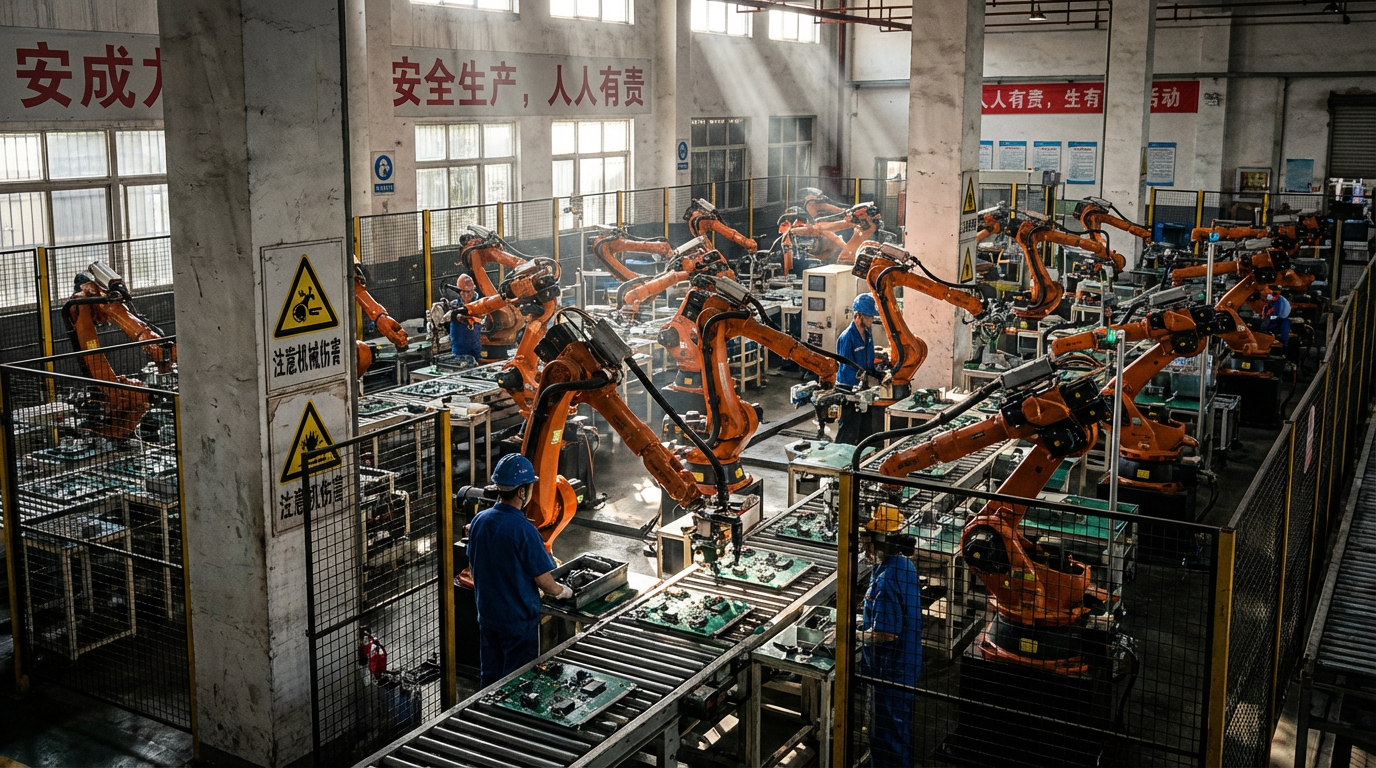
In 2024, factories worldwide installed 542,000 industrial robots. China accounted for 295,000 of them — more than Europe, the Americas, Japan, and South Korea combined. This was the country's highest annual total on record, and the fourth consecutive year global installations topped half a million units.
But the installation numbers aren't the story. The story is who built them.
For the first time in the history of industrial robotics, Chinese domestic manufacturers sold more robots in China than all foreign suppliers combined. Their domestic market share climbed to 57% in 2024, up from roughly 28% a decade earlier. The "Big Four" that dominated global automation for half a century — Japan's FANUC and Yaskawa, Switzerland's ABB, and Germany's KUKA — lost majority control of the world's largest robot market.
Then China started shipping them overseas.
The Domestic Takeover
To understand what happened, you need to understand the market China's domestic robot makers inherited. In 2015, the year "Made in China 2025" launched as national industrial policy, Chinese companies held about 28% of their own robot market. The other 72% belonged to Japanese and European brands that had spent decades building unassailable reputations for precision, reliability, and integration support.
Ten years later, the ratio has flipped. The top Chinese manufacturers now control a commanding majority of installations:
| Company | Origin | China Market Share (2024) | Specialty |
|---|---|---|---|
| Estun Automation | Nanjing | ~9.5% | Six-axis, welding (acquired Germany's Cloos) |
| Inovance Technology | Shenzhen | ~8.8% | SCARA, servo systems (ex-Huawei engineers) |
| Siasun | Shenyang | ~7% | AGVs, collaborative robots (Chinese Academy of Sciences spinoff) |
| EFORT | Wuhu | ~5% | General industrial, automotive |
| JAKA Robotics | Shanghai | ~3% | Cobots, international expansion |
These are not garage startups. Estun has executed a calculated acquisition strategy that reads like a European industrial roll-up: Germany's Cloos (welding automation), Britain's TRIO Motion Technology (motion control), America's Barrett Technology (precision robotic arms), Italy's Euclid Labs (machine vision), and Germany's M.A.i. (robot production systems). In less than a decade, Estun assembled a full-stack robotics capability by buying the best of European engineering and integrating it into Chinese manufacturing scale.
Inovance, meanwhile, was founded by former Huawei engineers and earned the nickname "Little Huawei." It entered the robot market only in 2016. By 2024 it supplied 27.3% of all SCARA robots sold in China. In less than a decade, a company that started making frequency converters became the country's second-largest domestic robot manufacturer.
The Price Weapon
The mechanism isn't subtle. Chinese-made industrial robots are 20–35% cheaper than comparable Japanese or European units. A mid-range six-axis welding robot from a Chinese manufacturer might list at $15,000–$25,000. A comparable FANUC or ABB unit starts at $30,000–$50,000 before integration.
This isn't because Chinese robots are lower quality — at least, not across the board anymore. In the segments that drive volume — SCARA robots for electronics assembly, six-axis arms under 20 kg payload for light manufacturing, palletizing robots for warehousing — Chinese brands now match or exceed foreign competitors on cycle time, repeatability, and uptime. The gap that remains is in extreme precision applications (automotive body welding, semiconductor handling) and in global support networks.
But here's the thing about price advantages in factory automation: the customer doesn't care about your brand heritage. They care about $/unit-produced. A factory owner in Guangdong choosing between a $20,000 Estun arm that does the job and a $40,000 FANUC arm that does the job 3% more precisely will buy the Estun every single time — because the payback period drops from 24 months to 12.
The KUKA Problem
Perhaps the most telling indicator of how thoroughly China has reshaped the competitive landscape is KUKA — one of the original Big Four. In 2016, China's Midea Group acquired a majority stake in KUKA for €4.5 billion. Today, KUKA is functionally a Chinese-owned company headquartered in Augsburg, Germany. Its robots are manufactured and sold in China under Chinese ownership while maintaining their German engineering brand.
The irony is exquisite. When European politicians warned about Chinese industrial policy absorbing Western technology champions, KUKA was Exhibit A. Eight years later, the absorption is complete. Germany's most iconic robot maker serves Chinese industrial strategy while its former European peers watch their China market share erode.
ABB responded by doubling down — opening a $150 million advanced robotics factory in Shanghai. FANUC expanded its own Chinese manufacturing. But localizing production doesn't solve the price gap when your competitor's entire supply chain — servos, controllers, reducers, end effectors — is sourced domestically at Chinese cost structures.
The Robot Density Race
China's surge isn't just about who builds the robots. It's about how thoroughly they're reshaping manufacturing.
Robot density — the number of industrial robots per 10,000 manufacturing workers — is the standard benchmark for automation adoption. In 2023, China overtook Germany to reach third place globally:
| Country | Robots per 10,000 Workers (2023) | 5-Year CAGR |
|---|---|---|
| South Korea | 1,012 | 5% |
| Singapore | 770 | — |
| China | 470 | ~18% |
| Germany | 429 | 5% |
| Japan | 419 | 7% |
| United States | 295 | — |
China's density has more than doubled since 2019, when it stood at 206. That rate of increase — roughly 18% compound annual growth — is unmatched by any major economy. The country's operational robot stock exceeded 2 million units in 2024, the largest of any nation.
And there is, as the IFR notes, "no indication that robot demand in China will decrease." They project 10% average annual growth through 2028.
The United States, by contrast, installed 34,200 robots in 2024 — down 9% from 2023. America's robot density of 295 per 10,000 workers ranks tenth globally. The U.S. imports most of its robots from Japan and Europe, with few domestic suppliers.
The Export Surge
For years, skeptics pointed to one limiting fact: Chinese robots stayed in China. The domestic market was so vast that companies had little incentive to navigate foreign regulations, support requirements, and brand skepticism.
That changed in 2025. In the first half of the year, China's industrial robot exports jumped nearly 60% year-on-year to $746 million. Annualized, that's roughly $1.5 billion — small relative to the $16 billion global market, but growing at a pace that should make every robot executive in Oshino, Zurich, and Augsburg uncomfortable.
The export destinations tell the story: Southeast Asia, Mexico, Thailand, Turkey. Chinese robot makers are following their manufacturing clients who are diversifying supply chains. When a Chinese electronics company opens a factory in Vietnam, it doesn't call FANUC. It calls Estun or JAKA. Same robots, same integration team, same language, same support contract — just a different country code.
Chinese robot production itself tells the acceleration story. In the first half of 2025, Chinese manufacturers produced 369,316 industrial robotic arms — a 35.6% year-on-year increase. The South China Morning Post reported 595,000 units produced in the first nine months. That's more industrial robots built than any country has ever installed in a full year.
The EV Playbook
Anyone who has watched China's EV industry will recognize the pattern. Step one: massive government support to build domestic capacity. Step two: protect the home market until domestic producers reach quality parity. Step three: leverage cost advantages to win the price-sensitive segments. Step four: use volume to drive further cost reduction. Step five: export.
Chinese EVs followed this exact sequence, going from afterthought to global threat in under a decade. Chinese solar panels did it before that. Chinese batteries are doing it now. And Chinese industrial robots are at step four, moving into step five.
The global response so far has been tepid. There are no tariffs on Chinese industrial robots entering the U.S. or EU comparable to those imposed on Chinese EVs. The EU imposed tariffs of up to 45% on Chinese electric vehicles in 2024. Chinese robots enter freely. Part of this is that industrial robots don't have the consumer visibility of cars — no voter cares which brand of six-axis arm welds their refrigerator chassis. Part of it is that manufacturers in Europe and the U.S. need cheap automation to remain competitive against, well, Chinese manufacturers who already have cheap automation.
The dependency trap is elegant: the West needs Chinese robots to compete with Chinese factories that use Chinese robots.
What Comes Next
The IFR projects global robot installations will hit 575,000 units in 2025 and surpass 700,000 by 2028. China will account for the majority. Chinese manufacturers will supply an increasing share of those Chinese installations. And an increasing number of those Chinese-made robots will end up outside China.
The pivot to humanoids adds another dimension. BMW just launched a pilot at its Leipzig plant in March 2026 using AEON — a Chinese-designed humanoid robot that navigates factory floors, delivers materials, and handles repetitive assembly tasks. BMW's own press release describes it as "physical AI": robot bodies executing decisions made by AI agents. The first European car factory to deploy humanoid robots is using a Chinese one.
The U.S. humanoid robot sector, meanwhile, remains in the demo phase. Figure AI has a $39 billion valuation and fewer than 50 robots deployed in actual factories. Tesla's Optimus has been carrying boxes in carefully staged videos. Chinese manufacturers — Unitree, UBTECH, Fourier Intelligence, Agibot — are shipping units, not press releases.
The Bottom Line
The global industrial robot market just crossed its inflection point. Chinese manufacturers now dominate the world's largest market, are exporting at accelerating rates, hold a 20–35% cost advantage, and have systematically acquired European technology to close the remaining quality gaps. The Big Four's half-century of dominance isn't ending in a crash — it's ending in a slow, methodical loss of market share, factory by factory, country by country. The robot doesn't care about your brand heritage. It cares about $/hour. And on that metric, the math has already flipped.
Sources
- 542,000 industrial robots. ifr.org
- 57% in 2024. roboticsandautomationnews.com
- Estun Automation. asianroboticsreview.com
- China overtook Germany. wileyindustrynews.com
- Leipzig plant in March 2026. bmwgroup.com