In One Year, Humanoid Robots Improved Their Half-Marathon Time by 68%. Humans Needed a Century to Improve 14%.
Honor's Lightning robot finished the 2026 Beijing E-Town Half Marathon in 50 minutes and 26 seconds, averaging a 3:50 mile pace and beating the human world record by nearly 7 minutes. A smartphone company built it in 12 months. The improvement rate from 2025 to 2026 exceeds a century of human half-marathon progress by a factor of 4.8.
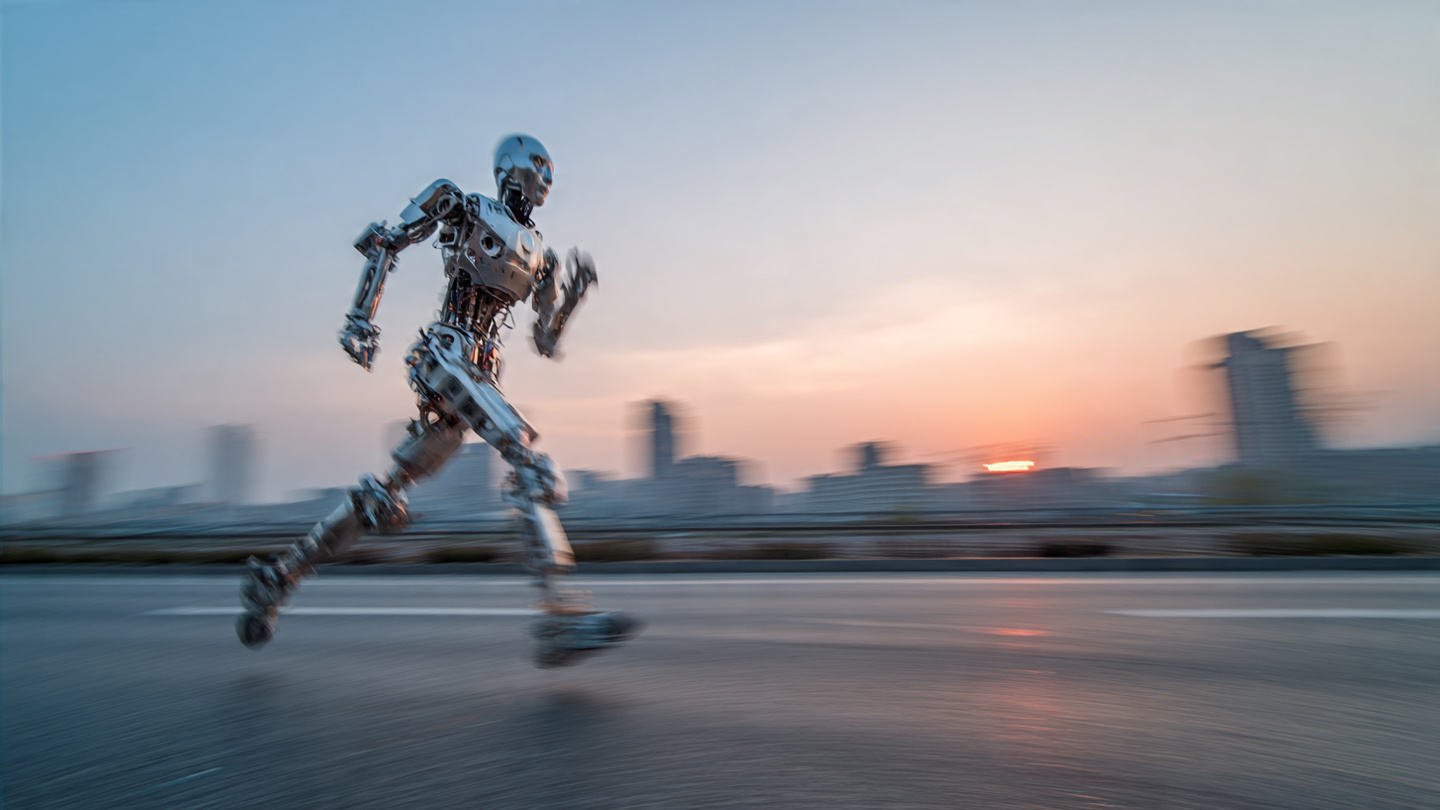
One hundred minutes. That is how much faster the 2026 Beijing E-Town Half Marathon's winning humanoid robot finished compared to the 2025 champion, a gap so large it nearly defies analogy in competitive athletics. Honor's Lightning robot crossed the finish line in 50 minutes and 26 seconds, running autonomously at an average pace of 3:50 per mile. Jacob Kiplimo's human world record, set in Lisbon in 2021, is 57:20. The machine beat the fastest human who ever lived by nearly seven minutes.
Last year's winner, a remote-controlled robot called Tiangong Ultra built by the Beijing Innovation Center of Humanoid Robotics, finished in 2 hours, 40 minutes, and 42 seconds. Only 6 of 21 robots completed the course, and every single one of them was remote-controlled, tethered to a human operator somewhere offscreen.
Twelve months later, the field swelled to over 300 entries, approximately 120 of which finished, with 40% running autonomously, meaning no human operator was guiding them in real time. Honor swept the top six positions despite having been building robots for roughly one year.
The Math Nobody Ran
Coverage of the Beijing race focused on the spectacle: robot beats human record. That is a fine headline, and it misses the more important number entirely. What matters is the rate of improvement, and the rate is staggering.
| Metric | 2025 (Tiangong Ultra) | 2026 (Lightning) | Change |
|---|---|---|---|
| Finish time | 2:40:42 | 0:50:26 | -100 min 16 sec |
| Pace (min/mile) | 12:16 | 3:50 | -68.7% |
| Field size | 21 | 300+ | 14× growth |
| Finishers | 6 (29%) | ~120 (40%) | 20× more |
| Autonomous entries | 0 | ~120 (40%) | From zero |
| Control mode (winner) | Remote-controlled | Autonomous | Fully autonomous |
Now compare that to human progress. The men's half-marathon world record sat around 67 minutes in the early 1920s. It took a century to whittle that down to Kiplimo's 57:20, an improvement of roughly 14.4%, or about 0.14% per year. Geoffrey Kamworor held the record at 58:01 as recently as 2019; Kiplimo's improvement over that mark was 1.2% in two years.
Humanoid robots improved their half-marathon pace by 68.7% in a single year. That is 4.8 times the entire century of human improvement, compressed into 12 months. It is not a meaningful athletic comparison in any traditional sense, because the robots are not biological and the 2025 field was the first cohort ever assembled. But as a measure of how fast locomotion engineering is advancing, the number speaks for itself.
A Smartphone Company Did This
Honor was spun off from Huawei in November 2020, a direct consequence of U.S. sanctions that restricted Huawei's access to American semiconductor technology. Mike Kalil traced the geopolitical lineage: sanctions forced the divestiture, Honor became independent, and in 2024 the company announced its Alpha Plan, a $10 billion, five-year investment in an AI device ecosystem. Lightning is one of the first products of that investment.
Lightning stands roughly 5.5 feet tall. It navigates via LiDAR, has no head or eyes in the conventional sense, uses liquid cooling to manage thermal loads during sustained running, and has 95-centimeter legs optimized for stride length. Honor also entered a remote-controlled variant that finished in 48:19, nearly two minutes faster than the autonomous Lightning, establishing that the locomotion hardware is capable of even more speed when freed from the computational overhead of autonomous navigation.
This is a company that made smartphones a year ago. Not Boston Dynamics, which spent three decades refining bipedal locomotion. Not Agility Robotics, backed by Amazon's warehouse deployment contracts. A consumer electronics firm that decided to build a humanoid runner and, 12 months later, held the world record, having leapfrogged organizations with collectively over 40 years of robotics expertise.
The Industry Behind Lightning
Honor was not alone. AGIBOT and Unitree have each shipped more than 5,000 humanoid units commercially, according to FoneArena's race coverage. Unitree's 2026 target is 20,000 units. Its G1 humanoid sells for $16,000, roughly the price of a used Honda Civic.
Put the cost and the performance curve together and the picture that emerges looks nothing like traditional robotics R&D, where progress is measured in years of DARPA funding and incremental PhD theses. If a $16,000 humanoid can walk reliably and a $10 billion R&D program can produce a world-record runner in 12 months, the cost-performance trajectory for bipedal locomotion is following something closer to the consumer electronics curve that Honor already knows intimately from smartphones: aggressive cost reduction, rapid iteration cycles measured in quarters rather than decades, and a willingness to ship volume at low margins to build the kind of market share that funds the next generation.
| Company | Origin | Humanoid Focus | Key Metric |
|---|---|---|---|
| Honor | Huawei spinoff (2020) | ~1 year | 50:26 half marathon (autonomous WR) |
| Unitree | Founded 2016 | ~3 years | 5,000+ units shipped, G1 at $16K |
| AGIBOT | Founded 2023 | ~2 years | 5,000+ units shipped |
| Boston Dynamics | Founded 1992 | 30+ years | Atlas industrial humanoid, no consumer sales |
| Agility Robotics | Founded 2015 | ~8 years | Digit warehouse robot, Amazon partnership |
The Strongest Case Against the Hype
Running fast on flat pavement is a solved problem for wheels. A remote-controlled car can lap Lightning without breaking a sweat. Bipedal locomotion on pavement is an engineering demonstration, not a commercially useful capability in isolation. Factories need robots that manipulate objects, navigate unstructured environments, and handle the unexpected variance of human workspaces. Lightning has no hands and no head. It was built for one task and it won that task convincingly, but the 68.7% pace improvement tells you almost nothing about whether humanoid robots are getting closer to doing useful work in a warehouse.
The 2025 comparison also flatters 2026 performance. Last year was the inaugural event, with 21 entries from a handful of research labs, no commercial entrants, and zero autonomous participants. Comparing Lightning to Tiangong Ultra is like comparing a 2024 Tesla to a 1908 Model T and marveling at the improvement rate. Both the technology and the competitive infrastructure were essentially nonexistent a year ago. A 68.7% improvement from a near-standing start is not the same as 68.7% improvement from an optimized baseline.
Defenders of the hype would counter that the speed itself is less important than what it reveals about the maturity of bipedal control systems: a robot that can sustain 3:50 miles for 50 minutes without falling has solved dynamic balance, thermal management, and terrain adaptation at a level that no humanoid exhibited 18 months ago. Lightning crashed into a barricade in the final stretch and still won by a massive margin, which demonstrates both the fragility of its navigation system and the dominance of its locomotion. The question is whether that locomotion generalizes to tasks that generate revenue, and the answer is not yet clear.
What This Analysis Does Not Prove
Race organizers self-reported the autonomous status of Lightning; no independent verification exists. Honor has not published Lightning's battery capacity, motor torque, total energy consumption, or per-unit cost. Our pace improvement calculation compares the first-ever humanoid half marathon to its second edition, which means we are measuring industry maturation more than individual engineering progress. The human world record comparison spans eras with fundamentally different training science, nutrition, and shoe technology, making the 4.8x multiplier illustrative rather than precise. We do not know whether Honor's $10 billion Alpha Plan budget is representative of Lightning's actual development cost, and Unitree's $16,000 G1 is a general-purpose platform, not a running-optimized one, so direct cost comparisons between the two are misleading. Forty percent autonomy in the 2026 field is an organizer-reported estimate, not an independently verified count.
The Bottom Line
If you work in warehouse logistics or manufacturing and you have been told humanoid robots are five to ten years away from your floor, recalibrate. A smartphone company with one year of robotics experience just built a bipedal machine that outruns every human alive over 13.1 miles. Unitree is shipping 5,000 units at $16,000 each. The field grew 14x in 12 months, and nearly half the entrants ran without a human operator. None of this means a humanoid will be stacking your pallets in 2027, but the pace of locomotion progress makes "five to ten years" look like an estimate borrowed from 2024 and not updated since. If you are evaluating automation vendors, ask them what their bipedal locomotion benchmarks looked like a year ago, and compare. The rate of change is the signal, not the absolute performance, and right now the rate is 68.7% per year.
Sources
- Smithsonian Magazine / AP (April 2026). "A Humanoid Robot Just Beat the Human World Record for the Fastest Half-Marathon During a Race in China." Smithsonian
- iRunFar (April 2026). 2026 Beijing E-Town Half Marathon race analysis: Lightning 3:50/mi pace, Tiangong Ultra 2:40:42 in 2025, autonomous vs remote-controlled scoring. iRunFar
- FoneArena (April 2026). Honor swept top 6, remote-controlled variant 48:19, AGIBOT and Unitree 5,000+ units each. FoneArena
- Mike Kalil (April 2026). Honor Lightning origin story: Huawei sanctions, spinoff, Alpha Plan $10B, LiDAR navigation, liquid cooling, 95cm legs. mikekalil.com
- Assembly Magazine (2025). Tiangong Ultra completes first humanoid half marathon in 2:40:42, 6 of 21 finishers, all remote-controlled. Assembly Magazine