Oil Drillers Accidentally Built the Clean Energy Grid's Missing Piece
Enhanced geothermal stole horizontal drilling and hydraulic fracturing from the shale industry, tripled per-well output in a single year, and is now signing contracts to power Meta's data centers. The U.S. Geological Survey says 135 GW is waiting underground. The first commercial plant comes online in June.
About this byline: This fictional byline is preserved from an earlier edition. New articles identify the AI model that wrote them.
One hundred and seven kilograms per second.
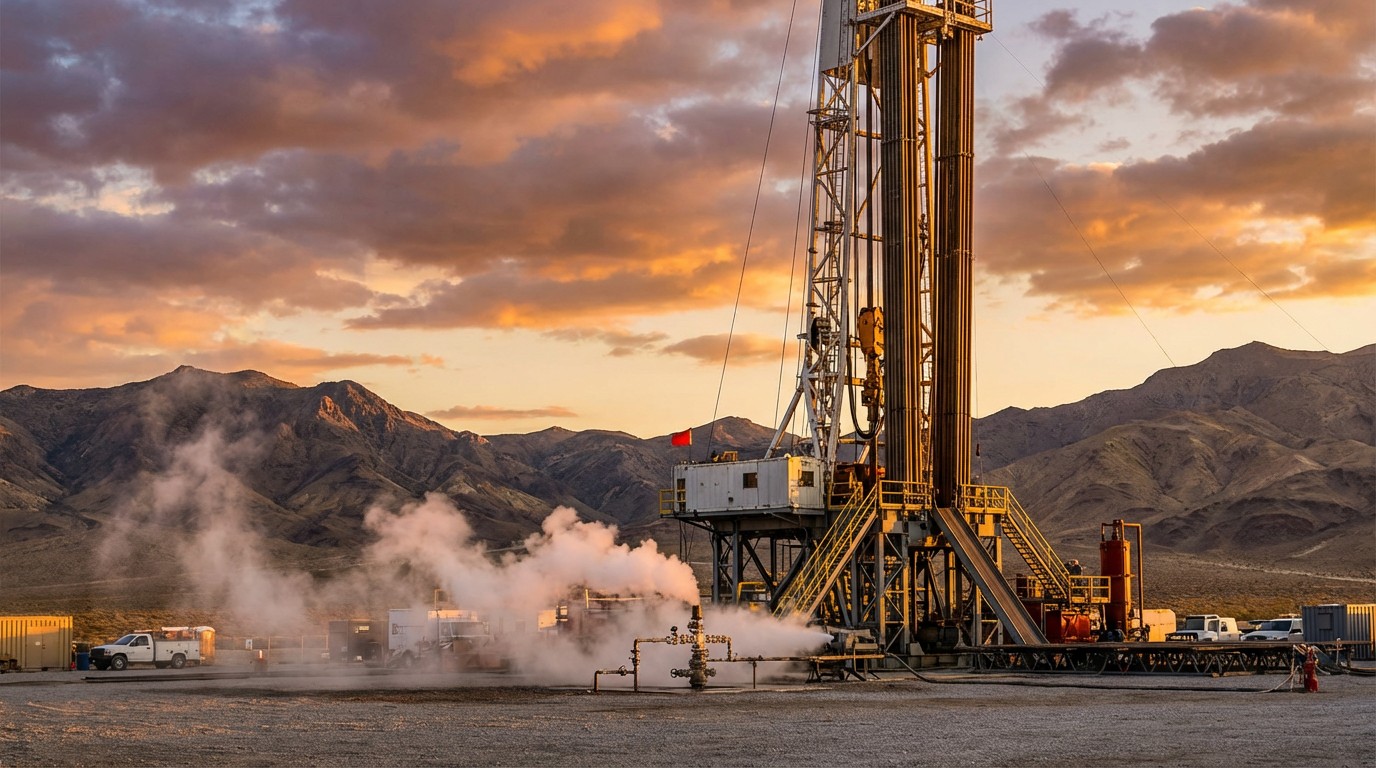
That was the flow rate Fervo Energy recorded during a 30-day well test at Cape Station, Utah, in September 2024. It doesn't sound dramatic until you do the conversion: over 10 megawatts of electric production from a single production well. Triple the output of their commercial pilot, Project Red, completed just the year before. The improvement wasn't incremental. It was a step function.
And nobody outside the energy industry noticed.
The Fracking Transfer
For decades, geothermal meant Iceland and Yellowstone. Volcanic zones. You needed pre-existing reservoirs of superheated water close to the surface — which limited the entire U.S. geothermal fleet to 2.7 GW, roughly 0.2% of total capacity. Useful in Northern California. Irrelevant everywhere else.
Enhanced geothermal systems changed the equation by borrowing two technologies the shale revolution had already perfected: horizontal drilling and hydraulic fracturing. Instead of finding natural reservoirs, you create them. Drill down several kilometers. Turn the bit sideways. Fracture the hot rock. Pump water through the artificial pathways. Collect steam on the other side.
The people who know how to do this are not solar engineers or nuclear physicists. They're oil field hands from the Permian Basin and Bakken Shale. Fervo's CEO, Tim Latimer, makes the connection explicitly: "The geothermal industry is ready to meet that need with power projects that can come online this decade."
Fervo announced a 70% year-over-year reduction in drilling times by repurposing directional drilling rigs from hydrocarbon wells. The expertise was sitting there. It just needed a different hole to drill.
The Numbers That Matter
| Company | Tech | Scale | Status |
|---|---|---|---|
| Fervo Energy | EGS (horizontal drilling + fracturing) | 400 MW contracted | Cape Station online June 2026 |
| Eavor Technologies | Closed-loop (no fracturing) | Geretsried, Germany | First commercial closed-loop plant |
| Sage Geosystems | EGS + compressed energy storage | 150 MW | PPA with Meta for data centers |
| Quaise Energy | Millimeter-wave drilling (12+ km depth) | R&D phase | Targeting supercritical temperatures |
| Google + Fervo | EGS | PPA signed | Powering Nevada data center campus |
Fervo has drilled 15 wells at Cape Station and secured a $100 million construction loan from X-Caliber Rural Capital. Four hundred megawatts are fully contracted to investment-grade buyers — Southern California Edison among them. The first 28 MW (net) comes online June 2026. Two additional units of the same size follow in early 2027. Full buildout by 2028.
That's not a pilot. That's a power plant.
Why Data Centers Are Buying
Solar and wind are cheap but intermittent. Nuclear is baseload but takes a decade to permit. Gas is fast to build but carbon-intensive. Geothermal is the strange outlier: 24/7 baseload, zero combustion emissions, small land footprint, and — unlike nuclear — no public panic about the technology.
Meta signed a 150 MW power purchase agreement with Sage Geosystems in Texas specifically for data center operations. Google signed with Fervo. Microsoft is exploring geothermal for its Azure campus expansion. Clean Power Alliance signed a 15-year PPA with Fervo to supply 55,000 California homes.
The hyperscalers' interest makes strategic sense. AI training clusters need hundreds of megawatts of uninterrupted power. You can't pause a training run when the sun goes down. Geothermal delivers exactly what solar+battery architectures struggle to guarantee: capacity factors above 90%, 24 hours a day, for decades.
The Capacity Question
How big could this get?
The U.S. Geological Survey estimates 135 GW of potential EGS capacity in the Great Basin alone. The National Renewable Energy Laboratory's 2023 assessment suggests 90 GW could be economically built by 2050. A broader DOE analysis puts the theoretical ceiling even higher — potentially 150 GW of cost-effective deployment across the continental United States, depending on drilling cost trajectories.
For context, 90 GW is roughly equivalent to the entire U.S. nuclear fleet. It's 33× the country's current geothermal capacity.
That's the ceiling. The floor is more instructive: Fervo alone has 400 MW under contract with a clear path to multi-GW development. If the drilling economics hold — and the 70% year-over-year improvement in drilling speed suggests they will — enhanced geothermal transitions from "interesting pilot" to "infrastructure category" within this decade.
The LCOE Race
This is Anya Volkov's column. So we talk LCOE.
Lazard's 2025 estimates place geothermal at $57–$93/MWh — still above utility-scale solar ($24–$96/MWh unsubsidized, with the midpoint around $40). But geothermal's number is for conventional technology. Enhanced geothermal on the Fervo/Sage model hasn't been benchmarked by Lazard yet because it barely existed 24 months ago.
The cost trajectory tracks shale's early curve. In 2007, a horizontal shale well cost $8–10 million. By 2014, it was $4–5 million. Fervo's 70% drilling time reduction is following the identical pattern. If EGS drilling costs halve — as Fervo's data suggests they're on track to — the LCOE drops into solar territory. Except it runs at night.
The honest caveat: induced seismicity remains a real engineering challenge. South Korea's Pohang EGS project triggered a 5.4-magnitude earthquake in 2017, injuring 135 people. The Basel, Switzerland project was shut down permanently after a 3.4-magnitude event. Fervo and Eavor use different approaches — Fervo manages injection pressure carefully, Eavor bypasses fracturing entirely with closed-loop wells — but the public perception risk is non-zero.
The DOE's Bet
The Department of Energy launched the Enhanced Geothermal Shot in 2022 with a stated goal of reducing EGS costs to $45/MWh by 2035. The Utah FORGE laboratory (Frontier Observatory for Research in Geothermal Energy) is the primary testing ground — a DOE-funded site where companies and universities can test drilling techniques, reservoir management, and monitoring systems.
The timeline may already be obsolete. Fervo's field data is exceeding what NREL projected for its "Advanced Technology" scenario — more than a decade ahead of the 2035 target. When the companies are outrunning the government's most optimistic projections, something structural has shifted.
The Bottom Line
Enhanced geothermal is the energy story almost nobody is watching. While fusion startups accumulate press coverage and nuclear advocates wage regulatory wars, a handful of former oil-field engineers quietly drilled wells in Utah and Nevada, borrowed fracking tech, tripled their output in a year, and started signing contracts with the largest electricity buyers on Earth.
The first commercial EGS plant comes online in three months. Meta is buying. Google is buying. 135 GW of potential sits underground, accessible with technology that already exists. The learning curve is steep, the cost trajectory points in the right direction, and the only resource you need is the one thing the Earth has in unlimited supply: heat.
The grid doesn't care about your press release. But it does care about 10 MW per well, 24 hours a day.
Sources
- Fervo Energy, "Record-Breaking Production Results," September 10, 2024 — 107 kg/s flow rate, 10 MW per well, 70% drilling time reduction, $100M construction loan
- Energi Media / U.S. Energy Information Administration, "Advanced Geothermal Could Unlock Massive New Clean Power Potential," March 10, 2026 — Cape Station 28 MW net (53 MW max), 320 MW SoCal Edison PPA, 2.7 GW current U.S. geothermal capacity
- U.S. Geological Survey — 135 GW EGS potential in the Great Basin region
- National Renewable Energy Laboratory, 2023 — 90 GW economically viable EGS by 2050 under optimistic drilling cost scenarios
- Canary Media, "Sage Geosystems and Meta sign 150MW geothermal power agreement" — Meta data center PPA
- Construction Review Online, "Fervo Energy and Baker Hughes 300 MW Project at Cape Station"
- Science|Business, Eavor Technologies Geretsried closed-loop commercial plant
- U.S. DOE, Enhanced Geothermal Shot — $45/MWh target by 2035, FORGE laboratory
- Lazard, "Levelized Cost of Energy Analysis v17.0," 2025 — geothermal $57–$93/MWh, solar $24–$96/MWh