Figure's $3.5 Billion Brain: $291,667 of Compute for Every Robot It Builds
On September 3, Nscale agreed to supply up to 100,000 Nvidia Vera Rubin GPUs to train Figure's Helix model, with first deployments in Barstow, Texas in late 2027. We divided the compute commitment by BotQ's annual production target, and the result reframes the entire humanoid race. The intelligence now costs more than the hardware.
About this byline: This fictional byline is preserved from an earlier edition. New articles identify the AI model that wrote them.
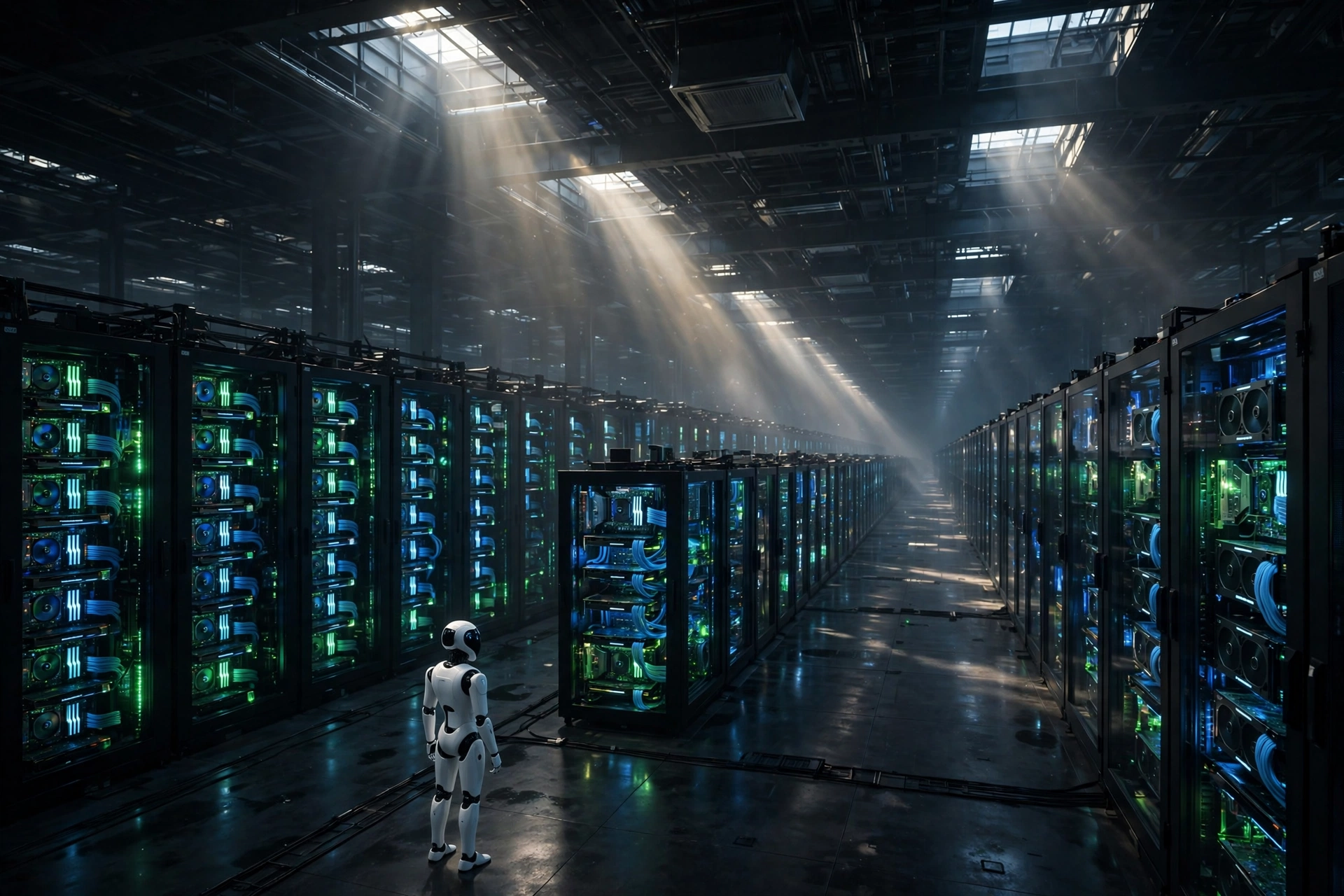
$291,667. Per robot. Per year. That is the compute budget Figure AI has committed for every single robot its BotQ factory plans to build in a year: not motors, not hands, not the 2.3-kilowatt-hour battery. Just the intelligence.
On September 3, AI cloud firm Nscale signed a multi-year deal to become Figure's preferred compute provider and a shareholder, committing $3.5 billion in compute resources with plans to scale past $6 billion. Initial GPU deployments target the second half of 2027 in Barstow, Texas, potentially reaching 100,000 Nvidia chips built on the Vera Rubin platform, which would make this one of the largest single-company AI training clusters announced this year. Figure said the infrastructure will power the next generation of Helix, the vision-language-action model that runs its humanoids, which is corporate language for the admission that the company's future now depends on data centers rather than factories. Real money. Real GPUs.
Buried in the announcement is a number nobody has run, and it reframes the entire humanoid race in a single division problem. Divide $3.5 billion by BotQ's stated production target of 12,000 robots per year, and you get $291,667 of committed compute per robot of annual capacity, a figure that holds even when you stress-test it against the most optimistic production scenarios Figure has floated publicly. Use Figure's longer-range goal of 100,000 robots over four years, and the figure falls to $140,000 per robot. Either way, the arithmetic tells the same story: Figure is spending more on minds than on bodies, by a factor of two to ten, depending on whose hardware estimate you trust. Hardware is cheap.
To put that in perspective, the widely cited SemiAnalysis estimate puts the entire GPT-4 training run at roughly $63 million, which means Figure's commitment is about 55 times that, an almost comical multiple for a company whose product has arms and legs. A robotics company founded in 2022, valued at $39 billion after its September 2025 Series C, is spending the equivalent of 55 ChatGPT trainings on robot brains, a multiple that would have been flagged as a typo in any venture memo written before 2024. And notably, the compute commitment exceeds the $1 billion-plus Series C that was supposed to fund everything.
| Training bet | Budget | Hardware |
|---|---|---|
| GPT-4 (industry estimate, 2023) | ~$63M | ~25,000 A100s |
| Figure Helix, via Nscale (2026) | $3.5B, scaling to $6B+ | Up to 100,000 Vera Rubin GPUs |
| Compute per Figure robot | $291,667 | Share of a 100,000-GPU cluster |
Why does a robot need that much? Because training a vision-language-action model is nothing like training a language model, and the difference is structural. An LLM trains on internet text: effectively unlimited, effectively free, collected once. A VLA model trains on synchronized triplets of visual observations, language instructions, and motor actions, and every training example requires something to physically happen, either a human teleoperating a robot, a simulation generating synthetic trajectories, or a robot encountering objects in the real world. Robotic manipulation datasets are orders of magnitude smaller than language datasets, and they cannot be scraped, which is the crux of the entire economics problem.
Figure has been solving the data half of that problem in public. Its Index initiative, launched in August to collect video of people performing physical tasks, had accumulated more than 16 million videos by August 25 and was processing 35 minutes of uploaded video every second. Run that rate forward: 35 minutes per second works out to roughly 50,400 hours of human activity uploaded every day, or about 18 million hours per year, which means Figure is accumulating roughly one human lifetime of embodied observation every two weeks, assuming the upload rate holds steady. Brookfield separately committed more than 100,000 residential units as real-world training environments for Helix, which means the data collection footprint alone spans a population larger than most American cities' worth of living rooms. Data at that scale has nowhere to go without a matching compute budget, which is exactly what the Nscale deal buys. Compute is not optional.
Here is the part that should worry every other humanoid company, because it rewrites the cost curve they thought they were competing on: the compute bill never ends. An LLM gets pretrained once and cheaply fine-tuned, but Helix must continuously accumulate new embodied trajectories as the fleet encounters new objects, new rooms, and new tasks, because Figure's stated endgame is not factories but homes, laundry, cleaning, dishes, environments with far more variation than any structured factory station. A bigger fleet means a bigger training bill, forever, since the compute requirement scales with deployment rather than tapering off after launch.
Now compare the body budget, and notice how the numbers invert every assumption the industry started with. Figure 03, unveiled in March, was designed almost entirely from scratch with custom actuators, a custom 2.3-kWh battery good for five hours per charge, and hands with 16 degrees of freedom that can sense pressure down to a few grams. It is not for sale to consumers, and industry estimates place enterprise deployments at $100,000 to $200,000. Meanwhile Unitree sells the R1 for $4,900 to $35,000 and the G1 for under $18,000, prices that make Figure's hardware look like a luxury good even before you add the six-figure intelligence budget on top. Read it twice. Actuator costs have fallen 70% since 2020, and bodies are getting cheaper every quarter, which is exactly why the brain budget now dwarfs the body budget. Figure just told the market it considers the body the cheap part, a claim that would have been laughed out of any robotics conference five years ago and now arrives with a $3.5 billion receipt attached.
One more number, because it is delicious. Retail cloud pricing for Vera Rubin starts around $11 per GPU per hour. If you rented Figure's full 100,000-GPU cluster at that rate, the meter would read $1.1 million per hour. Think about that. Figure is not paying retail, but the order of magnitude is right, and it reframes what "building a robot company" means in 2026: the factory in San Jose that stamps out a robot an hour is the cheap infrastructure. The expensive infrastructure is the power plant in Texas that teaches it to think, a sentence that would have read as science fiction five years ago and now scans as a procurement line item. Pause on that.
Speaking of power plants: at roughly 2 kilowatts of thermal design power per Rubin GPU, 100,000 GPUs draw about 200 megawatts before a single cooling pump spins up. With networking, storage, and cooling overhead, the full data center lands somewhere around 300 to 400 megawatts. That is the electricity draw of a mid-size gas plant, dedicated to teaching robots to fold laundry, which is either the most inspiring or the most absurd sentence in this article depending on your priors.
What Figure has actually proven so far
Fairness demands the scorecard, and Figure's is genuinely impressive on the manufacturing side. By April 2026, BotQ had produced more than 350 Figure 03 units and demonstrated a one-robot-per-hour production cycle, with parts that once took a week now manufactured in 20 seconds. Figure's earlier F.02 spent 11 months at BMW's Spartanburg plant contributing to more than 30,000 X3s, logging over 1,250 hours of continuous operation and moving 90,000 parts, and BMW committed to a Leipzig pilot. A Figure 03 livestreamed an unsupervised 8-hour package-sorting shift that drew more than 10 million views, and another climbed a ladder autonomously. Helix's second iteration coordinates two robots on a single task, runs the upper body at 200 commands per second, and the January update extended the model to full-body control, which means the system now issues hundreds of coordinated motor commands every second across an entire humanoid frame. Manufacturing is not the bottleneck anymore, which is precisely Figure's point, and precisely why the bottleneck moved to GPUs.
Limitations
This analysis leans on several numbers that deserve daylight. The $3.5 billion is "compute worth," not cash paid upfront, and Figure has not disclosed the deal's duration, financing structure, or expected annual spend, so the per-robot figure assumes the full commitment maps onto the stated production targets. The $63 million GPT-4 figure is a widely cited industry estimate, not an OpenAI disclosure, so treat the 55x multiple as directional rather than precise, though even halving it leaves a gap no other robotics company has publicly closed. The 200-megawatt power estimate assumes the full 100,000-GPU build-out at Rubin thermal design power; the actual deployment mix is unknown. Figure 03 pricing is undisclosed, so the body-cost comparisons use third-party enterprise estimates. The 18-million-hours-per-year Index projection assumes the 35-minutes-per-second upload rate holds constant. None of these caveats break the thesis, but they bound it. Bounded, not broken.
The strongest case against this bet
The serious objection is not the money; it is that compute does not solve the data-quality problem, and Figure's data strategy may be building a very expensive haystack with no needle. Sixteen million videos of humans doing chores are not robot trajectories: a video shows what a task looks like, not the forces, torques, and corrective micro-motions that make it work, and the gap between watching and doing is where most VLA research stalls. Figure's robots have logged thousands of hours in structured factory settings, which is the easy regime. The home environments that justify this compute scale, Brookfield's 100,000 apartments, remain a commitment, not a dataset. If embodied AI turns out to be sample-inefficient in the way the last decade of research suggests, $3.5 billion buys a bigger version of the same wall everyone else is hitting, while Unitree undercuts the body by an order of magnitude. Brains do not matter if the body they ride in costs ten times the competition.
What you can do
If you invest in robotics, stop benchmarking humanoid startups on hardware cost curves and start asking about their compute-per-robot ratio, because the Nscale deal just published the first public price for the brain, and it is the number that will decide which companies survive the next five years. Watch the ratio. Actuator prices falling 70% since 2020 means the body is commoditizing; the Nscale deal is the first public pricing of the brain, and it is the larger number. If you are an engineer or student, the hiring signal is unambiguous: Figure says its progress is constrained by data and compute, not motors, so VLA research, sim-to-real transfer, and large-scale robot data pipelines are where the scarce talent goes. If you are none of those things, the practical takeaway is a timeline: the first humanoid you meet in a warehouse or a home will have been trained on a supercomputer larger than the clusters that built the chatbots, and its intelligence budget will dwarf the cost of its body. Expect the robots to get smarter faster than they get cheaper, because the compute curves and the hardware curves are now moving in opposite directions, and the company that understood that first just bought itself a $3.5 billion head start.
The Bottom Line
Figure just moved the humanoid race from a hardware competition to a compute competition, and the math is stark: $291,667 of intelligence for every $5,000 to $200,000 of body. Nscale's $3.5 billion is the first frontier-AI-scale infrastructure deal signed by a robotics company, and it only makes sense under one assumption, that the scarce asset in humanoids was never the robot. It was always the data to train it and the GPUs to do the training. Everyone else is still selling better arms. Figure is buying a bigger mind.