The Ocean Floor Has Enough Battery Minerals to Replace Every Car on Earth 5 Times Over. The Race to Mine It Just Went Live.
21 billion tons of polymetallic nodules sit on the floor of the Pacific. The US just signed an executive order to start mining them. China holds 5 exploration contracts. 32 countries want a moratorium. And scientists recently discovered the nodules might produce oxygen in total darkness.
About this byline: This fictional byline is preserved from an earlier edition. New articles identify the AI model that wrote them.
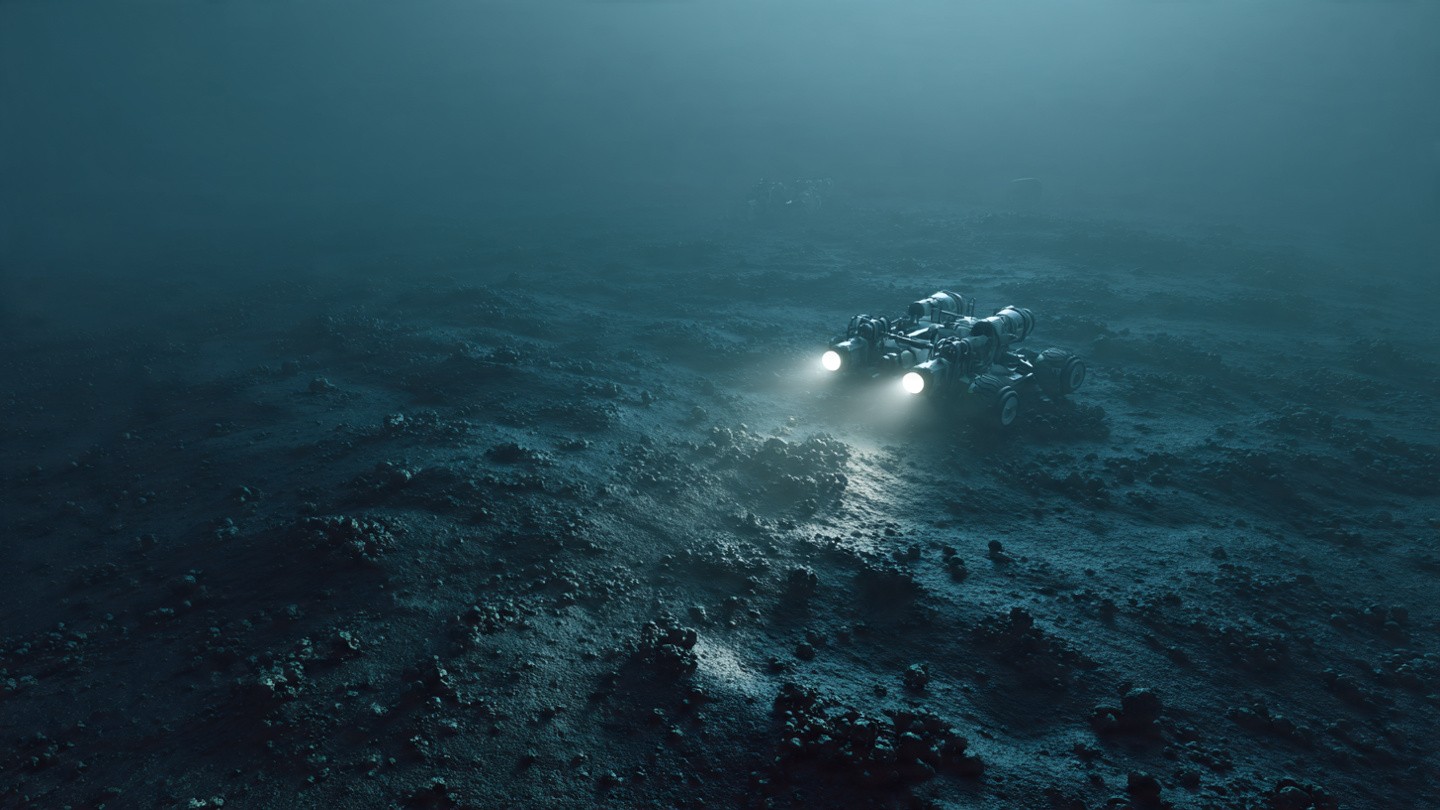
21 billion metric tons.
That is how much polymetallic nodule material sits on the floor of the Clarion-Clipperton Zone, a 4.5-million-square-kilometer stretch of abyssal plain between Hawaii and Mexico, roughly the size of the European Union. Potato-sized rocks formed over millions of years, the nodules contain approximately 273 million tons of nickel, 42 million tons of cobalt, 231 million tons of copper, and 5.67 billion tons of manganese. Those four metals are the backbone of the global energy transition. And in April 2025, the United States signed an executive order to start extracting them.
China already holds 5 exploration contracts in the zone. Russia holds contracts. South Korea, France, Germany, and the United Kingdom hold contracts. A total of 31 exploration licenses have been granted by the International Seabed Authority, 19 of them for CCZ nodules specifically. But nobody is mining yet, because the ISA has not finalized its mining code, and the most powerful country on Earth just decided it does not need to wait.
The Numbers That Matter
The math turns this from a geology curiosity into a geopolitical crisis. A modern NMC 811 EV battery (75 kWh) requires approximately 40 kg of nickel and 5 kg of cobalt. CCZ nickel alone could supply roughly 6.8 billion battery packs. Its cobalt could supply about 8.4 billion. Roughly 1.4 billion vehicles make up the global automobile fleet.
Run the division: CCZ nickel alone could electrify every car on Earth about 4.9 times over. CCZ cobalt, about 6 times. Even at a conservative 10% recovery rate, you get enough minerals for 680 million EVs, roughly half the world's current fleet.
| Metal | CCZ Estimate | Global Land Reserves | CCZ Multiple | Years of Current Production |
|---|---|---|---|---|
| Nickel | 273M tons | 130M tons | 2.1x | 76 years |
| Cobalt | 42M tons | 11M tons | 3.8x | 190 years |
| Copper | 231M tons | 1,000M tons | 0.23x | 9 years |
| Manganese | 5,670M tons | 1,700M tons | 3.3x | 283 years |
Sources: CCZ metal content from USGS Mineral Commodity Summaries 2024 and ISA geological survey averages. Land reserves from USGS. Production figures: nickel 3.6M tons/year, cobalt 220,000 tons/year, copper 24.9M tons/year, manganese 20M tons/year.
Copper is the outlier. Land-based copper reserves dwarf the CCZ. For nickel, cobalt, and manganese, the ocean floor holds multiples of everything currently accessible on land. That is not a minor detail for countries whose EV ambitions depend on importing these metals from a handful of producers, primarily Indonesia (nickel), the Democratic Republic of Congo (cobalt), and South Africa (manganese).
Who Holds What
The International Seabed Authority, headquartered in Kingston, Jamaica, governs mineral resources in international waters under UNCLOS. A total of 31 exploration licenses have been issued, each covering 75,000 square kilometers.
China is the most aggressive player. Beijing holds 5 exploration contracts in the CCZ through state-sponsored entities and signed a bilateral deep-sea mining partnership with the Cook Islands in 2025. Russia holds contracts dating to the 1990s. South Korea, Germany, France, the UK, and several Pacific island states also hold licenses.
Then there is the United States. Washington never ratified UNCLOS. It cannot hold ISA contracts. Instead, the Trump administration issued an executive order in April 2025 directing NOAA to expedite permits under the Deep Seabed Hard Minerals Resources Act of 1980, a domestic law that predates UNCLOS. It explicitly covers both US territorial waters and international areas. Washington is building a legal framework to mine outside the ISA system entirely.
The Regulatory Vacuum
In June 2021, Nauru triggered the ISA's "two-year rule" on behalf of The Metals Company (TMC), requiring the ISA to finalize its Mining Code by July 2023. That deadline passed without a framework. As of March 2026, negotiations continue, with the next session scheduled for July 2026. Key disputes: royalty rates, environmental impact standards, benefit-sharing with developing nations, and liability for environmental damage. Meanwhile, 32 countries have called for a moratorium or precautionary pause, and Norway postponed its own deep-sea mining program by four years in December 2025.
Supply chains are not waiting. On March 29, 2026, Glomar and Cobalt Blue announced plans for the first US-based deep-sea mineral processing facility. Infrastructure for an industry that lacks permission to operate commercially.
The Environmental Calculation Nobody Wants to Make
Every battery mineral comes at an environmental cost. Which cost is acceptable? Compare the per-ton numbers for nickel, the bottleneck metal for EV batteries:
| Impact Metric | Indonesian Laterite Mining | CCZ Nodule Mining (est.) |
|---|---|---|
| Land/seabed disturbed per 1,000 tons Ni | ~2.5 hectares rainforest | ~7,500 m² abyssal plain |
| CO&sub2; per ton Ni | ~35 tons | ~6 tons (ship fuel) |
| Acid drainage risk | High | None |
| Habitat recovery time | Decades | Centuries to millennia |
| Species catalogued | Well-documented | <10% of CCZ species identified |
The CO2 comparison is striking: roughly 83% less carbon per ton of nickel from nodule mining versus Indonesian laterite processing, mainly because laterite mining requires extensive smelting. No acid mine drainage. No deforestation. On paper, the environmental case for deep-sea mining looks strong.
But the recovery time column tells a different story. Terrestrial habitats recover in decades. At 4,000 to 6,000 meters depth, the abyssal plain operates on geological timescales. A 2020 study revisiting the site of a 1989 experimental disturbance in the CCZ found that fauna had not recovered after 26 years. Sediment plumes from collector vehicles extend 4 to 10 kilometers and blanket filter-feeding organisms. ISA scientists have warned that recovery could take centuries.
Dark Oxygen: The Discovery That Changed the Debate
In July 2024, a team led by Andrew Sweetman of the Scottish Association for Marine Science published findings in Nature Geoscience reporting that polymetallic nodules appear to produce oxygen through an electrochemical process in complete darkness, at depths where photosynthesis is impossible. Sweetman's team termed this "dark oxygen," suggesting the nodules function as natural batteries, with their metallic layers generating small voltages that split seawater into hydrogen and oxygen.
If confirmed broadly, this means the objects being targeted for mining are not inert geological deposits. They are active participants in deep-ocean oxygen production. Removing them does not just disturb sediment. It may remove an oxygen source that we did not know existed until two years ago.
Preliminary and under active scientific debate, the finding has already reshaped the political calculus. France cited dark oxygen in its October 2024 call for a mining moratorium. Several Pacific island nations referenced the research in their ISA council statements.
The Strongest Counterargument
The strongest case against deep-sea mining is epistemological. We have catalogued less than 10% of species in the Clarion-Clipperton Zone. We discovered that the nodules produce oxygen in 2024, after decades of studying them. In the history of terrestrial resource extraction, every time humans mined a habitat they poorly understood, they underestimated the damage. Mountaintop removal was supposed to be containable. Deep-well injection was supposed to be safe. Tailings dams were supposed to hold.
Mining the ocean floor to build batteries to fight climate change while potentially destroying an oxygen-producing geological system we barely comprehend is not irony. It is a cost-benefit analysis with one side of the ledger still blank.
Limitations
Metal content percentages vary across the CCZ. This analysis uses averages from multiple geological surveys, but actual concentrations in any given contract area may differ by 20-30%. Our 10% recovery scenario is illustrative, not predictive; TMC estimates 70-80% recovery from its NORI-D contract area, but extrapolating that to the entire CCZ is speculative. LFP batteries (lithium iron phosphate, containing no nickel or cobalt) captured 40% of the global EV battery market in 2025, per Wood Mackenzie, potentially reducing long-term demand for CCZ metals. Sodium-ion batteries represent another cobalt-free alternative gaining traction. Environmental comparison figures use estimates for commercial-scale nodule mining that have not been validated at commercial volumes, since only small-scale test mining has been conducted. Dark oxygen findings are from a single research group and await independent replication.
What You Can Do
If you work in policy or international law: Track the ISA's July 2026 session. If mining code negotiations fail again, the regulatory vacuum widens and unilateral action by the US (and eventually China) becomes the default framework. The Deep Sea Mining Observer publishes session summaries.
If you invest in EV supply chains or battery materials: Watch The Metals Company (NYSE: TMC), the most advanced commercial entrant. Their NORI-D contract area holds an estimated 1.6 billion tons of nodules. Also watch Cobalt Blue (ASX: COB) and Glomar's US processing plans. If the US bypass strategy succeeds, it creates a two-track regulatory world for seabed minerals.
If you care about environmental impact: Push for the dark oxygen replication studies to be funded and completed before any commercial extraction begins. Sweetman et al.'s original paper is open access. IUCN maintains a position tracker on deep-sea mining policy.
If you are buying an EV: Know where your battery metals come from. LFP batteries avoid the nickel-cobalt question entirely. Tesla's base Model 3 and BYD's Blade battery vehicles use LFP cells. Choosing LFP is not a compromise on range for most drivers (current LFP packs deliver 250-300 miles) and it removes your vehicle from the seabed mining demand equation.
The Bottom Line
CCZ contains more nickel than every mine on Earth combined. More cobalt than every known terrestrial deposit by a factor of nearly four. Enough battery minerals to electrify the entire global auto fleet several times over. That resource concentration has turned 4.5 million square kilometers of Pacific abyssal plain into the most contested terrain in the critical minerals race. Washington is building a legal framework outside international governance. Beijing is building one inside it. Thirty-two countries want nobody to mine it at all. And the nodules themselves may be doing something we only discovered two years ago. A race that is live. A rulebook that is not finished. Science that is not settled. And mining infrastructure being built anyway.