5,838 MW of Offshore Wind Was 70% Built. The Government Tried to Kill It. Courts Said No, Five Times.
Federal stop-work orders on five nearly complete Atlantic offshore wind farms burned an estimated $7.5 million per day in delay costs. Every court challenge failed. A cost-of-destruction analysis shows what political sabotage looks like when measured in dollars per megawatt per day.
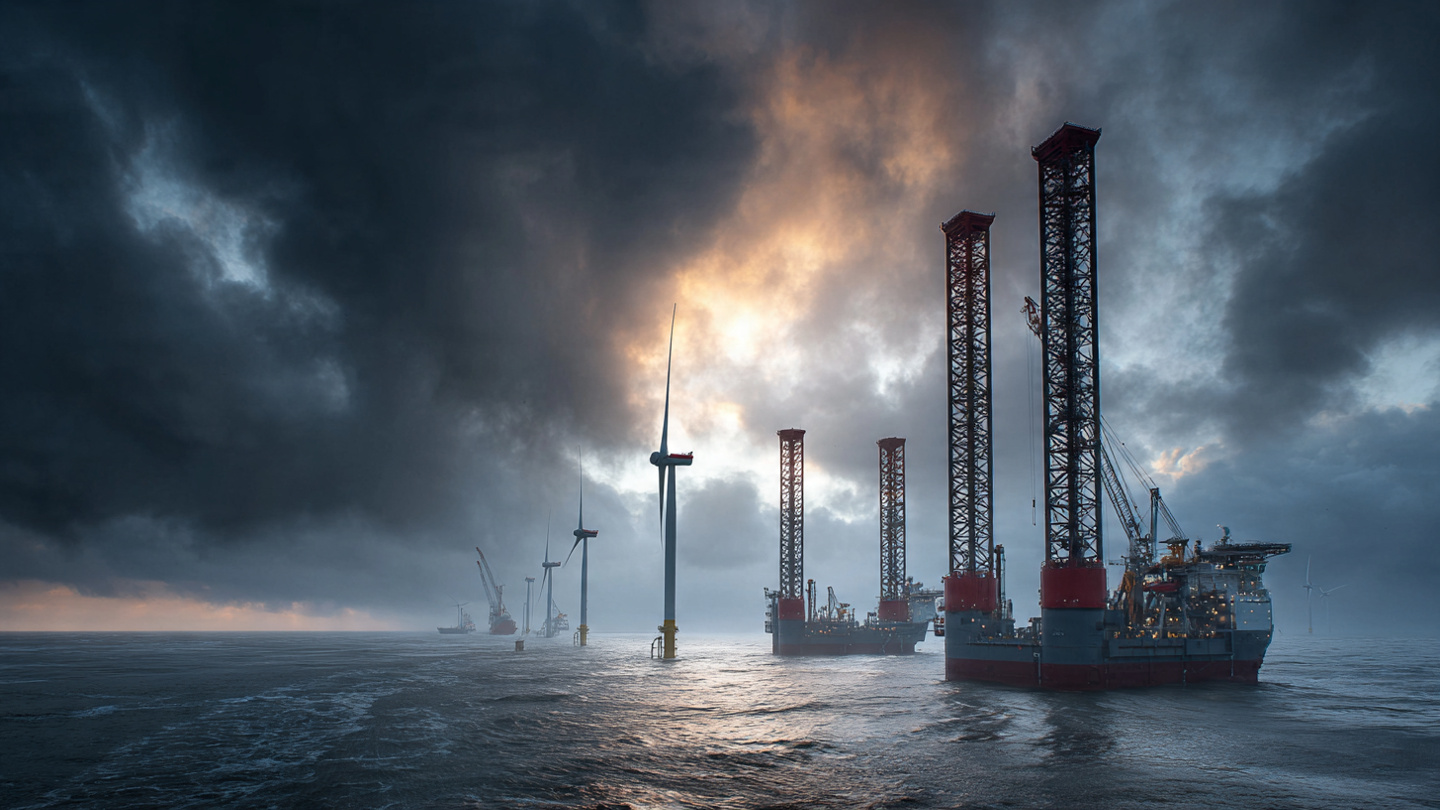
$7.5 million. Every day. For three weeks.
On December 22, 2025, the Department of the Interior issued stop-work orders on five offshore wind projects along the Atlantic Coast. Combined capacity: 5,838 megawatts. Average completion: over 70%. One project had a single turbine left to install. Another was 87% finished. All five had cleared years of environmental review by NOAA, the Department of the Interior, and the Department of Defense before breaking ground.
By late January, federal judges had overturned every single order. Five cases, five losses for the government. But the math had already happened.
What $7.5 Million a Day Looks Like
Dominion Energy's Coastal Virginia Offshore Wind project (CVOW) is the largest of the five: 2,600 MW, 176 Siemens Gamesa SG 14-222 DD turbines, $10.7 billion projected cost. At the time of the order, the project was 50% complete with $8.9 billion already invested. In court filings, Dominion documented delay costs exceeding $5 million per day.
Ørsted's Sunrise Wind (924 MW, 44 of 84 foundations already installed) reported losses above $1 million per day. Empire Wind, Equinor's $6 billion project off Long Island, was 60% complete with $4 billion invested. Revolution Wind was 87% complete. Vineyard Wind 1 had 799 of 800 MW installed, with one turbine remaining.
Here is what the five projects look like together:
| Project | Capacity (MW) | Completion | Invested | Daily Delay Cost |
|---|---|---|---|---|
| CVOW (Dominion) | 2,600 | ~50% | $8.9B | $5.0M (documented) |
| Sunrise Wind (Ørsted) | 924 | ~45% | ~$3B est. | >$1.0M (documented) |
| Empire Wind (Equinor) | 810 | >60% | $4.0B | ~$1.0-2.0M (est.) |
| Revolution Wind (Ørsted/Skyborn) | 704 | 87% | ~$3.5B est. | ~$0.5M (est.) |
| Vineyard Wind 1 | 800 | >99% | ~$4B est. | ~$0.3M (est.) |
| Total | 5,838 | ~70% avg | ~$23.4B | ~$7.5M |
Over the roughly three-week period before courts intervened, the combined delay costs reached an estimated $157 million to $210 million. That money did not build anything. It did not generate a single kilowatt-hour. It paid for idle construction vessels, standing crew contracts, and penalty clauses triggered by missed milestones.
Where the Money Flows When Construction Stops
Connecticut's Department of Energy and Environmental Protection estimated that cancelling Revolution Wind alone would cost New England ratepayers roughly $500 million per year in higher wholesale electricity prices. That figure does not include the sunk construction costs. It represents the delta between wholesale prices with 704 MW of offshore wind on the grid versus without it.
An American Clean Power Association analysis found that removing all five projects would raise wholesale electricity prices during evening peaks and winter storms across 15 states and Washington, D.C. Offshore wind's production profile peaks in winter when demand is highest and solar output is lowest. Removing it forces grid operators to dispatch more expensive gas peaker plants.
CVOW alone was projected to power 660,000 homes, create 2,000 direct and indirect jobs, and generate $2 billion in economic activity. Dominion and Stonepeak had already committed $8.9 billion of the project's $11.2 billion budget. Those dollars do not evaporate if the project is cancelled. Ratepayers absorb them through rate recovery, paying for power they never receive.
An Original Calculation: Cost of Destruction Per Megawatt
Nobody has aggregated the per-MW cost of delay across all five projects. Here is that math.
CVOW's documented $5 million per day across 2,600 MW works out to $1,923 per MW per day of delay. At that rate, three weeks of idled construction costs $40,385 per MW. For context, CVOW's total project cost is $4,115 per MW ($10.7 billion / 2,600 MW). A three-week stop-work order destroyed value equal to roughly 1% of the project's entire capital cost, producing nothing in return.
Scale that across all five projects. At an aggregate daily burn rate of $7.5 million across 5,838 MW, the blended cost of destruction is approximately $1,285 per MW per day. Over 21 days: $26,985 per MW wasted.
Compare that to what this capacity would cost to replace:
| Alternative | Cost per MW | Build Time | Emissions |
|---|---|---|---|
| Combined-cycle gas | ~$1.5M | 3-4 years | Yes (CO2, NOx) |
| Solar + 4-hour storage | ~$3.0-4.0M | 2-3 years | No |
| Nuclear SMRs | ~$8.0-10.0M | 8-12 years | No |
| Offshore wind (these projects) | ~$4.1-4.8M | Already 70% built | No |
Replacing 5,838 MW of offshore wind with nuclear SMRs would cost $47 billion to $58 billion and take at least a decade. With combined-cycle gas, the capital cost would be lower ($8.8 billion) but fuel expenses, carbon pricing exposure, and 20-year total cost of ownership make it substantially more expensive. And critically, none of these alternatives can deliver power by 2027. Most of the five wind projects can.
The Datacenter Paradox
On January 20, 2025, the administration declared a national energy emergency, citing surging electricity demand driven by data centers, AI computing, and cryptocurrency mining. Two days before Christmas, it ordered construction halted on projects that would supply a meaningful fraction of that demand.
Here is the arithmetic. At a 45% capacity factor (consistent with operational data from Block Island Wind Farm and the first 62 turbines of Vineyard Wind 1), 5,838 MW generates approximately 23,015 GWh per year. In 2022, U.S. data centers consumed roughly 200 TWh. By 2026, the International Energy Agency projects that figure will reach 260 TWh, about 6% of total U.S. electricity consumption.
These five offshore wind projects could supply 8.9% of total U.S. datacenter electricity demand. A single hyperscale AI training campus requires 300 to 500 MW of continuous power. CVOW alone, at 2,600 MW nameplate and roughly 1,170 MW average output, could power two to three hyperscale facilities. All five projects together could support five to nine campuses.
For scale: Microsoft's 20-year power purchase agreement to restart Three Mile Island covers 835 MW. Google contracted with Kairos Power for 500 MW of small modular reactors. Amazon invested $20 billion in the Susquehanna nuclear site. None of these deals will produce a single electron before 2028 at the earliest. CVOW was on track for late 2026. Empire Wind and Revolution Wind were targeting 2026-2027. Sunrise Wind expected first power this year.
Five Courtrooms, Five Losses
Between late December 2025 and February 2026, developers filed legal challenges in federal court. Each argued that the stop-work orders exceeded the administration's authority, lacked statutory basis, and would cause irreparable financial harm. Every court agreed, issuing preliminary injunctions or temporary restraining orders.
Judge Carl Nichols found that the Empire Wind halt "lacked a solid foundation" and issued a preliminary injunction. Revolution Wind won a court-ordered restart on January 12. Vineyard Wind resumed almost immediately. Sunrise Wind received its ruling in February, with Ørsted stating it would "restart impacted activities immediately." CVOW, which had partially resumed through legal maneuvering, returned to full construction pace.
Governor Kathy Hochul of New York called the Empire Wind stop-work order based on "bogus" national security justifications. Connecticut's DEEP warned that cancellation would "increase costs for CT and New England ratepayers."
All five projects are now back under construction. No environmental violations were found. No safety incidents were cited. No national security threat was substantiated.
Strongest Counterargument
North Atlantic right whales number approximately 350 individuals. Pile-driving noise from monopile foundation installation can cause behavioral disturbance and, in worst cases, hearing damage in marine mammals. If the stop-work orders were genuinely motivated by whale protection, delaying construction during the winter calving season would have some biological basis. Industry monitoring has documented vessel strike risk and entanglement hazards in construction zones. Environmental groups including the Natural Resources Defense Council have called for stronger protections throughout the offshore wind buildout, not just during politically convenient moments.
But the evidence points away from ecological motivation. All five projects completed multi-year NOAA environmental reviews with marine mammal mitigation protocols: real-time acoustic monitoring, exclusion zones, seasonal construction restrictions, and bubble curtains to attenuate pile-driving noise. Vineyard Wind had one turbine left. Revolution Wind was 87% done. Issuing blanket stop-work orders on five projects simultaneously on December 22, after construction seasons were well underway and billions were spent, is inconsistent with targeted environmental protection.
Limitations
Daily delay costs for Empire Wind, Revolution Wind, and Vineyard Wind are estimated, not documented. Only CVOW ($5M/day) and Sunrise Wind (>$1M/day) appear in public court filings. Actual combined costs could be higher or lower than the $7.5 million aggregate used here. Similarly, only two projects have publicly confirmed investment figures (CVOW: $8.9B, Empire Wind: $4B). The remaining projects' invested amounts are estimates based on their completion percentages and total budgets. Capacity factor assumptions (45%) are based on limited operational data from Block Island and early Vineyard Wind 1 performance. Actual capacity factors for CVOW and the other projects may range from 40% to 50%, shifting the datacenter demand calculation by up to one percentage point in either direction. Grid interconnection timelines are not addressed: connecting 5,838 MW to the Eastern Interconnection requires transmission upgrades that introduce their own delays and costs, independent of the stop-work orders. Consumer cost estimates from ACP and Connecticut DEEP rely on wholesale market modeling with assumptions about gas prices and demand growth that may not hold. Court rulings referenced here are preliminary injunctions and temporary restraining orders, not final adjudications. The underlying legal disputes may still be pending.
The Bottom Line
Five offshore wind projects with $23 billion invested and 5,838 MW of capacity were ordered to stop construction at 70% completion. Federal courts overturned all five orders. Between $157 million and $210 million in delay costs were incurred, producing nothing. These projects could supply nearly 9% of U.S. datacenter electricity demand, the same demand the government cited when declaring an energy emergency. Ratepayers in 15 states and D.C. will absorb every dollar of delay cost through their electricity bills. If the grid does not care about your press release, it cares even less about your stop-work order.