The $30 Billion Fuel Cell Boom Has a 60-Tonne Bottleneck
AI data centers are ditching the electrical grid entirely, driving fuel cell revenues from $2.8 billion to a projected $30 billion by 2030. Virtually every gigawatt-scale contract flows through one company, one ceramic chemistry, and one critical mineral whose global supply totals 60 tonnes per year. China controls most of it.
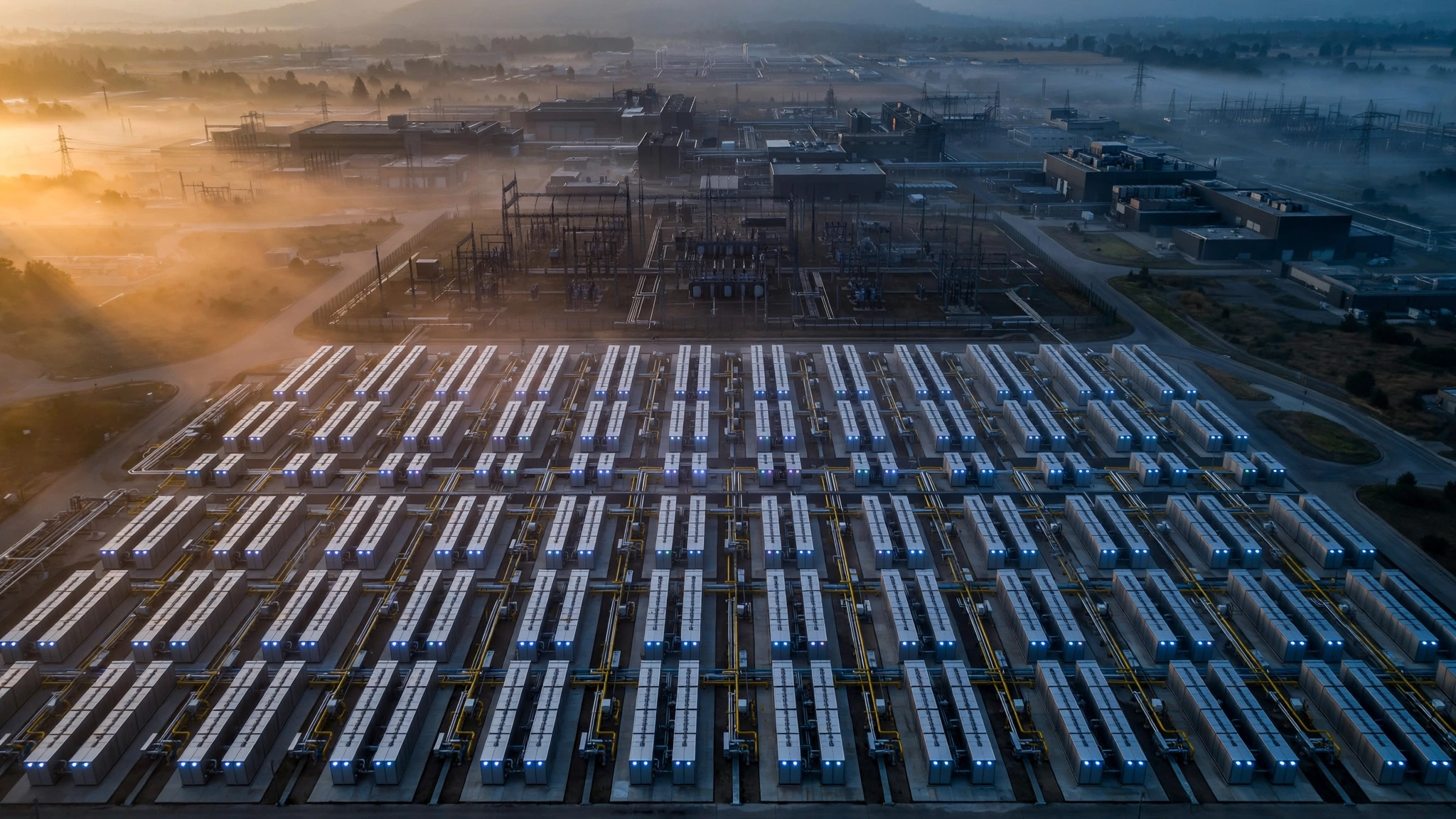
Fifty-five days. That is how long it took Bloom Energy to deliver a fully operational fuel cell system to Oracle, beating the 90-day deployment target by more than a month. In Virginia, the same Oracle would have waited three to six years just for a grid interconnection approval. That gap between 55 days and six years is not an inconvenience. It is a $1.3 billion opportunity cost per 100-megawatt site, and it explains why the fuel cell market is about to undergo the most violent expansion in the history of distributed power.
Rystad Energy projects fuel cell revenue will grow from roughly $2.8 billion in 2025 to around $30 billion by 2030, a 10.7× increase in five years that would make fuel cells the fastest-growing segment in distributed power generation history. Already, the contracted order book stands at approximately 9 gigawatts, with framework agreements spanning Oracle, American Electric Power, Equinix, and Brookfield. But the boom has a structural fragility that nobody in the AI supply chain is talking about: virtually every primary-load solid oxide fuel cell contract in the visible order book belongs to a single vendor, and that vendor’s core technology depends on a mineral whose entire annual global production could fit in a single shipping container.
Why the Grid Lost
Grid interconnection timelines in the United States have tripled since 2015. A large data center requesting 100 megawatts or more now faces a three-to-six-year queue, according to Rystad’s analysis, and the delays are getting worse, not better. GE Vernova’s gas turbine order book is full through 2031. Combined-cycle gas turbine construction costs have surged 66% in two years, reaching $2,157 per kilowatt according to BloombergNEF. More than 70% of interconnection requests are withdrawn before they reach operation, according to Berkeley Lab data.
The bottleneck is not regulatory obstruction but physics: transformers take 18 months to manufacture, high-voltage transmission lines require rights-of-way that traverse multiple jurisdictions, substations need environmental reviews that can consume a year on their own, and every link in the chain has a queue because AI demand is piling on top of electrification, reshoring, and EV charging load simultaneously.
Fuel cells sidestep all of it. Bloom Energy’s solid oxide fuel cell systems arrive as modular cabinets, each producing 300 kilowatts, installed on a concrete pad at the customer’s property: no transmission lines, no substation upgrades, no interconnection queue. Natural gas piped in, electricity generated on-site through an electrochemical reaction at 800°C rather than combustion. The result is lower emissions than grid power (823 pounds of CO2 per megawatt-hour versus the grid average of roughly 1,000 pounds) and a deployment timeline measured in weeks.
The Grid Avoidance Premium: An Original Calculation
The economics of bypassing the grid are not subtle; they are overwhelming. Consider a 100-megawatt AI data center: a mid-sized facility by 2026 standards, hosting roughly 12,000 GPUs at current power densities.
At prevailing GPU-as-a-service rates, a facility of this size generates approximately $300 million per year in cloud computing revenue, a conservative mid-range estimate cross-checked against NVIDIA DGX Cloud pricing and hyperscaler unit economics. If that facility waits 4.5 years for grid interconnection (the midpoint of the current 3–6 year range) instead of deploying fuel cells in 90 days, it defers 4.25 years of revenue. At an 8% discount rate, the net present value of that deferred income is approximately $1.07 billion.
Now suppose fuel cells cost more to operate: $100 per megawatt-hour versus $60 for grid electricity, a $40 premium that many analysts consider generous to the bull case. Annual additional energy cost: 100 MW × 8,760 hours × 0.95 capacity factor × $40 = $33.3 million. Over a 20-year fuel cell operating life, that is $666 million in cumulative extra energy cost before discounting.
| Factor | Grid Connection | On-Site Fuel Cells |
|---|---|---|
| Time to power | 3–6 years | 55–90 days |
| Revenue during delay (100 MW site) | $0 | ~$300M/year |
| NPV of speed advantage (4.25-year delta) | — | ~$1.07 billion |
| 20-year energy cost premium | Baseline | ~$666 million |
| Net economic advantage of fuel cells | — | ~$400 million per site |
The net result: even accepting a significant energy cost markup, fuel cells generate roughly $400 million more value per 100-megawatt site than waiting for grid power, the kind of arithmetic that makes procurement decisions instantaneous and explains why Oracle committed to 2.45 gigawatts at a single campus in New Mexico without blinking.
One Company, One Chemistry, One Mineral
Bloom Energy holds virtually every primary-load SOFC contract in the visible order book. The concentration is remarkable: Oracle (2.8 GW), American Electric Power (1 GW), Equinix (100+ MW across 19 data centers), and a $5 billion partnership with Brookfield. Solid oxide fuel cells account for 53% of cumulative stationary fuel cell deliveries, and Bloom dominates that segment.
But this dependency runs deeper than market share. Bloom’s SOFC technology uses scandium-stabilized zirconia (ScSZ) as its electrolyte, the ceramic layer where oxygen ions migrate during the electrochemical reaction that converts natural gas to electricity. Scandium doping lowers the operating temperature and improves ionic conductivity compared to the more common yttria-stabilized zirconia (YSZ), giving Bloom a meaningful performance advantage.
It also creates an extraordinary supply chain vulnerability. Global scandium production is approximately 60 tonnes per year, a quantity that would fit comfortably in a mid-sized pickup truck. There are no dedicated scandium mines operating at scale. Scandium is recovered as a byproduct of rare earth processing, aluminum refining, and titanium sponge production, overwhelmingly in China, with smaller contributions from the Philippines and Russia. At full utilization of its planned 2-gigawatt manufacturing expansion, Bloom’s theoretical scandium requirement would approach the size of the entire global market, according to Rystad Energy.
Approach is doing heavy lifting in that sentence, because the contracted orders already exceed the planned capacity. Oracle alone has framework agreements for 2.8 GW. Add AEP’s 1 GW. Add Equinix. Add the unnamed customers embedded in Brookfield’s $5 billion commitment. Visible pipeline exceeds 4 GW against 2 GW of planned manufacturing. If even half of those contracts materialize on the aggressive timelines that data center operators demand, scandium requirements could push well beyond 60 tonnes annually, into a supply gap that no existing mine or refinery can close quickly.
China Holds the Chokepoint
Geopolitics makes this worse. The United States is building its AI infrastructure on fuel cells whose critical electrolyte material is controlled by China, a country that has already demonstrated willingness to weaponize critical mineral exports. In December 2023, China restricted gallium and germanium exports; in 2024, it added antimony and graphite. Scandium has not yet appeared on an export restriction list, but the precedent is clear, and the incentive structure is aligned: limiting scandium would slow American AI infrastructure without affecting any Chinese industry of consequence.
New scandium sources exist in development. Scandium International Mining’s Nyngan project in Australia holds significant resources, and European Scandium Metals’s facility in Norway is advancing through pilot stages. But “in development” for a mining project means five to eight years from permitting to production at scale. Five years from now, Bloom’s manufacturing expansion is supposed to be complete and running at full capacity, already consuming the scandium that does not yet have a non-Chinese source at industrial volume.
The Counterargument Stated at Full Strength
The strongest case against concern about this bottleneck goes like this: Bloom can reformulate its electrolyte. Competitors already use yttria-stabilized zirconia, which requires no scandium at all. If scandium supply tightens, Bloom switches chemistry, accepts a modest performance penalty, and the constraint evaporates. Meanwhile, data center operators are hedging their fuel cell bets with gas turbines, nuclear power agreements, and renewable purchase contracts; fuel cells are a bridge, not a foundation, and the bridge only needs to hold for three to five years until grid capacity catches up.
This argument deserves serious engagement because each component is partially true. Bloom could reformulate, but swapping the electrolyte chemistry of a ceramic fuel cell operating at 800°C is not a software update; it affects thermal expansion coefficients, degradation rates, and stack lifetime in ways that require years of qualification testing. Competitors do use YSZ, but they do not hold the contracts or the deployment track record; switching vendors mid-buildout carries its own delays. And grid capacity is expanding, just not fast enough to close the gap before 2030, particularly with GE Vernova’s turbine book full through 2031 and transformer lead times stretching to 18 months.
What the Numbers Actually Show
Rystad projects 10.4 GW of cumulative fuel cell demand from data centers between 2026 and 2030, with around 40% of projected 2030 US data center capacity modeled as likely to pursue dedicated on-site power rather than grid connection. North America accounts for 91% of installed global on-site generation capacity. The EIA projects US power consumption will rise from a record 4,195 billion kilowatt-hours in 2025 to 4,397 billion kWh in 2027, with commercial demand outpacing residential for the first time on record in 2026, driven overwhelmingly by data centers. S&P Global’s 451 Research projects US data center power needs will reach 134.4 GW by 2030, up from 61.8 GW in 2025.
Manufacturing capacity is the binding constraint on the fuel cell side. Aggregate operational and planned output is on track to reach 4 GW per year by 2030, up from 1.8 GW today. SOFC system costs are expected to fall 20–25% over the same period. A Bloom Energy survey of 152 industry decision-makers found that 73% are embedding on-site power into long-term strategies, and 45% expect to adopt direct-current distribution architectures in new data centers by 2028.
Limitations
This analysis relies on Rystad Energy’s publicly available summary data rather than the full Data Center Report 2026 available only to Rystad clients; detailed assumptions behind the 10.4 GW demand projection are not independently verifiable. The grid avoidance premium calculation uses a $300M annual revenue estimate for a 100 MW facility, which is sensitive to GPU utilization rates, contract structures, and the mix between inference and training workloads; at the low end ($150M/year), the net advantage per site drops to roughly $100M, still strongly positive but less dramatic. Bloom Energy does not publicly disclose its scandium consumption per gigawatt of installed capacity, so the Rystad characterization that full utilization “would approach” the global supply is accepted at face value. Finally, grid interconnection timelines vary enormously by geography: some jurisdictions process large-load requests in 12–18 months, while others exceed six years. The 3–6 year range represents the national central tendency, not every site.
The Bottom Line
The AI industry has discovered that time is worth more than efficiency. A 100-megawatt data center that deploys fuel cells in 55 days instead of waiting 4.5 years for grid power captures roughly $400 million in net value per site, even after paying a permanent energy cost premium. That arithmetic has made Bloom Energy the most important energy company in AI infrastructure and fuel cells the fastest-growing segment in distributed power.
But the boom has constructed a dependency chain that looks uncomfortably familiar: one dominant vendor, one specialized ceramic chemistry, one critical mineral produced in quantities that would not fill a single dump truck, and a supply chain routed through a country that has already weaponized mineral exports against American technology firms. Nobody is asking whether fuel cells will power AI; they already do. What nobody has answered is whether anyone has a plan for what happens when 4 gigawatts of contracted demand meets 60 tonnes of annual scandium supply.
What You Can Do
If you manage data center procurement: demand supply chain transparency from fuel cell vendors on critical mineral sourcing, particularly scandium. Evaluate whether backup contracts with YSZ-based competitors (FuelCell Energy, Ceres Power) provide meaningful hedge value even at lower electrical efficiency. Time-to-power is the variable that dominates your financial model; quantify it explicitly rather than treating it as a qualitative advantage.
If you invest in energy infrastructure: watch scandium. Mining juniors with advanced-stage scandium projects in non-Chinese jurisdictions (Australia, Norway, Canada) could become strategic assets if any major fuel cell deployment triggers a supply squeeze. The market is small enough that a single large contract can move spot prices by multiples.
If you work in energy policy: add scandium to the critical minerals list for industrial policy attention. America has no domestic scandium production at industrial scale, and the defense implications of routing AI data center power through Chinese-controlled mineral supply chains are as obvious as they are unaddressed. IRA clean energy manufacturing incentives could be extended to scandium recovery from domestic aluminum processing waste, where recoverable quantities exist but extraction is currently uneconomic.