57 Power Plants. Zero Public Hearings. The AI Industry Is Building a 73-Gigawatt Shadow Grid and One State Made It a Crime to Talk About It.
Cleanview data shows 57 off-grid natural gas plants totaling 73 GW are being fast-tracked for AI data centers across the United States, with approvals in as little as 45 days. An original emissions analysis reveals this shadow grid could increase U.S. power-sector nitrogen oxide emissions by 25%, reversing a full decade of air quality progress. The equipment to fix the problem would cost less than 0.1% of the revenue these data centers generate.
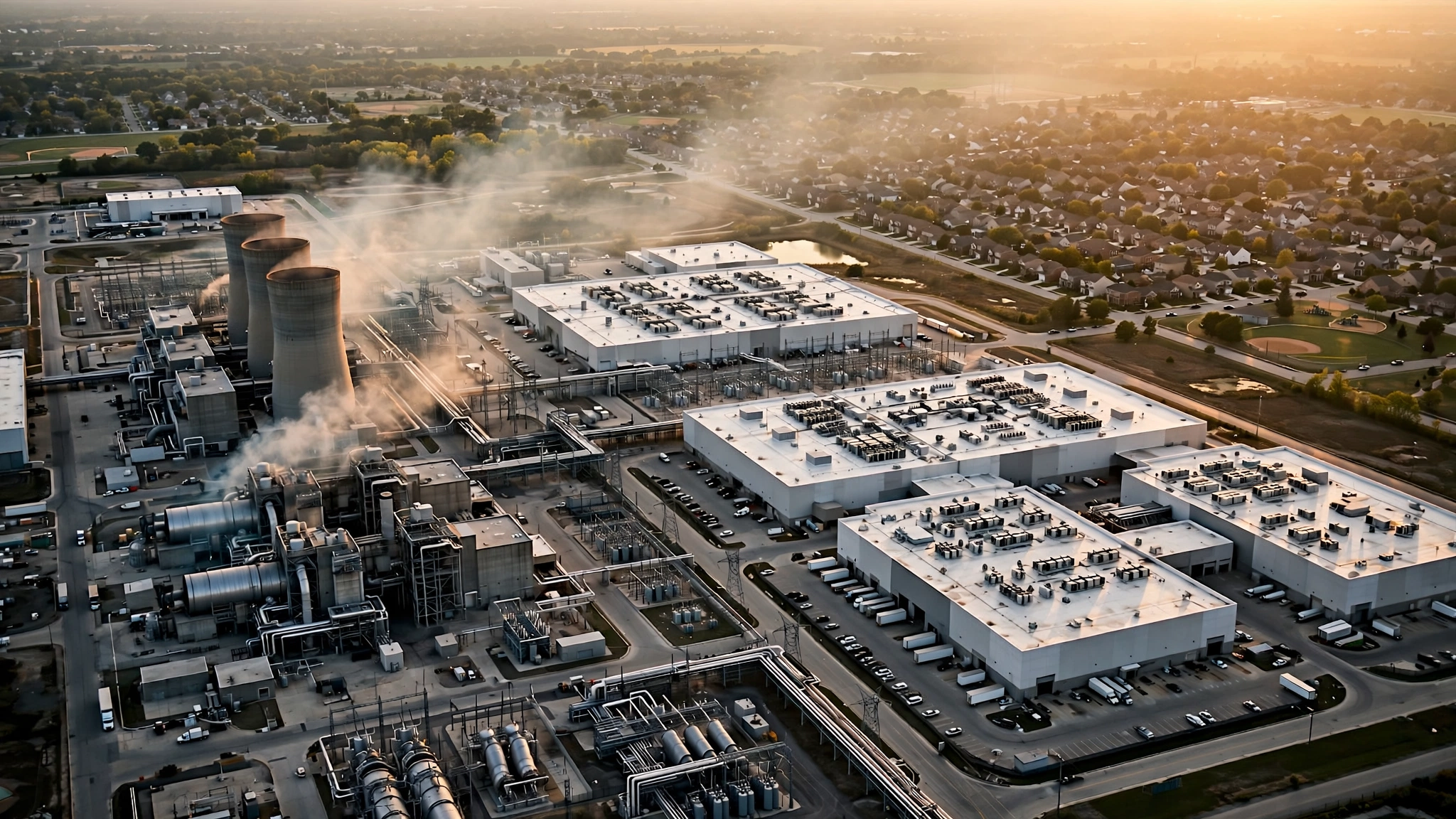
Seventy-three thousand megawatts. That is a country-sized power grid being built in the shadows. It is the combined nameplate capacity of 57 off-grid natural gas power plants currently proposed or under construction in the United States to serve individual AI data centers, according to data that research firm Cleanview provided to Reuters. For context, 73 GW is roughly the combined generating capacity of New York, New Jersey, and Connecticut, larger than the entire installed wind power fleet of Germany, and it would rank as the 18th-largest electric power fleet on Earth if it were a country.
Most of these plants were approved without public hearings, and at least a dozen won permits in under a year while two are already operating. In Ohio, lawmakers passed a provision making it a criminal offense for public officials to disclose details about data center projects, a provision inserted into an unrelated college athletics bill.
Here is what nobody has calculated yet: the air quality cost of this shadow grid, measured against the revenue it enables, and the price of fixing it.
Permitting Without Permission
A traditional natural gas power plant connecting to the grid requires 4 to 7 years of environmental review, community engagement, and state utility commission approval. All 57 plants in Cleanview's tracker are bypassing nearly all of that by exploiting a simple distinction: they are not selling power to the public.
Behind-the-meter generation serves a single private customer, so it falls outside the jurisdiction of state public utility commissions in most states. No commission, no review. FERC oversight? Often avoided entirely. In Ohio, a 2025 law allows certain generating facilities to win state approval in as little as 45 days without public hearings, a timeline that enabled Meta's Apollo Generating Station in Wood County to go from filing to approved in under three months, with construction beginning before the state's draft air permit was even publicly available.
Apollo was listed under a subsidiary called Liames LLC. Will Power LLC, itself a subsidiary of pipeline company Williams Companies (WMB), is building it and developing four similar projects in Ohio with 18- to 24-month construction timelines. Breanne Kidd, a daycare operator whose home faces the Apollo site across the street, told Reuters she was never notified about the power plant. "I'm living next to a threat," she said.
Memphis is worse. Elon Musk's xAI operated gas turbines at its Colossus data center without permits, telling regulators the units were "temporary" and not connected to the grid. West Virginia went further, passing legislation that exempted data center microgrids from local zoning laws entirely, stripping counties of any legal mechanism to challenge or even review the power installations being built within their jurisdictions. Same legal theory, same loophole. If the electrons never touch the public grid, the public has no standing to object.
Frankenstein Turbines
None of this hardware is what utilities buy. Combined-cycle gas turbines, the most efficient commercially available gas technology, have lead times stretching 5 to 7 years, sold out through the decade, and AI developers cannot wait that long.
So they improvise. Cleanview CEO Michael Thomas described the procurement strategy as "anything they can get their hands on": mobile gas generators strapped to semitrailer trucks, aeroderivative turbines originally designed for aircraft carriers and warships, reciprocating engines that ramp fast but burn fuel less efficiently, and in at least one documented case, repurposed cruise ship turbines. Cleanview's February report identified specific equipment orders at two-thirds of the projects it tracked, with commitments to GE Vernova, Caterpillar, Siemens, and Doosan.
Why does the equipment mix matter so much for air quality? A modern combined-cycle gas turbine with selective catalytic reduction (SCR) emits roughly 0.04 pounds of nitrogen oxides per megawatt-hour of electricity. A simple-cycle gas turbine without SCR emits 1.5 lb/MWh. A lean-burn reciprocating engine, the type being trucked to data center sites on flatbeds, emits 2.5 lb/MWh or more, which means the difference between the cleanest and dirtiest equipment in these plants spans a factor of 40 to 60.
Running the Numbers Nobody Ran
We built a bottom-up estimate of what 73 GW of shadow-grid capacity would emit at full buildout, using EPA AP-42 emission factors matched to the equipment categories Cleanview identified.
| Parameter | Value | Source / Basis |
|---|---|---|
| Nameplate capacity | 73,000 MW | Cleanview via Reuters (Jun 2026) |
| Capacity factor | 65% | Data centers run 24/7; maintenance/ramp margin applied |
| Annual generation | 415,668 GWh | 73 GW × 0.65 × 8,760 hrs |
| Share of US generation | 9.9% | 415.7 TWh / 4,200 TWh (EIA 2024) |
| Avg. NOx rate (equip. mix) | 1.5 lb/MWh | Weighted: 30% simple cycle, 40% recip, 30% aero |
| Annual NOx | 283,000 metric tonnes | 415,668M MWh × 1.5 lb ÷ 2,205 |
| US power NOx (2024) | 1,112,000 metric tonnes | EIA Electric Power Annual, Table 9.1 |
| NOx increase | +25.4% | 283K / 1,112K |
| Avg. CO2 rate | 490 kg/MWh | Higher than CCGT (400) due to equipment mix |
| Annual CO2 | 203.7 million tonnes | 415,668 GWh × 490 t/GWh |
| US power CO2 (2024) | 1,537 million tonnes | EIA |
| CO2 increase | +13.2% | 203.7M / 1,537M |
That NOx number demands attention. Between 2014 and 2024, the U.S. power sector cut annual nitrogen oxide emissions nearly in half, from 2.1 million metric tonnes to 1.1 million, the result of coal plant retirements, SCR installations, and tightening Clean Air Act standards over two decades of sustained effort. At full buildout, this shadow grid could add back 283,000 metric tonnes of NOx annually, rolling the national total back to roughly 2020 levels. Five years of progress. Gone.
Nitrogen oxides are not an abstract regulatory concern. They are a direct precursor to the two air pollutants most consistently linked to human mortality across three decades of epidemiological research: ground-level ozone and fine particulate matter. NOx reacts with volatile organic compounds in sunlight to form ground-level ozone, the primary component of smog, which the American Lung Association links to asthma attacks, cardiovascular events, and premature death. It also converts to fine particulate matter (PM2.5) through atmospheric chemistry, the pollutant most strongly associated with mortality in the epidemiological literature.
$314 Million to Fix an $800 Billion Problem
Here is where the arithmetic becomes damning. Cleanview's data and analyst estimates suggest AI data centers powered by this infrastructure generate $10 to $12 billion in annual revenue per gigawatt of power consumed, making them among the most revenue-dense industrial operations in human history, drawing more economic value per megawatt than any sector short of semiconductor fabrication. At 73 GW, the shadow grid enables roughly $730 to $876 billion in annual revenue.
What would it cost to clean up? Not much.
| Mitigation | Cost per Plant | Total (57 plants) | % of Annual Revenue |
|---|---|---|---|
| Selective catalytic reduction (SCR) | $5–12M | $285–684M | 0.04–0.08% |
| Continuous emissions monitoring (CEMS) | $0.5–1.5M | $29–86M | <0.01% |
| Combined SCR + CEMS | $5.5–13.5M | $314–770M | 0.04–0.09% |
Add it up. Including both NOx reduction equipment and continuous monitoring, the entire cleanup bill comes to $314 to $770 million in one-time capital expenditure, just 0.04% to 0.09% of the annual revenue stream these plants enable. Annualized over a 20-year operating life with maintenance, the cost rises to perhaps $50 to $80 million per year, which against $800 billion in revenue vanishes into statistical noise, less than a single day's earnings for any one of the hyperscale operators building these plants.
So no, this industry is not choosing between profitability and clean air but between clean air and saving a few weeks of permitting time.
Secrecy as Infrastructure
What compounds the emissions gap is a transparency gap just as engineered. Ohio's legislature recently passed provisions shielding large infrastructure projects, including data centers, from public records laws. Officials who disclose protected project information, including emissions data, capacity figures, or the identity of the companies behind shell-company filings, could face criminal charges. Republican state Senator Brian Chavez inserted the provision into an unrelated college athletics bill; his top two campaign donors in 2025 were a construction union that supports data center development and utility NiSource, each contributing $10,000.
Meta operated its Bowling Green, Ohio project under the code name "Project Accordion" for nearly two years, routing all filings, land purchases, and utility agreements through a subsidiary called Liames LLC, a name that appears in no other corporate registry and whose officers overlap entirely with Meta's infrastructure division. Microsoft, after criticism over secretive projects in Wisconsin, announced in March that it would stop using non-disclosure agreements with local governments nationwide. Meta told Reuters that confidentiality agreements are "standard in site selection processes."
Practical effect: communities cannot quantify what they are breathing because they cannot access the operating data, and the information deficit cascades through every regulatory layer. Without CEMS requirements there are no real-time emissions records; without public hearings there are no forums to request them; without disclosure there is no accountability to enforce against. Secrecy here is not protecting competitive advantage. It is preventing the very measurements that would trigger Clean Air Act obligations.
Why This Might Actually Be Less Bad
Fair counterargument, stated at full strength: if these 73 GW of data centers connected to the grid instead, the consequences might be worse. Grid interconnection queues in PJM and ERCOT now stretch 5 to 7 years. Every gigawatt of AI demand added to those queues pushes renewable energy projects further back in line and forces existing coal and gas peakers to run longer and harder. In regions like PJM, the marginal unit dispatched to serve a new large load is often a coal plant emitting 2,200 lb/MWh of CO2, not a natural gas plant at 490.
Behind-the-meter gas, even using inefficient equipment, may in some regions produce lower emissions per megawatt-hour than the marginal grid unit it displaces. Speed matters too: every month these data centers sit idle represents lost AI development that could, optimistically, yield breakthroughs with their own environmental payoffs. And economically, the case is not even close, because an industry generating $800 billion annually from this power can internalize any externality cost regulators impose and still earn stratospheric returns, which is precisely why the choice to skip cleanup looks less like necessity and more like laziness.
Limitations
Our emissions estimate has several caveats that pull in different directions. Cleanview's 73 GW is nameplate capacity, and some of these plants will never be built, which would reduce actual emissions below our estimates; our 65% capacity factor may be high for some sites and low for others. A 1.5 lb/MWh NOx rate is a weighted estimate across equipment categories using EPA AP-42 factors; actual rates depend on control technology, maintenance quality, ambient temperature, and fuel composition, all of which vary site to site, and some states may impose controls that bring individual plants well below our figures. In the other direction, we deliberately used equipment-specific estimates rather than worst-case uncontrolled emission rates, which for simple-cycle turbines without any post-combustion treatment can exceed 3.5 lb/MWh, a figure that would push the aggregate NOx number well above our central estimate. Social cost values for NOx and CO2 carry wide confidence intervals, and revenue projections of $10-12B per GW reflect current AI training economics that could shift if GPU utilization or pricing changes.
Bottom Line
Between 2004 and 2024, the United States spent billions of dollars and two decades of regulatory effort to cut power-sector NOx emissions by 47%. Now, in one infrastructure cycle, AI is on track to add back a quarter of those reductions, using equipment that operates outside normal environmental oversight, in some cases without permits, and increasingly behind laws that criminalize public disclosure.
This is not a story about whether AI should have power. It should. It absolutely should. This is a story about $314 million in cleanup equipment that nobody is installing because nobody is being asked to. Technology exists. Money exists. Only the requirement is missing.
What You Can Do
If you live near a proposed or active data center with on-site power generation, request the air permit from your state environmental agency; if your state has a public records exemption for data center projects, file the request anyway and document the denial. If you work in state government, compare your state's approval timeline for behind-the-meter generation against grid-connected generation of the same capacity: the gap reveals the regulatory arbitrage. If you invest in or work at a hyperscaler, advocate internally for SCR and continuous monitoring on all behind-the-meter facilities, and point to this math: the cost is 0.04% to 0.09% of the revenue the power enables. Watch for the EPA's forthcoming guidance on off-grid data center emissions, expected before year-end. And track Cleanview's quarterly updates at distilled.earth, the most comprehensive public tracker of this infrastructure build-out.