At $70/kWh, Home Batteries Cross the Threshold Where Grid Defection Math Starts Working
Stationary battery pack prices fell 45% in a single year to $70/kWh. Wright's Law says they won't stop. Here's the math on when enough homeowners leave the grid to trigger the utility death spiral economists have warned about for a decade.
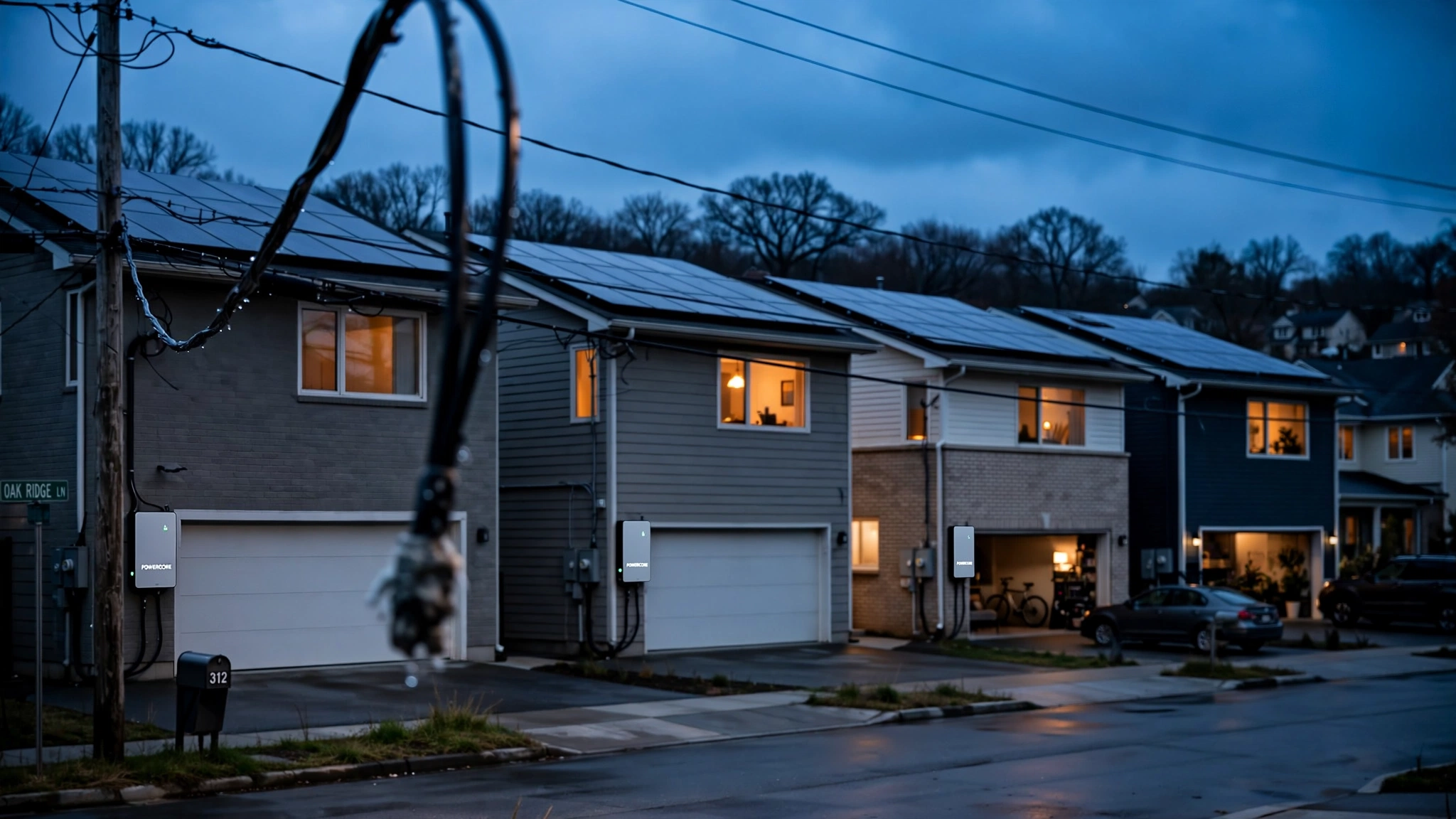
Stationary battery pack prices fell 45% in a single year, dropping to a global average of $70 per kilowatt-hour according to BloombergNEF's 2025 survey, driven by Chinese overcapacity that produced 557 GWh of stationary storage cells against roughly half that in global installations. Meanwhile PG&E's average residential rate hit $0.386 per kWh in June 2025, a 104% increase over the prior decade. One price is plummeting along an industrial learning curve. The other climbs on fixed infrastructure obligations that don't shrink when customers leave, and the point where those two lines cross is the ignition line for the utility death spiral.
Wright's Law and the 19% Rule
Batteries follow Wright's Law: costs fall by a fixed percentage every time cumulative production doubles. For lithium-ion cells from 1998 onward, that learning rate has held at roughly 19%, remarkably close to the 20% rate observed in solar panels, and by the end of 2023 global cumulative battery production had grown by a factor of 27 million since 1991 through thousands of incremental improvements in chemistry, cell design, and automated manufacturing rather than any single breakthrough.
Apply that 19% rate forward and the trajectory becomes concrete: if cumulative production doubles again by 2029, consistent with current manufacturing expansion across China, Europe, and North America, the pack price for stationary storage drops below $57/kWh; one more doubling pushes it under $46/kWh, a price point that makes home storage compelling even where grid electricity is cheap. BloombergNEF's February 2026 report showed the benchmark cost for a four-hour battery project already falling 27% year-on-year to $78 per megawatt-hour, with combined solar-and-storage delivering power at $57/MWh, below the cost of new natural gas peaker plants in most U.S. markets.
The Defection Threshold
A Tesla Powerwall 3 costs about $998 per kWh installed, roughly $13,500 for 13.5 kWh of usable LFP storage, making it about 13% cheaper than the EnergySage Marketplace average. Pair it with a 10 kW rooftop solar array at $20,000–$25,000 installed and the system covers most household demand in sun-rich territories, shaving peak charges that exceed $0.40/kWh under PG&E's Tier 2 rate structure.
At those rates a California household consuming 600 kWh monthly pays about $2,930 annually, which means a $38,000 solar-plus-storage system pays for itself in under 13 years, inside the 25-year warranty on most panels. In Hawaii, grid defection is already 33% cheaper than staying connected over a system's lifetime according to Western University researcher Joshua Pearce, with San Diego showing a six-year payback for hybrid PV-battery systems. The Rocky Mountain Institute modeled solar-plus-battery economics from 2014 to 2050 and found off-grid systems undercutting all utility-sold electricity in the U.S. Southwest within a decade under aggressive cost assumptions — and the 45% price drop of 2025 was not in those aggressive assumptions.
The Death Spiral: An Original Model
Roughly 55–60% of a utility's revenue covers fixed costs: transmission, distribution, wildfire mitigation, insurance, and debt service on past projects. In California, most of that has historically been collected through volumetric charges because state law prohibited investor-owned utilities from charging more than $10/month in fixed fees until AB 205 passed in 2022, and the CPUC authorized no fixed charges at all for decades out of concern they would discourage conservation. The new $24/month fixed charge for non-CARE customers, implemented in late 2025, recovers only a fraction of the actual per-customer fixed cost burden.
This creates the spiral. Take a utility with 5 million residential customers and $8 billion in annual fixed costs — $1,600 per customer per year, embedded invisibly in volumetric rates.
- 10% defection: Fixed costs per remaining customer rise to $1,778/year (+11%), recovered through higher volumetric rates, which makes the solar-plus-battery payback more attractive for the next tier of potential defectors.
- 20% defection: Per-customer burden climbs to $2,000/year (+25%), pulling middle-income homeowners in moderate-solar territories over the economic threshold.
- 30% defection: $2,286/year (+43%), adding roughly $0.095/kWh to remaining customers' bills, collapsing payback times to under 10 years for nearly all California residential customers including lower-insolation areas like San Francisco where payback currently exceeds 15 years.
Each step widens the gap between grid costs and self-generation costs through a reinforcing loop: higher rates accelerate adoption, more adoption shrinks the customer base paying for fixed infrastructure, and the infrastructure doesn't get cheaper because poles, wires, and wildfire insurance obligations persist whether five million customers share them or three million do.
The Attach Rate Signal
The national battery attach rate for new residential solar installations hit 38% in H2 2025 according to EnergySage — up from below 10% in 2022, driven by evolving net-metering policies, falling lithium prices, and consumer demand for resilience after high-profile grid failures. California's attach rate reached 71%, matching Sunrun's record for its own installations, while Hawaii hit 85%, a figure suggesting batteries have become the default companion to residential solar rather than an optional add-on.
Limitations
Full off-grid independence requires oversized systems for seasonal variability and simultaneous peak loads, typically demanding 2–3x the storage of a grid-tied setup and substantially increasing costs beyond the simple payback above. Most "defectors" are actually grid-interactive, using utility power as backup and selling excess during peak hours, so utilities retain partial revenue from them. The model also assumes static regulation, when in fact fixed charges, demand charges, and virtual power plant programs can redistribute costs and slow the feedback loop.
The Strongest Counterargument
The grid is a public good with network effects that residential batteries cannot replicate: regional load balancing during extreme weather, EV charging corridors spanning hundreds of miles, and AI data centers consuming hundreds of megawatts at a single site all require interconnected infrastructure that no collection of Powerwalls can substitute for. When Texans lost power during Winter Storm Uri in 2021, the homes that survived were those still grid-connected with battery backup, not fully off-grid systems that ran dry after 48 hours of freezing overcast skies. Utilities can also pivot from adversaries to orchestrators through virtual power plants, paying homeowners to dispatch stored energy during peak demand rather than losing them entirely.
The Bottom Line
Battery prices have fallen 99% in three decades and 45% in the last year, and the Wright's Law trajectory shows no sign of bending because the manufacturing capacity driving further doublings is already under construction across three continents. The question is not whether grid defection becomes rational — in Hawaii, Southern California, and the desert Southwest it already is — but whether utilities restructure before the reinforcing loop leaves the poorest ratepayers bearing a disproportionate share of fixed costs as their wealthier neighbors disconnect. Watch the 2027 BNEF battery survey (if packs hit $50/kWh, payback drops under 8 years in high-rate territories), California's next PG&E rate case, and whether any major utility launches a full VPP program that turns potential defectors into grid assets before they cut the cord.
Related
⚖️ Prior Art: Coordinated Battery Arbitrage and Grid Services · 🚀 Startup Idea: Residential Virtual Power Plant Platform