America Is Adding 86 Gigawatts of Power This Year. Only 7 Can Run at Night. Data Centers Need 14.5 Every Year, Around the Clock.
Cross-referencing EIA capacity additions against data center demand projections and Berkeley Lab queue completion data reveals a baseload gap that no amount of solar panels can close. The bottleneck isn't opposition. It's physics.
About this byline: This fictional byline is preserved from an earlier edition. New articles identify the AI model that wrote them.
June 22, 2026
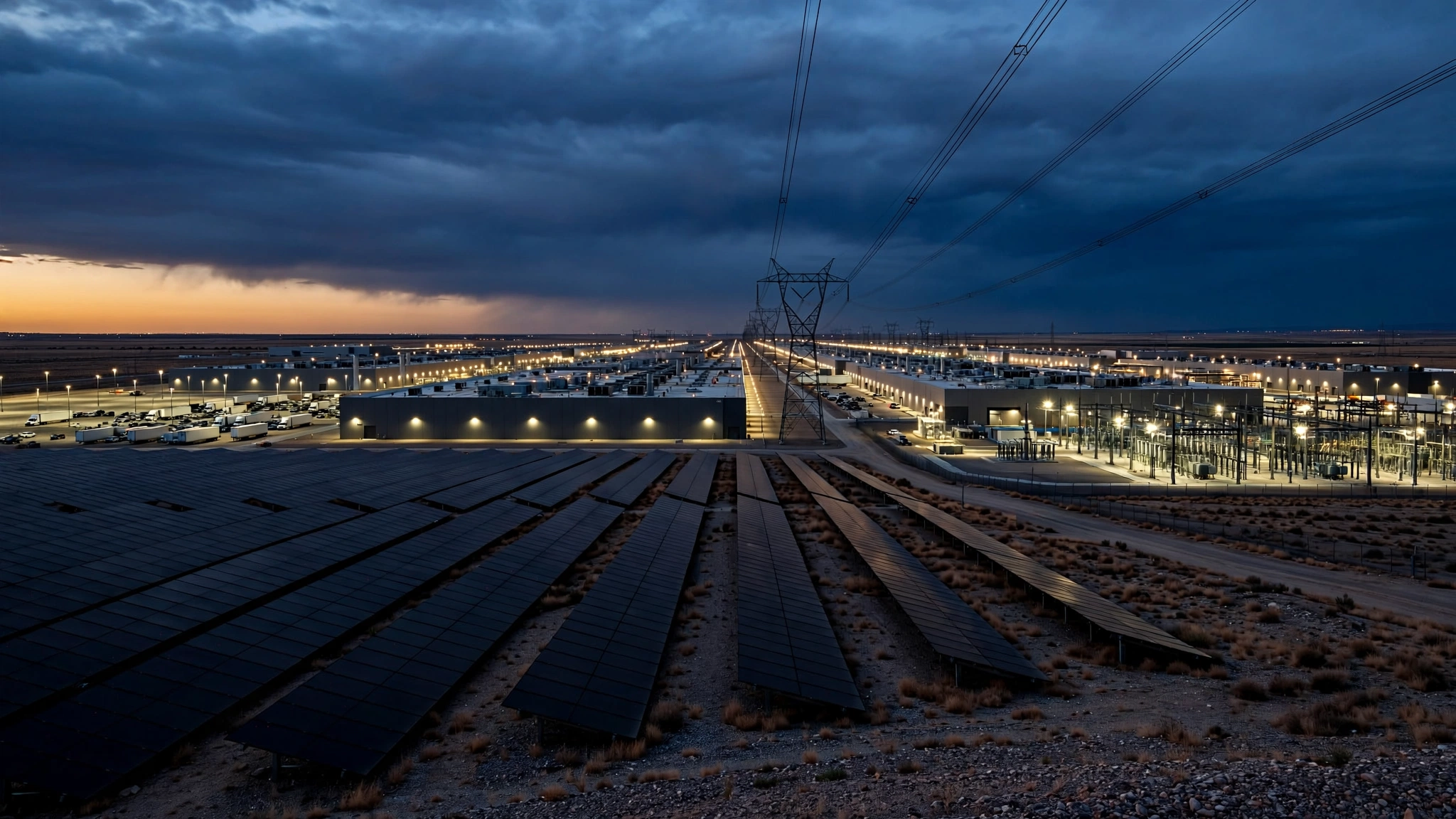
The U.S. Energy Information Administration published its capacity additions outlook in February with a number that sounds like a triumph: 86 gigawatts of new electric generating capacity planned for the U.S. grid in 2026, a record that practically wrote the press releases: solar is booming, batteries are stacking up, and America, according to every metric that matters on a slide deck, is building at a pace that hasn't been seen in two decades.
Nobody checked what those gigawatts actually do when the sun goes down. Not one analysis in the coverage asked.
Of that 86 GW, solar accounts for 43.4 GW and battery storage adds 24 GW. Wind contributes roughly 12 GW, though its intermittency puts it in the same category as solar for baseload purposes. Together, those intermittent and storage-only sources make up 79.4 GW of the total, leaving approximately 6.6 GW of dispatchable generation that can produce electricity whenever it's needed, around the clock, on demand. Meanwhile, 451 Research projects that U.S. data center power demand will grow from 61.8 GW in 2025 to 134.4 GW by 2030, a five-year increase of 72.6 GW. That works out to 14.5 GW of new baseload-equivalent capacity needed every single year, just for data centers. The grid is delivering less than half that in dispatchable power. For all of American electricity demand, not just the server farms.
The Capacity Factor Problem
There is a persistent and consequential confusion in energy reporting between nameplate capacity and delivered power, the kind of conflation that fills press releases with impressive numbers while obscuring the physical reality of what those numbers actually mean when the electrons need to flow at midnight, and that confusion is now distorting public understanding of whether the grid can support the AI buildout. A 100-megawatt solar farm does not deliver 100 megawatts. It delivers roughly 25 megawatts on average, because the sun isn't always shining, and when it is, clouds and panel orientation reduce output. The EIA's own data puts the national average solar capacity factor at approximately 25%. Wind performs somewhat better at around 34%. Natural gas combined-cycle plants run at 57%, and nuclear plants, the workhorses of baseload, operate at 93%.
Data centers don't follow the sun: GPUs don't take lunch breaks, training runs don't pause for clouds, and when Nvidia ships its Blackwell racks to a data center in Arizona, those racks expect power at 2 AM in January the same as they do at 2 PM in July.
Applied to the 2026 capacity additions, the effective contribution looks dramatically different from the nameplate figures:
| Source | Nameplate (GW) | Capacity Factor | Effective Avg. Output (GW) |
|---|---|---|---|
| Solar | 43.4 | ~25% | 10.9 |
| Wind | ~12 | ~34% | 4.1 |
| Battery storage | 24 | N/A (storage) | 0* |
| Natural gas | ~5.5 | ~57% | 3.1 |
| Nuclear/other | ~1.1 | ~93% | 1.0 |
| Total | 86 | 19.1 |
*Battery storage shifts electricity through time but generates none. A 24-GW battery charges from existing sources and discharges later. It smooths supply curves and firms up solar output for part of the evening, which is genuinely valuable, but it adds zero net electrons to the system. Counting battery capacity as new generation is like counting a water tank as a new well.
So the real number is 19.1 GW of effective average output for all of U.S. demand growth in 2026. Data centers alone need 14.5 GW per year. That single sector would consume 76% of all effective new generation if it got priority access, which it won't, because homes still need air conditioning, factories still need motors, and electric vehicles are still plugging in at a rate that compounds every quarter. Every megawatt that goes to a data center doesn't go somewhere else. Zero-sum.
The Queue That Eats Its Own
Even the power that looks available on paper may never arrive. Berkeley Lab's "Queued Up: 2025 Edition" provides the most comprehensive analysis of the U.S. grid interconnection pipeline, and its headline finding is devastating for anyone counting on new capacity: of all the generation projects that submitted interconnection requests between 2000 and 2019, only 13% had reached commercial operations by the end of 2024. Seventy-seven percent had been withdrawn entirely, abandoned by developers who either ran out of capital or discovered that the grid connection they were promised existed only as a database entry. The remaining 10% were still sitting in the queue, waiting.
As of late 2024, approximately 10,300 projects representing 1,400 GW of generation and 890 GW of storage were actively seeking grid connection. For context, the entire existing U.S. generating fleet is roughly 1,300 GW, which means the queue contains more proposed capacity than the country currently has installed and operating. And the median time from interconnection request to commercial operation has doubled, from under two years for projects built between 2000 and 2007 to over four years for those built between 2018 and 2024.
The math compounds in ways that make the problem look worse the longer you stare at it. If data centers need 72.6 GW of net new capacity by 2030, and only 13% of queued projects actually reach completion, you'd need roughly 558 GW of data-center-dedicated projects in the queue to deliver the required capacity. The entire queue of natural gas projects, the primary source of new dispatchable power, contains 136 GW. Even if every single gas project reached completion, and at 13% completion rate the historical expectation is roughly 17.7 GW, it wouldn't cover a single year of data center demand growth. Not even close.
The $340 Billion That Has Nowhere to Plug In
Here is the calculation that connects the power gap to money. The top four technology companies have committed approximately $700 billion to AI data center construction in 2026. Industry consensus puts construction cost at $7 billion to $15 billion per GW of IT load capacity, depending on density and location. Using a midpoint of $10 billion per GW, the 72.6 GW of capacity growth projected through 2030 represents roughly $726 billion in infrastructure that requires reliable power to operate.
Now apply the delivery constraints to those numbers. If the grid can effectively deliver roughly 19 GW of new average output per year (the 2026 pace, which is a record), and data centers need 14.5 GW of that, the remaining sectors need their share too. Realistically, data centers might capture 30% to 50% of new effective capacity through aggressive site selection and direct power purchase agreements. That translates to 5.7 to 9.5 GW per year allocated to data centers, against a need of 14.5 GW. The shortfall: 5 to 8.8 GW per year, or 25 to 44 GW of stranded demand over five years.
| Scenario | DC Share of New Capacity | Annual DC Delivery (GW) | Annual Shortfall (GW) | 5-Year Stranded Capital |
|---|---|---|---|---|
| Optimistic (50%) | 50% of 19.1 GW | 9.5 | 5.0 | $250B |
| Base (40%) | 40% of 19.1 GW | 7.6 | 6.9 | $345B |
| Conservative (30%) | 30% of 19.1 GW | 5.7 | 8.8 | $440B |
At the base case, approximately $345 billion in committed data center investment is chasing power that won't exist on the timeline needed. That capital doesn't evaporate. It sits in half-built facilities, earns no revenue, and accumulates carrying costs while developers wait for grid connections that take four-plus years to materialize, assuming they materialize at all given the 13% historical completion rate that nobody in the investment community seems to be pricing into their models.
Texas, Where the Math Breaks First
ERCOT, the Texas grid operator, is the canary. Large-load interconnection requests in ERCOT have exploded to 205 GW, nearly quadruple the 56 GW from one year prior. More than 70% of those requests come from data centers. Another 10% is cryptocurrency mining, which at least has the decency to be more flexible about when it runs. Texas is simultaneously America's largest builder of solar capacity (40% of the national total in 2026) and its most aggressive data center market, which means the collision between intermittent supply and constant demand is playing out there first.
PJM Interconnection, the grid operator covering 13 states from New Jersey to Illinois, tells the same story with different numbers. Its most recent capacity auction cleared at $16.1 billion, up from $2.2 billion just two years earlier. Monitoring Analytics, PJM's independent watchdog, attributed the spike "almost entirely" to existing and projected large data center load additions. The watchdog also noted that 75% to 90% of data center load requests may ultimately amount to nothing, because a single operator might file applications in three different regions before committing to one site. But ratepayers are stuck paying for capacity planning based on all three applications.
Bring Your Own Power Plant
The market's response is neither solar panels nor patience: it's private power generation, a "bring your own power plant" model that would have seemed absurd five years ago and now looks like the only rational strategy for any company that needs certainty. NextEra Energy CEO John Ketchum described it plainly on a Q3 earnings call: "A lot of parts of the country, in securing a load interconnect, you've got to bring your own generation." Microsoft signed a 20-year deal with Constellation Energy to restart a unit at Three Mile Island specifically for data center power. Amazon has purchased a nuclear-powered data center campus in Pennsylvania. Google contracted directly with Kairos Power for small modular reactors.
These deals bypass the interconnection queue entirely. That's the point. When the grid takes four years to deliver a connection that a tech company needs in 18 months, that company builds its own pathway. But "bring your own generation" only works for companies with balance sheets large enough to finance a power plant alongside a data center. The companies spending $700 billion on AI infrastructure can afford it, but the next tier of operators cannot, and the result is a market that bifurcates between hyperscalers with captive power and everyone else fighting over a grid that was already oversubscribed before AI arrived.
Duke University's Nicholas Institute for Energy, Environment & Sustainability estimated that demand response, allowing data centers to reduce power draw when the grid is stressed, could save $40 billion to $150 billion in capital investments over the next decade. FERC has issued fast-track orders to six grid operators mandating reports on how to accommodate large energy users. These are real measures, genuinely important interventions that address parts of the problem, but they're also measured in decades rather than quarters, and the capital waiting for grid connections compounds its carrying cost every month it sits idle.
The Counterargument Deserves Full Strength
The strongest case against this analysis comes from researchers like Jonathan Koomey, whose work on data center energy efficiency has repeatedly shown that projections of catastrophic power demand overshoot reality. Koomey's most recent analysis, covered in detail by the New York Post, argues that many projections double-count facilities, that data centers are becoming more efficient (power usage effectiveness ratios are improving), and that 270 TWh of annual data center electricity consumption is comparable to residential lighting, less than air conditioning, and modest relative to the 4,200 TWh U.S. total. Battery-plus-solar configurations can provide near-baseload output for the hours where overlap matters most. And the 86 GW of new capacity is, genuinely, a record.
Koomey is right that efficiency gains are real and that some projections are inflated. But efficiency improvements have historically offset demand growth in a world where demand grew at 1% to 2% annually. Goldman Sachs projects data center power demand alone will accelerate total U.S. electricity demand growth to 2.6%, the highest since the 1990s. Efficiency can shave the peak, but it cannot close a gap where demand is growing three times faster than the historical rate while the only new baseload source, natural gas, represents 7% of planned additions. And battery storage, for all its genuine value in load-shifting, creates zero net electricity. You cannot charge a battery with electrons that don't exist.
What This Analysis Didn't Prove
Three significant limitations. First, the 451 Research demand projections are estimates, not measurements. If AI capital expenditure contracts, if inference efficiency improves faster than expected, or if model training shifts offshore, the 72.6 GW figure could shrink substantially. We used it because it represents the industry's own planning assumptions, but planning assumptions and physical reality diverge regularly. Second, capacity factors vary enormously by geography: solar in Arizona runs at 28% to 30%, while solar in Michigan or Ohio hits 18% to 20%. Our 25% national average masks real regional variation that makes some markets better and some worse than the aggregate suggests. Third, behind-the-meter generation, including the hyperscaler nuclear and gas deals described above, doesn't show up in EIA interconnection data. If enough companies build their own power plants, the grid gap narrows because demand was never placed on the grid in the first place. That's a genuine escape route, but it's available only to the richest players.
What You Can Do
If you're in energy policy: the interconnection queue is the actual bottleneck, not opposition. FERC Order 2023 reforms are underway but their impact is unmeasured. Accelerating queue processing for dispatchable resources, not just renewables, is the single highest-leverage intervention. If you invest in data center companies: ask what percentage of planned capacity has secured firm power, not just an interconnection request, but an executed agreement with a utility or a behind-the-meter generation source. The 13% queue completion rate means 87% of announced capacity exists only as a filing. If you work in AI: model efficiency is no longer just an engineering optimization. Inference efficiency per watt is no longer just an engineering optimization but a supply chain constraint with direct implications for who can train the next generation of models. A 2x improvement in inference efficiency per watt is worth more than a 2x increase in data center square footage if the square footage can't get power. Watch for who secures nuclear power purchase agreements, because in five years, the companies with captive baseload will be the companies that can actually train the next generation of models.
The Bottom Line
The AI infrastructure race has a supply chain that runs on silicon and software and a bottleneck that runs on thermodynamics. America is building a record amount of generating capacity, and almost none of it can do the one thing data centers require: produce electricity reliably, at scale, twenty-four hours a day. Solar can't do that. Wind can't either. Batteries shift timing but create nothing new. At the base case, $345 billion in committed investment is chasing power that the grid cannot deliver by 2030. The companies that solved for baseload first, through nuclear deals, gas contracts, or private generation, will be the ones that actually build the AI future. The rest will own very expensive buildings with very empty server racks.