Bitcoin Miners Own 8.8 GW of US Power Infrastructure. AI Companies Will Pay 3x More for It.
TeraWulf just signed a $19 billion, 20-year lease with Anthropic for 401 MW at a former mining site in Kentucky. An original per-megawatt revenue decomposition reveals AI hosting generates $2.37 million per MW per year versus $797,000 for Bitcoin mining, and the industry's 8.8 GW of US power capacity could close nearly a fifth of America's projected AI data center gap years before new generation breaks ground.
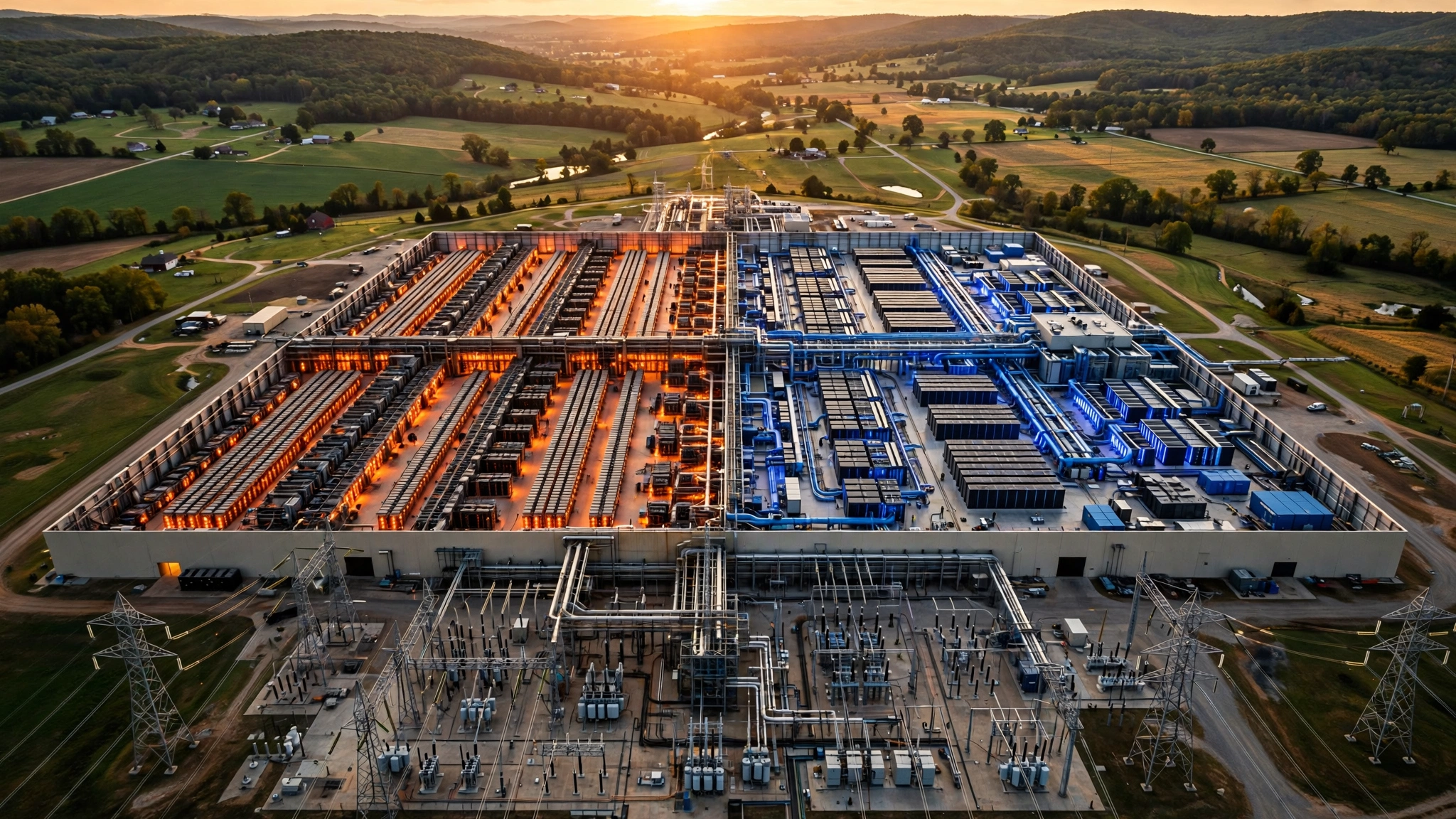
$2,369,076. That is how much revenue TeraWulf will earn per megawatt per year from its new Anthropic lease at the Justified Data campus in Hawesville, Kentucky, a figure derived from dividing $19 billion in contracted revenue by 20 years and 401 megawatts of critical IT load. On the same day the deal was announced, a Bitmain Antminer S21 plugged into one megawatt of power at the current hashprice of $38.2 per petahash per second per day generated $797,000 in annualized Bitcoin mining revenue from an identical amount of electricity. Hosting AI is worth 2.97 times as much as mining Bitcoin, a ratio so clean you can round it to 3x and lose nothing.
That single ratio explains a migration already underway across six publicly traded companies, $65 billion in signed contracts, and a 14.5 percent decline in Bitcoin's global hash rate from its October 2025 peak. It also reveals something the AI industry has mostly ignored: the fastest path to closing America's gaping data center power shortage is not building new nuclear plants or waiting for fusion. It is buying the power that Bitcoin miners already own, already permitted, already grid-connected, and available for roughly a third of what greenfield construction would cost.
Per-Megawatt Revenue: The Math
Nobody has published a clean per-megawatt comparison of AI hosting versus Bitcoin mining revenue using the TeraWulf-Anthropic contract as the benchmark, so here it is.
| Metric | AI Hosting (TeraWulf-Anthropic) | Bitcoin Mining (S21-class, current) |
|---|---|---|
| Contracted revenue | $19B over 20 years | N/A |
| Annual revenue per MW | $2,369,076 | $796,700 |
| Revenue multiple | 2.97x | |
| Electricity cost per MW/yr (at $0.04/kWh) | Pass-through to tenant | $350,400 (miner absorbs) |
| Operating margin | 80-90% | Thin to negative at scale |
| Hardware capex per MW | $2-5M (facility retrofit) | $125-175M (ASICs @ $5-7K each) |
Three things jump out of that table. First, AI hosting contracts typically pass electricity costs through to the tenant, while miners eat that cost directly, which turns $797K in gross revenue into roughly $447K after power at a favorable $0.04/kWh rate, and into essentially nothing at the national average of $0.09/kWh, a spread that makes the 3x revenue headline actually understate the economic advantage. Second, the hardware capex differential is staggering. Filling one megawatt with S21-class ASICs at 3,500 watts each requires approximately 286 machines at $5,000 to $7,000 apiece, while converting a mining facility for AI hosting requires $2 to $5 million per megawatt in infrastructure upgrades but zero GPU purchases, because the tenant brings their own compute. Third, the 80 to 90 percent operating margins on AI hosting contracts reported by CoinShares' 2026 outlook make mining margins look like a rounding error barely worth the electricity bill.
What Bitcoin Would Have to Cost
For mining revenue per megawatt to match AI hosting revenue per megawatt, Bitcoin's price would need to reach approximately $184,000, assuming a linear relationship between price and hashprice. It would not be linear. Higher Bitcoin prices attract more miners, which increases network difficulty, which pushes per-terahash revenue back down. The real parity price, accounting for difficulty adjustment, is likely north of $200,000.
Bitcoin traded at $61,865 on the day the TeraWulf deal was announced, which means it has not come within $100,000 of the parity threshold in its 17-year existence. Miners waiting for price appreciation to close the gap are making a bet that requires a 200 percent rally against a 3x revenue premium available today, with a 20-year contract and an investment-grade counterparty. Some will take that bet. Most won't. The market is telling us that much already, and the TeraWulf stock reaction, up 16 percent in premarket on the Anthropic news, confirms where institutional money sees the better risk-adjusted return.
8.8 Gigawatts and a 45 GW Hole
Here is a number the AI infrastructure discourse has overlooked. US Bitcoin mining capacity stands at approximately 8.8 gigawatts: 6.3 GW operational and 2.5 GW under construction, according to EIA estimates and industry aggregation by CoinMarketCap. Projections for the AI data center power gap through 2028 range from 35 to 55 GW, with a midpoint around 45 GW. Mining infrastructure represents 19.6 percent of that gap.
One-fifth of the gap, sitting in buildings that are already permitted, already grid-connected, already staffed by people who understand utility tariff structures, power engineering, interconnection queues, and high-density cooling, the exact combination of skills and relationships that takes new entrants half a decade to assemble. AI developers face 18 to 36 months just to get grid access for a new site. Mining facilities can be converted in 12 to 18 months, based on TeraWulf's own timeline: deal signed July 2026, initial capacity online H2 2027. That is a two-to-three-year speed advantage over greenfield construction, and speed is the commodity in shortest supply in the AI infrastructure buildout.
The Revenue Uplift Nobody Has Quantified
If the entire 6.3 GW of operational US mining capacity converted to AI hosting at TeraWulf-Anthropic contract rates, aggregate annual revenue would jump from $5.02 billion to $14.93 billion. That is a delta of $9.91 billion per year. Over 20-year contract terms, the total addressable value is $298.6 billion, a figure so large that it has attracted not just the miners themselves but the private equity firms, sovereign wealth funds, and hyperscaler procurement teams who are now circling the industry with term sheets in hand. Even at Bernstein's more conservative estimate that 20 percent of mining capacity shifts to AI, that is 1.76 GW generating $4.17 billion per year instead of $1.40 billion.
Six publicly traded miners have already signed HPC or AI hosting contracts: Core Scientific, Cipher Mining, TeraWulf, Applied Digital, Iris Energy, and Bit Digital. Hut 8 announced a $7 billion AI infrastructure agreement with Google in December 2025. MARA Holdings filed with the SEC for Bitcoin sales to fund its own pivot. CoinShares projects mining revenue will plummet from 85 percent of total company revenue in early 2025 to less than 20 percent by end of 2026 for companies with AI contracts. This is not a pivot being contemplated; it is a pivot already executing at a pace that will reshape both industries within 18 months.
Why 80 Percent Transfers and 20 Percent Does Not
ASICs cannot run AI workloads. A Bitmain S21 computes SHA-256 hashes and absolutely nothing else, which means the hardware inside a mining facility is worthless for AI training, inference, or any other GPU-class computation. But the hardware is not the hard part. What makes a mining site valuable to an AI company is everything that took a decade to build around those machines: power purchase agreements negotiated over years with rural utilities, high-voltage substations delivering hundreds of megawatts, building shells engineered for heat rejection, fiber backhaul trenched through miles of countryside, and relationships with local permitting authorities who already said yes once and will say yes again faster than they would approve a stranger's greenfield application. That is 80 percent of what an AI data center needs.
Conference presentations from the Bitcoin 2026 conference estimate the remaining 20 percent, liquid cooling retrofits, high-density networking, and upgraded power distribution inside the building, costs $2 to $5 million per megawatt. Expensive, but compare that to $10 to $15 million per megawatt for a new data center from bare earth. For 6.3 GW, full conversion capex runs $12.6 to $31.5 billion, a fraction of the $200 billion-plus that hyperscalers plan to spend on AI infrastructure through 2028. TeraWulf's CEO Paul Prager said it plainly: "The defining constraint in this market is no longer computing hardware. It is power, transmission infrastructure, and execution certainty."
The Hash Rate Problem Is Real
Bitcoin's global hash rate has fallen 14.5 percent from its October 2025 peak. Some of that decline is cyclical, the normal shakeout of less efficient miners after a halving. But some of it is structural: capacity that shifted to AI hosting is not coming back when Bitcoin rallies, because 20-year contracts do not have a "Bitcoin hit $100K, we'd like our megawatts back" clause, and no rational operator walks away from $2.37 million per megawatt to chase $797,000.
Adam Back, the cryptographer whose Hashcash protocol is cited in the Bitcoin whitepaper, argues this is exactly what the difficulty adjustment mechanism is designed for. When miners exit, difficulty drops, and remaining miners become more profitable. Bitcoin has survived larger hash rate declines, including a 50 percent drop when China banned mining in 2021. But the 2021 decline was geographic redistribution. Miners moved from Sichuan to Texas. This time, the megawatts are leaving the Bitcoin network entirely, repurposed for a use case that pays three times more and locks them up for two decades.
If Bernstein's 20 percent conversion estimate holds, that is 1.76 GW exiting Bitcoin permanently. If the market clears at a higher conversion rate, and the economics strongly favor it, 3 to 4 GW could leave within five years. At some threshold the network's decentralization assumptions weaken: fewer, larger miners means a higher concentration of hash power in fewer hands, which makes 51 percent attack scenarios cheaper to execute even as total hash rate partially recovers through difficulty adjustment.
Counterargument at Full Strength
Location. Mining sites were chosen for cheap power, not low-latency networking. Hawesville, Kentucky, is not Northern Virginia, and for inference workloads that serve real-time user requests, every millisecond of network latency matters, placing rural mining sites at the wrong end of the fiber map. If AI demand tilts toward inference rather than training, a significant fraction of mining sites may be geographically disqualified from the highest-value contracts.
Anthropic chose Hawesville anyway. Training workloads, which consume the majority of current AI compute demand, are not latency-sensitive. A model training run that takes 90 days cares about sustained throughput, not round-trip millisecond response. TeraWulf's Buffalo site, a converted coal plant, hosts Core42 and FluidStack (backed by Google) for the same reason: power density matters more than proximity to population centers for batch compute. But training's share of total AI compute may decline as inference scales, and the mining industry's location advantage could narrow if the workload mix shifts. That is a genuine uncertainty, not a theoretical one.
Contract Duration Risk
Twenty-year leases sound like guaranteed revenue, but AI demand trajectories are genuinely uncertain at that timescale, and inference costs are falling roughly tenfold per 18 months. If that rate continues, the megawatt requirements for a given level of AI capability drop dramatically. Tenants locked into 401 MW at 2026 prices may find themselves paying for capacity they no longer need by 2032. Most of these contracts are not structured as take-or-pay power agreements; the exact termination provisions are not public, and that opacity is itself a risk factor for investors modeling TeraWulf's contracted revenue at face value.
Limitations
This analysis uses a single contract, TeraWulf-Anthropic, as the benchmark for AI hosting revenue per megawatt. One deal does not make a market price. Smaller miners without TeraWulf's scale, location, or negotiating leverage will likely receive less favorable terms, and the $2.37 million per MW figure should be treated as an upper bound rather than an industry average. Hashprice, which drives the mining revenue side of the comparison, is volatile enough to swing 30 percent in a month; the $38.2/PH/s/day figure is a snapshot, not a constant. CoinShares' all-in mining cost data shows most public miners operating at all-in losses at current prices, with Bitdeer at $118,188 per BTC and Hut 8 at $160,402 per BTC against a $61,865 spot price, but these figures predate the April halving adjustment period and may not reflect current run rates. Finally, the "80 percent infrastructure transferable" claim originates from a conference presentation, not a rigorous engineering audit; actual transfer rates will vary by site, and no independent assessment has validated the figure at scale.
The Bottom Line
America has a 45 GW AI power problem and an 8.8 GW Bitcoin mining answer that is already permitted, grid-connected, and available for roughly one-third the cost of building from scratch. The economics are not subtle: 3x revenue premium, higher margins, lower capex, and counterparties willing to sign 20-year contracts worth billions. For the mining industry, the question is no longer whether to pivot but how fast. For the AI industry, the question is whether it can absorb 8.8 GW of converted mining capacity fast enough to matter, and the answer, given that new nuclear plants take a decade and interconnection queues run two to three years, is almost certainly yes.
If you hold shares in publicly traded Bitcoin miners, the per-MW revenue comparison in this article is the valuation framework that matters now: mining revenue ($797K/MW/yr) versus AI hosting revenue ($2.37M/MW/yr), and where each company's contracted megawatts fall on that spectrum. Core Scientific, TeraWulf, and Hut 8 have already crossed. Cipher Mining and MARA are in transition. Watch for new contract announcements and the percentage of total revenue derived from AI hosting in quarterly earnings, because that ratio is the single best predictor of which miners survive and which become acquisition targets. If you work in AI infrastructure procurement, call a miner before you break ground: the power, permitting, and substation you need may already exist in a building full of obsolete ASICs, available two years sooner than your current timeline at a fraction of the cost.
Sources
- Reuters (July 6, 2026). TeraWulf signs 20-year lease with Anthropic for 401 MW at Justified Data site, Hawesville, KY. ~$19B contracted revenue. Reuters
- CoinShares (Q1 2026). Bitcoin Mining Report: all-in cost per BTC (Bitdeer $118K, Hut 8 $160K), mining revenue share projections. CoinShares
- CoinMarketCap / TheEnergyMag (2026). 14 public miners building ~30 GW targeting AI; US mining capacity 8.8 GW. CoinMarketCap
- ETF Trends / CoinShares 2026 Outlook. $65B in miner-to-AI contracts; AI hosting 3x revenue per MW; 80-90% operating margins. ETF Trends
- US Energy Information Administration (2026). US cryptocurrency mining capacity estimated at 10,275 MW total, ~80% utilization, ~2.3% of US power demand. EIA
- Barron's / Investors.com / CoinDesk (July 2026). TeraWulf site details: Buffalo 750 MW (Core42, FluidStack tenants), Muskie Data 1 GW campus, CEO Paul Prager on power as constraint. Barron's
- ForkLog / Bitcoin Policy Institute. AI revenue 17-25x per kWh vs mining; 20% capacity shift estimate (Bernstein). ForkLog
- Bitcoin 2026 Conference / LinkedIn. Infrastructure 80% transferable; conversion timeline 12-18 months; talent scarcity in power engineering + high-density compute. Bitcoin Conference