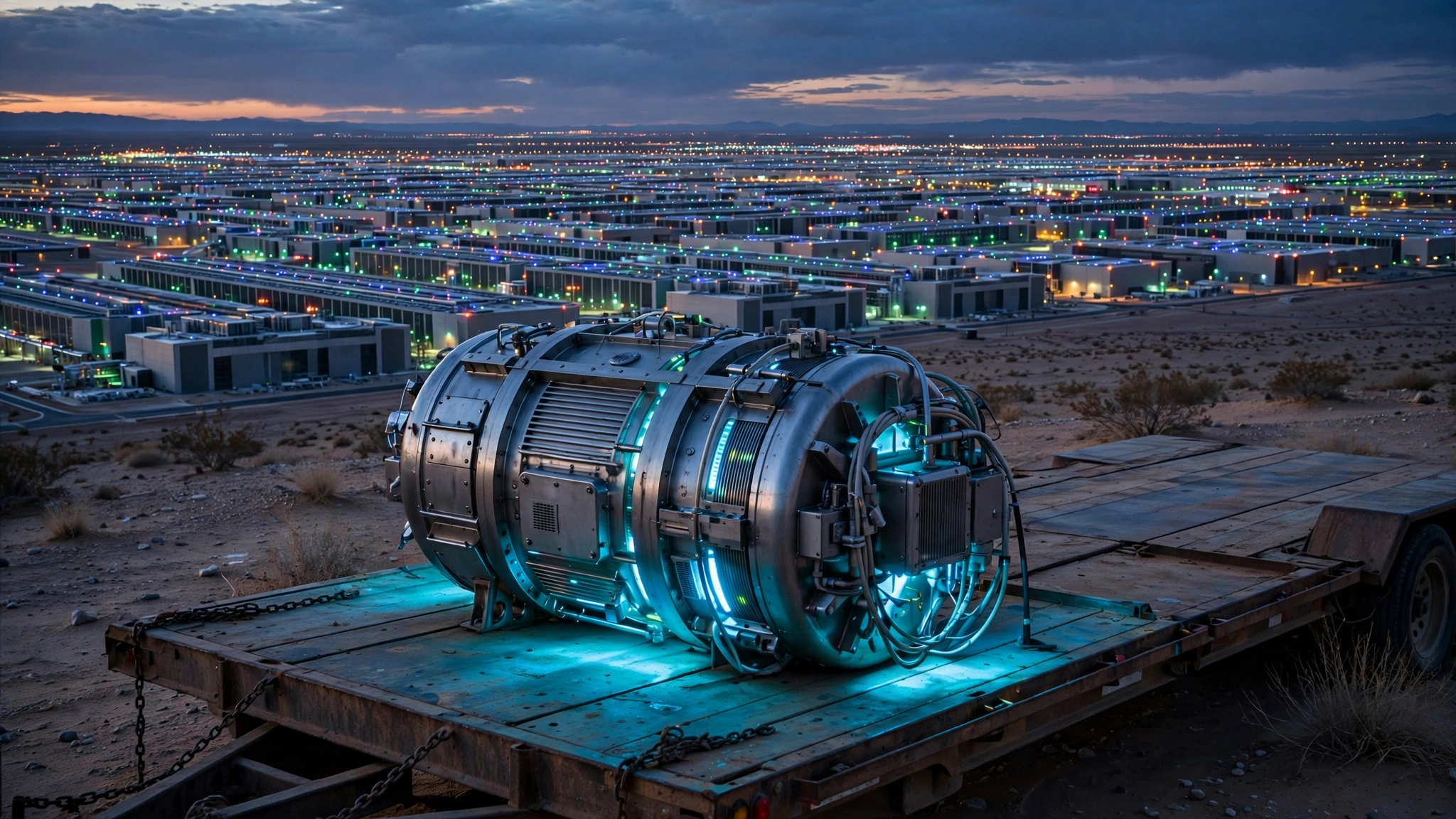
One hundred and fifty days. That is how long it took Deployable Energy to go from project kickoff at Idaho National Laboratory to a self-sustaining nuclear chain reaction in its Unity reactor, a gas-cooled microreactor small enough to ship in a 20-foot container. Bobby Gallagher, the company's CEO, drove the core test rig from Houston to the Idaho desert in a Ford F-150, because when your reactor fits in a pickup truck, that is how you prove a point about portability. Valar Atomics took a different approach: three C-17 Globemaster military transport aircraft hauling its Ward 250 from California to Utah, which is either a logistics feat or a warning about what "small" means when it still weighs enough to need Air Force cargo planes. Both reactors went critical, joining Antares Nuclear's Mark-0, which crossed the threshold on June 4. Three startups. Three fundamentally different designs, all critical before the fireworks.
A real deadline drove it. President Trump's Executive Order 14301, signed in May 2025, established the Reactor Pilot Program and set a target: at least three advanced reactors achieving criticality by July 4, 2026, America's 250th birthday, a timeline that the nuclear industry's old guard considered somewhere between ambitious and delusional. DOE selected ten companies, offering federal land at national laboratories, safety review support, and exemptions from the NRC's multi-year permitting process. Each company funded its own hardware, and Aalo Atomics, founded in 2023 with two employees, now has nearly 200 people and built its reactor in five months flat. It was on the verge of criticality as the deadline arrived.
On July 1, Valar ran a demonstration that made the headlines everyone wanted to write: its Ward 250 generated electricity that powered Nvidia's Blackwell AI chip architecture, marking the first time a microreactor had supplied electricity to a data center. Irresistible symbolism. Nuclear fused with AI, delivered on Independence Day weekend, powered by a 27-year-old founder bankrolled by Palmer Luckey and Palantir's CTO.
Then the math intrudes.
What Nobody Headlined: Output
During the Nvidia demonstration, Ward 250 operated at 37% of its 100-kilowatt thermal capacity. Thermal-to-electric conversion yields roughly 11 to 15 kilowatts of electricity at that output. A team member plugged in an Nvidia RTX desktop and ran a website at nuclearwebsite.com. Bloomberg called it "just a trickle of electricity." Fair. A single Nvidia B200 GPU draws about 1 kilowatt; an eight-GPU rack draws 10.2 kilowatts. At peak, that demo reactor could power roughly one and a half GPU racks.
Just one and a half racks.
Scale those numbers to meet the problem they are meant to solve, and the gulf becomes staggering. Goldman Sachs projects US data center power demand will grow from 31 gigawatts in 2025 to 66 gigawatts by 2027, a 35-gigawatt jump in 24 months, which is roughly the peak generating capacity of every nuclear plant currently operating in France, conjured from nothing in two years. IEA forecasts global data center electricity consumption will hit 945 terawatt-hours by 2030, more than doubling from 2024 levels. Gartner pegs 2026 demand at 132 gigawatts worldwide. Midline projections, all of them, from institutions that would rather undercount than overcount.
Now take the three reactors that just went critical. Deployable Energy's Unity produces 1 megawatt of electrical output. Valar's Ward 250, at full commercial scale, targets 5 megawatts. Antares Nuclear's Mark-0, a sodium heat-pipe microreactor aimed at military and remote applications, operates in a similar range. Cover just the 35-gigawatt US demand increase that Goldman projects by 2027, and you need 35,000 Unity reactors, or 7,000 Ward 250s at full scale, or some combination of both, which is a number so large it stops being a manufacturing challenge and starts being a category error. Even NuScale, whose 77-megawatt modules remain the only small reactor design with NRC certification, would require 455 modules to close that gap. NuScale has built zero. It does not expect its first commercial deployment before the early 2030s.
| Reactor | Design Capacity | Units for 35 GW | Operating Units |
|---|---|---|---|
| Deployable Energy UNB | 1 MWe | 35,000 | 0 |
| Valar Ward 250 (full scale) | 5 MWe | 7,000 | 0 |
| Oklo Aurora (target) | 15 MWe | 2,333 | 0 |
| NuScale VOYGR (module) | 77 MWe | 455 | 0 |
Zero. That is the number in the rightmost column, and it is doing a lot of work. Not one of these companies has a commercially operating reactor, not one has generated a kilowatt-hour that a utility has paid for, and not one has demonstrated continuous operation beyond a matter of hours.
Dollars Per Megawatt: A Disconnect
Wall Street has priced these companies as if the gap between zero and thousands were a matter of paperwork. Oklo trades at $52.36 per share, cratered from a 52-week high of $193.84, with a market capitalization of $9.1 billion. Headline deals abound: a 1.2-gigawatt nuclear campus with Meta in Ohio, agreements with the Department of Defense, enough memoranda of understanding to paper a conference room. No commercial reactor. NuScale, holder of the only NRC-certified SMR design in the United States, trades at $9.76, down 82% from its October 2025 peak of $53.43, carrying a $3.6 billion market cap against roughly $31 million in 2025 revenue, nearly all from engineering studies and licensing fees rather than electrons sold.
Context sharpens the absurdity of those valuations. NextEra Energy, the world's largest generator of wind and solar power, carries approximately $170 billion in market capitalization against 34 gigawatts of operating capacity, which works out to roughly $5 million per operating megawatt. Oklo's ratio divides $9.1 billion by zero operating megawatts. Undefined. Use its signed Meta pipeline of 1.2 gigawatts as a denominator instead, and you still get $7.6 million per megawatt for capacity that does not yet exist, on a timeline stretching well into the 2030s. Valar, privately valued at $2 billion after $600 million raised, has produced approximately 15 kilowatts of electricity in a single demonstration.
Fifteen kilowatts. Two billion dollars.
Speed Meets the Licensing Wall
Construction velocity is the genuine achievement here, and it deserves its full credit. Deployable Energy built a reactor in 150 days. Valar went from bare dirt to a critical reactor in nine months. Aalo Atomics finished in five. For context, Shippingport Atomic Power Station, America's first commercial nuclear plant, broke ground in 1954 and reached criticality in December 1957, three years of construction for a 60-megawatt facility. These startups compressed the build phase by an order of magnitude, which is a real engineering triumph, not a press release dressed up as one.
But they did it under DOE authorization, not NRC licensing. That distinction, buried in most coverage, determines everything about what comes next. RPP participants are exempt from NRC's multi-year permitting process for test reactors; companies design, build, and operate on DOE land under DOE safety review, which is how you get a reactor built in 150 days rather than 150 months. When any of these designs needs to generate commercial electricity, sell power to a utility, or run behind-the-meter at a data center campus, NRC jurisdiction kicks in, and the clock resets to something far slower.
How much slower? NuScale submitted its design certification application to NRC in 2017 and received approval in 2023: six years for a paper review of a design, no physical reactor involved. NRC is drafting a microreactor licensing rule that Deployable Energy's CEO believes could cut commercial review times to six to twelve months. If that rule materializes, and if Deployable submits later this year as planned, the optimistic path to a commercial license is mid-to-late 2027. Aalo Atomics targets commercial operations by 2029. Individually reasonable timelines, all of them, but collectively irrelevant to Goldman's 35-gigawatt-by-2027 projection, because licensing approves a design, not a factory. Mass-producing hundreds of identical approved units is a subsequent industrial challenge that zero companies have attempted and zero investors have priced.
What Got Proved
Strip away the market hype, strip away the AI-nuclear branding, and what remains is still significant. Private companies demonstrated that advanced nuclear reactors can be designed, fabricated, transported, and brought to criticality in months rather than years, spending their own money the entire way. Antares proved sodium heat-pipe cooling with TRISO fuel works as modeled. Valar proved a high-temperature gas-cooled reactor can go from empty lot to generating electrons in nine months. Deployable proved a shipping-container reactor sustains a chain reaction on standard low-enriched uranium and off-the-shelf supply chain components, which means the manufacturing bottleneck is scale, not exotic materials, and that is a genuinely different problem from the one the nuclear industry has been stuck on for thirty years. Engineering validations, not commercial products. Keep that distinction straight and the achievement is real.
Big Tech nuclear deals underscore what the industry actually needs and what it cannot yet get. Meta committed to a 1.2-gigawatt Oklo campus and is funding two TerraPower units capable of 690 megawatts. Amazon works with X-energy on more than 5 gigawatts of SMR capacity by 2039. Google signed with Kairos Power for its first operating reactor by 2030. Largest corporate balance sheets in history, underwriting reactors that have never generated commercial power. Real money, committed money, patient money. No megawatts.
Limitations
Our reactor-count calculations assume each microreactor operates at stated design capacity with high availability, which no design has demonstrated in continuous commercial service. Goldman's 35-gigawatt demand figure represents total incremental load, not all of which would or could be served by nuclear; natural gas and renewables will supply the majority in any realistic scenario. None of these companies have disclosed unit manufacturing costs, making it impossible to assess whether mass production is economically viable even if technically feasible. Finally, these projections could overshoot if AI inference becomes more power-efficient or if the data center buildout slows for regulatory or economic reasons.
Strongest Counterargument
Here it is at full strength: nobody builds the 7,000th reactor until somebody builds the first one, and the entire commercial nuclear industry traces to a single 60-megawatt plant on the Ohio River in 1957. Within 25 years, 109 reactors generated 19% of American electricity. Wright Brothers flew 120 feet at Kitty Hawk; 66 years later, Neil Armstrong stepped onto the moon, which is what exponential deployment curves look like when they have political will, private capital, and proven physics behind them. Criticality arrived faster than nearly anyone predicted, and if NRC's microreactor rule enables six-month licensing, if factory production drives unit costs below $5 million per megawatt, if the designs prove reliable in continuous operation, then the gap between three test reactors and thousands of deployed units might close faster than linear extrapolation suggests, because these reactors are small, standardized, and factory-built, and that is the entire thesis of why microreactors might succeed where conventional nuclear has failed.
Give it its full weight, because it deserves every ounce.
Now the rebuttal: the nuclear industry has been promising factory-built reactors for two decades, and the number operating commercially in the United States remains zero. Cost overruns and schedule delays are the norm. Vogtle Units 3 and 4, the only new conventional reactors completed in the US in a generation, came in seven years late and $17 billion over budget. Optimism about microreactors scaling differently must contend with an industry whose optimism has never survived contact with construction.
Bottom Line
Something remarkable happened before America's 250th birthday. Private companies proved advanced reactors can be built on compressed timelines with private capital, validated physics for designs that exist only on paper everywhere else. Valar even lit up a Blackwell chip, which is the kind of thing that makes venture capitalists reach for their checkbooks and headline writers reach for exclamation points.
None of that changes the arithmetic. US data centers need tens of gigawatts of new power within three years. Most advanced microreactors produce single-digit megawatts, carry no commercial licenses, and have never operated for more than a few hours. Between three critical reactors and a meaningful fraction of the grid sits years of licensing, billions in manufacturing investment, and a factory production capability that nobody has built yet, in an industry where "nobody has built it yet" has been the defining condition for longer than most of these founders have been alive.
What You Can Do
Evaluating nuclear for behind-the-meter data center power? Model for 2030 delivery at the earliest, and budget for natural gas bridging in the interim, because no microreactor will receive a commercial NRC license before late 2027 at best. Investing in nuclear startups? Draw the line between companies that have achieved criticality (Antares, Valar, Deployable) and those that have not, and between DOE test authorization and NRC commercial licensing, because one is a physics demonstration and the other is a business permit, and the distance between them has swallowed entire companies before. Policymakers should watch Deployable Energy's NRC application, expected later this year, as the first real test of whether the microreactor licensing rule can deliver six-month reviews, because the Reactor Pilot Program proved that regulatory compression works for test reactors, and the only remaining question is whether NRC can match that speed for commercial approvals without compromising safety standards that exist for very good reasons.