NYC Logged 401 Lithium-Ion Fires This Year. The Buildings Full of E-Bikes Keep No Registry.
New York's e-bike battery fires are up 41 percent in 2026, a Queens apartment fire killed four people in October, and no city law requires a landlord to know which batteries sit inside their building. Insurance brokers are telling property managers to build a device registry anyway. Nobody sells the software.
The Problem
On October 28, an e-bike battery charging near the front door of a Patterson Houses apartment in the Bronx went into thermal runaway. The front door was the apartment's only exit. Four people died, including 11-year-old Zion Maine at the scene, with three more family members dying in the days after. The battery blocked the single way out. That is the failure mode that makes lithium-ion building fires different from every other kind: the device sits next to the door, the hallway, the lobby, exactly where people need to run. New York's public housing authority has written rules about this since March 2024, one device charging at a time, an awake adult present, nothing within five feet of heat, never blocking an entrance or exit. NYCHA has logged 53 battery fires total and 22 so far in 2026. The rules exist on paper. Enforcement is near-nonexistent: three lease-termination cases, and charging behavior does not even appear on inspection forms.
Worse: the private market has no rules at all. Here is the fact that should stop a landlord cold: no New York City law currently regulates e-bike storage inside residential buildings. The city banned the sale of uncertified devices in 2023, gave the fire department new enforcement powers in 2024, and padlocked three retailers. Inside the building, where the battery actually charges, the law is silent. So the buildings improvise. Co-ops and condos ban the devices outright, which pushes charging into stairwells and fire escapes, the worst possible locations, and onto riders who then hide the bikes instead of registering them. A Bronx housing attorney already advises NYC housing providers to create e-bike disclosure forms and mandatory registry systems. The advice is delivered by lawyers, in PDFs. The registry product does not exist.
How big is the unregistered fleet? The Workers Justice Project's number: about 90 percent of the roughly 65,000 delivery workers' devices in New York lack third-party safety certification. Los Deliveristas Unidos put it the same way in 2023: fewer than 10 percent of e-bikes sold in the city were certified to a recognized standard. These are the people whose livelihoods depend on the device. A certified battery costs $1,000 or more. An uncertified one costs a few hundred dollars. Nobody in that math buys the certified battery, and the building has no record of either one.
Then there is the orphaned-battery problem, which is new and ugly. In November 2025 the Consumer Product Safety Commission logged 31 fires and $734,500 in property damage tied to Rad Power batteries, and the importer refused the recall, saying it could not afford replacements. In June 2025 a Chinese manufacturer refused a recall on FENGQS batteries after 9 fires. In March 2026 Ridstar refused after 11 fires and a burn injury. Three major CPSC battery actions in a row ended with the company refusing to take the batteries back. Those batteries do not vanish. They stay in circulation, unremediated, mostly in apartment buildings, with no manufacturer to call and no registry that knows where they are.
The Scale
TAM calculation: Start with the NYC floor. The city has roughly 3.7 million housing units, about two-thirds of them rental, per the Independent Budget Office, with about a million of those rent-stabilized. On the device side, a September 2026 City Council briefing counts around 65,000 delivery workers on e-bikes and scooters, the Workers Justice Project says 80,000, and 90 percent of those devices are uncertified. Treat 150,000 devices stored in NYC rental buildings as the working estimate (the delivery fleet plus commuter and consumer e-bikes; accurate within plus or minus 50 percent, since no official registry exists and the commuter fleet is unsized). The buyable compliance layer has three revenue streams: the tenant device registry at $0.75 per unit per month to the landlord; the charging-room management fee at $100 per month per room for the buildings that build them; and the retrofit referral, roughly 10 percent of a $50,000 to $60,000 charging-room buildout, the only published cost anchor being a San Francisco bike shop's sprinkler retrofit. At an 8 percent registry penetration of 2.4 million rental units, 2,000 charging-room referrals over five years, and 5,000 managed rooms, the NYC market is about $35 million a year. Extend the model to the 25 largest US metros as they adopt NYC-style rules, which San Francisco already has, and to California's statewide landlord mandate, detailed below. Ten times the NYC market gives a TAM of roughly $350 million a year. Treat it as accurate within plus or minus 50 percent: the building counts are derived from unit counts, not measured, and the penetration assumption is doing real work.
The buyable SAM sits in NYC plus California, the two jurisdictions where the law is already forcing landlord behavior. California's Civil Code section 1940.41, enacted in 2024, requires landlords to provide a common-area charging or storage area for micromobility devices, or to allow residents to charge one device in their unit. That is a statewide landlord mandate covering on the order of 6 million rental units. NYC SAM at maturity: $35 million a year. California SAM at maturity: roughly $90 million a year (larger stock, same math, earlier in the enforcement curve). Combined SAM: roughly $125 million a year in registry, room-management, and retrofit-referral revenue.
Year 3 target: 1,500 NYC buildings and 800 California buildings on the registry at an average $180 per month, which is $4.97 million in ARR, plus 300 charging-room spec packages at $2,500 and retrofit referrals on 150 rooms at roughly $5,000 each, for about $6.5 million in Year 3 revenue.
What Compliance Actually Requires
Regulation here is a patchwork, and the holes are the opportunity. At the retail level, New York is the strictest market in the country. Local Law 39 of 2023 requires every e-bike, e-scooter, and standalone battery sold, leased, or rented in the city to carry certification from an accredited lab to UL 2849 for e-bikes, UL 2272 for scooters, or UL 2271 for batteries, effective September 2023. Local Law 42 bans reconditioning batteries from used cells. Local Laws 49 and 50 of 2024 gave the fire department concurrent enforcement, let the city padlock retailers after three violations in three years, and raised penalties to $2,000 per device type. Enforcement is real at retail: more than 850 inspections, 315 violations, three retailers padlocked, and the FDNY's e-safety task force logging over 1,000 violations.
None of that reaches the building interior, which is where the 2026 fire data says the problem moved. Deaths fell to a single fatality in 2025, two years after the certification law, which means the retail ban worked at the point of sale. But fires kept climbing: 268 in 2023, 277 in 2024, 292 in 2025, and 401 year-to-date as of October 28, 2026, a 41 percent increase, with 61 percent now classified as non-structural, many in garbage trucks (76 in city sanitation trucks alone, against 55 in all of 2025). The sales ban displaced the hazard; it did not eliminate it. The next regulatory frontier is storage, and the cities moving first are not New York. San Francisco Fire Code section 325, effective March 2024, requires certified devices, caps homes at four devices, and demands sprinklers, smoke detection, and three-foot spacing wherever five or more chargers operate in a building. California then made it a landlord duty statewide with section 1940.41. In London, where the fire brigade logged a record 206 e-bike and e-scooter fires in 2025, the Gherkin, Canary Wharf, and Savills' residential portfolio all ban in-building charging outright, and fire-suppression locker networks are deploying across the UK.
What a building needs today, in the cities with rules and the cities expecting them: a registry of every device and battery in the building with make, model, and certification status; verification that the certification label is real, since the FDNY has found fake UL stickers on batteries and chargers; a recall cross-check against CPSC actions, updated as refused recalls orphan new models; a code-compliant charging area or a documented reason it does not exist; and a compliance packet the insurer and the auditor can read. The insurance market is already moving before the law does: the Insurance Bureau of Canada issued formal guidance in August 2026 urging landlords to adopt battery policies and designated storage, Toronto incidents are up more than 200 percent in three years, and US brokers warn community associations that one fire can cost hundreds of thousands in insurance premiums, with carriers eventually refusing non-compliant properties. In this market the underwriter becomes the regulator. The buildings that can produce the packet get insured. The buildings that cannot get a quote.
The Product
A landlord-side battery compliance platform: the registry, the recall radar, the charging-room log, and the insurance packet. Every tool in this space is built for the rider. Battery-swap fleets sell subscriptions to delivery workers. Hardware lockers sell steel boxes to buildings. Nobody sells the building the one thing the insurer is about to demand: a living record of every battery under its roof.
- Tenant device registry: Every e-bike, e-scooter, and standalone battery in the building gets logged at move-in and lease renewal: photo, make and model, serial number, and claimed certification. The platform checks the claim against UL's listing database and flags the fakes, because counterfeit UL marks are now common enough that FDNY inspectors warn about them. The building finally knows what is in the stairwell. The registry is the wedge: it is cheap to start, it is the thing the lawyer already recommends in PDF form, and it generates the dataset every other feature consumes.
- Recall radar: CPSC e-bike battery actions are now routinely ending in manufacturer refusal, which means the remediation burden falls on whoever knows where the battery is. The platform cross-references the registry against the CPSC recall feed and pushes an alert to the tenant and the manager the day a registered battery is recalled, with the specific failure mode and the safe-storage interim guidance. The orphaned-battery inventory is the moat: nobody else is keeping a building-level list of which RadWagon 4s and Ridstar Q20s are still charging in hallways after their importers walked away.
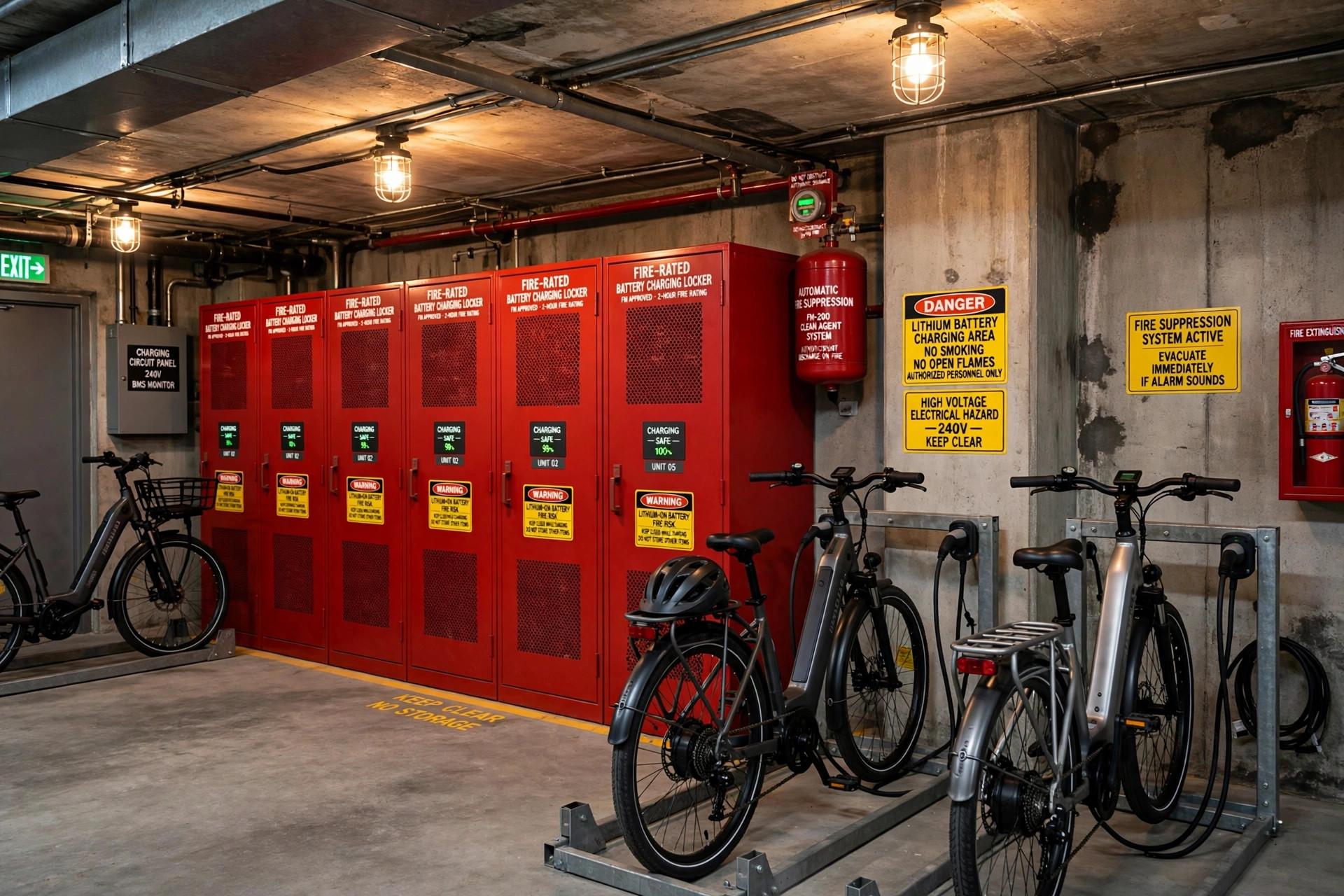
- Charging-room OS: For buildings that build a charge-safe room, the platform runs it: check-in and check-out logging, battery identity on every slot, thermal sensor and smoke-detection integration, sprinkler and spacing compliance documentation, and an incident log that exports in the format the fire department and the insurer expect. Where the building has no room, the module documents the California-compliant alternative: the one-device-per-resident in-unit allowance with its fire-safety rules.
- The compliance packet: One exportable document that answers the underwriter's questions: how many devices, what certification share, which recalls cleared, when the room was last inspected, staff training records, incident history. This is the artifact that keeps the building insurable. It is also the artifact that wins the first enterprise sale, because the property manager can send it to the broker before renewal instead of scrambling after a fire.
- Trade-in bridge: The registry flags uncertified devices and offers the resident a certified trade-in path through Whizz, New York's official trade-in supplier, instead of an eviction notice. This is not charity bolted on. It is the political survival of the product. A registry that only feeds evictions becomes a tenant-organizing target and a city council hearing. A registry paired with an affordable path to a certified battery is a safety program the building can defend.
Unit Economics
| Metric | Value |
|---|---|
| Registry SaaS (per building, by unit count) | $150-$250/month |
| Charging-room management module | $100/month per room |
| Charging-room spec package (one-time) | $2,500 |
| Retrofit referral take (10% of ~$50K buildout) | ~$5,000 per room |
| UL database + recall feed cost per building | ~$8/month |
| Building CAC (management-company channel) | $1,500 |
| CAC payback at $180/month | ~9 months |
| Gross margin (SaaS mix) | 82% |
| Startup cost (18-month runway) | $1.2M |
| Break-even | 20 months |
Methodology note: The $150 to $250 monthly band prices against what property managers already pay for single-issue compliance modules: fire-violation tracking, elevator logs, backflow scheduling. The registry replaces a lawyer-drafted PDF process, so the reference price is the lawyer's retainer, not a consumer app. The 82 percent gross margin reflects that the expensive inputs, the UL listing database and the CPSC feed, are fixed platform costs spread across buildings; the per-building marginal cost is notification delivery and packet generation. The $1,500 building CAC assumes the management-company channel works: one sale to a 40-building manager is forty buildings. Break-even at 20 months assumes the NYC pilot converts three mid-size management companies in year one. Honest footnote: if buildings respond to the first mandate by banning devices instead of registering them, the registry revenue collapses to the charging-room module alone, and the business becomes a facilities-consulting company with a nice dashboard.
Go-to-Market
Phase 1 (months 1-9): Launch in New York with the registry alone, priced to be a rounding error: $150 a month for a 50-unit building. Sell through property management companies, not individual supers, because one contract covers dozens of buildings and the compliance officer is the actual buyer. Seed the recall radar with the refused-recall brands, Rad Power, FENGQS, Ridstar, and make the first sales call after a fire in the prospect's portfolio, which is grim and also how fire compliance has always been sold. Partner with a tenant-legal clinic on the trade-in bridge so the registry launches with resident credibility instead of resident suspicion.
Phase 2 (months 10-18): Add the charging-room OS and the spec package as San Francisco-style rules spread and the Patterson Houses aftermath pushes New York toward a storage mandate. The pitch to the management company flips from risk to revenue: the room is a buildout you can amortize, the referral fee offsets the software cost, and the compliance packet is the renewal document the broker asked for. Expand to California, where section 1940.41 makes the charging-area question mandatory for every landlord, which turns a New York fire story into a California compliance deadline.
Phase 3 (months 19-30): Open the insurer channel. The product the underwriter wants is not software; it is the packet. Sell the compliance packet as the standard battery-risk disclosure for multifamily policies, the way the elevator inspection certificate became standard a century ago. Add Boston, Chicago, and Seattle as their fire marshals copy San Francisco's section 325. The long game is the BIQ-style kitemark play: the registry's data, millions of verified device records, becomes the actuarial input the insurance market prices against, and the company that holds the data holds the standard.
Competitive Landscape
| Company | What It Does | Landlord Registry? | Pricing |
|---|---|---|---|
| SiteCompli | NYC building compliance: FDNY, DOB, and HPD violation tracking; used by 90% of the city's largest management companies; Yardi integrations | No: tracks violations, not the devices that cause them; no battery module | Per-building SaaS, undisclosed |
| BatteryIQ (UK) | AI battery-health dashboard with a per-battery chip and remote shutdown; building a "BIQ kitemark" for insurers and landlords | Adjacent: hardware-based, per-battery, UK pilots in 2027; no US presence, no registry workflow | Undisclosed |
| Nomoto | Battery-failure warning device, a hardware sensor for the pack | No: senses the battery, does not register or document it for the building | Hardware, undisclosed |
| PowerShelter / Tyred | Fire-suppression smart charging lockers deploying UK-wide | No: sells the locker to the building, not the compliance record the insurer reads | Hardware, per-unit |
| Whizz, JOCO, Zoomo | E-bike subscriptions and battery-swap for delivery riders; Whizz is NYC's official trade-in supplier ($59/wk to $169/mo tiers) | No: sells to the rider, which is why the trade-in bridge is a partnership, not a build | $20-$169/week to the rider |
| Housing attorneys (PDF registries) | Norris McLaughlin-style advice: disclosure forms and mandatory registry policies drafted per building | Yes in spirit: the current state of the art, a lawyer's PDF, no software, no recall feed, no verification | Legal fees per engagement |
| UL Solutions | The certification body behind UL 2271/2272/2849; maintains the listing database | No: certifies the product, does not track where it is installed | Testing fees to manufacturers |
| This startup | Tenant device registry with certification verification, CPSC recall radar, charging-room OS, and the insurer-facing compliance packet | Core product: revenue comes from the landlord, and the dataset is the moat | $150-$250/mo per building; $2,500 room spec; ~$5K retrofit referral |
The gap is the landlord's desk. Every battery-safety company sells to the rider or the fire department. Every building-compliance company tracks violations after the fact. The lawyer's PDF registry is the entire current market for proactive building-side battery compliance, and it has no verification, no recall feed, and no software. SiteCompli is the real competitive threat: it owns the management-company relationship and could add a battery module in a quarter. The defense is depth: the recall radar and the insurer packet are data products, not form fields, and they take real fire-code expertise to build right. A violation tracker bolting on a battery checklist is a feature. The registry, verified against UL listings and CPSC actions, wired to the trade-in path, is the product.
Why Now
Six forces are converging, and the Patterson Houses fire is the one that will move the slowest institutions first. First, the fire count broke the trend. New York logged 401 lithium-ion fires year-to-date as of October 28, already past 2025's full-year total of 292, a 41 percent increase, and the profile changed: 61 percent are now non-structural, including 76 fires in city sanitation trucks alone. The sales ban worked at retail, deaths fell to one in 2025, and the hazard moved into storage and disposal, which is exactly the part nobody regulates.
Second, the October fire created the political moment. Four deaths in public housing, a battery blocking the only exit, and a mayor floating cinder-block charging rooms is the kind of event that converts a fire-department wish list into a council bill. NYCHA's own rules date to March 2024 and its own fire count hit 22 this year; the authority's inability to enforce its own policy is the argument for a mandated, auditable system. When the mandate comes, buildings will need the registry on day one.
Third, California already wrote the landlord mandate. Section 1940.41 forces every rental property in the state to provide a charging area or document the in-unit alternative. That is the second market, and it arrives without a fire-death catalyst. San Francisco's section 325 gives the building code the teeth: certified devices only, four per dwelling, sprinklers and three-foot spacing at five chargers. The December 2025 Tenderloin fire, roughly $3 million in damage with a 77-unit building evacuated, showed the city what the rule was for.
Fourth, the recall refusals created the orphan problem. Three CPSC battery actions in a row, Rad Power in November 2025, FENGQS in June 2025, Ridstar in March 2026, ended with the importer refusing to take the batteries back. There is no remediation path for those packs except knowing where they are. A building registry is the only inventory of refused-recall batteries in existence.
Fifth, the insurers moved first. The Insurance Bureau of Canada's August 2026 guidance tells landlords to adopt battery policies and designated storage now. US brokers warn associations that a single fire can move premiums by hundreds of thousands of dollars. BatteryIQ is building an insurer-facing kitemark in the UK. The pattern from every other building risk, elevators, boilers, facades, is that the insurance market standardizes the compliance artifact years before the city council does, and the artifact becomes the sale.
Sixth, the model is already traveling. London logged a record 206 e-bike and e-scooter fires in 2025, and the buildings responded first: the Gherkin, Canary Wharf, and Savills' residential portfolio all ban in-building charging, while fire-suppression locker networks deploy across the UK. Bans without registries push the risk into stairwells. The buildings that want to allow the devices safely need the software that makes allowing them defensible.
Original Contribution: The Orphaned-Battery Inventory
A calculation we could not find published anywhere: count the batteries nobody is responsible for. Take the working estimate of roughly 65,000 delivery devices in New York and the three refused-recall brands, Rad Power, FENGQS, Ridstar, plus the reconditioned packs that Local Law 42 banned from sale but did not remove from circulation. If even 5 percent of the city's delivery fleet rides on batteries whose manufacturers have refused recall or exited the market, that is about 3,250 orphaned batteries charging in residential buildings tonight, with zero remediation path, no manufacturer to call, and no inventory that knows which stairwell each one is in. The 5 percent is an assumption, flagged as such, but the direction is documented: the CPSC's own recent battery actions keep ending in refusal, and every refused battery stays in a building.
Now the ratio that matters for the sale. The December 2025 Tenderloin fire did roughly $3 million in damage to a 77-unit building. A registry at $200 a month costs $2,400 a year. One prevented Tenderloin-scale event pays for 1,250 building-years of the registry. Fire protection is the most asymmetric spend in the building's budget, and it is currently the line item with no software on it. The elevator gets a maintenance contract, the boiler gets an inspection log, the battery gets nothing. That asymmetry is the entire pitch, and no incumbent can make it, because no incumbent knows where the batteries are.
Limitations
Several weaknesses in this analysis deserve plain acknowledgment. First, the core regulatory bet is unmade law: no New York City law currently requires landlords to register e-bike batteries in buildings, and the honest baseline is that most buildings respond to battery risk with a ban, not a registry. Bans do not buy software. The business case leans on a mandate that the Patterson Houses fire makes likely but not certain.
Second, the uncertified-battery problem is a poverty problem, and the product can read as a surveillance tool aimed at delivery workers. Ninety percent of the fleet is uncertified because certified batteries cost $1,000-plus and the riders earn delivery wages. A registry without a funded trade-in path is an eviction machine, and the first building that uses it that way will generate the tenant-organizing campaign that kills the category. The trade-in bridge is load-bearing, not decorative.
Third, the charging-room cost anchor is thin. The $50,000 to $60,000 figure is a single San Francisco bike shop's sprinkler retrofit, not a multifamily charging-room price study, and Alibaba fireproof cabinets run $220 to $999 while smart swap cabinets run $2,900 to $4,900. The retrofit referral revenue is real in structure but soft in number; stress-test the business on the SaaS line alone.
Fourth, certification verification has a counterfeit problem. The FDNY has found fake UL stickers on batteries and chargers, which means the registry's core verification step is probabilistic, not definitive, for the cheapest devices, which are exactly the ones that catch fire. The platform can flag claimed certifications it cannot confirm in UL's database, but it cannot X-ray a pack.
Fifth, the TAM is built on unit counts, not building counts, because no verified count of New York multifamily rental buildings was available. The 8 percent penetration assumption is doing real work. Stress-test at 3 percent, which cuts the NYC SAM to roughly $13 million.
Sixth, the Patterson Houses fire is recent enough that the political response is unknowable. A mayor floating cinder-block charging rooms could produce a mandate, a city-built public charging network that undercuts the private product, or a news cycle that fades. Betting a company on a tragedy requires the tragedy to stay legible, and tragedies fade.
Strongest Counterargument
The strongest case against this startup is that landlords will ban, not buy, and the law lets them. No statute forces a New York landlord to accommodate e-bikes; NYCHA's own rulebook shows the institutional instinct is restriction, and co-ops are already banning devices outright. A ban costs nothing, satisfies the insurer's questionnaire, and requires no software. The registry only wins in the world where the city mandates accommodation, and the city might instead build public charging infrastructure, which Streetsblog reports is currently stalled but politically alive, and which would solve the building's problem without a per-building SaaS contract.
There is also the adverse-selection trap. The buildings that buy the registry are the professionally managed ones that already care about compliance. The buildings generating the 401 fires are the ones whose supers will not log in. If the risk concentrates where the software does not go, the product's safety claims rest on the safest buildings, and the insurer packet becomes a credential for the already-compliant rather than a fix for the dangerous.
And the incumbent threat is not a startup; it is SiteCompli, which already sits inside 90 percent of New York's largest management companies, already tracks FDNY violations, and already integrates with Yardi. A battery-registry module is a quarter of engineering for them, distributed through a channel this startup would have to build building by building. The honest version of this pitch is a feature they have not built yet, in a market they already own, and the window is the time it takes them to notice the Patterson Houses fire too.
The Bottom Line
New York logged 401 lithium-ion battery fires this year, up 41 percent, and a Queens fire killed four people in October because a charging battery blocked the apartment's only exit. The city bans uncertified sales, the fire department padlocks retailers, and inside the building, where the battery actually charges, no law requires the landlord to know a thing. Ninety percent of delivery workers' devices are uncertified, three major CPSC battery recalls in a row ended with the manufacturer refusing to take the packs back, and insurance brokers are telling landlords to build a registry before the underwriters require one. The tenant device registry with certification verification, recall radar, charging-room logs, and the insurer-facing packet is the missing compliance layer, in a TAM of roughly $350 million a year. The honest caveats stand: the mandate is unmade law, bans are free, the uncertified problem is poverty not negligence, and SiteCompli could build the module in a quarter. But the elevator has a logbook, the boiler has an inspection record, and the battery, the fastest-growing fire load in the building, has nothing. Somebody is going to sell the building its battery registry. It should come with a trade-in path, because the alternative is a surveillance tool for evicting delivery workers, and that is not a company worth building.
What You Can Do
- Check your battery's certification: look for a UL 2271, UL 2272, or UL 2849 mark from an accredited lab, and treat a sticker you cannot verify in the UL database as no certification at all.
- Never charge where you would flee: keep batteries away from your only exit, the front door, the hallway, the fire escape, because thermal runaway gives you minutes and the door is the plan.
- Charge awake and present: one device at a time, plugged into a wall outlet, never overnight while you sleep, never within five feet of heat.
- Photograph the certification label now: the sticker wears off, the receipt gets lost, and the day your building asks for proof is the day you will not have it.
- Ask your building for a registry: the lawyer-drafted PDF version already exists as legal advice, so asking for the real thing is not a radical request.
- Check the CPSC recalls before you buy used: refused-recall brands stay in circulation for years, and a used battery with no manufacturer behind it is a liability you carry upstairs.
- Landlords: register before the mandate: the compliance packet is cheapest to build voluntarily and most expensive to assemble after a fire, and the insurer is already asking.
- Support the trade-in path: certified batteries cost $1,000-plus, which is why 90 percent of delivery devices are not certified, and enforcement without an affordable alternative is just punishment.
Related
📰 The Moss Landing Fire Burned for Two Days. Every Battery Project Needs a Fire-Code Paper Trail — grid-scale batteries and the same compliance-paperwork instinct, one market segment up
📰 The Federal Charger Subsidy Died on June 30. 23 Million Apartments Still Need Plugs. — the other electrification problem in multifamily buildings: EV chargers and who pays for the panel upgrade
📰 5.9M Buildings Must Inspect Every Fire Door Annually. The Software That Proves It Happened Doesn't Exist — the fire-door inspection mandate and the software that documents compliance, the closest analog to the battery packet