The Moss Landing Fire Burned for Two Days. Every Battery Project in America Now Needs a Fire-Code Paper Trail.
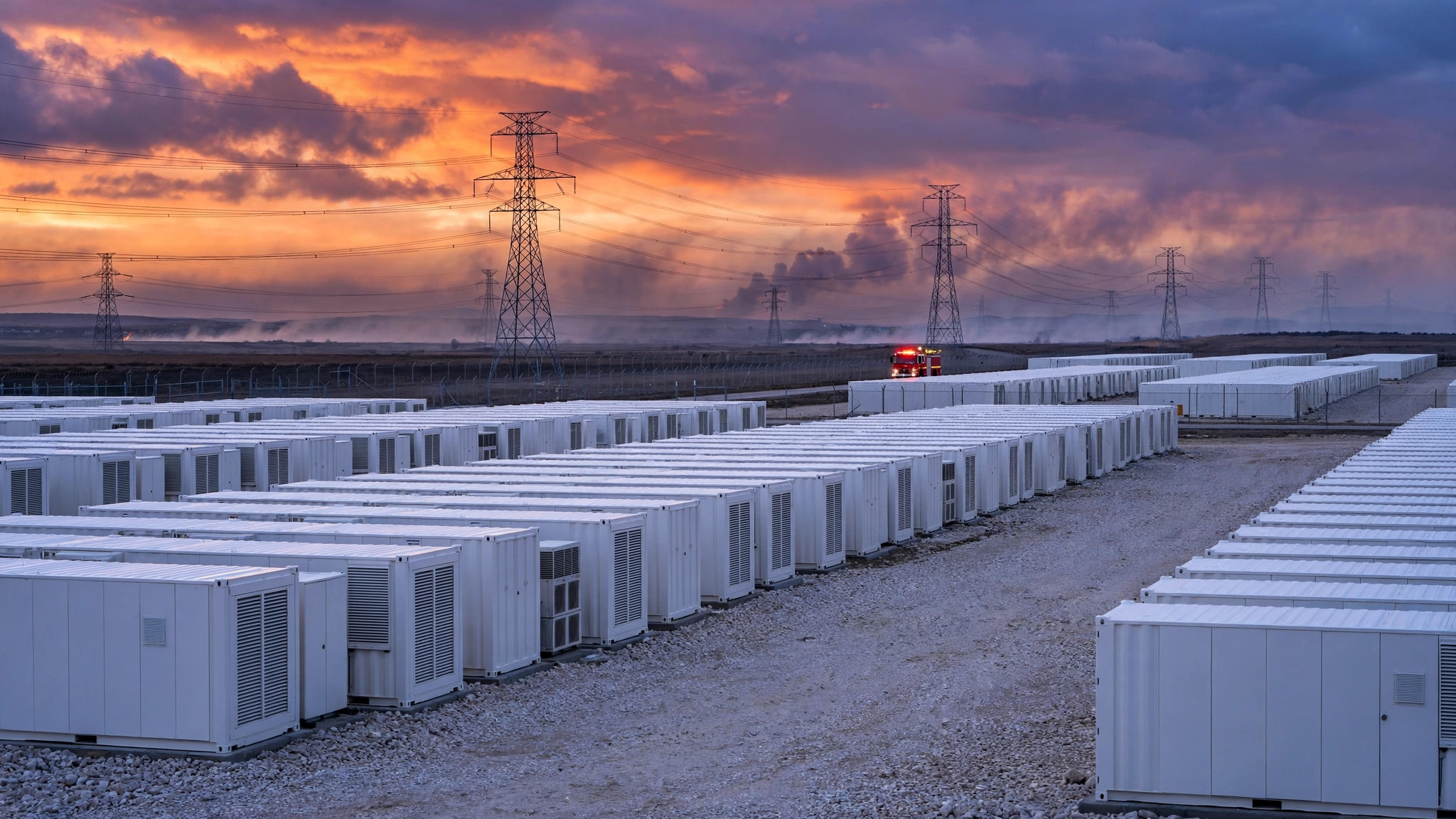
On January 16, 2025, a fire started at the Vistra battery storage facility in Moss Landing, California. It burned for two days, incinerated more than 50,000 lithium-ion batteries, forced the evacuation of up to 1,500 residents, and closed Highway 1. It was the largest battery storage fire in US history. The aftermath rewrote the rules for every battery project in the country: new state laws, county moratoriums, a tougher 2026 edition of NFPA 855, and insurance underwriters demanding documentation most developers cannot produce. The United States installed a record 57.6 gigawatt-hours of battery storage in 2025 and is on track for 600+ GWh by 2030. Every one of those projects now needs a hazard mitigation analysis, a fire-department-coordinated emergency response plan, UL 9540A test documentation, and ongoing compliance records. The entire industry does this work with $400-an-hour consultants and email threads. Nobody has built the software.
The Problem
Battery energy storage is the fastest-scaling piece of the US power grid. According to the Solar Energy Industries Association, the industry installed a record 57.6 gigawatt-hours of new capacity in 2025, up 30% from the previous record, and four times what was installed three years earlier. Cumulative utility-scale storage reached 137 GWh, with another 19 GWh of commercial and industrial and 9 GWh of residential systems. SEIA expects more than 600 GWh installed by 2030. Texas is set to overtake California as the largest storage market in 2026.
Then Moss Landing happened. The Vistra Phase I facility was a 300-megawatt installation housed inside a former natural gas power plant building, one of the largest lithium battery storage sites in the world. Firefighters could not extinguish the blaze because of the extreme heat from thousands of burning cells, so they let it burn. Evacuation orders covered roughly 1,200 residents. A San Jose State University study later found the fire spread 55,000 pounds of toxic heavy metals across the surrounding area. Monterey County's local emergency proclamation was still being renewed in April 2026, fifteen months after the fire.
The political response was immediate and is still compounding. Orange County imposed an emergency moratorium on large battery facilities in unincorporated areas in February 2025. Morro Bay voted a two-year moratorium, and Vistra withdrew its proposed 107-acre oceanfront battery plant there entirely. Monterey County advanced a year-plus moratorium while it drafts new safety ordinances. In Sacramento, Assembly Bill 303 (the Battery Energy Safety and Accountability Act) was introduced eleven days after the fire, and Governor Newsom signed Senator John Laird's SB 283, which took effect January 1, 2026. Under SB 283, battery developers must coordinate with local fire departments before submitting a project application, include facility design, risk assessment, and emergency response plans in the filing, and pass a fire-official safety inspection before operating. Developers pay for the inspections.
At the same time, the technical rulebook got harder. The 2026 edition of NFPA 855, the national standard for energy storage installation, expanded the required Hazard Mitigation Analysis to cover thermal runaway initiation and propagation, hazardous gas generation and dispersion, deflagration and explosion potential, and the performance of detection, suppression, and ventilation systems. Explosion control must now follow NFPA 69, with deflagration venting under NFPA 68 no longer accepted as the primary strategy. New combustible-concentration-reduction systems are required to keep hazardous gases from accumulating during thermal runaway. The 2025 revision of UL 9540A, the fire-propagation test method, added large-scale fire testing expectations that feed directly into spacing and permitting decisions. And UL notes that UL 9540A remains the only consensus standard cited in NFPA 855 for large-scale fire testing.
The result: every battery project in America now needs a thicker compliance file than at any point in the industry's history, and the file keeps getting thicker. Developers must produce hazard mitigation analyses, coordinate with fire departments that have never reviewed a battery project, track conditions of approval across dozens of jurisdictions, maintain current UL 9540A test documentation for their exact cell and system configuration, and hand underwriters the documentation package that determines their insurance pricing. Small and mid-size developers, the companies building most of the C&I and community-scale pipeline, have no in-house fire protection engineers. They hire consultants at $300 to $500 an hour, wait weeks for deliverables, and manage the whole thing over email.
The Scale of the Buildout
The compliance burden is growing because the deployment numbers are extreme. EIA data shows US utility-scale battery capacity exceeded 26 GW at the end of 2024 after developers added 10.4 GW in a single year, a 66% increase. SEIA's 2025 figures put the trajectory steeper still: 57.6 GWh installed in one year, 137 GWh cumulative utility-scale, 19 GWh C&I, 9 GWh residential, and a 600+ GWh target by 2030. Two-thirds of 2025 utility-scale installations were built in states won by Donald Trump in the last election, which matters because the buildout is no longer a blue-state phenomenon subject to one region's politics. It is national, which means thousands of local fire departments and planning departments, most of which have never seen a battery project application, are now the permitting authority.
The safety record is genuinely improving, which is worth stating plainly. EPRI's BESS Failure Event Database shows the incident rate per unit of deployed capacity dropped 99% between 2018 and 2025 as lessons from early failures were designed into newer systems. Root-cause analysis found 46% of failures traced to controls, 43% to balance-of-system components, and only 11% to the cells themselves. The Fire & Risk Alliance assessment found that many documented fires involved legacy systems designed before NFPA 855 and UL 9540A existed. The problem is not that batteries are getting more dangerous. The problem is that public tolerance for the remaining risk collapsed after Moss Landing, and the regulatory response treats every new project as guilty until documented innocent.
That documentation demand is now a direct cost driver. Insurers told ESS News in late 2025 that rising fire-related costs and tighter OEM warranties are creating new financial pressure on battery projects, even as underwriting data improves. kWh Analytics' BESS Broker Council found that documented communication with local fire authorities, including BESS-specific firefighter training, carries significant weight with underwriters and can improve coverage terms. Projects that follow current codes, maintain proper spacing, run advanced monitoring, and secure fire-department buy-in earn measurably better pricing. An Amwins advisory lists what underwriters actually ask for: UL 9540A unit-level test results at minimum, 8 to 10 feet of clearance between rows (an insurance requirement found in no engineering standard), an emergency response plan built with local fire brigade input, and firmware kept current. Every one of those items is a document that must be produced, versioned, and kept current. Today that happens in PDFs and spreadsheets.
The Gap in the Market
The current market for battery fire-safety compliance is entirely human consulting and test labs. Nobody sells software.
| Provider Type | What They Do | What's Missing |
|---|---|---|
| Engineering consultancies (DNV, Exponent, Fire & Risk Alliance) | Hazard mitigation analyses, fire and explosion risk modeling, permitting package support. DNV works directly with fire departments on permitting requirements. | $300-$500/hr, project-by-project, months of lead time. No ongoing monitoring. A 20 MW community-scale developer cannot justify a six-figure consulting engagement, so smaller projects get the thinnest analyses. |
| Fire protection firms (Hiller Companies and regional peers) | Fire protection system design, large-scale fire testing coordination with labs like TÜV Rheinland, AHJ engagement. | Services, not software. Engaged per project. Their deliverables are reports, not living compliance records. |
| Utility safety consultants (ScottMadden and peers) | BESS safety programs, emergency preparedness training, regulatory alignment for utilities. | Built for large utilities with internal EHS teams. Nothing self-service for the independent developers and C&I installers building most of the pipeline. |
| Test labs (UL Solutions, CSA, TÜV Rheinland) | UL 9540/9540A testing and certification, large-scale fire testing. | They produce the test reports. They do not help anyone manage, version, or present those reports to AHJs and insurers across a 30-project pipeline. |
| Insurance data providers (kWh Analytics) | Insurance products and risk data for renewable energy and storage assets. | They sit on the insurer side of the table. They do not generate the compliance documentation developers need to earn better terms. |
The structural gap: a mid-size developer with 15 projects across 6 states needs a hazard mitigation analysis for each project, fire-department coordination logs that satisfy SB 283-style requirements, UL 9540A documentation matched to each project's exact cell and system revision, conditions-of-approval tracking across every AHJ, and an insurer documentation package refreshed at every renewal. Today that is five consultants, forty email threads, and a shared drive. The data is standardizable (NFPA 855 is a national standard; the American Clean Power association even published a model ordinance built on it, and Michigan, Indiana, Maryland, and New York have moved to require NFPA 855 compliance), the deliverables are templatable, and the customers are price-insensitive to a $2,500/month tool that replaces a $60,000 consulting engagement.
The Solution
1. Permit Package Builder ($15,000 per project or $2,500/month per developer org): The developer enters the project location, system configuration, and cell/integrator selection. The platform generates a jurisdiction-aware permitting package: NFPA 855 compliance checklist mapped to the locally adopted edition and amendments, a structured Hazard Mitigation Analysis template pre-populated from the project's UL 9540A test data (thermal runaway propagation results, gas composition and volume, deflagration analysis), site-plan spacing verification against both code minimums and the 8-to-10-foot insurer expectations, and a draft emergency response plan. Where SB 283 or equivalent state rules apply, it generates the fire-department coordination workflow: required touchpoints, documentation of each meeting, and the sign-off trail inspectors ask for.
2. HMA Engine (included in project package): The Hazard Mitigation Analysis is the document AHJs scrutinize most and consultants charge the most to write. The platform structures it per NFPA 855 Section 4.4: thermal runaway initiation and propagation scenarios, hazardous gas generation and dispersion, deflagration and explosion potential per NFPA 69, and evaluation of detection, suppression, ventilation, and separation strategies. It pulls the project's actual UL 9540A test results (cell, module, unit, and installation-level data where available) and flags where the analysis needs a licensed fire protection engineer's stamp. Partner PE firms provide the stamp as a fixed-fee review, turning a $40,000 custom analysis into a $15,000 package with a $3,000 engineering review.
3. Fleet Compliance Monitor ($500-$1,500/month per operating site): Once a project is built, compliance does not end. The platform tracks every ongoing obligation: conditions of approval from each AHJ, inspection schedules, UL 9540A report currency against the installed cell revision (a cell swap can invalidate the test basis), battery management system firmware status (insurers explicitly check this), and local reporting requirements. When NFPA 855 moves from the 2023 to the 2026 edition, or a state amends its fire code, the platform diffs the changes against each site's compliance file and flags what needs updating. This is the product the consultants cannot sell, because it requires software.
4. Insurer Documentation Vault ($750/month per owner, bundled with monitoring): A single versioned package containing everything underwriters ask for: UL 9540A reports matched to installed equipment, spacing calculations, fire-department coordination records and training documentation, emergency response plans, and firmware and monitoring system status. The kWh Analytics broker council finding is the sales pitch: documented fire-authority coordination moves coverage terms. The vault makes that documentation auditable instead of anecdotal, and adds premium benchmarking across the platform's customer base so owners can see whether their pricing reflects their risk profile.
5. AHJ Review Portal ($5,000/year per jurisdiction): The other side of the market. Most fire departments reviewing their first battery project have no internal expertise and no budget to hire it. The portal gives them a structured plan-review checklist built on NFPA 855 and the ACP model ordinance, BESS 101 training materials for their inspectors, pre-incident plan templates, and a direct channel to receive the developer's coordination submissions. Every AHJ that adopts the portal becomes a distribution channel: developers learn that filing through the portal is the fastest path to approval.
The Math: What a Permitting Delay Actually Costs
Take a representative 200 MW / 800 MWh standalone storage project in California, the kind of project that now faces the full post-Moss Landing gauntlet. Installed cost runs roughly $250 per kWh, so the project represents about $200 million of capital. Once operating, a project this size in the California market can reasonably gross $20 to $30 million per year from energy arbitrage, capacity payments, and ancillary services. Use $25 million.
Scenario A: permitting proceeds on the pre-2025 timeline. Eighteen months from application to notice to proceed. Financing closes on schedule. First-year revenue: $25 million.
Scenario B: the AHJ, facing its first battery project and new SB 283 coordination requirements, takes an additional nine months. The fire department asks for a revised hazard mitigation analysis. The planning commission continues the hearing twice. Nothing about the project changes except the calendar.
Cost of the nine-month delay: $18.75 million in foregone gross revenue (nine months of $25M/year), plus carrying costs on committed capital. If $60 million of equity and development capital is tied up at an 8% cost of capital, nine months costs another $3.6 million. Interconnection deposits and equipment reservation fees add more. Total: comfortably above $20 million, before counting the risk that offtake contract deadlines slip or tax credit timing shifts.
Against that, the cost of the platform for this project: one $15,000 permit package plus $1,500/month monitoring, or about $33,000 in year one. The pitch to the developer is not "save money on consultants," though it does that too. The pitch is "de-risk the single most unpredictable line item in your development timeline." A tool that shortens permitting by even one month pays for itself roughly 600 times over on a project this size.
Revenue Model
| Revenue Stream | Amount | Notes |
|---|---|---|
| Permit Package Builder (per project) | $15,000 one-time | HMA template, jurisdiction package, ERP draft, spacing verification. ~80% gross margin after PE review partner fees. |
| Developer platform subscription | $2,500/month per org | Unlimited jurisdiction research, code-change alerts, pipeline dashboard. Land-and-expand across the developer's project pipeline. |
| Fleet Compliance Monitor (per site) | $500-$1,500/month | Scaled by site size. Ongoing obligations tracking, firmware status, code-edition diffs. 90%+ gross margin. |
| Insurer Documentation Vault | $750/month per owner | Bundled with monitoring. Versioned underwriter package + premium benchmarking. High retention: switching costs are the compliance history itself. |
| AHJ Review Portal | $5,000/year per jurisdiction | Plan-review checklists, inspector training, submission intake. Distribution channel as much as revenue: AHJs steer developers to the platform. |
| PE stamp review (pass-through + margin) | $3,000 per HMA | Partner fire protection engineering firms. 20-30% margin on pass-through. Required in jurisdictions demanding a licensed stamp. |
Unit economics on a typical mid-size developer (10-project pipeline, 4 operating sites): Annual platform subscription: $2,500 x 12 = $30,000. Permit packages: 3 projects/year x $15,000 = $45,000. Site monitoring: 4 sites x $1,000 x 12 = $48,000. Vault: $750 x 12 = $9,000. Total first-year revenue per customer: $132,000. Customer acquisition cost via industry conferences, AHJ referrals, and insurer broker partnerships: ~$18,000. LTV at 5-year retention: ~$600,000. LTV:CAC ratio: 33x. The numbers work because the customer's alternative is six figures of consulting per project.
Market Size
TAM: Annual US spending on BESS fire-code compliance: new-project permitting and HMA consulting (roughly 500 utility-scale and 2,000 C&I projects entering permitting each year at an average $20,000 consulting-equivalent = $50M), ongoing operating-site compliance and insurer documentation (~3,500 sites by 2028 at ~$12,000/year = $42M), and AHJ review tooling (~1,000 active BESS jurisdictions at $6,000/year = $6M). Total: ~$100M/year, growing roughly in line with the 30%+ annual deployment growth SEIA reports. International expansion (the same NFPA/IEC framework logic applies in Canada, Australia, and the UK) roughly triples the long-term figure.
SAM: Utility-scale and C&I developers, owners, and EPCs in California, Texas, Arizona, New York, and Florida, the five states holding roughly 70% of US deployments and the strictest AHJ regimes (SB 283 in California, New York City's fire department requirements, Arizona's post-McMicken scrutiny). Approximately 45% of the TAM: ~$45M/year.
SOM (year 3): 120 developer/owner customers at $35,000 blended average annual contract (platform subscription plus permit packages amortized) = $4.2M ARR, plus ~$1.8M in cumulative one-time permit package and PE review fees. Roughly 9% penetration of SAM.
Why Now
Moss Landing reset the politics permanently. A two-day fire that evacuated 1,500 people and spread 55,000 pounds of heavy metals does not fade from county supervisors' memories. Moratoriums in Orange County, Morro Bay, and Monterey County are the visible part. The invisible part is the hundreds of planning commissions that now treat battery projects as guilty until documented innocent. SB 283 made fire-department coordination a statutory requirement in the country's largest storage market as of January 1, 2026, and Assembly Bill 303, introduced eleven days after the fire, would add further restrictions. The compliance ratchet only turns one direction.
NFPA 855-2026 and UL 9540A-2025 landed at the same time. The new HMA requirements, NFPA 69 explosion control, combustible-concentration-reduction systems, and large-scale fire testing expectations took effect just as AHJs began adopting them into local code. Every project designed under the 2020 or 2023 editions faces re-examination questions. A platform that encodes the current edition and diffs it against prior ones is most valuable at exactly this kind of code transition, which happens every three years.
Deployment velocity is overwhelming the AHJs. 57.6 GWh installed in 2025, 600+ GWh expected by 2030, and two-thirds of new utility-scale capacity going up in states where most fire departments have never reviewed a battery application. The bottleneck in battery deployment is shifting from interconnection queues to local permitting. Anything that makes AHJ review faster and more predictable has developers, insurers, and the AHJs themselves as buyers.
Insurance turned documentation into money. The kWh Analytics broker council finding is the industry telling developers outright: documented fire-authority coordination and code compliance earn better coverage terms. With OEM warranties tightening and fire-related costs rising, the spread between a well-documented project and a poorly documented one is now measured in real premium dollars. Compliance stopped being a cost center and became a P&L input.
The standards converged enough to encode. Michigan and Indiana passed laws requiring NFPA 855 compliance. Maryland and New York adopted regulations enforcing the latest edition. The American Clean Power association published a model ordinance built on NFPA 855 as its core. For the first time, there is a close-enough-to-national compliance framework that software can encode once and localize per jurisdiction, instead of fifty bespoke consulting engagements.
Startup Costs
| Category | Cost | Notes |
|---|---|---|
| Compliance rules engine (NFPA 855 + UL 9540A + state amendments, 8 months) | $260K | 2 backend engineers + 1 licensed fire protection engineer. Must correctly encode HMA requirements, spacing rules, explosion control provisions, and jurisdiction-level amendments across the top 5 states. |
| Document generation pipeline (HMA, ERP, permit packages) | $90K | 1 full-stack + 1 document engineer. Templated generation from project inputs and UL 9540A test data ingestion. |
| Frontend (developer dashboard + AHJ portal, 6 months) | $120K | 1 frontend + 1 full-stack developer. Pipeline view for developers, review queue for AHJs, document vault for owners. |
| PE validation and legal review | $45K | Fire protection PE to validate the rules engine against real HMA practice. Legal review of state-by-state filing requirements and PE stamp partner agreements. |
| Pilot program (5 developers, 10 projects) | $30K | Subsidized permit packages in California and Texas in exchange for feedback, case studies, and AHJ introduction rights. |
| Industry presence (year 1) | $35K | RE+, Energy Storage Summit, state fire marshal conferences. Booth, travel, AHJ training workshops. |
| Operating buffer (12 months) | $50K | Cloud hosting, data licensing, customer support, legal entity. |
| Total | $630K |
Limitations
The TAM build-up leans on estimates, not measured spending. Nobody publishes what US developers spend annually on battery fire-code consulting, so the $50M new-project figure is constructed from project counts and assumed per-project consulting costs. If the true average consulting spend is $8,000 rather than $20,000, the TAM compresses substantially. The project-count inputs (500 utility-scale and 2,000 C&I projects entering permitting per year) are inferred from deployment trajectories, not counted from permit filings.
The safety trend cuts against the urgency narrative. EPRI's data shows the failure rate per unit of deployed capacity fell 99% from 2018 to 2025. If the industry's actual risk keeps falling while the regulatory burden keeps rising, there is a scenario, perhaps five years out, where the compliance pendulum swings back and the documentation requirements relax. A business built on compliance friction is exposed to deregulation risk, and battery storage has a plausible path to being treated as routine electrical infrastructure rather than a special hazard.
SB 283 is California-only. The strongest statutory driver in the pitch applies to one state, albeit the largest storage market. The moratoriums are county-level. Federal preemption or a change in California's political winds could slow the state-law momentum, though the NFPA 855 code cycle provides a standard-driven floor regardless of legislation.
The AHJ portal faces a cold-start problem. Fire departments adopt tools slowly, through associations and state fire marshal channels, not through SaaS sales motions. The portal-as-distribution-channel thesis requires years of relationship building with organizations that buy almost no software today.
Strongest Counterargument
The industry is already fixing this without software, and the incumbents have the relationships that matter. DNV has worked directly with the New York City Fire and Building Departments on storage permitting. Exponent wrote the guidance on the new NFPA 855 provisions. The American Clean Power association, the industry's own trade group, published the model ordinance and is lobbying states to adopt it. Large developers and utilities already retain these firms, and the AHJs trust their stamps. A SaaS startup is asking fire chiefs and planning commissioners to trust a generated document over a relationship with a known engineering firm, in a domain where a mistake can mean a two-day fire and a county emergency proclamation. Trust is the product, and trust takes a decade to build.
The counterpoint has three parts. First, the trust objection applies to the largest developers, who are not the initial customer. The initial customer is the 20 MW community-scale developer in the Central Valley who cannot get DNV on the phone for a project that size, and the C&I installer doing their third battery project who currently has no compliance process at all. The underserved tail is where the consulting model structurally cannot reach, which is exactly where software wins. Second, the platform does not ask anyone to trust a generated document over an engineer's stamp. It generates the analysis and routes it to a partner PE firm for the stamp, keeping the trusted human in the loop while automating everything around them. Third, the AHJs are the actual bottleneck, and they are the buyers most desperate for help. A fire department reviewing its first battery project does not have a trusted relationship with anyone. It has a 400-page application it cannot evaluate. The portal gives it the checklist, and the checklist creates the standard the developers then build to.
What You Can Do
If you're a battery developer with projects in permitting: Request your integrator's complete UL 9540A test package today, not at the AHJ's request. You need cell, module, unit, and installation-level results matched to the exact cell revision you plan to install. A cell swap after the HMA is written can invalidate the test basis and restart your permitting clock. Separately, call the local fire department before you file anything. SB 283 requires it in California, and everywhere else it is the cheapest schedule insurance you will ever buy. Document every meeting.
If you're a fire official or AHJ planner seeing your first battery application: Start with the American Clean Power model ordinance and the Interstate Renewable Energy Council's Energy Storage Systems Guide, which was written specifically as a training reference for safety officials. Require the NFPA 855 Hazard Mitigation Analysis as a condition of a complete application, and require the applicant to fund your third-party review. Do not accept a UL 9540 listing alone as evidence of installation safety. The listing covers the product. The HMA covers the installation.
If you're a developer considering this space: Start with the HMA as the wedge. It is the single document every AHJ asks for, every consultant overcharges for, and every insurer wants to see. Your MVP is a structured HMA builder for one jurisdiction (pick a California county with an active moratorium conversation; the AHJs there are motivated buyers) that ingests a UL 9540A test report and outputs a Section 4.4-compliant analysis with a partner PE stamp. Skip the AHJ portal and the insurer vault for v1. If you can reliably turn a test report into a stamped HMA in two weeks for $15,000, you have a business, and every fire department that accepts your format becomes your sales team.
The Bottom Line
The United States is installing battery storage faster than any energy technology in its history, 57.6 gigawatt-hours in 2025, on the way to 600 by 2030, and the January 2025 Moss Landing fire converted every one of those future projects into a fire-code compliance exercise. The rules are real and getting stricter: a new NFPA 855 edition with expanded hazard analysis and explosion control requirements, a California statute mandating fire-department coordination, county moratoriums, and insurance underwriters who now price the quality of your documentation. The work of complying is real too: hazard mitigation analyses, emergency response plans, UL 9540A test packages, conditions-of-approval tracking across thousands of local jurisdictions. And the entire industry still does it the way it did everything in 2019, with consultants billing by the hour and PDFs in shared drives. The formulas are published. The standard is national. The deliverables are templatable. The customers are developers who will pay $2,500 a month to protect a $200 million project schedule. Somebody is going to build the compliance layer for the battery buildout. The fire already happened. The paperwork is the opportunity.