The Federal Charger Subsidy Died on June 30. 23 Million Apartments Still Need Plugs.
Retrofitting a single Level 2 charger into an old apartment garage costs $5,000 to $20,000, mostly in electrical work the federal government used to subsidize. Load-management software can put ten chargers on the breaker panel that used to hold one. Nobody sells that as a managed service to the mid-market landlords who own most of the buildings.
The Problem
About 80 percent of all EV charging happens at home, according to the Department of Energy. That statistic is the quiet engine of the entire charging industry, and it quietly excludes tens of millions of renter households. If you own a house, charging is a $500 outlet and an electrician's afternoon. If you rent an apartment, charging is a negotiation with a property manager, an HOA, an electrical panel installed when Nixon was president, and a trenching quote that starts at five figures.
Demand is not the problem. In the National Multifamily Housing Council's 2024 renter preferences survey, only 4 percent of renters drove a fully electric or plug-in hybrid vehicle, but 12 percent planned for their next vehicle to be electric and another 35 percent were considering it. Of those considering or planning, 42 percent expected to buy or lease within two years. Only one-quarter of current EV-driving renters were even somewhat satisfied with their building's charging options, and 34 percent said their community had no chargers at all. A separate 2024 survey found 34 percent of tenants want EV chargers in their building, up seven percentage points from the year before. Jeff Allen, executive director of the nonprofit Forth, put it bluntly: in San Jose, an apartment manager needs to be providing charging today.
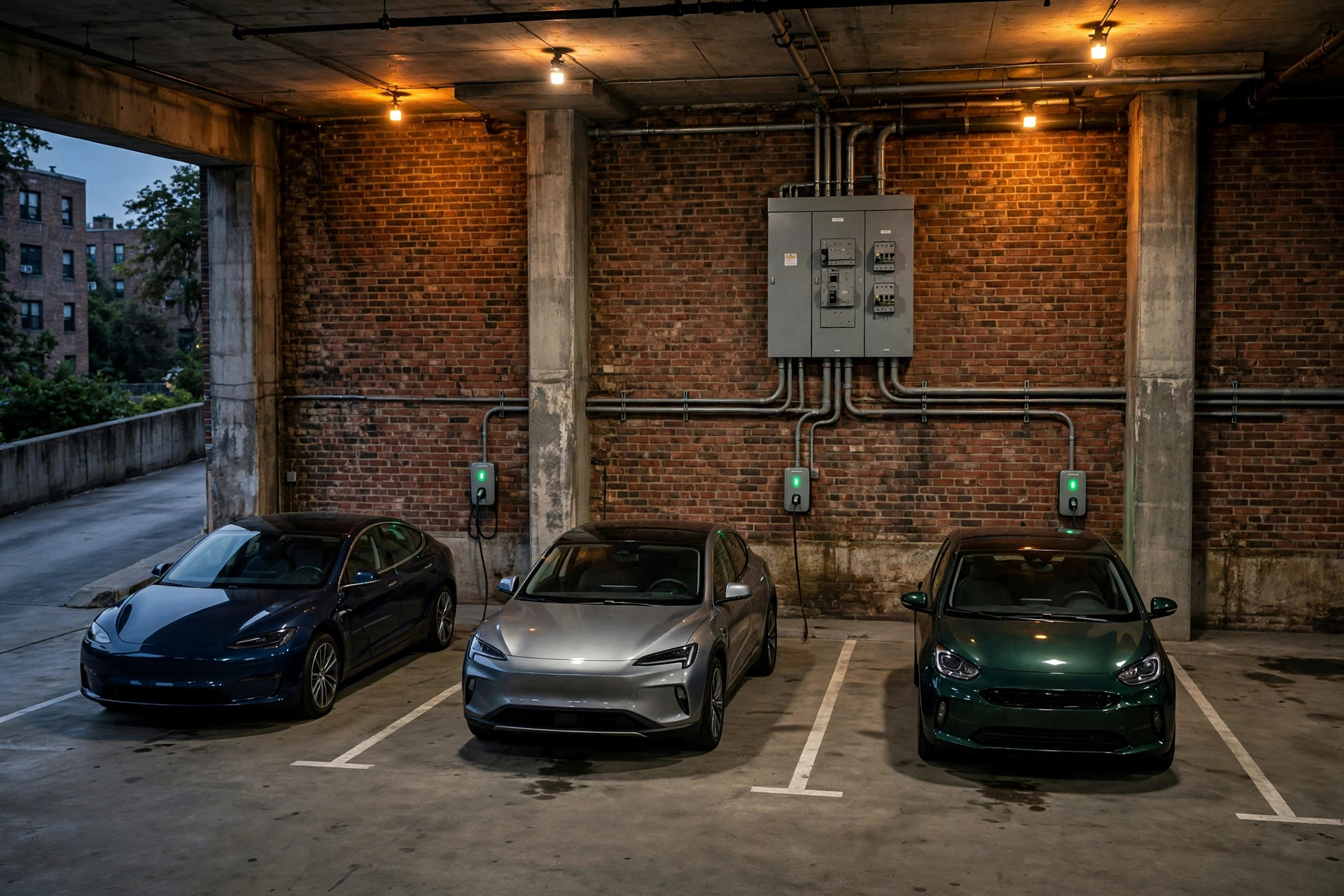
Supply is where the math breaks. Loren McDonald, CEO of the analyst firm EVAdoption, estimates that retrofitting older (pre-1990s) apartment buildings with Level 2 charging runs $5,000 to $20,000 per station, because the buildings typically need electrical panel upgrades and sometimes new service pulled from the utility. Forth Mobility puts the typical installed cost under $5,000 per charger, dropping to $2,000 to $3,000 when several go in at once, but notes that full service upgrades can push individual projects past $100,000. A 1968 garden-style complex with a 200-amp house panel and 150 feet of asphalt between the panel and the parking lot is not a $2,000 job. It is a trenching, boring, permitting, transformer-coordination job, and the utility's side of that coordination now routinely takes 12 to 24 months.
Until four months ago, the federal government softened that blow with the Section 30C charging credit. It expired for new installations on June 30, 2026. What that did to the economics is the timing story of this whole idea, covered in Why Now below.
Meanwhile the law is narrowing landlords' room to refuse. California's right-to-charge statute (Civil Code 1947.6, in force since 2015) bars landlords from unreasonably refusing a tenant's written request to install a charger at the tenant's own expense, and similar statutes now exist in Colorado, Florida, Hawaii, Maryland, New Jersey, New York, Oregon, and Virginia. Most of those cover condos and HOAs; California's and Colorado's extend to rental apartments. Illinois went further for new construction: its Electric Vehicle Charging Act requires 100 percent of parking spaces in new homes and multiunit dwellings to be EV-capable, with conduit and reserved capacity for future chargers. In a growing number of states, landlords cannot unreasonably say no. What they lack is a way to say yes that does not involve a six-figure electrical project and a tenant billing headache.
Market Size
TAM calculation: Start with the housing stock. The National Multifamily Housing Council puts the count at 23 million apartment units in the United States (buildings with five or more units), housing more than 41 million people. A multifamily industry analyst quoted in Multifamily Executive expects that by 2030, a quarter of the vehicles parked at a typical apartment complex could be electric. At roughly one vehicle per unit, that implies about 5.75 million resident EVs needing a home plug by 2030. Price the software-and-billing revenue per EV at $20 per month in orchestration SaaS plus energy margin, or $240 per year. That puts the fantasy TAM at about $1.4 billion per year. Most of those EVs will never materialize on that schedule, and many buildings will solve charging with dumb outlets and no software.
Anchor the realistic SAM to ports, not cars. Industry coverage citing NREL's 2030 national charging-needs projections puts the U.S. need at 28 million charging ports by 2030, of which 2.1 million are Level 2 ports at multifamily properties, workplaces, and businesses. Assigning roughly half of those to multifamily gives about 1.05 million multifamily ports by 2030. At $20 per port per month in SaaS revenue, that is $252 million per year in software SAM. Add tenant energy billing: 1.05 million ports averaging 200 kWh per month at a 6-cent margin is $151 million per year in billing margin. Add one-time onboarding engineering ($2,500 per building across roughly 30,000 buildings, averaging 35 ports each) for $75 million in cumulative services revenue. Combined SAM: roughly $403 million per year in recurring revenue at 2030 scale, plus the onboarding layer.
Year 3 target: 40,000 managed ports at a blended $32 per port per month ($20 SaaS plus $12 energy margin) equals $15.4 million in ARR, plus $2 million in onboarding engineering fees, for about $17 million in Year 3 revenue. Getting there runs through mid-market property managers: one 150-building management company at 60 ports per building is 9,000 ports in a single contract.
Why Now
Five forces are converging. First, the subsidy cliff. When the 30C credit died on June 30, 2026, it removed the 30 percent federal offset that made $5,000-to-$20,000-per-port retrofits pencil out. Morningstar's OPIS coverage of the expiration quoted installers bracing for exactly this math: without the credit, the only retrofits that clear a property manager's hurdle rate are the cheap ones. A no-upgrade install at under $2,500 per port is no longer the budget option. It is the only option.
Second, the legal ratchet only moves one way. Ten states now have right-to-charge statutes or EV-capable construction mandates touching multifamily housing, and California's building code keeps tightening EV-capable requirements for new apartments. Most existing statutes cover condos and HOAs, but California's and Colorado's extend to rentals, and every one of these laws converts tenant demand into landlord obligation while doing nothing about the electrical reality of a 1970s building. Today that compliance workflow is a folder of PDFs and an electrician's cell number.
Third, the demand curve bent upward right on schedule. NMHC's 2024 data shows 12 percent of renters planning an EV next and 35 percent considering one, with 42 percent of the intenders buying within two years. PwC's EVSE analysis has multifamily going from nearly zero percent of the charging market to 17 percent by 2030. Buildings that install orchestration now get the learning curve and the tenant goodwill; buildings that wait get the same tenant requests with less panel headroom left.
Fourth, the utility programs are still alive even though the federal credits are not. National Grid's programs can pay up to 100 percent of multifamily charging infrastructure costs, including wiring and trenching, and most major utilities run some version of a make-ready or EV-ready site plan. A software company that arrives with an engineered, utility-friendly install design is the ideal counterparty for these programs, which currently drown in applications from property owners who have no idea what to ask for.
Fifth, the hardware got cheap enough to be disposable. A reliable OCPP-compliant Level 2 charger now costs around $400, down from over $1,000 five years ago. When the charger is a commodity, the value migrates to the layer that decides how much power each one gets and who pays for it. That layer is software, and it is the only part of the stack with recurring revenue.
The Product
A hardware-agnostic charging orchestration platform sold to property managers, built around one guarantee: no panel upgrade required. It starts with an engineered load study of the building's actual electrical capacity, then designs a charger layout that fits inside it, then operates the whole thing: power orchestration, tenant billing, and maintenance dispatch. Five modules:
- PanelFit screening: The wedge product. A $499 remote screening that answers the only question a property manager actually has: how many chargers can this building's existing service support? It models the panel, the feeder, the building's overnight base load, and the utility's time-of-use windows, then estimates a port count and a per-port power budget. Buildings that clear screening can commission the full $2,500 stamped engineering study, signed by a licensed engineer, which certifies the no-upgrade design. The stamped fee is credited against first-year SaaS on deployments of 100 ports or more. If the math says the building needs a service upgrade, the study says so plainly; a screening product that sometimes says no is more believable than one that never does.
- Orchestration engine: The core software. It speaks OCPP 2.0.1 to any compliant charger, which means the property can buy $400 commodity Level 2 units instead of $3,000 networked ones, and the platform still does building-level power management: per-circuit budgets, per-panel budgets, and whole-building budgets, reallocated in real time as cars plug in, taper off, and finish. Overnight, it shifts load into the utility's cheapest time-of-use window and keeps the building's 15-minute demand peak under the threshold that triggers commercial demand charges.
- Tenant billing and submetering: Each driver gets an account; each session is metered at the charger and billed at the property's configured rate (cost-plus, flat session fee, or time-of-use pass-through). Managers get one monthly settlement instead of a bookkeeping problem. On the electricity-resale question, the design intent is a parking amenity fee with metered reconciliation rather than a per-kWh sale in states that restrict resale, but that structure is untested at scale and every deployment gets state-by-state review by counsel before billing goes live. One honest tension is disclosed up front: on a flat $35 monthly amenity fee, the tenant pays for roughly 200 kWh while the building's off-peak cost is closer to $30, so the building keeps a spread. The platform defaults to cost-plus pass-through so tenants see the cheap overnight rate, and it flags any building pocketing more than a configured margin.
- Right-to-charge workflow: When a tenant invokes the state's right-to-charge law, the request lands in a managed queue: eligibility check, PanelFit verification that capacity exists, standardized installation scope, contractor dispatch, and billing enrollment. What was a legal obligation with no operational playbook becomes a three-click approval instead of a custom electrical project.
- Demand-charge guard: For buildings on commercial rates, the platform's overnight scheduling is explicitly optimized against the utility's demand-charge ratchet, which is where unmanaged charging silently destroys the economics. A single unmanaged 48-amp charger can add hundreds of dollars a year in demand charges; ten of them can add thousands. This is the module that pays for the subscription on its own.
Unit Economics
| Metric | Value |
|---|---|
| SaaS per managed port/month | $20 |
| Energy billing margin per port/month | $12 (200 kWh at 6 cents) |
| Blended revenue per port/month | $32 |
| PanelFit screening / stamped study per building | $499 / $2,500 (study credited vs year-one SaaS at 100+ ports) |
| Cloud + OCPP + metering cost per port/month | $2.50 |
| Support + maintenance dispatch per port/month | $2 |
| Gross margin | 86% |
| CAC per building (60-port average) | $8,000 ($133/port) |
| LTV per port (48-month retention, 86% margin) | $1,320 |
| LTV:CAC per port | 9.9:1 |
| Payback period per building | 4.8 months |
| Startup cost (18-month runway) | $1.4M |
| Break-even | Month 22 (model output) |
Methodology note: The 48-month retention assumes the product becomes load-bearing infrastructure: once tenant billing, utility rate optimization, and right-to-charge compliance run through the platform, switching costs are real. CAC of $8,000 per building reflects a 4-to-6-month sale to a regional property manager, including screening labor. Gross margin of 86 percent reflects a software-plus-metering model with no hardware inventory. Payback uses margin, not revenue: $8,000 in CAC divided by 60 ports at $27.50 monthly margin each ($1,650 per building per month) equals 4.8 months. The $1.4M startup figure breaks down as roughly $950K in loaded personnel (five engineers, two field engineers, one sales lead over 18 months), $250K for OCPP certification, UL 916 listing partnership, and a metering test lab, and $200K for cloud, legal, and insurance. Break-even at month 22 is a model output assuming the Phase 3 portfolio ramp below, not a commitment.
Go-to-Market
Phase 1 (months 1-6): The company sells the $499 PanelFit screening, not the platform. An engineered answer to "how many chargers can my building take" is an easy yes for any property manager fielding tenant requests, and every screening is a qualified lead with the building's electrical profile already in hand. California and Colorado come first: both extend right-to-charge protection to rental apartments and both sit in the top tier of EV adoption. Distribution runs through NAA local chapters and the property-management trade press, where the pitch is one line: find out what your panels can already do before you pay for an upgrade.
Phase 2 (months 7-14): Screenings convert to stamped studies and managed ports. The first 50 buildings prove the no-upgrade guarantee in the field and build the reference base. The commodity-charger bundle is priced aggressively: a $400 OCPP charger plus a $150 controller per port, installed by partner electricians, keeps the all-in per-port cost under $2,500 including the study. That number matters because it is less than half of Forth Mobility's typical $5,000 installed cost and requires no utility coordination.
Phase 3 (months 15-24): The company moves upmarket to portfolio managers. The top 50 management companies control 5.3 million units, about 24 percent of national apartment stock, and Greystar alone manages over a million units. Greystar itself is not the target; managers ranked 20 through 50 (40,000 to 150,000 units each) are big enough to move the port count and small enough to buy from a startup. Utility partnerships layer in next: make-ready programs like National Grid's, which can cover up to 100 percent of infrastructure costs, turn cheap installs into nearly free installs. Finally the demand-response channel opens: aggregated overnight charging load is exactly what utilities want to dispatch, and the platform is already scheduling it.
Competitive Landscape
| Company | What It Does | Why It Leaves the Gap | Pricing |
|---|---|---|---|
| ChargePoint | Networked Level 2 hardware plus cloud, the default enterprise multifamily choice | $3,000-plus hardware per port and ~$30-$40/month network fees; the property still pays for the panel upgrade and the demand charges | Hardware + $400+/port/year |
| EverCharge | Proprietary SmartPower dynamic load management over a wireless mesh, UL 916 listed | Strongest load-management tech in the market, but proprietary hardware means lock-in and premium pricing; built for large portfolios | Premium hardware + service contract |
| SWTCH Energy | Hardware-agnostic OCPP 2.0.1 platform with four-level load management; claims 10x more chargers per panel | Closest competitor; sells project-based enterprise deployments, not a managed per-port service for the mid-market | Project pricing |
| Orange Charger | Simple ~$800 outlet-style charger with an app, aimed at apartments | No load management, no panel engineering, no tenant billing; solves the outlet, not the building | ~$800 hardware |
| Xeal | Token-based chargers that work without network connectivity; owner buys hardware, no ongoing fees | Upfront hardware cost with no building-level orchestration or demand-charge management | Hardware purchase, 5-year warranty |
| AmpUp | Charging network software for shared and fleet use | Workplace and fleet focus; not built for multifamily tenant billing and right-to-charge workflows | SaaS per port |
| This startup | Hardware-agnostic orchestration with a certified no-upgrade install, tenant billing, and right-to-charge workflow, sold per port to mid-market managers | The gap: nobody bundles the engineering guarantee with the software for buildings too small for SWTCH and too old for ChargePoint economics | $20/port/month + screening |
This gap is a segmentation failure, not a technology failure. Running ten chargers on one panel is proven technology; SWTCH and EverCharge prove it. But both sell it as an enterprise project to big portfolios, ChargePoint sells expensive hardware to anyone who will buy it, and the cheap end of the market sells dumb outlets. A 50-to-300-unit building with a 1978 panel, a regional manager, and three tenants citing the right-to-charge statute has no vendor. That building is most of the country's apartment stock.
By nameplate math, the panel supports four chargers. By behavioral math it supports ten with room to spare.
Original Contribution: The Panel Math, Stated Honestly
A calculation the industry rarely shows its work on: what does a 200-amp apartment panel actually support once you stop sizing for nameplate and start sizing for behavior? A standard Level 2 charger draws 48 amps at 240 volts, or 11.5 kW. Ten of them sum to 480 amps of nameplate load, which is why the conventional answer is a service upgrade. But EverCharge's published multifamily operating data shows the average charging session delivers about 10 kWh, and the average vehicle dwell time in an apartment garage exceeds 16 hours. Ten kilowatt-hours spread over 16 hours is an average draw of 0.625 kW per car. Ten cars charging "simultaneously" in the statistical sense draw 6.25 kW combined, against 48 kW of available panel capacity.
Two derates keep this honest. First, the building's overnight base load: elevators at idle, corridor lighting, laundry rooms, and common-area HVAC typically draw 10 to 15 kW in a mid-size building, and PanelFit models that load explicitly rather than pretending the panel belongs to the cars. Second, the electrical code: EV charging counts as a continuous load, so NEC Article 625 requires sizing at 125 percent, which means a 200-amp panel legally carries 160 amps continuous, or 38.4 kW at 240 volts. Run the conservative case: every car needs its full 10 kWh inside a 6-hour overnight cheap-rate window rather than 16 hours. That is 1.67 kW average per car, 16.7 kW for ten cars, plus 12 kW of base load, totaling under 29 kW against a 38.4 kW continuous rating. The panel sits at about 75 percent of its legal continuous capacity with ten chargers running. By nameplate math it supports four chargers. By behavioral math, with the derates included, it supports ten.
Now the money version, per 100-unit building targeting 20 ports. Conventional retrofit at Forth Mobility's typical $5,000 per port: $100,000, plus likely panel work pushing toward $150,000. Orchestrated install at $2,500 per port all-in: $50,000. That $100,000 saving is larger than the entire 30C credit would have been on the conventional install. The subsidy died; software ate its lunch.
Limitations
Several weaknesses in this analysis deserve plain acknowledgment. First, the NREL port forecast bundles multifamily with workplace and business charging; the 50 percent multifamily split used in the SAM is an assumption, not a published figure. If workplaces take the larger share, the SAM shrinks proportionally.
Second, the "25 percent of on-site vehicles electric by 2030" figure is a single industry analyst's expectation quoted in the trade press, not a modeled forecast. Actual multifamily EV penetration will vary enormously by metro: San Jose is not Leavenworth, Kansas.
Third, electricity resale regulation is a genuine thicket. Several states restrict or condition the resale of electricity, which is why the product leads with an amenity-fee billing structure and state-by-state counsel review. That structure is defensible but untested at scale, and a hostile public utility commission ruling in one large state could force a pricing redesign.
Fourth, the PanelFit "no-upgrade guarantee" carries real engineering liability. A licensed engineer stamps every study, which means professional liability insurance, which means the $2,500 fee has to cover real review cost. If the close rate from $499 screening to stamped study to managed ports is low, the company becomes a low-margin engineering consultancy with a software hobby.
Fifth, the 48-month retention assumption is doing heavy lifting in the LTV math. Tenant turnover in apartments runs 40 to 50 percent annually; if charging accounts do not survive unit turnover cleanly, or if a new property manager rips out the platform during a management change, realized retention will be shorter and the 9.9:1 LTV ratio will compress.
Strongest Counterargument
The strongest case against this startup is that EV demand just fell off a cliff and the panel math does not matter if nobody buys the cars. Cox Automotive's data is brutal: U.S. new EV sales down 27 percent year over year in Q1 2026, market share at 5.8 percent versus a 10.6 percent peak in late 2025. Credits that pulled demand forward are gone, and the demand that remains is concentrated among affluent homeowners with garages, exactly the demographic that does not need this product. A property manager looking at a 5.8 percent national EV share does not see a charging emergency. They see three tenants asking for chargers and 97 units that do not care.
That mid-market focus cuts both ways. These buildings are underserved because they are expensive to serve: fragmented ownership, thin management margins, slow decisions, and a facilities contact whose inbox is already full of vendor pitches. SWTCH and EverCharge chase big portfolios because one contract can deploy a thousand ports. This startup's model needs hundreds of individual building decisions to reach 40,000 ports, and every one of them involves a site study, a licensed engineer, and a contractor. That is a services business wearing a SaaS costume, and services businesses scale like services businesses.
PanelFit is a clever wedge, but engineering studies are not patentable, and the licensed engineers who stamp them work for whoever pays. OCPP 2.0.1 is an open standard, which is the product's great enabler and its great vulnerability: anything the orchestration engine does, SWTCH already does, and ChargePoint could replicate for the mid-market in a single product cycle if the segment proves real. If the idea works, the incumbents will simply walk downmarket, and they will arrive with brand recognition, UL listings, and utility relationships the startup spent two years building.
Honestly, this company may be a roll-up target rather than a standalone business. If the orchestration layer proves the mid-market exists, the likely acquirers are SWTCH (which would gain a mid-market channel), ChargePoint (which would gain recurring revenue per port without hardware cost), or a utility make-ready administrator that wants a ready-made delivery arm. There is tension here with the pitch: the incumbents are not unable to serve this segment, they have chosen not to, and a proven mid-market channel is exactly what would change their minds. Building to be acquired is a fine strategy as long as it is the strategy, because the standalone path requires winning a land war of individual building sales against better-funded incumbents.
The Bottom Line
23 million apartment units. A third of renters wanting EV charging. Right-to-charge laws barring landlords from unreasonably refusing tenant-installed chargers. A federal subsidy for expensive retrofits that expired four months ago. What remains is the cheap install: commodity chargers on the existing panel, orchestrated by software that understands the difference between 480 amps of nameplate and 6 kW of actual overnight load. Every incumbent either sells expensive hardware, chases thousand-port enterprise deals, or sells dumb outlets. Millions of mid-market apartment buildings with 1978 panels have no vendor. Caveats are real: EV demand just took a 27 percent hit, electricity resale law is a thicket, and the moat is a head start rather than a wall. But the company that certifies the most panels, enrolls the most tenants, and owns the billing relationship becomes the default infrastructure for the segment, and infrastructure does not get ripped out.
The subsidy died; software ate its lunch.
What You Can Do
If you manage apartments: get an engineered load study before you price a panel upgrade, because the conventional quote assumes every charger pulls full power simultaneously and your tenants' cars sit parked 16 hours a day. Check your utility's make-ready program first; several will cover most or all of the infrastructure cost. If a tenant invokes your state's right-to-charge law, respond promptly and in writing and start the capacity conversation immediately, since the installations you approve this year determine how much panel headroom you have left. Price tenant charging as a flat monthly amenity fee ($25 to $40) rather than per-kWh billing if your state restricts electricity resale, and have counsel review the structure before the first invoice. If you rent and drive an EV: look up your state's right-to-charge statute before your landlord tells you it cannot be done. The statute is usually two pages long; send it to your landlord with your written request, because most property managers have never read it. Expect to carry the installation cost yourself in most states. And if you are considering building this company: the PanelFit screening is the whole wedge. Sell the answer first, the software second, and never let a building buy hardware before the engineering is stamped.
Related
📰 EV Charger Uptime Compliance SaaS for NEVI-Funded Station Operators — the public fast-charging side of the same industry: $7.5 billion in federal money, a 97 percent uptime mandate, and the 25-point gap between reported and actual reliability
📰 EV Charger Cable Theft Defense — the physical-security tax on every outdoor charger: copper theft, cut cables, and the hardware that fights back
📰 Grid Defection and the Home Battery Death Spiral — what happens to the panel math when the building adds batteries and starts arbitraging the utility instead of just buying from it