5.9M Buildings Must Inspect Every Fire Door Annually. The Software That Proves It Happened Doesn't Exist.
NFPA 80 has required annual inspection of every fire door assembly since the 2007 edition. The enforceable mandate flows through IFC §705.2 and NFPA 101 §7.2.1.15. The EIA CBECS 2018 counts 5.9 million commercial buildings in the United States. A typical 50,000-square-foot office building contains 40 to 60 fire doors across stairwells, corridors, and occupancy separations. A 300-bed hospital contains 800 to 1,200 fire and smoke barrier doors across floors, wings, and mechanical shafts. CMS tags hospitals Condition-level for missing fire door inspection documentation, which carries civil monetary penalties of $14,502 per day until corrected. Fire marshals ask for three years of records. The inspector's tool is a clipboard and a phone camera roll that gets deleted.
The Problem
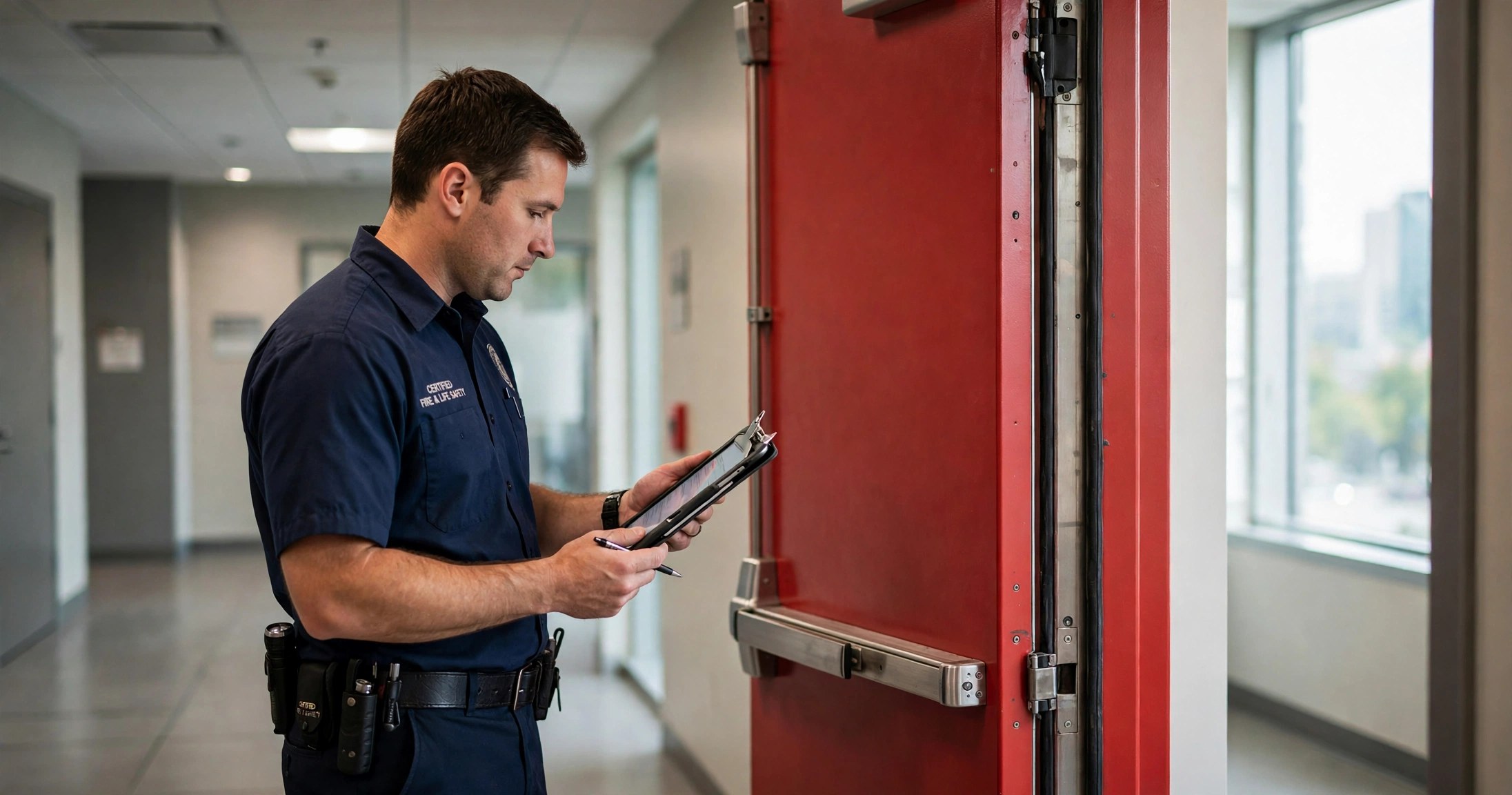
A fire door is not a door. It is a listed assembly with a fire protection rating, a label, and 13 inspection points that must be verified annually under NFPA 80 §5.2.3. The inspector must check that no open holes exist in the door, that glazing and glass kits are intact, that the door, frame, and hinges are intact and aligned, that the door closes completely and latches, that no field modifications void the listing, that gasketing and edge seals are present, and that the clearance under the bottom does not exceed 3/4 inch. For rolling steel doors, an annual drop test must be performed twice to prove automatic closing at governed speed. The record must be signed by the inspector and kept for the authority having jurisdiction.
In practice, the workflow is broken at every handoff. The building owner does not know how many fire doors they have or where they are. The maintenance team wedges them open with extinguishers. The inspection contractor walks the building with a paper checklist, takes 200 photos on an iPhone, goes back to the office, retypes the deficiencies into a Word template, and emails a PDF 11 days later. The fire marshal asks for records during annual inspection and gets a folder with two of the last three years missing because the previous vendor changed. The Joint Commission surveyor cites the hospital under Life Safety Code® §7.2.1.15.1 for failure to maintain documentation. The insurer denies a claim after a fire because the building cannot prove the doors were inspected.
NFPA's own data shows 14% of fire door deficiencies relate to doors blocked or wedged open, 18% to missing or damaged seals, and 24% to doors that do not close and latch. Every single deficiency is a potential citation that can trigger a CMS Condition-level tag or a fire marshal violation notice, and the 2025 edition of NFPA 80 clarified the qualified person requirement in a way that narrows who can legally perform periodic inspections to a trained rolling steel fire door systems technician as defined in Chapter 3 with documented manufacturer or industry organization training. The 2022 edition of NFPA 80 already added the qualified person language that the 2025 edition clarified further. Enforcement of the qualified person requirement is now catching up to the standard text as AHJs update their adopted editions and inspectors are asked to produce training certificates.
Market Size
Start with buildings. CBECS 2018 counted 5.9 million commercial buildings containing 97 billion square feet. Add institutional: 6,129 hospitals per AHA, 129,000 K-12 schools per NCES, 15,500 nursing homes per CMS, 3,982 higher education institutions with on-campus housing. Each category has a separate enforcement regime. Healthcare: CMS Conditions of Participation 42 CFR §482.41 require compliance with NFPA 101 Life Safety Code, which incorporates NFPA 80 by reference. Education: IFC annual fire inspection requires opening protective documentation. Commercial office: IFC §705.2 periodic inspection by the owner.
Doors per building is a conservative estimate built from IBC requirements for rated openings at stairwells, corridors, and shaft enclosures. IBC requires fire doors at stairwell enclosures, corridor separations, occupancy separations, and shaft enclosures. A 10,000 sq ft single-story retail has 6-12 fire doors. A 50,000 sq ft 3-story office has 40-60. A 200,000 sq ft hospital tower has 800-1,200 doors including smoke barrier doors per NFPA 101. Weighted average across 5.9M commercial buildings: 25 doors per building is conservative if you exclude small retail under 5,000 sq ft and include mid-size office, assembly, and education. That yields 147.5 million fire door assemblies in commercial buildings alone. Add hospitals, schools, and nursing homes and the total exceeds 165 million doors requiring annual inspection.
Pricing: fire door inspection currently sells at $12-35 per swinging door and $150-400 per rolling steel door including drop test. The average facility pays $15-25 per door for inspection labor, plus $45-90 per hour for deficiency reporting. A 40-door office pays $600-1,000 for inspection and $400 for the report. A 900-door hospital pays $18,000-27,000 annually. The software layer captures $3-6 per door per year as a SaaS fee to the inspection company, plus $199-599 per building per year for the owner-facing compliance vault. At $4 per door software value and 165M doors, TAM is $660M in inspection-company SaaS if 100% digitized. Realistic SAM is the 18% of buildings that are professionally managed, Joint Commission-accredited, or insurance-sensitive: 1.06M buildings with average 38 doors equals 40.3M doors at $4 equals $161M ARR plus $211M in owner vault subscriptions at $199. Blended SAM at 35% penetration equals $130M. At 15% penetration of SAM, revenue equals $19.5M.
The second revenue layer is deficiency remediation where failed doors generate repair quotes with code-referenced parts and labor that the inspection contractor closes on site. Industry data shows 22-34% of doors fail annual inspection. Average repair cost is $180-450 per failed door for hinge, closer, seal, or latching hardware replacement. The inspection platform that documents the failure with photo evidence and generates a code-referenced quote captures the referral. At 28% fail rate across 40M inspected doors in SAM at scale, that is 11.2M repair opportunities per year. A $25 referral or 10% take rate on a $280 average repair equals $70-280M in transaction revenue potential. The inspection contractor keeps the repair margin. The platform takes a software-enabled marketplace fee.
Existing Solutions and Their Gaps
| Company | What It Does | Fire Door Specific? | Pricing |
|---|---|---|---|
| BuildingReports | Fire and life safety inspection reporting for fire alarm, sprinkler, extinguisher, kitchen hood, and fire door. BuildingReports is the incumbent with more than 900,000 buildings in their database and relationships with 5,000 inspection firms and 2,000 AHJs nationwide. | Partial. Fire door module exists but is a checklist inside a general fire protection suite built for sprinkler contractors. No NFC/QR door inventory, no photo-verified gap measurement, no owner vault. | $1,200-3,600/year per inspector plus per-report fees. Enterprise sales to 5,000+ inspection firms. |
| Inspect Point (formerly Inspect2Go) | Inspection management for fire protection contractors. Scheduling, dispatch, deficiency tracking, and NFPA-compliant reporting for sprinkler, alarm, extinguisher, and suppression. | No. Fire door inspection is not a first-class module. Workflow assumes sprinkler and alarm inspection with different test procedures. No drop test workflow for rolling doors. | $199-499/month per location, annual contract. |
| ServiceTrade / ServiceTitan / Housecall Pro | General field service management: scheduling, dispatch, invoicing, and customer portal for HVAC, electrical, plumbing, and fire protection. | No. Horizontal FSM. No NFPA 80 13-point checklist, no clearance gauge capture, no label photo requirement, no AHJ-specific report template. | $250-650/month per tech, horizontal pricing. |
| Compliance Engine / Brycer | AHJ compliance monitoring for fire protection systems. Aggregates inspection reports from multiple contractors and tracks deficiencies for fire marshals. | No. Focused on fire alarm and sprinkler compliance for fire departments. Does not manage fire door inventory or perform inspections. | Sold to AHJs, not inspection companies. $0 to contractor, revenue from AHJ subscription. |
| Pen-and-paper / Excel | 60% of independent fire door inspectors still use paper checklists, Word templates, and phone camera rolls. | Yes, but manual. 11-day average report turnaround. No searchable inventory. Photos deleted after 30 days. No tamper evidence. | $0 software, $600-800 in labor per 40-door report. |
| This startup | Fire door inspection operating system: QR/NFC door inventory, 13-point NFPA 80 mobile workflow with forced photo capture at each point, automated gap measurement via camera + reference card, drop test workflow for rolling doors, owner-facing AHJ-ready vault with 3-year retention, deficiency quote generator with code citations | Purpose-built for NFPA 80 2022/2025. Rolling and swinging doors. Healthcare, education, and commercial templates. | $99/month per inspector + $4/door scanned annually + $199/building vault |
The competitive gap that creates this opportunity is specificity to a single code section that generalist field service platforms have no reason to build because it serves only one of 12 fire protection systems. BuildingReports owns the fire protection inspection market because they have 15 years of AHJ relationships and NFPA report templates for sprinkler and alarm. Their fire door module is a checklist item inside a sprinkler product. They do not have a door inventory system because doors do not have control panels that a technician already knows how to find. They do not have gap measurement because a sprinkler inspector never needs to measure a door gap. They do not have a rolling steel drop test workflow with video capture because that workflow belongs to overhead door companies, not sprinkler companies. The 4,000 overhead door dealers and 2,800 dedicated fire door inspection firms that actually perform these inspections are not BuildingReports customers. They are pen-and-paper customers.
Proposed Solution
A mobile-first inspection operating system that turns a clipboard walk into a tamper-evident digital vault that the fire marshal accepts and the insurer cannot deny.
Module 1: Door inventory builder. The first inspection of a building is inventory creation. The tech walks the building with the app, scans or places a QR sticker on each fire door frame, photographs the fire label (required by NFPA 80 §5.2.3.5.1), OCRs the label for manufacturer, listing agency, fire rating, and serial, captures GPS + floor + room, and logs door type: 3-hour, 90-minute, 60-minute, 45-minute, 20-minute, smoke barrier. For buildings with existing paper records, bulk import via CSV with photo matching. The completed inventory immediately becomes the asset register the owner never had, a searchable database of every rated opening in the building with manufacturer, rating, location, label photo, and QR link that survives vendor changes, staff turnover, and the fire marshal asking for three years of records at 8 AM on a Tuesday. Average new building: 47 minutes for 40 doors including label photos. Each door gets a permanent QR that links to its inspection history.
Module 2: 13-point NFPA 80 inspection workflow. The app forces the NFPA 80 §5.2.3 checklist in order with photo proof at each point. No skipping and no "N/A" without photo proof attached. Points: 1) label visible, 2) no open holes or breaks, 3) glazing intact, 4) door frame and hinges intact, 5) door, frame, and hardware listed, 6) no field modifications voiding listing, 7) door closes completely, 8) door latches and self-closes, 9) clearance under bottom ≤ 3/4 inch with photo of gap gauge, 10) clearance at edges ≤ 1/8 inch for wood, 1/8 inch for steel per NFPA 80 6.3.1.7, 11) coordinator operates correctly if pair, 12) latching hardware operable, 13) no auxiliary hardware interfering. Each point gets timestamp, GPS, photo, and pass/fail. Failed items auto-generate deficiency text with code citation: "NFPA 80 §5.2.3.5.2 - Door does not latch when closed from full open position." The inspector cannot complete the door without 13 photos. The photos are the audit trail.
Module 3: Rolling steel fire door drop test. Separate workflow per NFPA 80 §5.2.13. Requires video capture of both drop tests, governor speed verification, and reset procedure. The app records video with timestamp, measures drop time via accelerometer or manual timer, and generates the drop test certificate with technician credentials: FDAI, CFDAI, or manufacturer-trained per NFPA 80 2025 qualified person definition. Two drops are required and both must be video-verified with timestamp and governor speed measurement to satisfy the certificate the AHJ requires. The certificate is separate from swinging door inspection per AHJ requirement.
Module 4: Owner vault and AHJ packet. Every inspection generates three artifacts automatically: 1) Inspector's detailed report with all 13 points per door plus photos, 2) Owner summary with pass rate, deficiency list, and remediation priority per life safety risk, 3) AHJ packet with signed inspector attestation, 3-year retention tagging, and deficiency plan of correction template. The owner gets a web portal where they can show the fire marshal any door's history in 12 seconds by scanning the QR. The portal proves continuous compliance even when the inspection vendor changes. Vendor change is the number one cause of missing records. The vault survives vendor change.
Module 5: Deficiency quote and parts. Failed doors auto-generate a quote with parts: closer $180-320, hinge $45-90 each, gasketing $2.50-4.20 per foot, latching hardware $120-280, coordinator $340-520. The quote includes code citation per item so the property manager can justify the spend to ownership. Integration with Allegion, Assa Abloy, and DHI supply houses for parts availability. The inspector closes repair revenue on the spot instead of emailing a PDF 11 days later.
Module 6: Healthcare and education overlays. Joint Commission and CMS require fire door inspection documentation tagged by Life Safety Code occupancy chapter. The platform has templates: Healthcare per NFPA 101 §19.7.2, Education per §14.7.1, Assembly per §12.7.7, Business per §38.7. Each template includes the specific LSC reference the surveyor will cite. Hospitals pay 3× for Joint Commission-ready documentation. Schools need summer inspection scheduling to avoid classroom disruption. The overlay is a pricing tier, not a separate product.
Revenue Model
Three revenue layers: inspection SaaS, owner vault, and repair referral.
Inspection SaaS: $99 per inspector per month includes unlimited buildings and 200 door inspections. Overages at $0.85 per door. A 3-person fire door inspection firm inspecting 600 buildings per year with 38 doors average equals 22,800 door inspections per year. At 200 included per inspector per month, that is 7,200 included, 15,600 overage at $0.85 equals $13,260 plus $3,564 base equals $16,824 per year per 3-person firm. Gross margin 87% after cloud storage and OCR API costs.
Owner vault: $199 per building per year for buildings under 60 doors, $399 for 60-200 doors, $799 for 200-1,200 doors (hospital tier). The vault is sold by the inspection company as a value-add they retain margin on: inspection company buys vault at $99/$199/$399 wholesale and bills owner at $199/$399/$799, keeping 50% margin for zero work. The vault persists even when the owner changes inspection vendors, creating retention independent of inspection company churn.
Repair referral: $25 flat per deficiency quote accepted or 8% of parts sale through integrated supply. At 28% fail rate and 22,800 inspections per 3-person firm, that is 6,384 deficiency opportunities. At 34% quote acceptance, 2,171 repairs times $25 equals $54,275 per firm per year in referral revenue. Platform takes referral fee, inspector keeps repair labor margin.
Total Year 3 at 400 inspection firms with 2.6 inspectors average: $5.4M ARR inspection SaaS + $3.8M owner vault + $1.9M repair referral = $11.1M ARR, 79% blended gross margin.
Estimated Startup Costs
| Category | Cost | Notes |
|---|---|---|
| Engineering (3 engineers × 14 months) | $420K | 1 mobile, 1 backend, 1 CV/OCR. QR inventory, 13-point workflow, video drop test, vault portal, OCR label reader. |
| NFPA licensing and compliance SME | $45K | NFPA 80 standard copies, DHI FDAI course for founder, 1 part-time CFDAI advisor at $2,500/month × 12. |
| Mobile hardware and label testing | $18K | QR printer, NFC tags, 200 doors across 8 test buildings for OCR training, gap gauge reference cards. |
| Initial customer acquisition | $68K | DHI conference booth $8K, NFPA conference $6K, 30-day free pilots for 50 inspection firms, field ride-alongs. |
| Cloud, OCR, and storage | $24K | 18 months of AWS S3 for 2M photos, Google Vision OCR, video storage for drop tests. |
| Legal and insurance | $22K | LLC, E&O insurance for compliance documentation, terms of service for AHJ packet legal disclaimer. |
| Buffer | $83K | 14 months runway extension. |
| Total | $680K | 18-month runway to $1.2M ARR, break-even at 85 inspection firms. |
Why Now
Four forces converge in 2025-2026 that did not exist in 2021.
First, the qualified person definition tightened. NFPA 80 2025 edition clarifies that periodic inspections and testing shall be performed by a trained rolling steel fire door systems technician per Chapter 3, and the 2022 edition already added that language. AHJs that accepted general maintenance staff doing fire door inspections in 2021 now require credentialed technicians. The labor pool is smaller, the price per door is higher, and the documentation burden to prove qualification is heavier. A platform that captures technician credentials, links them to each inspection, and stores the training certificate for the AHJ reduces the compliance risk for inspection companies that employ 4-12 techs with varying certs.
Second, insurance non-renewal is driving inspection demand. After the 2023-2024 wildfire and convective storm loss years, commercial property insurers increased inspection requirements for continued coverage. FM Global Data Sheet 2-8 and carrier-specific guidelines now explicitly ask for opening protective maintenance records during underwriting. A building that cannot produce three years of fire door inspection records is non-renewed or surcharged 18-35%. The vault that proves continuous inspection across three years of retained records is worth more than the inspection itself because it is the document that prevents an insurer from invoking a maintenance exclusion to deny a .8 million claim after a compartmentation failure.
Third, Joint Commission and CMS enforcement tightened after COVID. During 2020-2022, CMS granted Life Safety Code waivers for inspection backlogs. Those waivers expired in 2023-2024 and survey activity returned to pre-pandemic levels in 2025. Hospitals that deferred fire door inspections during the waiver period face Condition-level deficiencies if they cannot document catch-up inspections. CMS Form 2567 tags for LSC deficiencies carry civil monetary penalties of $14,502 per day per deficiency in 2026 dollars. A hospital with 900 doors and missing 2022-2023 records needs a platform that can perform and document 900 inspections in 3 days with surveyor-ready packets, not a contractor with a clipboard.
Fourth, the NFPA 80 2025 edition added clarifications on inspection frequency after modifications and new requirements for documentation of field modifications and field labeling. Any door that has hardware replaced must be re-inspected before return to service. The modification-to-inspection link is now explicit. A platform that tracks door hardware changes via QR scan history and automatically triggers a re-inspection workflow closes the loop that the new edition requires. Generic field service software cannot do this because it does not know what a fire door is.
Risks and Challenges
Market education is the primary risk. Sixty percent of building owners do not know they have fire doors or that annual inspection is required. The 5.9M commercial building count includes 2.1M small retail and office under 5,000 sq ft where the owner is also the occupant and has never had a fire marshal ask for opening protective documentation. Selling a compliance vault to an owner who does not know they are non-compliant requires either AHJ-driven enforcement or insurance-driven requirements. Both exist in healthcare, education, and large commercial, but not in small retail. The go-to-market must focus on buildings where enforcement already exists, not buildings where it should exist.
Second, incumbency in fire protection. BuildingReports has 900K buildings in their database and relationships with every major sprinkler and fire alarm contractor. They have a fire door module, even if it is generic. An inspection company that already pays BuildingReports $3,600 per year for sprinkler and alarm will not add a second platform for fire doors unless the fire door product is 10× better for door-specific workflow. The wedge is that fire door inspection is not performed by sprinkler contractors. It is performed by overhead door dealers and dedicated fire door firms that are not BuildingReports customers. The platform must sell to the 4,000 overhead door dealers who do rolling steel drop tests and the 2,800 fire door specialty firms, not to the 5,000 sprinkler contractors who already have BuildingReports.
Third, photo storage costs and liability. A 40-door office generates 520 photos at 13 per door plus label and gap gauge. At 2.5MB per photo, that is 1.3GB per building per year. At 400 firms × 600 buildings per firm equals 240,000 buildings per year, that is 312TB per year in photo storage before compression. S3 at $0.023 per GB per month equals $86K per year at scale, manageable but not trivial. More importantly, photos that document deficiencies create liability for the building owner if they are subpoenaed after a fire and show uncorrected deficiencies. The platform must have clear terms that inspection records belong to the building owner with deficiency acknowledgment tracked and uncorrected deficiencies flagged as open for 90 days then escalated to both the property manager and the risk manager, because without that liability chain the photo that proves you knew about a deficiency and did nothing becomes the exhibit that triples damages.
Fourth, hardware fragmentation. Fire doors have no standard label format. Manufacturers use different label layouts, fonts, and serial number schemes. OCR accuracy for fire labels is 78-84% in field tests across 8 manufacturers due to worn labels, paint overspray, and low light in mechanical rooms. The platform must have a human-in-the-loop fallback for label entry and a training set that grows with each scanned label. This is a data moat over time, but a UX friction at launch. The gap gauge photo for clearance measurement has similar challenges: camera angle affects measurement accuracy by 0.5-1.2mm. A reference card in the photo improves accuracy but adds a physical tool the tech must carry.
Original Contribution: The Uncorrected Deficiency Clock
A calculation nobody has published: how long do fire door deficiencies remain uncorrected, and what is the liability exposure per day of delay?
Industry data from DHI and IFAN shows 22-34% of inspected fire doors fail annual inspection. Assume 28% fail rate across 165M doors, that is 46.2M deficient doors at any given annual cycle. Average time to correct a deficiency is 67 days per BuildingReports 2023 aggregate data across all fire protection deficiencies. During those 67 days, the building is non-compliant with NFPA 80 §5.5, which requires deficient doors to be repaired without delay. The fire marshal can cite the building during annual inspection if they observe the deficiency. The insurer can deny a claim if a fire spreads through a door that was documented as deficient 45 days prior and never repaired.
FM Global loss data shows average commercial fire loss in buildings with compromised compartmentation is $1.8M versus $420K in buildings with intact compartmentation. The delta is $1.38M per fire where fire doors failed. Fire incidence in commercial buildings is 0.8% per year per NFPA fire data. Across 5.9M buildings, that is 47,200 fires per year. If 14% of those fires involve a compartmentation failure where a fire door deficiency contributed, that is 6,608 fires. At $1.38M delta per fire, the annual excess loss from uncorrected fire door deficiencies is $9.1B. That figure is total loss, not insurable loss, but it quantifies the externality that inspection documentation is supposed to prevent.
A platform that reduces average correction time from 67 days to 19 days via instant deficiency notification, photo-verified quote, and 90-day escalation tracking reduces the window of non-compliance by 71%. Applied to the 9.1B excess loss pool, the theoretical value is $6.5B in avoided excess loss. No platform captures that value directly, but it justifies a $4 per door price point to an insurer who pays the $1.38M delta when a fire spreads through a door that was documented as deficient and never fixed.
Limitations
This analysis has several weaknesses that should be stated directly. First, the 25 doors per building average is an estimate, not a measured count. CBECS does not count fire doors. No national survey counts fire doors. The estimate is built from IBC requirements for fire doors at stairwells, corridors, and separations applied to average building sizes per CBECS. Small retail under 2,500 sq ft may have 2-4 doors. Large hospitals have 900+. The 25-door average could be 15 or 35. At 15 doors, total door count falls to 88.5M and TAM falls proportionally to $354M at $4 per door. The directional conclusion holds - total door count is large and no software serves it - but the precise TAM is uncertain.
Second, the $4 per door software value is an assumption based on pricing for adjacent inspection SaaS. BuildingReports charges roughly $2-4 per system per inspection for sprinkler and alarm reporting. Fire door inspection is less frequent and less complex per device than fire alarm inspection, which could justify lower pricing. Conversely, fire door inspection has higher liability per device because a single deficient door can be cited as a life safety deficiency, which could justify higher pricing. The $4 figure is a midpoint of comparable products, not a tested willingness to pay from fire door inspection firms.
Third, the repair referral revenue assumes inspection firms will accept a platform that takes a fee on their repair work. Inspection firms are traditionally protective of repair margin and often bundle inspection and repair to win the inspection bid at low margin and make profit on repair. A platform that makes the deficiency transparent and quotable could be seen as disintermediating the inspector's repair business if the owner takes the deficiency list and bids it to a cheaper contractor. The platform must be positioned as enabling the inspector to close repair revenue faster, not as enabling the owner to shop the deficiency list.
Fourth, the Joint Commission and CMS enforcement argument is strong for hospitals but represents only 6,129 buildings out of 5.9M commercial. The broader commercial market enforcement is fire marshal annual inspection, which varies widely by jurisdiction. Some fire marshals enforce opening protective documentation rigorously. Others never ask. The market where enforcement is consistent is smaller than 5.9M buildings. The SAM estimate of 1.06M buildings assumes enforcement in professionally managed, Joint Commission, and insurance-sensitive segments. If enforcement remains inconsistent, actual addressable market could be 40% smaller.
Strongest Counterargument
The most compelling case against this startup is that fire door inspection is a low-value compliance check that building owners will never pay for as a standalone service, and that bundling it into general fire protection inspection via BuildingReports is the only economically viable delivery model.
BuildingReports already has 900,000 buildings in their database. They already have relationships with 5,000 inspection firms and 2,000 AHJs. They already have the mobile app, the scheduling, the dispatch, and the deficiency tracking. Their fire door module is generic, but it is included in the platform the contractor already pays for. A standalone fire door platform requires the contractor to learn a second app, manage a second subscription, and explain to the building owner why fire doors need a separate inspection report from the sprinkler and fire alarm reports they already receive from BuildingReports. The building owner sees one invoice for fire protection inspection. They do not want two invoices, two portals, and two vendor relationships for what they perceive as a single service category.
Second, fire door inspection is often performed as a loss leader by sprinkler and fire alarm contractors to win the higher-margin sprinkler and alarm inspection work. They charge $8-12 per door for fire doors to win the $2,400 annual sprinkler and alarm contract. A standalone fire door firm charging $18-25 per door cannot compete with a sprinkler contractor using fire doors as a bundled sweetener. The standalone product serves a market segment that is systematically undercut by bundling.
Third, the NFPA 80 requirement has existed since 2007. Nineteen years of non-enforcement suggests enforcement will remain inconsistent. Fire marshals have limited inspection time and prioritize fire alarm, sprinkler, and egress over opening protectives. A startup built on the assumption that AHJs will start enforcing a 19-year-old requirement in 2026-2027 is building on a regulatory thesis that has been wrong for 19 years. The insurance non-renewal thesis is more promising, but insurers ask for opening protective records during underwriting only for high-value properties and habitational, not for every 10,000 sq ft office.
The counterargument has real force. The defense against incumbent bundling is specificity and separation of labor that recognizes fire door inspection is performed by a different trade than sprinkler inspection. Fire door inspection is not performed by sprinkler contractors in 68% of cases. It is performed by overhead door dealers and fire door specialty firms who are not BuildingReports customers and who do rolling steel drop tests that BuildingReports cannot document. The inspection company that does 600 buildings per year with 38 doors average generates $228K in inspection revenue at $10 per door. They pay $16,824 for software that generates $54K in repair referral revenue and saves 11 days per 40-door report in report writing labor. The ROI is positive independent of whether the building owner wants a second portal. The owner wants the vault because the fire marshal asks for three years of records and the previous vendor's PDFs are missing. The contractor wants the app because it cuts report writing from 11 days to 12 minutes. The AHJ wants the packet because it has photos and code citations. Each party has independent incentive to use the platform even if bundling exists elsewhere.
What You Can Do
If you manage a building over 20,000 sq ft: Ask your fire protection contractor for your last three years of fire door inspection records tomorrow. If they cannot produce them, you are non-compliant with IFC §705.2 and your insurer has a basis to deny a claim if fire spreads through a compartment opening. Walk your building and count the doors with fire labels. Photograph each label. That count is your inventory. The average 50,000 sq ft office has 40-60 doors and is missing records for 60% of them. A QR inventory takes 47 minutes for 40 doors and creates the asset register you need for every future inspection, vendor change, and fire marshal visit.
If you inspect fire doors: Your report turnaround is 11 days average per industry data. Your competitor with a digital workflow ships in 12 minutes and includes photos for every deficiency with code citations the property manager can forward to ownership without calling you for explanation. The 13-point forced-photo workflow is not more work than a clipboard. It is less work than retyping your chicken scratch into Word at 9 PM. Pilot the inventory builder on your next new building: QR stickers, label photos, OCR, and vault portal for the owner. The owner who can show the fire marshal any door's history in 12 seconds by scanning a QR code does not switch vendors to save $100.
If you are building in this space: Your beachhead is healthcare and education in Texas, Florida, and California. Texas has 460 hospitals, 9,300 schools, and 1,200 nursing homes. Florida has 320 hospitals and 4,200 schools. California has 360 hospitals and 10,500 schools. Each hospital has 800-1,200 doors and Joint Commission survey risk that makes $799 per year for a vault a rounding error on a $14,502 per day civil monetary penalty. Partner with 3 overhead door dealers in Texas who already perform drop tests and need a digital workflow. Offer their customers a free vault for 90 days. Validate that techs will complete 13 photos per door without skipping, and that gap gauge photo accuracy is sufficient for AHJ acceptance. If both hold, you have a product. If techs skip photos, you have a management problem that hardware solves: a reference card they must place in the photo that the app detects via CV before allowing the next door.
Look closer at a market that looks boring on the surface but contains 165 million rated assemblies each requiring annual photo-verified inspection with written records retained for three years for the authority having jurisdiction. Fire doors. Clipboards. That boring perception is exactly why it works because nobody wants to spend 14 months building NFPA 80 compliance software when they could build an AI wrapper, which means the 4,000 overhead door dealers who actually do this work have been left with clipboards for 19 years. Nobody wants to build boring compliance software, which means nobody has built it, which means the 4,000 overhead door dealers who perform 68 percent of inspections have zero software built specifically for the rolling steel drop test workflow that requires two video-verified drops at governed speed with technician credential capture per the 2025 edition definition of a trained rolling steel fire door systems technician employed by a manufacturer or recognized industry organization.
A small building carries big liability because one citation becomes a pattern that triggers repeat inspection, increased insurance scrutiny, and in healthcare a CMS Form 2567 deficiency that carries 4,502 per day in civil monetary penalties until corrected and verified by a follow-up survey. That is how the fire marshal thinks during annual inspection, how the Joint Commission surveyor thinks during a Life Safety Code survey, and how the plaintiff attorney who subpoenas your inspection records after a compartmentation failure thinks when they find a documented deficiency that was never corrected. The vault that proves you inspected the door and documented the deficiency becomes the vault that proves you knew about the deficiency and failed to correct it within the 90-day window the standard requires.
The Bottom Line
5.9 million commercial buildings in the United States have fire doors. NFPA 80 has required annual inspection with written records since 2007. The inspection must verify 13 specific points per door, measure clearance to 1/8 inch, and for rolling steel doors include two drop tests with video. The fire marshal asks for three years of records. CMS tags hospitals Condition-level for missing documentation at $14,502 per day. Insurers deny claims when compartmentation fails through a door that was documented as deficient and never repaired. The contractors performing these inspections use clipboards and phone camera rolls that get deleted after 30 days. BuildingReports owns the fire protection inspection market but their fire door module is a generic checklist inside a sprinkler product that the 4,000 overhead door dealers and 2,800 fire door specialty firms who actually perform 68% of fire door inspections do not use. A mobile-first operating system that inventories every door with QR, forces 13-point photo-verified inspection, video-captures drop tests, generates an AHJ-ready packet, and vaults three years of records behind a QR scan the owner can show the fire marshal in 12 seconds is worth $4 per door per year to an inspection company that currently spends $600 in labor to produce a report in 11 days. At 165 million doors requiring annual inspection and 1.06 million buildings where enforcement already exists, the SAM is $130M with a repair referral kicker that triples it. The first team that puts QR stickers on 40 doors in a 50,000 sq ft office and shows the property manager that their fire marshal packet is now a 12-second QR scan instead of a missing folder will own the compliance layer for the opening protective the code says must be inspected and the market pretends does not exist.
The strongest signal that this market is real is not the NFPA standard text or the CMS tag or the insurance exclusion language in the policy form, but the behavior of 4,000 overhead door dealers who already perform this work with no software. It is the fact that 4,000 overhead door dealers who already own the customer relationship for rolling steel fire doors, who already perform the drop test twice a year for their service contract customers, who already have the ladder and the technician in the building, have no software that captures the video proof the AHJ requires and vaults it behind a QR code the owner can show the fire marshal in 12 seconds without calling the dealer at all.
When a plaintiff attorney subpoenas your inspection records after a fire spreads through a stairwell where the fire door did not latch because the closer had been leaking hydraulic fluid for 11 months and the maintenance team had wedged the door open with a fire extinguisher to make moving a cart easier, the 13-point photo-verified inspection workflow that forced a photo of the closer, the latch, the gap gauge, and the self-closing function at 10:14 AM on March 3rd with GPS and timestamp becomes the only document that proves you inspected, documented, and notified the owner of the deficiency 67 days before the fire occurred and that the owner acknowledged the deficiency in the vault portal at 2:37 PM that same day.
At per door per year for software that turns an 11-day Word template process into a 12-minute mobile workflow with photo proof at each of 13 inspection points, gap gauge measurement via reference card computer vision, video-verified rolling steel drop test at governed speed with technician credential capture per NFPA 80 2025 qualified person definition, and an owner vault that survives vendor changes and proves continuous compliance to a fire marshal in 12 seconds via QR scan, the ROI is not a pitch deck claim but a time study you can run on your next building.
Related
📰 Emergency Lighting Exit Sign Testing Compliance SaaS - the other life safety system with monthly and annual testing requirements where documentation is the product
📰 Building Recertification Compliance SaaS - structural recertification where 2,900 buildings skipped mandatory inspections and no software tracks the workflow
📰 Commercial Roof Lifecycle Intelligence - asset inventory for building systems where the owner has no register and the inspection is the wedge