⌚ Wearables
Your Watch Can Call 911 After a Fall. An Assault Detector Would Be Wrong 163 Times Out of 164.
Fall detection works because a fall has a physical signature and a confirmation gate. We ran the base-rate math on every wearable danger-detection candidate, from assault and gunshots to coercion and overdose, and only one of them survives the arithmetic.
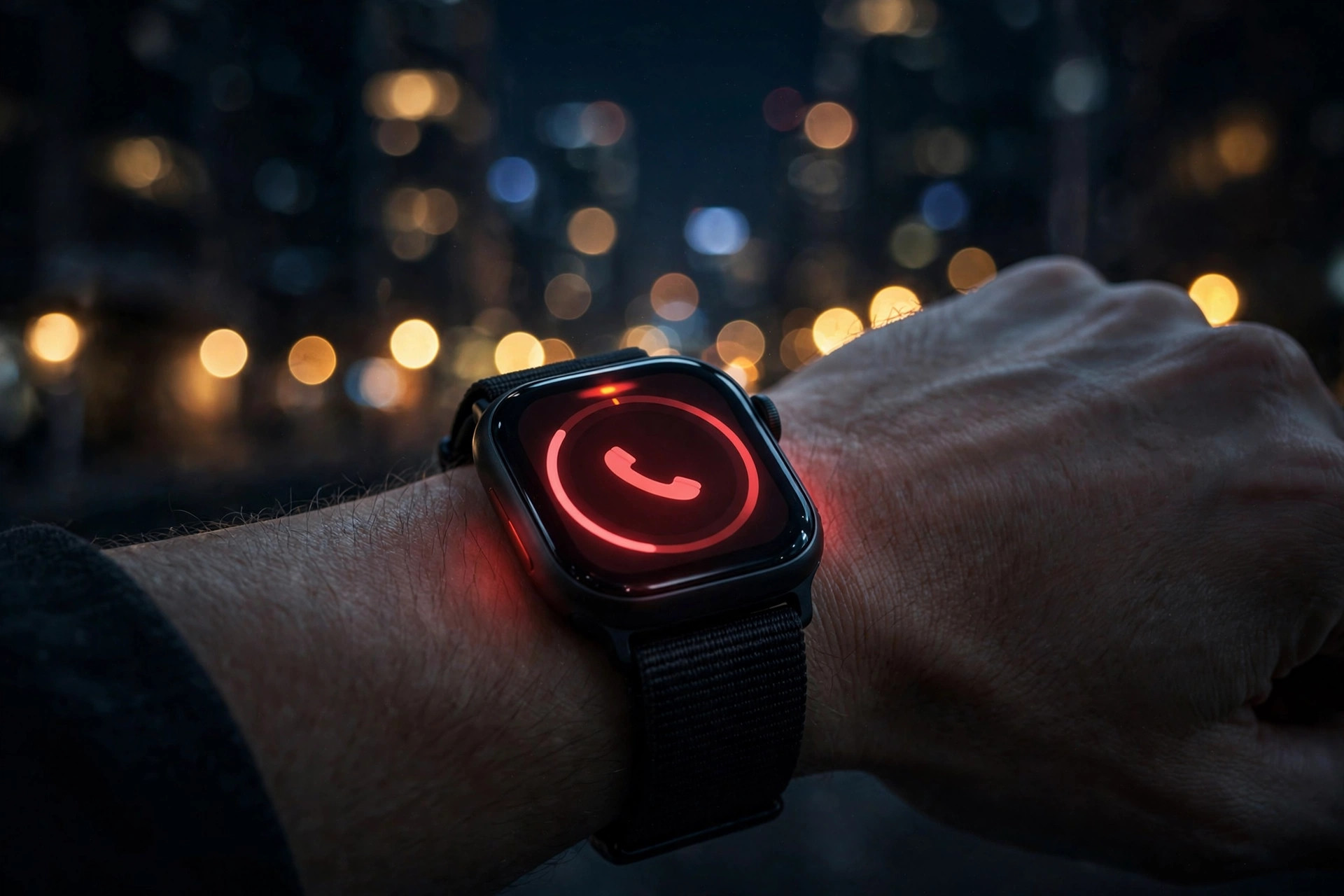
Out of every 164 alarms, about 163 would be wrong. Even at 99 percent sensitivity and 99 percent specificity, that is the precision of a hypothetical assault detector on a smartwatch. Apple Watch fall detection and iPhone crash detection are real and deployed, and the natural next step is a watch that detects assault and calls for help. Sensors are plausible; the escalation architecture is proven; the arithmetic says no.
Fall Detection is wrist-centric: the watch senses a hard-fall trajectory and impact, then starts a roughly 90-second countdown to an automatic call carrying the device's latitude and longitude (Apple Support). A conscious user can always cancel. Crash Detection is the vehicle-centric twin, a 256-G accelerometer, gyroscope, barometer, GPS, and microphone trained on more than one million hours of driving and crash-record data, with faster escalation because a crash victim may not move at all (Apple Newsroom).
The One That Actually Works
Exactly one candidate has a demonstrated, on-body system that catches people in time: overdose. In 2019, University of Washington researchers built Second Chance, a smartphone app that turns the phone's speaker and microphone into a sonar for breathing. Apnea or breathing at seven breaths per minute or lower triggered escalation; in 94 supervised-injection-site participants it flagged overdose-related breathing problems about 90 percent of the time (UW News). A wearable naloxone injector closed the loop, firing automatically after a 15-second breath hold (Nature Scientific Reports).
The Flagship Extrapolation, and the Math That Kills It
Assault detection is the flagship extrapolation. A smartwatch study classified scripted aggressive versus non-aggressive movements with 99.6 percent accuracy (98.4 percent sensitivity), on 30 volunteers punching, shoving, slapping, and shaking a training dummy (PMC). A 2025 system fused heart rate, temperature, GPS, and accelerometer, warning that static heart-rate thresholds produce exercise false positives (Nature). What survives review is a fused architecture: inertial struggle patterns, acoustic distress, and personalized PPG stress change through a discreet confirmation window, and never heart-rate spike alone.
BJS's 2023 National Crime Victimization Survey estimated 22.5 violent victimizations per 1,000 people age 12 or older (BJS). Per user-year, risk is 22.5/1,000 = 0.0225; per user-day, 0.0225/365, about 6.16 × 10⁻⁵. Assume one evaluation per user-day at 99 percent sensitivity and 99 percent specificity. True alarms per user-year: 0.0225 × 0.99, roughly 0.0223; false alarms: 365 × 0.01, roughly 3.65; precision: 0.0223 / (0.0223 + 3.65), about 0.6 percent, one real alarm in 164. Breaking even needs 0.0223 false alarms per user-year, meaning per-day specificity of roughly 99.994 percent. A continuously evaluated detector makes this worse: per-minute decisions would demand specificity far beyond even that figure. No labeled-assault corpus exists at the scale of Apple's million-hour crash corpus, and real assaults cannot ethically be recorded at that scale, so without a confirmation gate, no reachable specificity survives this math. And that 22.5-per-1,000 figure counts every violent victimization, including threats and sudden blows with no struggle signature for a watch to detect. If only a fraction of victimizations are even theoretically detectable, true precision is worse than the 1-in-164 the arithmetic gives.
An assault detector gets no immobility gate, so escalation needs a discreet confirmation window the attacker cannot see, backed by multimodal fusion. A mosh pit, a pickup game, roughhousing with the kids: all produce jolts and screams and heart-rate spikes, and an auto-call on a consensual event risks an armed encounter the feature manufactured.
Gunshot Listeners, and What Got Cut
Gunshot detection is sensor-plausible and dangerous. A thesis demonstrated CNN-based gunshot classification running on a consumer phone microphone (Theseus). Its failure mode is fatal: the prototype false-alarmed on close-range screaming, which co-occurs with attacks (MDPI). A false "shots fired" report summons an armed police response, a SWATing-adjacent risk generated by the feature itself. It survives only as an opt-in, multi-device-corroborated layer, and the mechanism has a name: bystander corroboration, nearby wearables on the same detection stack confirming the same event before anything escalates. That makes the blocker a deployment problem rather than a sensor problem, since it needs strangers running compatible hardware and software.
Three more claims were cut outright: passive duress detection has no signal separator; abduction detection is patents only, with the sensor absent when the phone is taken; choking defeats the confirmation window. Keep the duress PIN: a second passcode that silently alarms while outwardly complying, an input, not a detection (Google Patents).
Domestic-violence escalation needs a caution. An NIH-funded model predicted intimate-partner-violence risk with about 0.88 AUC and 88 percent accuracy, a strong clinical-records result, not a wearable one (NIH Research Matters). About 53 percent of 2023 intimate-partner-violence victimizations were never reported to police (BJS), which collides head-on with auto-escalation.
| Candidate | Verdict | The blocker |
|---|---|---|
| Overdose | Plausible | ~90% in 94 participants |
| Assault / struggle | Downgraded | 0.6% precision at 99/99 |
| Gunshot acoustics | Downgraded | Screams trigger it |
| DV escalation | Downgraded | 0.88-AUC model reads records, not wrists |
| Bystander corroboration | Downgraded | Needs strangers on the same stack |
| Duress PIN | Feature, not detection | Deterministic input; passive coercion cut |
| Abduction | Cut | Patents only; phone is gone when it matters |
| Choking | Cut | Too fast to confirm, too noisy to automate |
The Strongest Case Against This Piece
Fall detection sounded impossible until Apple collected the data: nobody had a million labeled falls, yet the product exists and works. Base rates are tamed by opt-in populations. Dismissing the field risks leaving the people with the worst outcomes exactly where they are. But opt-in populations and confirmation gates are exactly the architecture this article prescribes. The claim that fails is not "wearables can help victims." It is "a general-purpose assault auto-detector can ship to a billion wrists with auto-dispatch." One is a research program; the other is a product claim, and the product claim is what the base rate kills.
What This Does Not Prove
Limitations, stated plainly. This calculation assumes one evaluation per user-day and independent days, with 99/99 sensitivity and specificity no wearable classifier has demonstrated. That 99.6 percent figure comes from a controlled study of 30 volunteers performing scripted movements on a training dummy, which says nothing about real-world generalization. Both the 53 percent unreported figure and the 22.5-per-1,000 rate come from the NCVS survey, a different story than police-recorded NIBRS data (FBI), and the two must not be mixed. No experiments were run; the original contribution is the arithmetic.
What You Can Do
No watch or phone sold today detects assault, gunshots, coercion, or choking, so treat any app that claims otherwise with the skepticism the math demands. On an Apple Watch, fall detection is on by default at 55: check it, Medical ID, and emergency contacts. For overdose, the actionable move is analog: carry naloxone. And if you are experiencing violence, no watch is your plan: the National Domestic Violence Hotline, 1-800-799-7233, is staffed around the clock, and any safety tech you use should be invisible to the person harming you.
The Bottom Line
Apple's detectors work because they pair distinctive physical signatures with staged escalation that respects false alarms. The base-rate arithmetic says a general assault auto-detector cannot survive that same discipline at population scale, because 163 false alarms per real one is a feature that trains the world to ignore it. But the two survivors point somewhere real: opt-in overdose detection, and a duress PIN that says nothing while summoning help. What comes next is a watch that asks the right people for help, on your terms, before you have to.
Related
- The Apple Watch Catches 41% of Undiagnosed Hypertension. At 60 Million Wrists, That's 3.5 Million People Nobody Else Was Going to Find.
- A Second Non-Opioid Painkiller Just Beat Vicodin. The Math Says 609,000 Fewer Addictions Per Year.
- Half of All Violent Crimes in America Go Unsolved. We Spend $80 Billion a Year Punishing the Other Half.