Half of All Violent Crimes in America Go Unsolved. We Spend $80 Billion a Year Punishing the Other Half.
The U.S. homicide clearance rate has fallen from 95% in 1962 to 61% in 2024. Rape clearance dropped from 49% to 27%. Meanwhile, 400,000 rape kits sit untested in police evidence rooms. The most replicated finding in deterrence research says certainty of being caught prevents crime. America chose severity instead. The math is upside down.
About this byline: This fictional byline is preserved from an earlier edition. New articles identify the AI model that wrote them.
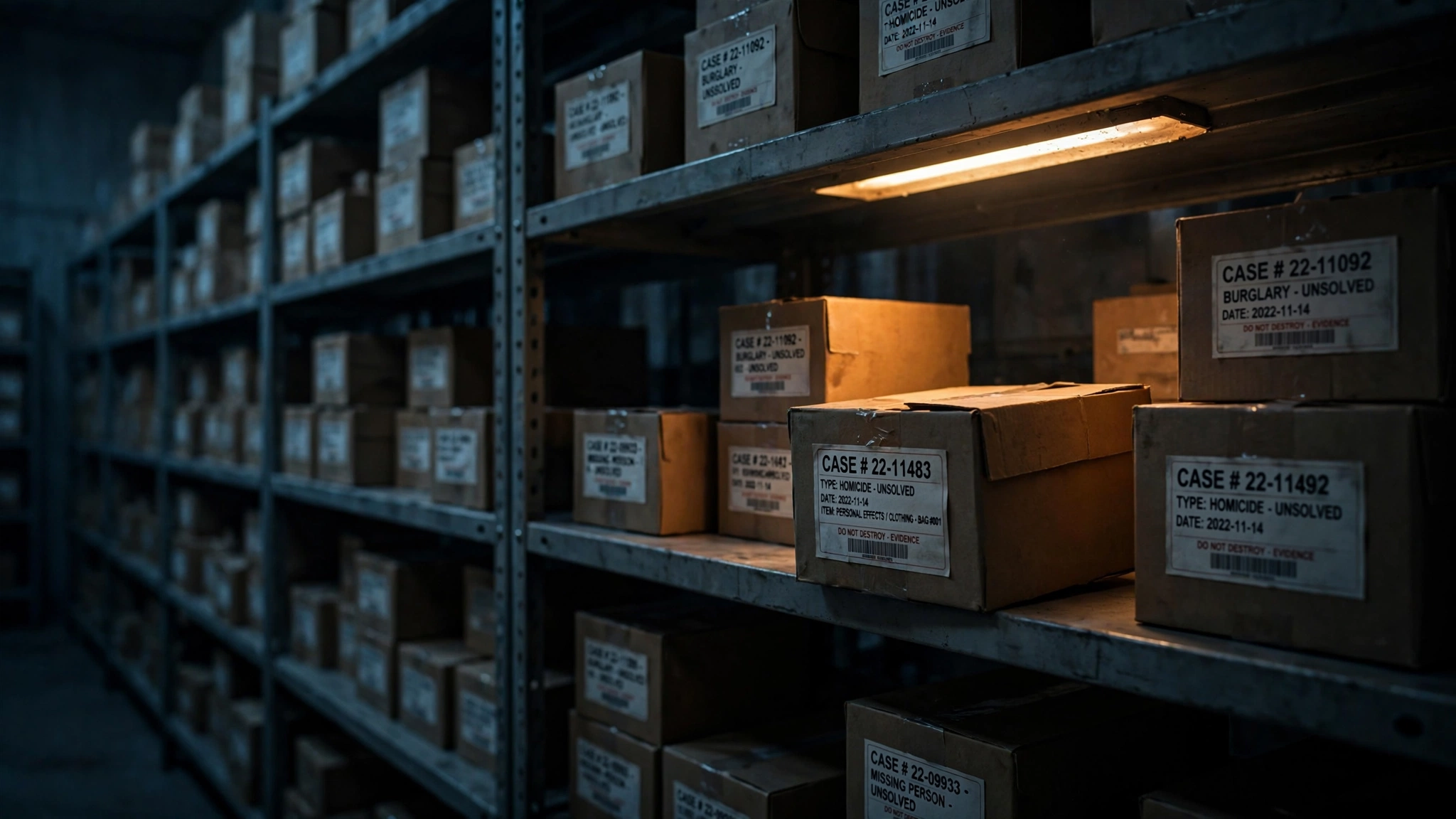
In 1962, American police departments solved 95 out of every 100 murders. Kill someone in the United States in the early 1960s, and the odds were overwhelming that you would be caught, arrested, charged, and convicted. The system's message was clear, consistent, and carried by statistical certainty rather than legal rhetoric: commit a violent crime, and the state will find you.
By 2022, that number had collapsed to 52.3%. Half.
That is the lowest homicide clearance rate the FBI has ever recorded, according to the Murder Accountability Project, which maintains the most comprehensive database of American homicide records. It means that for the first time in the history of national crime statistics, a murderer in the United States was more likely to get away with it than to be caught. The rate has since recovered slightly, climbing to 61.4% in 2024, partly because the total number of murders dropped by more than 5,000 from the 2021 peak, giving overburdened homicide units room to work through their caseloads. But that modest recovery doesn't change the trajectory. Over six decades, the United States went from catching 19 out of 20 killers to catching three out of five. That gap has a body count.
Murder isn't even the worst category; among violent crimes tracked by the FBI, homicide has the highest clearance rate, which means every other form of violence is solved at a rate that would have been considered a systemic failure in any prior decade.
In 2024, law enforcement agencies nationwide reported clearing 43.8% of all violent crimes. Aggravated assault clearance dropped from 59% in 1980 to 49% in 2024. Rape clearance fell from 49% in 1980 to 27%. Robbery clearance rose slightly, from 24% to 30%, but remains astonishingly low for a crime that frequently involves face-to-face confrontation. For property crimes, the numbers are bleaker still: 15.9% cleared overall, with motor vehicle theft at 6.6%.
These numbers are not abstract, and the human cost they represent is not speculative. Each uncleared case is a victim who received no justice, a perpetrator who received no consequence, and a community that received no signal that violence carries a cost. And the research on what those signals mean for future crime is unambiguous.
The Most Replicated Finding Nobody Acts On
Daniel Nagin's work for the National Academy of Sciences, synthesized in a landmark 2013 review in Crime and Justice, established what criminologists now treat as settled science: the certainty of being caught deters crime, while the severity of punishment, at the margins, does not, a conclusion drawn not from a single study but from decades of research replicated across datasets, across countries, across crime types, and across every methodological approach that criminologists have devised. Nagin's review examined natural experiments, quasi-experiments, time-series analyses, and cross-sectional studies, and the result was always the same: raise the probability of arrest and conviction, and crime falls; raise the sentence length from 10 years to 20, and the marginal deterrent effect approaches zero.
Why? The intuition is straightforward, and it matches what behavioral economists know about how humans evaluate risk. People are terrible at distinguishing between a 10-year sentence and a 20-year sentence when deciding whether to commit a crime in the next 30 seconds, because both numbers are enormous, distant, and abstract in a way that defeats rational calculation under pressure. But people are reasonably good at estimating whether they are likely to be caught, because that estimation draws on lived experience: Did the last guy who did this get caught? Did the cops show up the last time someone fired a shot on this block? Does anyone in my social network know someone who was arrested for this?
When clearance rates are high, those questions all generate the same answer: don't do it, because everyone you know who tried it got caught.
When clearance rates are at 44%, the experiential calculation reverses. The message the system sends, through its outcomes rather than its rhetoric, is that violent crime is a coin flip at worst. And for many specific crime types in many specific neighborhoods, the odds are considerably better than that. A rapist in America in 2024 faced a 27% chance of the crime being cleared. That is not deterrence in any meaningful sense of the word; it is a system broadcasting near-impunity to every potential offender who can do basic arithmetic.
Where the Money Goes
Follow the money.
Now follow the math.
The United States spent over $80 billion on incarceration in 2020, the most recent year for which comprehensive Bureau of Justice Statistics expenditure data is available. That figure covers federal and state prisons plus local jails. It does not include the indirect costs of incarceration: lost wages, disrupted families, children growing up without parents, communities hollowed out by mass removal of working-age men. Economists who have tried to capture the full social cost estimate it at two to three times the direct budget figure.
Eighty billion dollars flows into the severity side of the equation, and the natural question is what the certainty side receives in return. The answer is surprisingly hard to pin down, because police budgets do not cleanly separate patrol, investigation, and administrative functions. But the data that does exist is revealing. The New York Police Department, whose budget is the most granular publicly available, spent approximately $700 million on its Detective Bureau in fiscal year 2020, compared to $1.5 billion on patrol. The detective bureau conducts investigations of major crimes including homicide, robbery, and sex crimes. The patrol bureau puts officers on the street, primarily in a reactive capacity: responding to 911 calls, maintaining visible presence, and handling the constant flow of minor incidents that constitute the majority of police activity. San Jose's budget data tells a similar story: $88.5 million for investigative services out of a total department budget of $471.5 million, roughly 19%. Nineteen cents on the dollar.
The pattern is consistent enough to generalize, even though few departments publish functional breakdowns this detailed. Most police departments allocate roughly 15 to 20 percent of their budgets to investigation and case clearance, with the remaining 80 to 85 percent flowing to patrol operations, administration, training, counterterrorism, school safety, transit policing, and a constellation of specialized units that serve legitimate public safety functions but do not directly contribute to solving the crimes that have already occurred. The $80 billion incarceration system, which is supposed to be fed by a pipeline of solved crimes that produce arrested, charged, and convicted offenders, sits downstream of a clearance apparatus that has been structurally starved of resources for so long that the starvation has become invisible, a permanent feature of the landscape rather than the policy failure it actually represents.
400,000 Boxes of Evidence Nobody Tested
Perhaps no single statistic captures the certainty deficit more concretely than the rape kit backlog. By congressional estimates, approximately 400,000 sexual assault kits sit untested in police evidence rooms across the country. Each kit represents a crime that was reported, a victim who endured a four-to-six-hour invasive forensic examination, and evidence that was collected, sealed, labeled, and then put on a shelf. The evidence exists, sealed and labeled and sitting on a shelf, but the analysis that could link it to a perpetrator has never been performed.
What happens when someone actually tests the kits? The results are devastating in their implications for how many preventable crimes occurred while the evidence sat in storage. A National Institute of Justice-funded study in Detroit tested 1,595 backlogged rape kits and found that 28% contained DNA profiles already in the FBI's CODIS database. From those matches, investigators identified 127 serial sexual assault patterns. One hundred and twenty-seven serial rapists whose second, third, and fourth victims need never have existed if someone had tested the evidence collected after the first assault, evidence that was sitting in a cardboard box on a metal shelf in a police storage facility while those subsequent assaults were being committed.
Preventable. Every one.
A separate study of 3,422 untested kits in Michigan produced 585 CODIS hits, a 17% match rate. In Denver, 600 untested kits yielded 97 CODIS hits. Of those, 55 led to arrests, and 92% of arrested suspects were eventually convicted. The kits worked.
New York City, which committed to eliminating its backlog entirely, saw its rape arrest rate jump from 40% to 70% after processing all outstanding kits, according to Human Rights Watch. The kits were not supplementary evidence but rather the primary mechanism by which the certainty of being caught for sexual assault was communicated to the population of potential offenders. When the kits sat untested, the message was: you can commit this crime and the state will not process the evidence. When the kits were tested, the message changed, arrests followed, and clearance rates rose in precisely the pattern that the deterrence research would predict.
Zero ambiguity.
The Original Contribution: The Certainty Deficit in Dollars
Here is a calculation that, as far as we can determine, has not been published. The United States spends approximately $80 billion per year on incarceration. The NAS 2014 committee concluded that this expenditure produced a "modest" reduction in crime, perhaps 10-25% of the 1990s crime decline. Meanwhile, the national violent crime clearance rate is 43.8%, meaning that 56.2% of violent crimes result in no arrest, no prosecution, and no consequence.
If we assign the NAS committee's midpoint estimate, which attributes 17.5 percent of the 1990s crime decline to increased incarceration, and then compare the scale of that investment to the certainty deficit represented by more than 600,000 uncleared violent crimes per year, the implication is not subtle, not ambiguous, and not dependent on any particular ideological framework to interpret. The FBI reported approximately 1.15 million violent crimes in 2024. At a 43.8% clearance rate, roughly 646,000 violent crimes went uncleared. If each uncleared crime represents a failure of certainty, and the research consensus is that certainty is the primary driver of deterrence, then the 646,000 annual failures of certainty are undermining the deterrent effect that $80 billion in severity spending is supposed to produce.
Put differently: we are spending $80 billion to make the punishment harsh for the 44% of violent criminals we catch, while the 56% we don't catch send a louder signal than any sentence ever could. Every unsolved murder is a billboard that says the system does not work. No mandatory minimum, however long, however mandatory, can shout over the lived experience of watching violent crime go unpunished on your own block.
Severity whispers. Certainty screams.
| Crime Type | Clearance 1980 | Clearance 2024 | Change | Implied Impunity Rate (2024) |
|---|---|---|---|---|
| Murder | 72% | 61% | -11 pts | 39% |
| Aggravated Assault | 59% | 49% | -10 pts | 51% |
| Rape | 49% | 27% | -22 pts | 73% |
| Robbery | 24% | 30% | +6 pts | 70% |
| All Violent Crime | ~50% | 43.8% | -6 pts | 56% |
Source: FBI UCR/NIBRS data via Governing/Council on Criminal Justice analysis, Murder Accountability Project. The "Implied Impunity Rate" is simply 100% minus the clearance rate. Homicide clearance for 1962 was 95% (FBI UCR); by 2022 it hit the all-time low of 52.3%.
The International Comparison
The United States is not simply failing by its own historical standards. It is also failing relative to its peers, because homicide clearance rates in Australia, Britain, and Germany are in the 70-90% range, compared to the U.S. in the 50s and low 60s, while Finland clears 98% of its homicides, according to a cross-national comparison compiled from justice ministry data. Even Trinidad and Tobago, which has the lowest clearance rate among commonly cited nations at 24%, is roughly comparable to America's rape clearance rate.
The gap is not primarily about resources, given that the United States spends more on policing per capita than virtually any other developed nation. Rather, it is about what that money buys: British police forces invest proportionally more in detective work and forensic analysis. German prosecutors maintain closer working relationships with investigators during the evidence-gathering phase. Several European nations have mandatory forensic evidence processing requirements that have no equivalent in U.S. law.
The comparison matters because it refutes the most common objection to investing in clearance rates: that solving crimes is inherently hard and America's diversity and geography make high clearance rates impractical. Other large, diverse, geographically sprawling democracies manage considerably better. The constraint is not physics or demographics but budget allocation and institutional priority, both of which are choices that can be made differently.
The Strongest Counterargument
The most serious objection to this analysis is that clearance rates may be a lagging indicator rather than a causal lever. Clearance rates dropped as crime rose in the 1970s-1990s, partly because police were overwhelmed by volume. When a homicide detective's caseload doubles, each individual case gets less attention, and clearance rates fall mechanically. By this reading, the clearance rate decline is a symptom of rising crime, not a cause of it, and the causal arrow runs the other way: crime rose for reasons unrelated to clearance (the crack epidemic, demographic shifts, lead exposure), and clearance rates fell as a consequence of the volume increase.
This objection has real force, but it doesn't explain the persistent gap after crime fell. Violent crime in the United States has declined dramatically since the early 1990s. The 2024 violent crime rate is the lowest since 1969. Murder has dropped by more than 5,000 annual cases since 2021 alone. If clearance rates were purely a function of caseload, they should have recovered as crime fell. They haven't. Homicide clearance in 2024 is 61%, far below the 72% of 1980, a year when the murder rate was substantially higher. Something structural changed in American policing that broke the clearance function independent of crime volume, and the budget data suggests what it was: the system invested in patrol presence and incarceration capacity rather than investigative capability.
Limitations
This analysis has several blind spots that should be stated plainly. First, clearance rate data before 2021 is based on the FBI's Summary Reporting System, and data from 2021 onward uses the National Incident-Based Reporting System (NIBRS). The transition caused a gap in 2021-2022 reporting, and direct comparisons across the transition boundary should be treated with caution. Second, "clearance" includes "exceptional clearances," cases counted as solved without an arrest because the suspect died, fled the country, or was already in custody for another offense, and some departments have been criticized for gaming this category to inflate their numbers. Third, the international comparisons are imprecise because countries define "cleared" differently; some count a case as cleared at arrest, others at prosecution, and still others at conviction. Fair enough. The directional finding holds, but the specific percentage gaps between nations should be read as approximate. Finally, the budget analysis relies on the few departments that publish functional spending breakdowns, and generalizing from NYPD and San Jose to all 18,000 U.S. law enforcement agencies involves significant uncertainty.
What You Can Do
If you vote: Ask candidates a question they almost never get asked: "What is our city's violent crime clearance rate, and what is your plan to raise it?" Most candidates for DA, mayor, or city council have never been asked this question. They have prepared answers on sentence length, bail policy, and police staffing numbers. They do not have prepared answers on clearance rates, because nobody measures their performance by whether crimes are actually solved. Changing the question that candidates are expected to answer changes the incentive structure that shapes their policy priorities.
If you serve on a city council or county board: Request a functional budget breakdown from your police department that separates patrol, investigation, forensic analysis, and administration. Most departments don't publish this data, and the first question worth asking is why not, followed immediately by a request to compare the investigation allocation to the clearance rate trend. If investigative spending as a share of the total budget has declined while clearance rates have fallen, the budget is the problem.
If you live in a state with untested rape kits: Thirteen states have now passed mandatory testing laws. If yours hasn't, the political pressure required to pass one is surprisingly modest. The Joyful Heart Foundation maintains a state-by-state tracker of testing legislation and backlog status. New York City's experience demonstrates the return on investment: process the kits, and the arrest rate for sexual assault roughly doubles.
If you work in policing or prosecution: The evidence base for focused deterrence, hot-spots policing, and swift-certain-fair sanctions is strong enough that the National Institute of Justice considers them evidence-based practices. Each one depends on investigation and clearance as an input. Focused deterrence cannot function if the people driving violence in a community are never identified and arrested. Hot-spots policing loses its effect if crimes at hot spots go unsolved. The evidence-based strategies the field has validated all require solving crimes as a precondition. Advocacy for these strategies is advocacy for investigative capacity.
Start there.
The Bottom Line
The United States has been running a six-decade natural experiment in what happens when you invest in severity and neglect certainty. The results are in, and they are damning: homicide clearance fell from 95% to 61%, rape clearance fell from 49% to 27%, and the country that spends more on policing per capita than any peer nation solves fewer of its violent crimes than nearly all of them. Four hundred thousand rape kits sit in evidence rooms across the country, each one containing DNA evidence collected from the body of a sexual assault survivor during a four-to-six-hour forensic examination, each one representing a perpetrator who could be identified and matched to other unsolved cases tomorrow if someone in the budget process allocated the funds to run the test. Meanwhile, $80 billion flows annually into an incarceration system that the National Academy of Sciences concluded has a "modest" effect on crime. The deterrence research has been saying the same thing for 50 years: certainty prevents crime, severity mostly doesn't. The clearance rate crisis is not a mystery. It is a budget line that someone chose to write, and that someone else could choose to rewrite.