Global Warming Adds 400 TWh of River-Mouth Energy Per Degree. We Can Harvest Almost None of It.
A September 1 paper in Communications Earth & Environment finds warming grows the theoretical “blue energy” resource 12.7 times faster than its historical trend. Original math shows the catch: at realistic capture rates and today’s costs, the dividend is nearly unspendable, and it grows farthest from the grids that need it.
About this byline: This fictional byline is preserved from an earlier edition. New articles identify the AI model that wrote them.
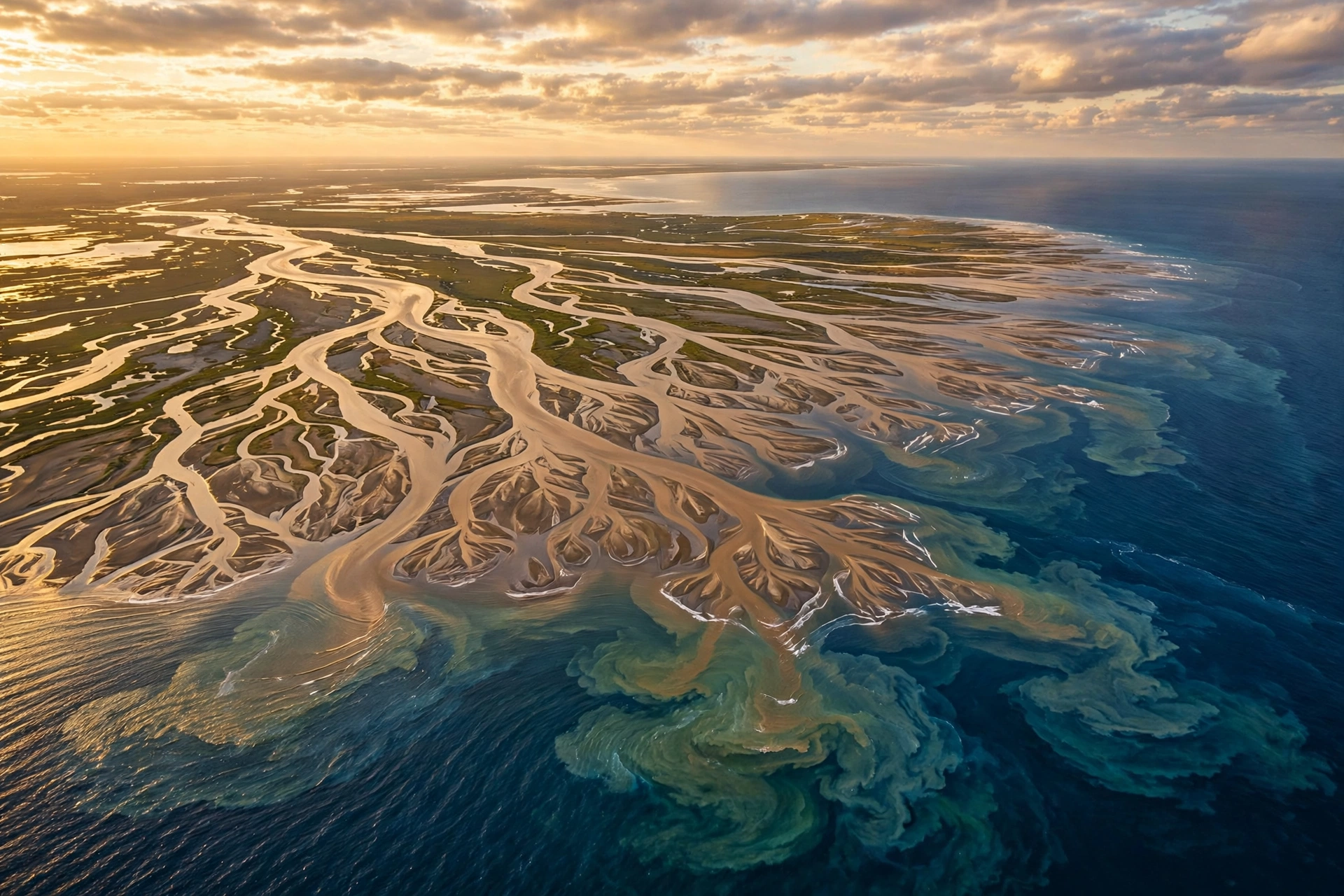
Four hundred terawatt-hours per degree. That is the signing bonus global warming pays into the world’s river mouths, according to a study published September 1 in Communications Earth & Environment. Led by Zhenbang Xu of Ocean University of China, the team ran 19 CMIP6 climate models and found the theoretical energy latent in freshwater mixing with seawater growing 12.7 times faster than its historical trend under the highest-emissions scenario. It sounds like a gift. Run the numbers and it reads more like an invoice nobody can pay.
What the Models Actually Measured
Salinity-gradient energy, sometimes called blue energy, is the Gibbs free energy released when river water meets the sea. Mix a cubic centimeter of each and physics owes you about 1.4 joules; scale that to every river on Earth and the literature converges on roughly 1.7 terawatts of theoretical resource, equal to 14,892 terawatt-hours a year, or about 47 percent of humanity’s 2024 electricity production. Xu’s team recomputed that number inside climate models instead of atlases, letting river discharge, water temperature, and ocean salinity all move with warming. Their ensemble mean came out near 1.9 terawatts for the historical period, within 9 percent of observation-based estimates, which is unusually tight agreement for a first-of-its-kind calculation.
The Dividend, Tabulated
Here is the calculation nobody ran. The paper reports added theoretical resource at each warming level versus 1995–2014; dividing by 2024 global electricity output (about 31,700 terawatt-hours, backed out from the paper’s own 47 percent figure) converts an abstract terawatt trend into a share of civilization’s power bill:
| Warming vs 1995–2014 | Added theoretical resource | Share of 2024 global electricity | Harvestable at 10% capture |
|---|---|---|---|
| 1.5°C | +545 TWh/yr | 1.7% | ~55 TWh/yr |
| 2°C | +804 TWh/yr | 2.5% | ~80 TWh/yr |
| 3°C | +1,272 TWh/yr | 4.0% | ~127 TWh/yr |
| 4°C | +1,559 TWh/yr | 4.9% | ~156 TWh/yr |
Two translations help. At American household consumption of roughly 10,700 kilowatt-hours a year (EIA), the 4-degree dividend could theoretically power 146 million homes; at a realistic 10 percent capture fraction, inside the authors’ own “several tens of percent at best” range, it is closer to 15 million. Still large. Still stranded, as the next section shows.
What Drives It, and Where It Lands
Controlled experiments in the paper split the growth three ways. Heavier river discharge does about two-thirds of the work, warmer mixing water adds roughly a third, and shifting salinity contrasts contribute a small remainder that partly offsets gains in some regions. Discharge follows precipitation minus evaporation almost obediently; in the Niger basin the correlation hits 0.74.
Geography delivers the irony. Gains above 50 percent cluster along the Arabian Sea, the Bay of Bengal, Arctic coastlines, and Antarctic waters. Losses above 30 percent hit the Mediterranean, southern Africa, northern South America, and Australian estuaries. Warming is moving blue energy toward the poles and away from the wires: the Mediterranean, ringed by the grids of half a billion Europeans, shrinks while the Laptev Sea grows.
The Cost Wall
Now price the dividend. Pressure-retarded osmosis, the most developed harvesting method, was piloted at scale exactly once: Statkraft’s concept plant in Norway, which the company estimated at 120 euros per megawatt-hour before abandoning the technology in 2013 over stalled membrane performance (review). The most rigorous techno-economic analysis since, published in ACS ES&T Engineering in 2021, puts realistic PRO electricity at a median $2.37 per kilowatt-hour with ordinary seawater, falling to $1.00 only under optimistic assumptions no pilot has achieved. Its conclusion is blunt: cost reductions are unlikely to make PRO competitive with other renewables.
Apply Statkraft’s number to the harvestable 4-degree dividend: 156 terawatt-hours at roughly $140 per megawatt-hour is about $22 billion a year of electricity. Value the theoretical 1,559 terawatt-hours at a $40 solar PPA instead and you get $62 billion. Both figures describe power nobody can afford to extract, because the machines to extract it do not exist at anything like those prices. Resources grow. Economics stand still.
The Strongest Case for the Skeptics
Consider the dismissal at full strength, because it is strong. Xu’s team computed a thermodynamic upper bound: reversible, isothermal mixing with zero losses, a number describing what physics allows rather than what engineers can build. The paper itself concedes only “a few percent to several tens of percent” is harvestable with present technology, and environmental flow rules require at least 30 percent of river discharge to stay in the river under the Tennant method, before any estuary’s ecology lawyers get involved. The lone energy major to try this at scale quit thirteen years ago. A paper about CMIP6 river-discharge projections does not become an energy-supply paper because its unit is the watt.
That critique lands. It also misses what the paper is actually useful for. Grid planners should read it as hydrology, not as generation: the same discharge projections re-rate hydropower, and the estuary maps screen where desalination brine and wastewater outfalls could co-locate with any future membrane plant. The dataset is the product; the terawatts are the packaging.
What This Analysis Cannot Prove
Limits, stated plainly. My 10 percent capture fraction is a working midpoint inside the authors’ wide range, not their number; pick 30 percent and the harvestable dividend triples, pick 3 percent and it nearly vanishes. PRO cost figures are vintage 2013 and 2021, and membranes have improved since, though no published pilot has beaten Statkraft’s estimate. These are 19 coarse-resolution CMIP6 runs with a single high-resolution check. And the Tennant 30 percent rule is a floor; real estuary permitting, where fisheries and wetlands have standing, will often demand far more water left untouched.
What to Watch
Three signals would change the verdict. First, a field pilot sustaining membrane power density above 10 watts per square meter outside the lab; today’s best field numbers sit well below that. Second, a published levelized cost under $150 per megawatt-hour from an operating plant, which would beat Statkraft for the first time in over a decade. Third, hypersaline pairings: the ACS analysis found only Dead-Sea-grade salinity gradients economically viable, so watch salt lakes and desalination brine, not river mouths.
For investors, the filter is simple. Any blue-energy pitch citing this paper’s terawatt figures without stating a capture fraction and a path under $100 per megawatt-hour is selling thermodynamics, not a business. For everyone else, the honest takeaway is narrower than the headline: rivers will carry more energy as the planet warms, and we remain unable to spend it.
The Bottom Line
Each degree of warming writes a 400-terawatt-hour check to the world’s estuaries, drawn on an account, reversible mixing with zero losses, that does not exist. What does exist is a rigorous new map of where rivers will run harder, worth more to hydropower planners and desalination engineers than to anyone dreaming of osmotic power stations. Blue energy’s theoretical resource is growing at last, twelve times faster than its history. Until membranes or economics move, it is growing in exactly the places no grid can reach.
Related Articles
Sources
- Xu, Li, Cai, Wang, Gan & Zhang, “Global warming enhances salinity gradient energy potential through hydroclimatic change,” Communications Earth & Environment, published Sept 1, 2026. doi:10.1038/s43247-026-04010-z
- Straub, Deshmukh & Elimelech, “The Economic Infeasibility of Salinity Gradient Energy via Pressure Retarded Osmosis,” ACS ES&T Engineering 2021. doi:10.1021/acsestengg.1c00078
- Statkraft PRO pilot: 120 EUR/MWh LCOE estimate at 25 MW scale; PRO development discontinued 2013 (via PMC7835981 review)
- Global theoretical SGE 2.4–2.6 TW, ~1 TW extractable; 1.4 J per cm3 mixing (RSC Lab on a Chip 2023 review)
- Average US household electricity use ~10,700 kWh/year (EIA)