Britain Cancelled Its Next Destroyer to Build Robot Warships Instead, and For the Price of One Type 83, the Royal Navy Could Field 20 Uncrewed Missile Barges
The UK just scrapped the Type 83 destroyer programme and announced four new classes of autonomous warships as part of a £5 billion drone investment. An original cost-per-sensor-day calculation shows the new hybrid fleet could deliver 7 to 13 times more patrol coverage per pound than the crewed vessels it replaces.
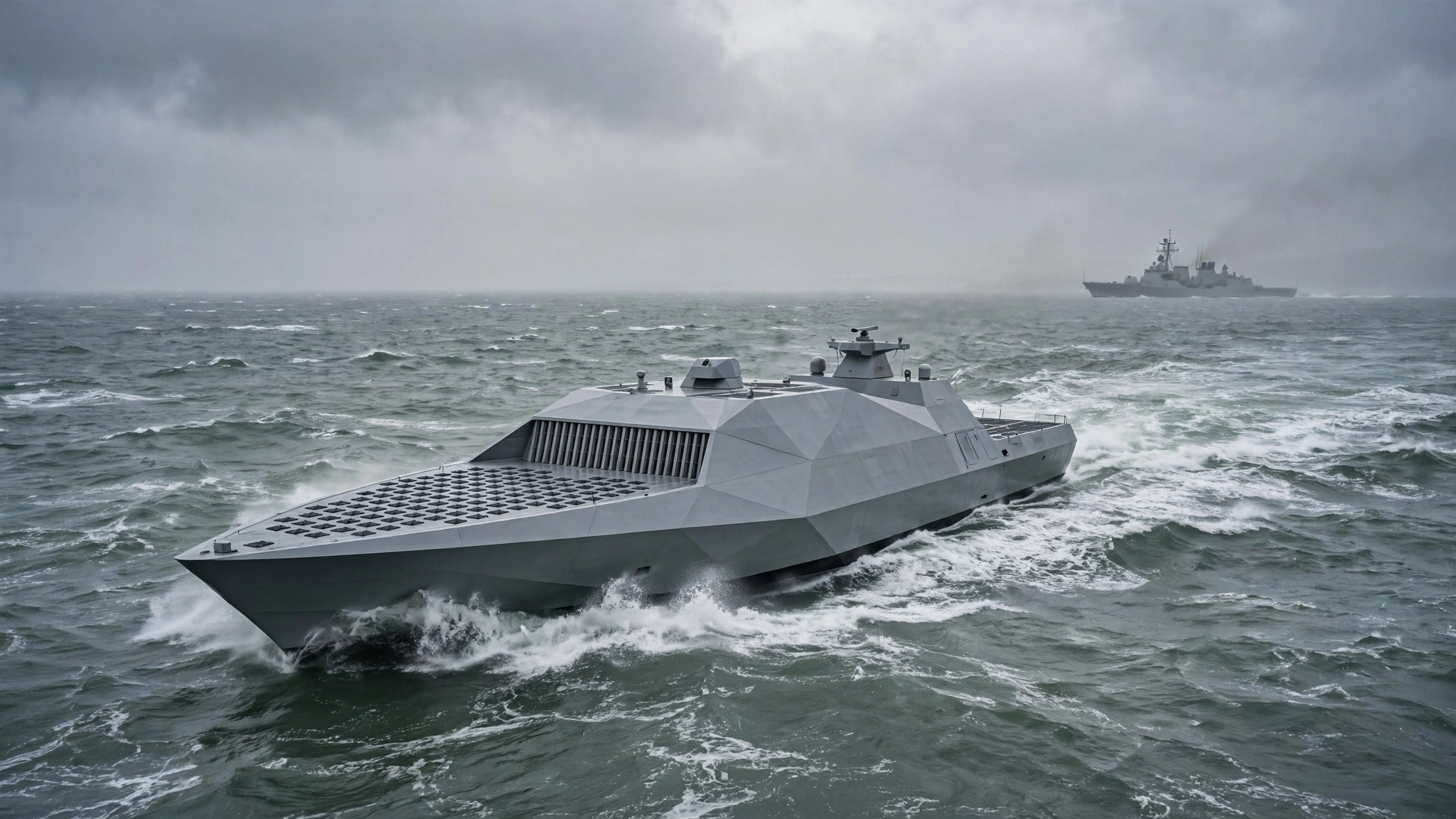
One hundred and ninety-one. That is how many sailors crew a Royal Navy Type 45 destroyer, and as of today, no future British warship will need one. Prime Minister Keir Starmer's £298 billion Defence Investment Plan, announced June 30, cancels the Type 83 destroyer programme and replaces it with something no major navy has attempted: four distinct classes of autonomous warships, controlled by a handful of crewed motherships, funded by £5 billion ($6.6 billion) earmarked for drones across all three services.
Officially it is called a "hybrid fleet," but in practice, Britain looked at the math on crewed warships, compared it to the math on drones, and concluded the destroyer as a concept was finished.
Four Classes, Zero Bunks
| Type | Role | Length | Displacement | Crew |
|---|---|---|---|---|
| Type 91 | Missile magazine ("floating VLS") | ~70m | ~800 tonnes | 0 |
| Type 92 | Anti-submarine warfare sensor | ~90m | ~1,500 tonnes | 0 |
| Type 93 | Extra-large UUV (subsurface) | Classified | Classified | 0 |
| Type 94 | Air defense sensor platform | ~100m | ~3,500 tonnes | 0 |
At least six Common Combat Vessels will serve as crewed command hubs, each operating a constellation of uncrewed consorts: one ship carries the brains, a dozen expendable platforms carry sensors and weapons, and the whole package disperses across hundreds of square miles rather than concentrating everything on a single hull.
What a Patrol Day Actually Costs
No MoD official has published what these vessels will cost, and contracts have not been awarded, but existing Type 45 data provides a hard baseline for comparison.
According to National Audit Office figures, six Type 45 destroyers carry a combined annual support bill of £188 million, or £31.3 million per ship. Add crew costs at 191 sailors averaging £45,000 in compensation (excluding training, housing, and pensions), and each destroyer costs approximately £40 million annually. With roughly 200 sea days per year, that works out to about £200,000 per patrol day.
An uncrewed Type 92 or Type 94 eliminates crew quarters, galley, damage control stations, life support, and the personnel overhead that accounts for roughly 60 percent of a frigate's lifetime cost according to RAND Corporation lifecycle analysis. Even with generous maintenance budgets and shore-based operator support, annual operating costs fall between £3 million and £5 million, and since uncrewed vessels can patrol 250 days per year (fatigue is irrelevant), the cost per sensor-day drops to £12,000 to £20,000.
Run the ratio: crewed costs £200,000 per sensor-day while uncrewed costs £12,000 to £20,000, and after accounting for mothership overhead and shore control infrastructure, the all-in advantage settles at 7 to 13 times cheaper per unit of ocean coverage.
Magazine Depth: Where Dispersal Beats Concentration
Had it been built, a Type 83 would have cost an estimated £2 billion to £3 billion per hull, based on the Type 45's trajectory (70 percent over budget) and the Type 26 frigate at £1.4 billion, and would have carried roughly 96 to 128 VLS cells.
Take the £2.5 billion midpoint and assume a Type 91 costs between £80 million and £150 million (consistent with DARPA's Sea Hunter at $20 million for 145 tonnes, scaled to an 800-tonne weapons platform), and one cancelled Type 83 buys 17 to 31 missile barges. At a conservative 16 VLS cells per hull, that dispersed fleet carries 272 to 496 cells versus 112 concentrated in a single destroyable ship.
Survivability inverts completely: an adversary must find and kill 17 to 31 small, low-signature targets instead of one large one, and losing a single Type 91 costs the force 16 cells rather than 112.
Beyond Ships: £5 Billion Across All Services
Naval autonomy absorbs the most dramatic slice, but the drone investment spans all branches: Project Nyx (24 autonomous armed drones with Apache helicopters by 2030), Project Corvus (24 surveillance drones replacing the troubled Watchkeeper), and a £50 million Rapstone boost for FPV and interceptor drones. For the RAF, funding continues for GCAP ($10.6 billion over four years), a Collaborative Combat Air autonomous wingman demonstrator by 2030, and Storm Shroud, an electronic warfare drone entering service this year.
Separately: £650 million for expendable autonomous systems, £2 billion for a "digital targeting web," and £215 million for AI deployment and defence research. Nuclear deterrence gets £63 billion for Dreadnought submarines and SSN-AUKUS, while munitions stockpiles receive £11 billion as a direct lesson from Ukraine's burn rate of 200,000 drones per month.
Why Expendability Is Untested at Sea
Here is the strongest case against this bet: Houthi rebels damaged or sank more than 80 commercial ships in the Red Sea between 2023 and 2025, and the crewed warships that survived did so because human damage control teams fought fires, sealed flooding compartments, and kept weapons systems online through manual intervention no autonomous system can replicate. When USS Gravely took a close-range cruise missile engagement in January 2024, a petty officer's split-second decision to activate point defense saved the ship.
A Type 91 taking a hit has no damage control party, no firefighting team, no human rerouting power or flooding a magazine to prevent catastrophic detonation. Britain is betting that numbers plus expendability beats survivability plus crew, a theory validated in Ukraine's land drone war (where $500 FPV drones destroy million-dollar tanks daily) but completely untested in blue-water naval combat, where sea states, electromagnetic interference, and satellite communication latency create failure modes land drones never face.
What This Analysis Cannot Determine
Cost estimates for Types 91 through 94 are extrapolations from existing USV programmes that cannot be verified until contracts are awarded, and operating cost comparisons assume mature systems when early-production vessels will cost far more. RAND lifecycle data was calculated for American Navy combatants rather than Royal Navy vessels, with different personnel structures, and no public data exists on uncrewed vessel endurance at this scale in North Atlantic winter conditions, making the patrol-day calculations theoretical rather than proven.
Bottom Line
Britain just became the first major naval power to bet its surface fleet on expendable autonomy over crewed survivability. At 7 to 13 times the patrol coverage per pound and an order of magnitude more dispersed firepower, the hybrid fleet solves a problem that building more destroyers cannot, but it also means designing a force that assumes it will lose ships regularly, plans to replace them cheaply, and accepts that no human will be aboard to fight for their survival. For NATO allies watching from Washington, Berlin, and Tokyo, the question is not whether the concept works on spreadsheets but whether any democracy can sustain public support for a navy that treats its warships as consumables. If Britain proves the model, every major navy follows within a decade; BAE Systems, Babcock International, and Thales UK are positioned to compete for contracts reshaping £20 billion or more in European naval procurement. If it fails, it fails in the North Atlantic, and the Royal Navy will not get a second chance.
Sources
- UK Government (June 30, 2026). Defence Investment Plan: £298B total defence spending, £5B drone investment, hybrid fleet strategy. gov.uk
- The War Zone (June 30, 2026). UK announces Type 91-94 uncrewed warship classes, cancels Type 83 destroyer programme. The War Zone
- National Audit Office. Type 45 Destroyer programme costs: £6.46B for 6 ships, £188M annual support. NAO
- RAND Corporation. Naval vessel lifecycle cost analysis: personnel accounts for ~60% of frigate lifetime costs. RAND
- Reuters (June 30, 2026). UK defence plan includes £11B munitions, £63B nuclear deterrent, 3.5% GDP target. Reuters