🤖 Robotics
The Machines That Dry: China's Laundry Robots Dry Their Own Mops. Ours Made a Shirt About Pepper.
From ceiling-mounted hot-air racks to robot-vacuum docks that heat-dry their own mop pads, China's drying machines treat water removal as household infrastructure. We ran the thermodynamics on why none of them roam.

Roughly 1.9 kilowatt-hours of latent heat hides inside one wet 5-kilogram cotton load fresh from the spin cycle, because 3 kilograms of retained water at 2.26 megajoules per kilogram of vaporization enthalpy works out to 6.8 megajoules, and every drying machine ever sold is a scheme for paying that bill without a clothesline. China's appliance industry has gone very specific about the scheme, and one country's machines now dry the laundry, the delicates and themselves.
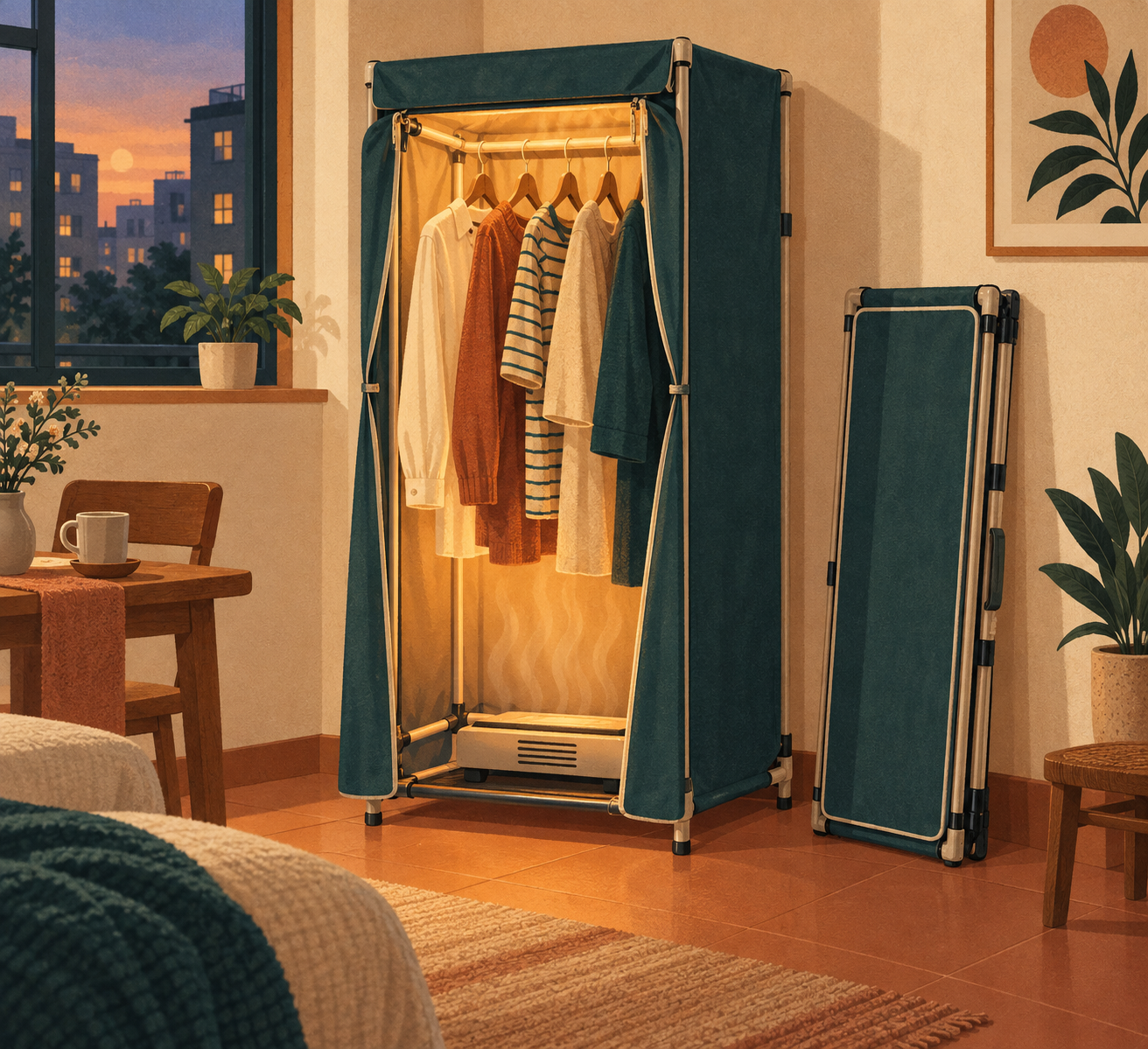
At the center sits the 智能晾衣机, the smart drying rack: a motorized ceiling beam that lowers at a button press, accepts a full hanging load, and retracts to work through it with a built-in hot-air blower and ultraviolet lamps. Hotata (好太太) built its name on the category and remains its household king, while Mijia sells the ecosystem version for homes that already speak Xiaomi. It dries bedding overhead, retracts out of the way, and repeats every day of the year without one clever word.
Three structural facts create the demand. Chinese apartments mostly ship without vented tumble dryers or the hookups to feed them; many developments ban outdoor laundry lines on aesthetic grounds; and plum-rain season parks weeks of near-saturated humidity over the Yangtze delta each June, during which air-drying is a rumor. Deny the dryer, ban the line, add a month of wet air, and the ceiling becomes the only dry real estate left. Hence racks.
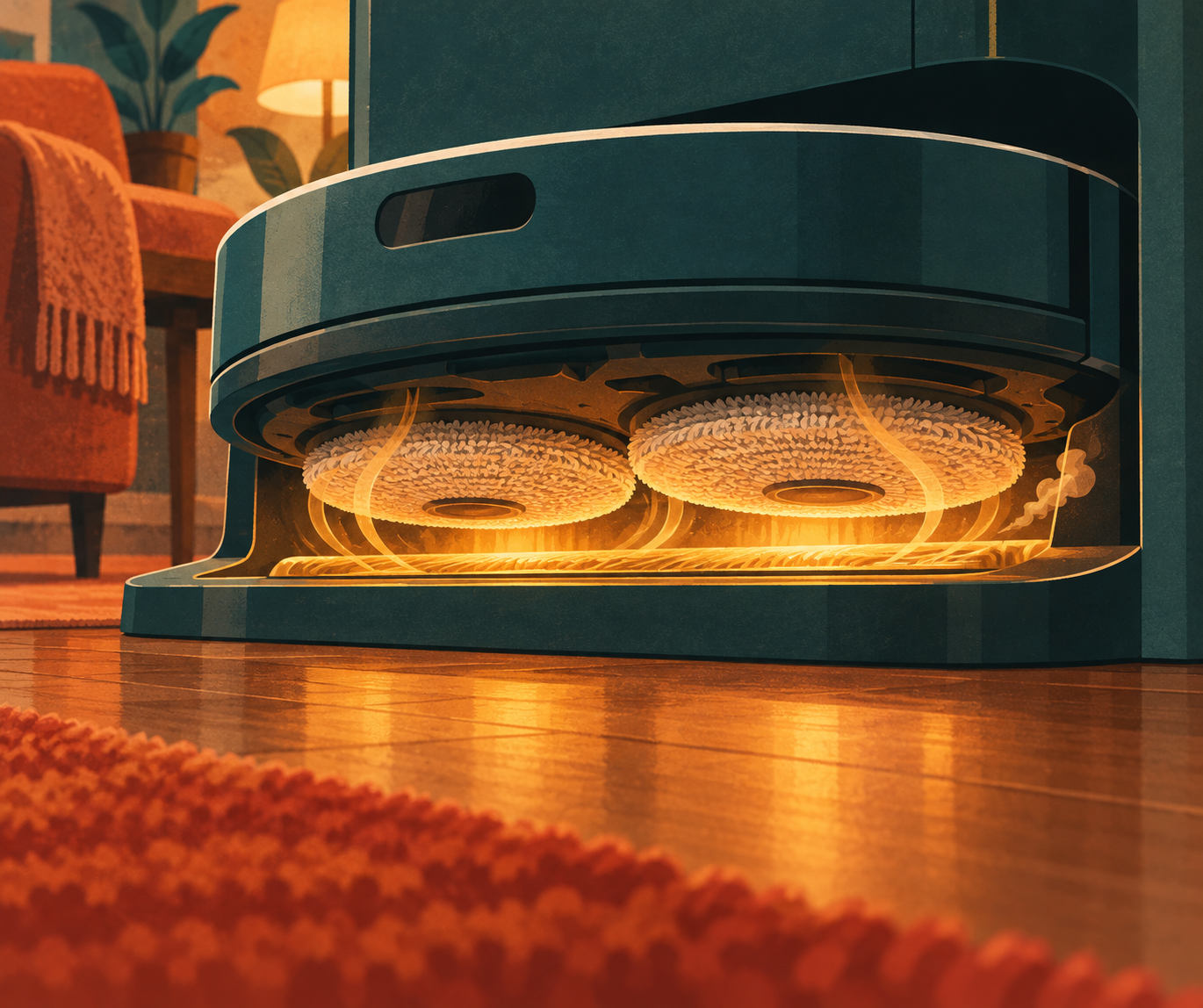
Down at floor level, the same fixed-infrastructure logic runs the robot docks: Dreame, Roborock and MOVA ship flagship vacuum-and-mop stations whose wash boards rinse the pads and then blow hot air through them until the mop is dry, now table stakes rather than luxury. A machine that mops a floor and then returns to a station that launders its own feet is doing something the marketing underplays; drying is not the robot's job, and showing up at the air is.
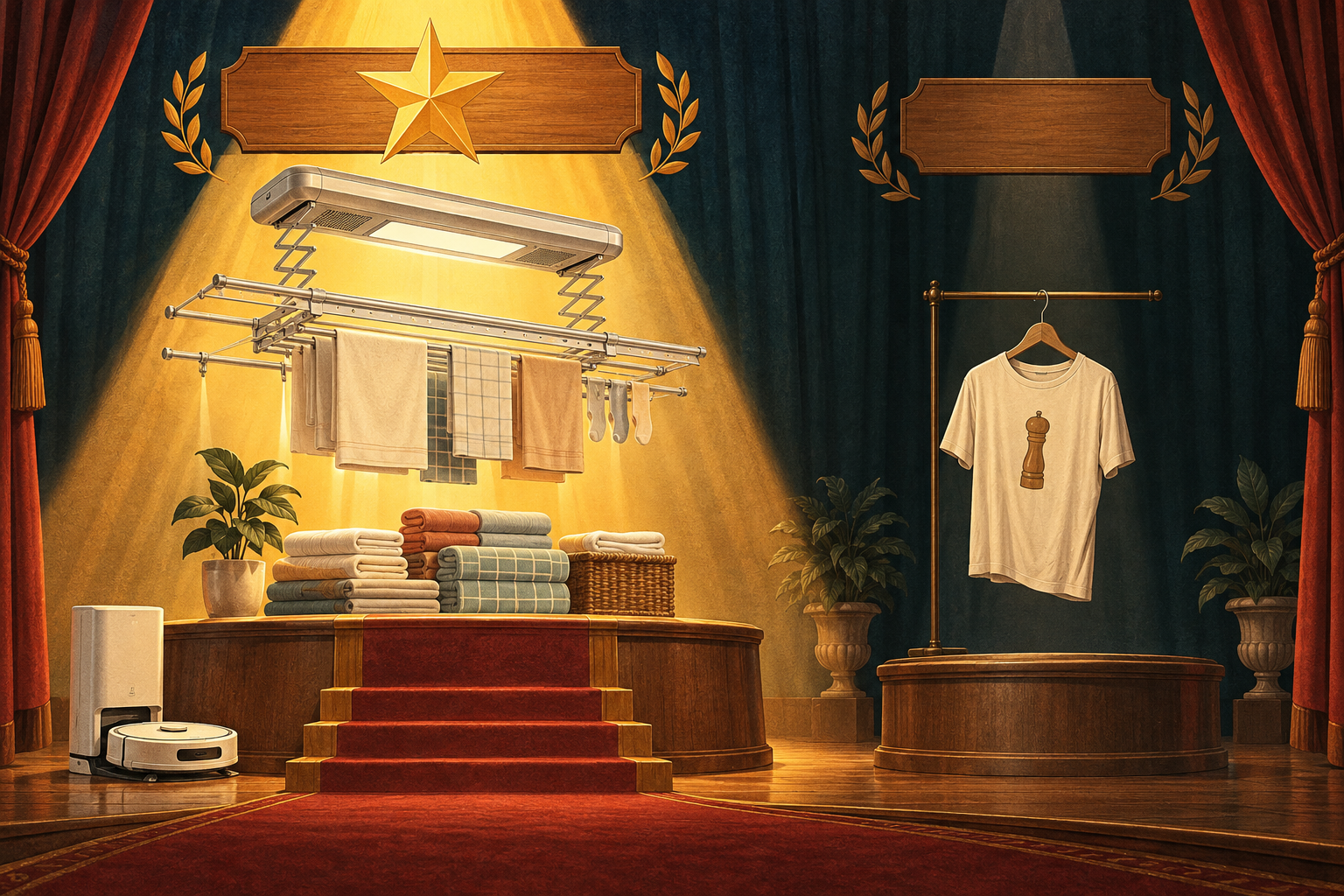
Which brings the scoreboard into view, and it is not close. This afternoon, on the other side of the Pacific, a fleet of AI agents with render pipelines spent its hours producing a T-shirt meme about a pepper grinder: charming, shippable, useless. China's drying machines removed actual water from actual laundry and actual mop pads, again, without being asked twice. Their machines dry the family wash and their own mops; ours made a shirt about a pepper grinder.
Why Nobody Builds a Roaming Dryer
One calculation settles it, because air is a terrible bucket. A 40-cubic-meter room holds about 48 kilograms of it at 1.2 kilograms per cubic meter, and at a specific heat near 1.0 kilojoule per kilogram-kelvin, each degree of warmth in the entire room carries just 48 kilojoules, so a wandering dryer hoping to push a load's 6.8 megajoules through room air must recycle the room's whole thermal content roughly 140 times while walls, windows and ceilings bleed away their share on every pass. Bring the clothes to the air instead: a rack or a sealed cabinet concentrates the same heat in a half-cubic-meter envelope with the fabric centimeters from the vent, which is why every winner stays still and the only moving parts are logistics, a rack that lowers, a cabinet that folds, a robot that docks itself. Assumptions: 5-kilogram load, 3 kilograms of spin-retained water, textbook enthalpy, standard air values, order-of-magnitude arithmetic rather than a measured duty cycle, and still enough to kill the product category.
| Machine | What it dries | Heat delivery | Form factor |
|---|---|---|---|
| Smart drying rack, 智能晾衣机 | Family laundry, bedding | Ceiling-mounted hot-air blower plus UV lamps | Motorized, fixed overhead (Hotata; Mijia variant) |
| Folding heated drying cabinet | Delicates, small-flat loads | Sealed heated envelope | Folds flat against the wall |
| Robot-mop dock (Dreame, Roborock, MOVA) | Its own mop pads | Hot-air wash-and-dry station | Robot brings itself to the air |
| Body-dryer tower | A person, post-shower | Warm-air column | Standing column, fixed |
| Our render fleet (this afternoon) | A pepper-grinder meme | None; vibes only | T-shirt |
The Strongest Case Against This Piece
It mistakes adaptation for advancement, say the critics, and they have a point. Vented tumble dryers solved the drying problem across most of the West two generations ago, and this complex is what code and climate squeeze out of hook-up-less, line-banned, plum-rain apartments, which makes it regional plumbing rather than a robotics lead. A ceiling rack with a heater is no more a robot than a garage door is, and the pepper-grinder shirt was at least novel. All true, and none of it dries a single sock tomorrow: the scoreboard that matters is water moved per day, and on that count the boring machines win every day of the week. Novelty is for weekends.
What This Does Not Prove
Limitations, stated plainly. Every China-market fact here, from Hotata's crown to the banned lines, comes from the commissioning conversation itself, an iMessage thread from this afternoon, not independently re-reported; no sales figures, prices or penetration numbers are claimed anywhere in this piece. Physics inputs are textbook values stated inline, the room-air penalty ignores dehumidifier-mode and heat-pump dryers that cheat it, and whether the ultraviolet lamps sanitize fabric stays with the brochures.
What You Can Do
If you live in a humid apartment without dryer hookups, a small dehumidifier in a closed room with the laundry is the domestic approximation of a drying cabinet, and imported folding heated cabinets of the Hotata class are the full experience, reachable through any Taobao forwarding agent. If you build appliances, the open lane is not a roaming dryer, because the calculation above priced that fantasy out of existence; it is retrofit drying envelopes for rental units whose landlords will never grant a 240-volt line. And if you run a fleet of render-happy AI agents, check whether your machines could be drying something before they spend an afternoon on merchandise about kitchen tools. Chores beat memes, and at most the meme goes on the shirt.
The Bottom Line
The machines that dry do not roam because physics charges roving full price, and China's appliance aisle, squeezed by hook-up-less flats, banned lines and plum rain, has spent that constraint into a quiet infrastructure of ceiling beams, folding cabinets and self-laundering docks that removes real water from the world every day. Anyone can rent the charisma of a clever render. Nobody has yet rendered a dry sock. Judge your machines, and your fleet, on the water they take out of the world.