🤖 Robotics
A Robot Steered by Water Ripples Points to a Chip That Decides in 4 Nanoseconds
Oxford researchers steered a real robot with ripples in a water tank, then showed in simulation how the same trick could run on a 1-micrometer magnetic chip. We worked out what each decision would cost in energy, and the answer exposes the device's sharpest unbuilt edge.
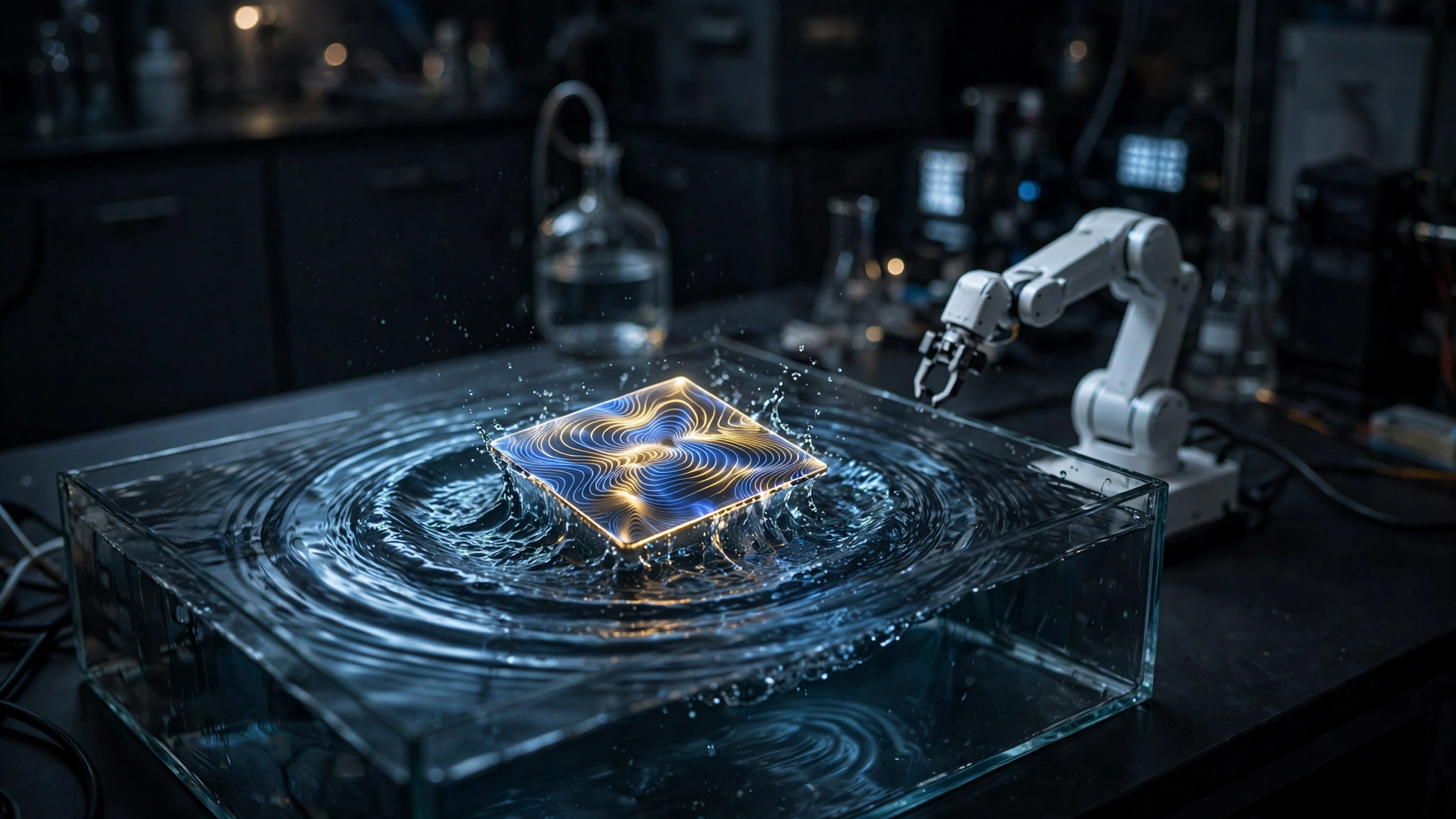
Four nanoseconds. That is the time between a sensor reading entering the device and a decision coming out: roughly the time light needs to cross a dinner plate. A paper published yesterday in Nature Communications shows how you get there, and the demonstration hardware is not a cleanroom chip. It is a tank of water.
Researchers at Oxford put ripple actuators in a shallow tank, fed the tank six ultrasonic distance readings from a small robotic vehicle, and let the waves interfere. Those interference patterns were the computation. With wave dynamics as the only "network," the little vehicle steered around obstacles in real time. Per the paper, obstacle recognition was near-perfect, with autonomous obstacle avoidance controlled entirely by the wave-based hardware. No training the waves. No backpropagation. Ripples, plus a linear classifier reading the pattern like a barcode.
That tank is real. Everything after it is a promise, and the promise is the interesting part.
Water is a visibility aid, not a prototype
Water was chosen because you can watch the waves. Direct visual access to the network dynamics is the tank's whole point, and also its ceiling: water waves move at centimeters per second, so the robot runs at robot real-time, a handful of decisions per second at most. Nobody is proposing data centers full of fish tanks.
What the team actually proposes is to shrink the same physics by a factor of roughly a million, onto a magnetic disk one micrometer across and 1.5 nanometers thick, where the waves are spin waves precessing at gigahertz frequencies. That version was never built. It was run inside MuMax3, a micromagnetic simulator, on GPUs, which is worth stating plainly because every number that follows about the chip comes from simulation, not measurement.
On paper, the simulated device is a good one. Here are the parameters the authors' public repo pins down:
| Parameter | Value | Where it comes from |
|---|---|---|
| Disk | 1 µm diameter, 1.5 nm thick | Simulation geometry |
| Grid | 512×512×1, 2 nm cells | Repo GEOMETRY.md |
| Drive carrier | 800 MHz | Repo PSEUDOCODE.md |
| Input pulse | 1.25 ns Gaussian, 6 channels | 6 ultrasonic distance readings |
| Decision window | 4 ns per sample | Tmax = 4 ns |
| Readout | Frame 100 of 201, 20 ps frames | Snapshot at 2 ns into the run |
| Integrator step | 0.2 ps | 20,000 steps per sample |
| Full benchmark sweep | Hours on a single GPU | Repo README |
How the trick works, and why the math is odd
This is physical reservoir computing. Each ultrasonic reading drives one actuator on the disk rim; the excited spin waves slosh, interfere, and mix the six inputs into a rich 2,500-dimensional pattern. A linear classifier, trained once on labeled examples, reads that pattern and outputs a class: obstacle configuration 1 through 5. Nothing about the physics is tuned to the task: the reservoir itself has zero trainable parameters.
It works disturbingly well on the benchmark. With a 5-class task, a plain linear SVM trained on the raw sensor values plateaus around 68%. Fed through the simulated wave reservoir, the same linear classifier hits 100% with about 500 training samples. That is a genuine gap, and the repo's 500-shuffle train-size sweep is the kind of reproducibility artifact most papers never ship.
Water-based computing is not new. A 2023 peer-reviewed review (Maksymov, Energies) traces the lineage from liquid-state machines through water-wave reservoirs and their spintronic, photonic, and mechanical cousins. What is new here is closed-loop robotic control driven by the reservoir, paired with the GHz spin-wave scaling path. Its contribution is the bridge from a visible toy to an invisible chip, not the water itself.
The calculation nobody ran: what one decision costs
Both the paper and the repo specify how the disk is driven: an effective anisotropy modulation of 8×10⁵ J/m³ per actuator, mapped in the repo to a VCMA (voltage-controlled magnetic anisotropy) drive. That mapping lets you compute the energy per decision from first principles, and as far as I can tell, nobody has published the result. So here it is.
Each actuator is a 50 nm diameter spot. On a record-class VCMA stack (coefficient ξ = 1 pJ/V·m, 1 nm MgO, relative permittivity 9.7), the 8×10⁵ J/m³ amplitude needs 0.8 V, comfortably under MgO's ~1 V/nm breakdown. Capacitance math gives 1.69×10⁻¹⁶ F per 50 nm spot, so one write pulse costs CV² = 108 femtojoules. Six sensor channels means six actuators per decision: about 0.65 picojoules of substrate write energy per decision.
For context, a Jetson-class robot board draws single-digit watts. Seven watts for a 10 ms inference is 70 millijoules per decision, so the substrate-level ratio against the simulated disk is roughly 1011: eleven orders of magnitude. Even if the unbuilt readout electronics cost a thousand times the write energy, the gap stays around eight orders of magnitude.
Now the catch, which is the entire second half of the calculation. This 0.65 pJ figure holds only on the best VCMA stack ever reported. Run the same amplitude on ordinary reported stacks (ξ = 100-200 fJ/V·m) and the voltage needed climbs to 4-8 V, at or past MgO dielectric breakdown. Repo documentation waves this through with a line about how "any Pt/CoFeB/MgO-class heterostructure can be matched by solving for Vpeak." You can solve for it, and the answer is that the simulated drive voltage is unreachable on typical stacks. On a hero device the sub-picojoule story is real physics; on commodity devices it is fiction. That is the chip's sharpest unbuilt edge, and it belongs in the headline as much as the femtojoules do.
250 million decisions a second
Latency is where the arithmetic gets cleaner. Frame 100 of 201 is the readout snapshot, one frame every 20 ps, so the classifier sees the state 2 nanoseconds into a 4 ns run. One decision per 4 ns window is a ceiling of roughly 250 million decisions per second per disk, before unmodeled readout latency. Meanwhile the water tank runs at order-of-Hz; the ratio is about 108. That quantifies the paper's own "gigahertz frequencies" claim: the spin-wave version does not just beat the water demo, it beats it by eight orders of magnitude per decision.
A different comparison matters, though: not against the tank. Against a Jetson doing 70 mJ decisions at 100 Hz, a fabricated chip would trade latency and energy for throughput at a scale where the bottleneck stops being the wave physics and starts being whatever reads the waves out. What the article cannot tell you, because it does not exist yet, is the cost of that readout.
The strongest case against all of this
Here is the honest version, in four sentences. The chip is simulated, not built. The only physical hardware is a water tank. In both versions the "brain" is a linear SVM running on a conventional computer: the waves do the nonlinear embedding, a CPU dot product makes the decision. And the benchmark task is six integer distance readings sorted into 2-5 classes, where a plain linear SVM already scores 92% on the easy variant.
Each of those sentences has a defense, and the defenses are worth hearing. Simulation-first is how all neuromorphic substrates start; you cannot tape out a device you cannot simulate. Digital readout is intrinsic to reservoir computing, not a cheat: the claim is that waves replace the expensive nonlinear layers, not that digital logic disappears. As for the task, it is a canonical probe, the reservoir equivalent of MNIST, designed to isolate the reservoir's contribution.
But none of the defenses survive contact with the readout problem. For the chip, the MTJ sensor array, the analog-to-digital conversion, and the classifier hardware are unbuilt and un-costed, and they appear in no energy figure anywhere in the paper. Remember: the 0.65 pJ is substrate write energy. Whatever reads 2,500 channels at gigahertz rates is going to cost something, and if it costs more than the waves save, the whole architecture is a curiosity. That is the number to watch.
What this analysis did not prove
Spin-wave results: simulation-only, from an accepted-manuscript version of the paper that is subject to edits. Energy and latency numbers above are substrate-level; readout electronics are unmodeled and their cost could swamp the write-energy advantage. VCMA voltage realism requires record-class stacks, as computed above. That benchmark task is synthetic: no sensor noise, no distribution shift, no closed-loop dynamics in the benchmark itself (the closed loop was the water tank, not the chip). And there is no fabricated-device data at all: no retention, endurance, thermal, or yield numbers. Every Jetson comparison is board-level against substrate-level; it is an energy budget, not a benchmark.
What to actually do with this
If you fund or build neuromorphic hardware, stop asking about the reservoir and start asking about two numbers: the VCMA coefficient ξ of the actual stack, and the energy cost of the readout chain per channel. A press release that quotes write energy without both is selling you a numerator without a denominator. Wave-computing demos die exactly here, per the track record, and the honest version of the paper's claim is a conditional: if record-class VCMA stacks reach production and gigahertz MTJ readout comes in under a few hundred femtojoules per channel, then wave reservoirs beat digital accelerators by orders of magnitude at sensing-rate inference.
If you are a researcher, the repo is genuinely good: clone it, rerun the 500-shuffle sweep, and check whether the 100% scores survive sensor noise. Nobody has published that test yet, and it is the cheapest experiment in the field right now.
If you are just watching: one signal settles it, a fabricated disk, any fabricated disk, with a measured write voltage and a measured readout cost. Until then, the water tank is a beautiful demo of physics, the chip is a beautiful simulation of a device, and the 4-nanosecond decision is real in the only place that matters for now, which is the math.
The Bottom Line
A robot steered by ripples in a water tank sounds like a science fair project, and the spin-wave chip it points to sounds like the future. Both are true, and neither is the story. The story is a ledger: 0.65 picojoules per decision on a hero VCMA stack, 250 million decisions per second per micrometer disk, zero trainable parameters in the reservoir, and a simulated drive voltage that typical stacks cannot survive. The hype dissolves into something better: a conditional, checkable bet on two hardware milestones. When a fabricated disk reports its write voltage and its readout cost, you will know exactly where to look to decide whether this is the future of sensing or the prettiest demo in neuromorphic computing.
Sources
- Nature Communications, 2026-09-10, DOI 10.1038/s41467-026-77661-3 (open access; accepted-manuscript early version; water-tank experimental system, near-perfect robotic-vehicle obstacle recognition, autonomous obstacle avoidance controlled by wave-based hardware, spin-wave extension via micromagnetic simulation)
- Authors' reproducibility repo: wave-based-neuromorphic-hardware (GEOMETRY.md: 1 µm disk, 1.5 nm thick, 512×512×1 grid, Ms = 1e6 A/m, Aex = 1.5e-11 J/m, α = 0.012, Ku1 = 6.3e5 J/m³, Bext = 45 mT; PSEUDOCODE.md: 800 MHz carrier, σ = 1.25 ns Gaussian, Ap = 8e5 J/m³, Tmax = 4 ns, 20 ps frames, Δt = 0.2 ps; Demo README: 6-channel robotic vehicle task, frame-100 readout, linear SVC, 500-shuffle train-size sweep, hours-per-sweep GPU cost)
- Maksymov, "Analogue and Physical Reservoir Computing Using Water Waves," Energies 16(14):5366 (2023) (peer-reviewed review; water-wave physical reservoir computing lineage, spintronic/photonic/mechanical physical RC surveyed)