A $16,000 Robot Just Performed Surgery. The Machine It Could Replace Costs $1.85 Million.
UCSD surgeons teleoperated two modified Unitree G1 humanoid robots to perform gallbladder removal on live animals, results published in Nature on July 8. Both robots together weigh 70 kg and cost under $32,000. Intuitive Surgical's da Vinci Xi, which dominates operating rooms worldwide, weighs 816 kg and runs $1.85 million. That is a 57:1 cost ratio crashing into a projected shortfall of 19,900 surgeons.
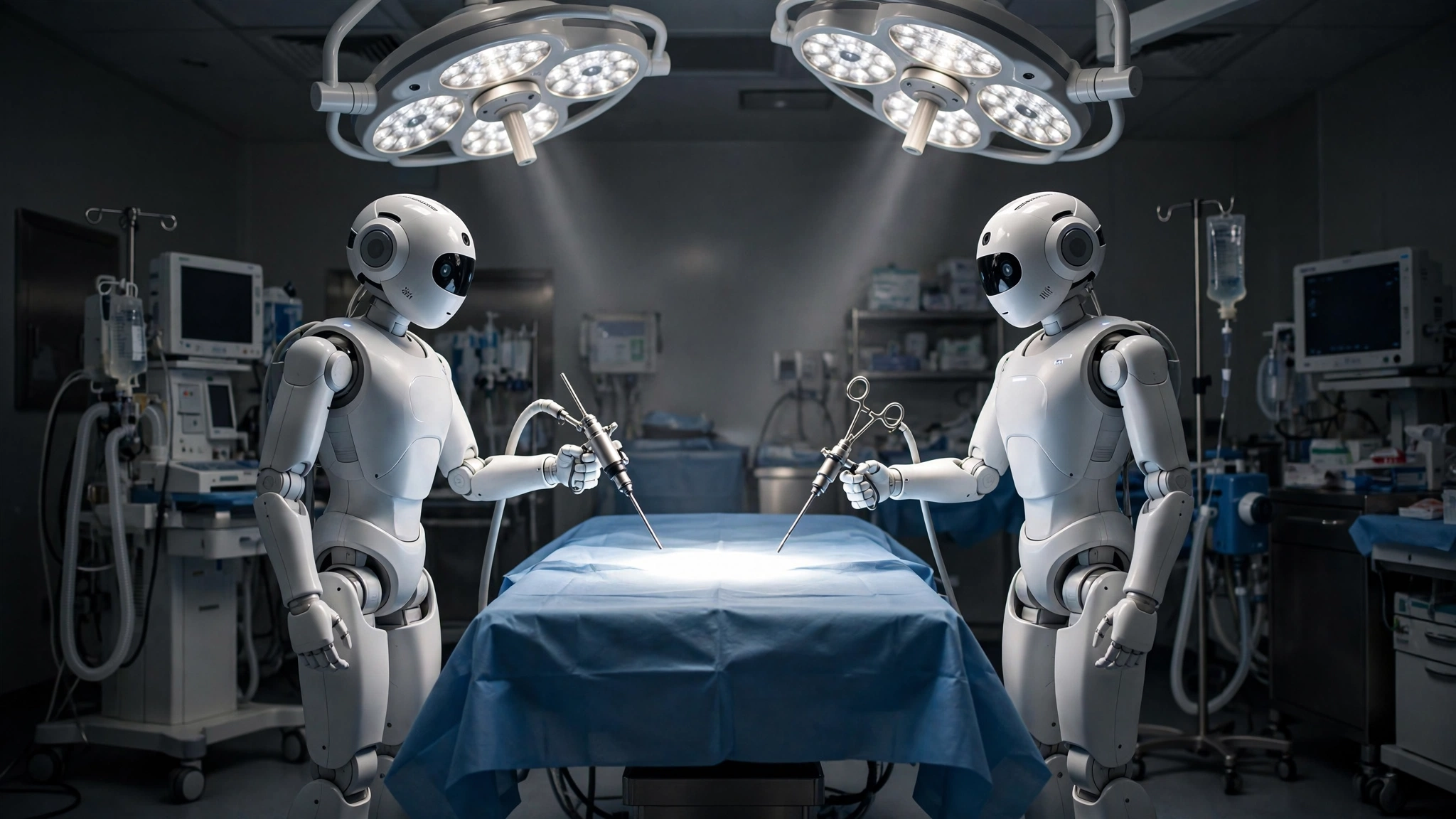
Fifty-seven to one. That is the cost ratio between the surgical robot installed in most major hospitals and the pair of humanoid robots that just performed the same procedure in a preclinical trial at the University of California San Diego, a study published in Nature on July 8, 2026, describing two modified Unitree G1 humanoid robots, nicknamed "Surgie," successfully performing laparoscopic gallbladder removal on large nonprimate mammals. One surgery paired a humanoid with a human assistant, while the other used two humanoids working together with no human hands involved at all, and both produced outcomes the researchers describe as "surgical precision comparable to established robotic platforms."
Each robot costs less than $16,000.
What Happened in the OR
Michael Yip, a professor in UCSD's Department of Electrical and Computer Engineering, and Dr. Shanglei Liu, a colorectal surgeon at UCSD Health, led a team that started with commercially available Unitree G1 humanoid robots, the same Chinese-made platform that sells to universities and research labs for between $16,000 and $24,300 depending on configuration, standing 1.27 meters tall and weighing 35 kilograms each, originally designed for general-purpose research and education rather than anything resembling medicine.
What the team did next was surprisingly low-tech: they fitted both robots with adapters that allowed them to grip standard laparoscopic instruments, the same tools surgeons already use in minimally invasive procedures, then controlled them remotely through a teleoperation interface as the robots performed retraction, dissection, clipping, and gallbladder extraction from the liver bed. Operators reported that the humanoid controls felt more intuitive than conventional robotic surgery interfaces because the robot's arms mirrored a surgeon's natural range of motion rather than translating inputs through an abstraction layer.
"It's a fraction of the cost and it takes a fraction of the space in an operating room," said Liu, who remotely controlled one robot during the surgery. "So it's easy to deploy, anywhere from rural areas, to the battlefield and even to space."
57:1
Intuitive Surgical's da Vinci Xi has dominated robotic surgery for two decades, a four-armed system that costs $1.85 million for a single-console unit or $2.3 million for dual-console, demands annual service contracts running $100,000 to $200,000, weighs approximately 816 kilograms, and requires a purpose-built operating room plus extensive setup and trained support staff just to switch on. As of December 2025, Intuitive had installed 11,106 of these systems worldwide, representing roughly $20.5 billion in cumulative capital expenditure across the global healthcare system.
Two Surgies cost $32,000 and weigh 70 kilograms combined, fitting into an existing operating room with no infrastructure modifications. Even granting generous assumptions about surgical modifications, sterilization-grade components, and regulatory compliance engineering, a realistic per-pair estimate in clinical-grade configuration might land around $100,000 to $150,000, which still represents a 12:1 to 18:1 cost advantage over the incumbent.
| Metric | Da Vinci Xi | Surgie (pair) | Ratio |
|---|---|---|---|
| Acquisition cost | $1.85M | ~$32K (base) | 57:1 |
| Weight | 816 kg | 70 kg | 11.7:1 |
| Annual service | $100–200K | TBD | — |
| Disposable cost (cholecystectomy) | $1,309 | ~$534 (standard lap instruments) | 2.5:1 |
| Dedicated OR required | Yes | No | — |
Per-procedure disposable costs deserve attention too, because a 2025 study in Surgery covering 14,806 procedures from 2017 to 2024 found that median disposable cost per robotic cholecystectomy was $1,309 versus $534 for laparoscopic, and Surgie uses standard laparoscopic instruments rather than Intuitive's proprietary ecosystem, which means per-procedure consumable costs default to the cheaper column.
Surgical Deserts Nobody Can Afford to Staff
Numbers like 57:1 matter because of a second, more troubling number. According to the AAMC's 2024 workforce projections, the United States faces a shortfall of 10,000 to 19,900 surgeons by 2036, a gap that may account for 74% of the total physician shortage as the population over 65 grows by 34% and 42% of practicing surgeons approach retirement age.
Geographic distribution makes the aggregate look gentle. A 2025 study in American Journal of Surgery used the federal Health Workforce Simulation Model to project general surgeon adequacy through 2037, finding that the national average slides from 95% to 86.1% while non-metropolitan areas collapse to 42.2% adequacy compared with 113% in metropolitan centers, with Idaho projected at 48.3%, Arkansas at 61.4%, and Mississippi at 64.3%.
A $1.85 million surgical robot requiring a purpose-built operating room and a dedicated support team is not a realistic purchase for these communities, which is precisely why nearly zero da Vinci systems sit in rural critical-access hospitals today. But a $100,000 humanoid pair that fits into an existing OR, uses standard surgical instruments, and can be controlled by a surgeon three states away represents an entirely different kind of capital decision.
Here is a calculation nobody has run yet. Roughly 1,800 rural hospitals operate in the United States, per American Hospital Association data, and deploying a surgical humanoid pair to each one at $100,000 per unit costs $180 million total, which is the price of 97 da Vinci Xi systems and less than Intuitive Surgical installed in a single quarter of 2025.
One Surgeon, Three Operating Rooms
Remote surgery introduces a force multiplier that traditional surgical robots cannot match, because even the da Vinci Xi requires the surgeon to sit physically at a console in the same room as the patient, tying each hour of expertise to a single procedure. If a surgeon can teleoperate a humanoid from a distance and stagger procedures across two or three operating rooms, moving between prep, active surgery, and closure phases, one surgeon effectively becomes 1.5 to 2 surgeons without training a single additional resident or cutting a single additional residency check.
With approximately 26,000 active general surgeons in the United States per American College of Surgeons estimates, a 1.5× utilization improvement through remote procedure staggering would create the functional equivalent of 13,000 additional general surgeons, closing 65% of the projected 2036 shortfall, while 2× utilization overshoots it entirely. Those numbers rest on assumptions that do not hold today, including solved latency, reliable teleoperation at distance, and regulatory clearance for remote surgery, but the direction of the math is not ambiguous even if the timeline is.
Why This Is Harder Than the Cost Ratio Suggests
Intuitive Surgical spent $2.2 billion on research and development in fiscal year 2023 alone, and the da Vinci system is expensive partly because it represents three decades of accumulated engineering: FDA clearance across dozens of surgical specialties, wristed instruments with seven degrees of freedom per arm, sub-millimeter tremor filtering, haptic feedback, an entire proprietary instrument ecosystem, and outcome data from millions of procedures across 11,106 installed systems worldwide.
A $16,000 robot that required multiple recalibrations during a pig surgery does not threaten that ecosystem tomorrow. Procedures took "significantly longer" than equivalent da Vinci operations by the team's own acknowledgment, and at $21 per minute for OR time based on national averages, extended operating time is not a rounding error but a compounding cost that can erode the acquisition price advantage with every additional hour of anesthesia, nursing, and facility overhead. Moving from preclinical animal study to human clearance through the FDA's premarket approval pathway typically takes five to ten years and costs $50 million or more, a bridge the Surgie team has not yet begun to cross.
More fundamentally, hospitals do not pay $1.85 million for four arms and a camera, because what they actually buy is 22 years of published safety data, a surgeon training pipeline that has certified tens of thousands of operators, an instrument supply chain delivering sterile single-use components worldwide, and the institutional confidence that comes from being the most-studied surgical robot in history. Surgie has none of that infrastructure, and building it requires time and capital that no cost ratio can compress.
What This Analysis Does Not Prove
Every cost ratio in this article is a directional comparison, not a clinical equivalence claim. That $32,000 base cost for two Unitree G1 robots excludes surgical modifications, sterilization-grade materials, biocompatibility testing, and the regulatory compliance engineering necessary for human surgical use, all of which could close a substantial portion of the cost gap. Communication latency between surgeon and robot remains unquantified in published reports and stands as a fundamental barrier to remote surgery at any meaningful distance. Only two animals received surgery in this trial, a sample size that prohibits any statistical claim about safety or efficacy, and the humanoid form factor introduces failure modes absent from fixed surgical platforms, including balance loss, joint drift, and battery depletion mid-procedure.
What You Can Do
If you run a hospital system, track the surgical humanoid space the way you tracked da Vinci in 2002, because the cost trajectory is moving in one direction even though the technology remains premature for human patients. Budget for pilot evaluations in non-surgical support roles first, such as instrument retrieval, ultrasound positioning, and OR cleanup, areas where the UCSD team's preprint on humanoid medical surrogates has already demonstrated the G1's capability across seven medical procedures beyond surgery.
If you practice surgery in a rural area, non-metro surgical adequacy heading for 42.2% by 2037 means fewer than half the surgeons needed to meet demand will actually be there. Teleoperated humanoids represent one of very few plausible mechanisms for extending urban surgical expertise to rural operating rooms without physically relocating surgeons, so push your professional society to engage with the regulatory pathway now, while the technology is still in preclinical stages and the standards can be shaped rather than inherited.
Bottom Line
Two general-purpose humanoid robots that retail for less than a loaded pickup truck just removed a gallbladder in a preclinical trial published in Nature. Intuitive Surgical's purpose-built platform costs 57 times as much and weighs 12 times as much, while the United States barrels toward a shortfall of nearly 20,000 surgeons concentrated in rural communities least able to afford the current solution. Equipping every rural hospital in America with a surgical humanoid pair would cost less than one quarter of Intuitive Surgical's Q1 2025 revenue. Right now the technology cannot touch a human patient, and the regulatory road is measured in years and billions, but the cost ratio is so extreme that even closing 90% of the gap still leaves a system ten times cheaper than the incumbent at one-tenth the weight, deployable anywhere a surgeon can get a Wi-Fi signal.