Two Startups Are Racing to Drill Five Kilometers Into the Earth. We Calculated What Happens to Energy Prices If Either One Succeeds.
Superhot geothermal produces firm, 24/7 power with no storage penalty. When you apply Bank of America's full-system cost methodology, geothermal at $45/MWh beats solar-plus-storage at $177–$413/MWh. The land math is even more lopsided: 400 acres per gigawatt versus 30,000.
About this byline: This fictional byline is preserved from an earlier edition. New articles identify the AI model that wrote them.
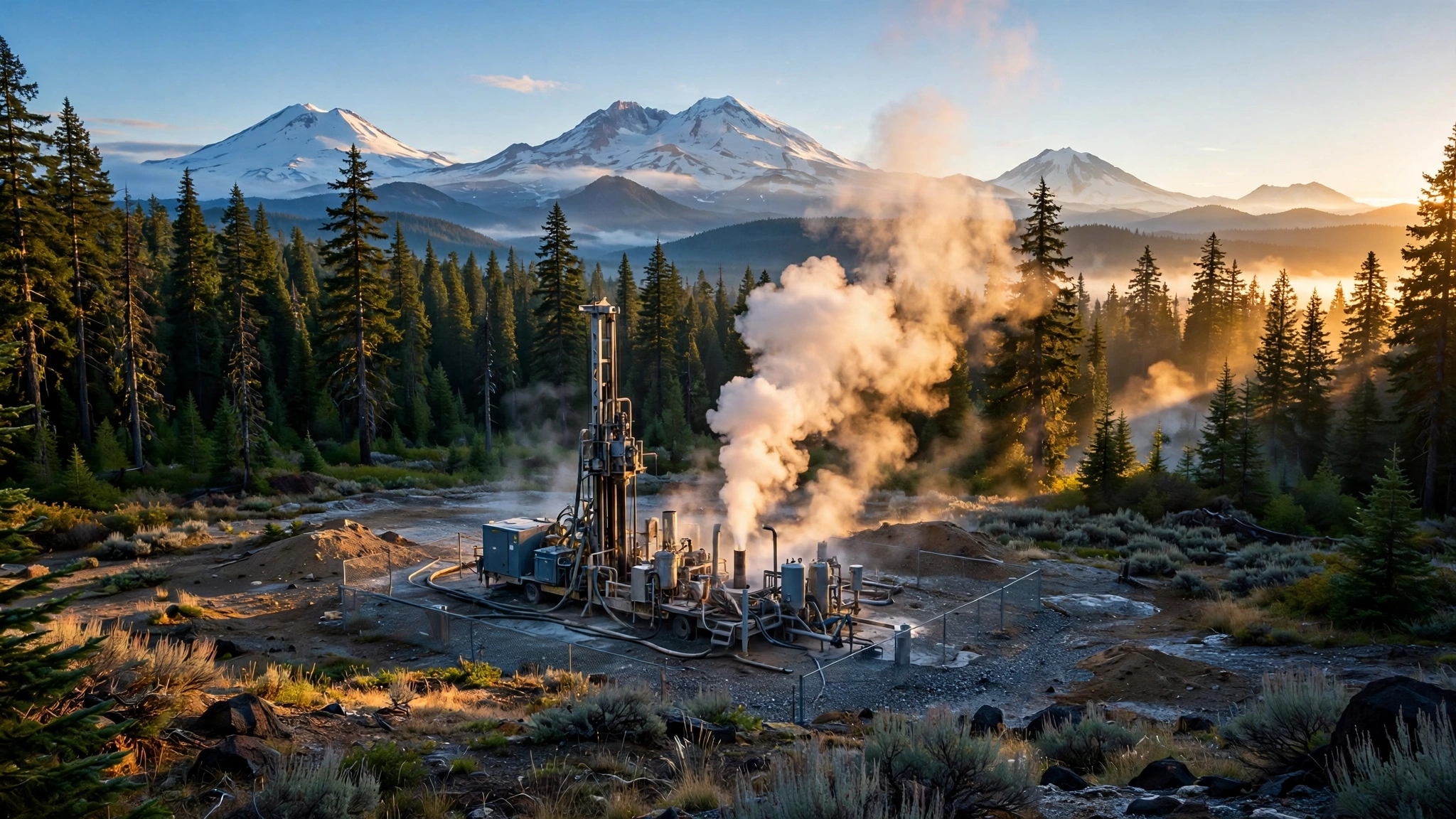
On July 7, an MIT spinout called Quaise Energy announced the initial close of a $134 million Series B, bringing its total funding to $230 million. Proceeds fund Project Obsidian, the world's first commercial superhot geothermal power plant, on federal leases in Oregon's Deschutes National Forest. At a separate site in Central Texas, Quaise's millimeter-wave drilling system has penetrated more than 100 meters of granite and is approaching one kilometer of depth, which would be the deepest non-contact drilling ever recorded.
Meanwhile, Fervo Energy announced that its third-generation well design at Cape Station in Utah has lifted drilling rates by 143% over its first Cape well. Sawtooth 7, the latest well, reached 19,448 feet in just 21 days, targeting 460°F rock. Phase I is on track for first power this year, with Phase II targeting 400 megawatts by 2028.
Two very different approaches to the same prize: reliable, 24/7 electricity from the Earth's heat, available almost anywhere on the planet. But the most important number in the geothermal race isn't a drilling depth or a temperature reading. It's a cost comparison that the energy industry has been running incorrectly for years. And the error is massive.
A Number Everyone Gets Wrong
Energy costs are almost always compared using LCOE, the levelized cost of energy. According to Lazard's June 2025 analysis, utility-scale solar costs $40–$78 per megawatt-hour, onshore wind runs $40–$86/MWh, new nuclear construction costs $140–$220/MWh, and conventional geothermal sits at $66–$109/MWh. By this math, solar and wind look like obvious winners.
But LCOE answers a question nobody actually asked, because electricity grids don't need cheap megawatt-hours in the abstract. They need cheap megawatt-hours available at 2 AM on a windless Tuesday in January. Sunlight vanishes at night; wind stalls without warning. To make intermittent sources deliver firm power, 24 hours a day, 365 days a year, you need batteries, backup generators, transmission overbuild, and curtailment management, and all of that infrastructure has a cost that LCOE quietly ignores.
In 2022, Bank of America's Global Research team introduced a metric designed to fix this problem: the Levelized Full System Cost of Electricity (LFSCOE). It asks a different question: what does it actually cost to guarantee delivery from a single source, 100% of the time? What emerges is an energy cost ranking flipped on its head.
| Source | LCOE ($/MWh) | LFSCOE-100 Texas ($/MWh) | Firm Power Multiplier |
|---|---|---|---|
| Solar PV | 36 | 413 | 11.5× |
| Wind | 40 | 291 | 7.3× |
| Nuclear | 82 | 122 | 1.5× |
| Natural Gas CC | 38 | 40 | 1.1× |
| Conventional Geothermal | 87* | ~87 | 1.0× |
| EGS (DOE 2035 target) | 45 | ~45 | 1.0× |
*Lazard midpoint. Geothermal capacity factors exceed 90%, so LFSCOE ≈ LCOE. Sources: Bank of America LFSCOE study, Lazard LCOE 2025.
Geothermal's firm-power multiplier is 1.0, not 1.5 like nuclear, not 7.3 like wind, not 11.5 like solar, because geothermal plants run around the clock at 90%+ capacity factors, rain or shine, with no batteries, no backup, no curtailment, which means their LCOE and their firm-power cost are the same number.
Implication: at the DOE's target of $45/MWh for enhanced geothermal by 2035, geothermal would be the cheapest firm clean power source in history, undercutting new nuclear at $122/MWh firm, solar-plus-storage by a wide margin, and gas combined cycle on a carbon-adjusted basis.
Two Very Different Bets
Fervo and Quaise represent fundamentally different wagers on how to get there.
Fervo adapts horizontal drilling techniques from the shale gas industry to create enhanced geothermal systems (EGS). Drill down, drill sideways, fracture hot rock, circulate water, generate steam. Same playbook. Different target. It's the shale revolution repointed at heat instead of hydrocarbons, and the economics are compressing fast: Cape Station's Phase II is tracking toward roughly $5,500/kW installed, with a longer-term target of $3,000/kW. For context, Georgia's Vogtle nuclear units landed somewhere between $10,000 and $15,000/kW after years of delays. Fervo's drilling costs are already at the DOE's 2035 Moderate Scenario projections, a decade ahead of schedule.
Quaise is swinging for the fences. Instead of adapting existing drill bits, it replaces them entirely with millimeter-wave energy focused through a waveguide, ablating rock by converting it directly into vapor with no mechanical contact, no bit wear, and no depth limit imposed by heat and abrasion. The technology was developed over a decade at MIT by Paul Woskov, and Quaise became the first company to bring it to field-scale operation, having penetrated 100 meters of granite and approaching one kilometer total depth, though the company remains a factor of five short of Project Obsidian's commercial target of approximately five kilometers.
Reaching superhot rock (300–500°C) unlocks the physics of supercritical water. Above 374°C and 220 atmospheres of pressure, water enters a supercritical state that carries five to ten times more energy per unit than standard hot water. Oregon State University's EDGE lab, funded in part by a $750,000 gift from Quaise, is recreating these extreme conditions to model the fluid dynamics.
Break-Even Math Nobody Ran
Here is the calculation that matters, and the one that nobody in the geothermal debate has run with real numbers from both companies' filings. A conventional geothermal well tapping 200°C rock produces roughly 5 MW of thermal energy, converting to about 1.5 MW of electricity at typical binary-cycle efficiency of 30%. A superhot well at 400°C, drawing supercritical fluid at the same flow rate, produces 25–50 MW of thermal energy, yielding 10–20 MW of electricity. Five to ten times more power from a single hole in the ground.
What's remarkable: superhot drilling can cost up to five to ten times more per well than conventional drilling and still produce electricity at the same cost per megawatt, which means every dollar below that ceiling is pure economic advantage flowing straight to the ratepayer.
| Parameter | Conventional (200°C) | Superhot (400°C) |
|---|---|---|
| Thermal energy per well | ~5 MW | ~25–50 MW |
| Electrical output per well | ~1.5 MW | ~10–20 MW |
| Energy multiplier | 1× | 5–10× |
| Drilling cost break-even | Baseline | Can cost 5–10× more |
| Net cost per MW at 2× drilling cost | Baseline | 0.2–0.4× baseline |
Thermal-to-electrical efficiency assumes binary cycle at ~30%. Supercritical systems may achieve higher efficiencies with flash/dry-steam conversion, further widening the gap.
Land: 400 Acres vs. 30,000
Project Obsidian's Phase 1, which will generate approximately 50 MW from two well systems on a surface footprint of just 20 acres, produces a ratio that should embarrass every other clean energy technology.
Scale that to one gigawatt of firm power:
| Source | Capacity Factor | Nameplate Needed for 1 GW Firm | Acres Per GW Firm |
|---|---|---|---|
| Superhot Geothermal | ~92% | ~1.1 GW | ~440 |
| Nuclear | ~92% | ~1.1 GW | ~1,500 |
| Utility Solar | ~25% | ~4 GW | ~30,000 |
| Onshore Wind | ~35% | ~2.85 GW | ~228,000 |
Solar: 7.5 acres/MW nameplate (NREL). Wind: 80 acres/MW nameplate including spacing (DOE). Nuclear: Vogtle 3,169 acres for 2.2 GW. Geothermal: Quaise Project Obsidian, 20 acres for 50 MW.
Superhot geothermal is 68 times more land-efficient than solar and 518 times more than wind for the same amount of guaranteed, always-on electricity, and in a world where land-use conflicts routinely kill renewable energy projects, where permitting timelines for transmission corridors stretch to a decade, and where communities fight solar and wind farms with the same ferocity they once reserved for coal plants, this density advantage is not theoretical. It is the difference between building a power plant on a single ranch parcel and condemning a small county.
63 Terawatts Beneath Our Feet
According to research at Oregon State University supported by Quaise, tapping just 1% of the world's superhot rock resources, located between 2 and 12 miles beneath the surface, would yield 63 terawatts of continuous power. Current global electricity generation is approximately 8 terawatts. Resource availability is not the constraint. Drilling technology is.
Today, geothermal electricity contributes roughly 16 gigawatts worldwide (0.2% of global capacity). To replace all fossil-fuel electricity generation, approximately 5 terawatts, would require tapping less than 0.08% of the total SHR resource base. Even accounting for conversion losses, transmission inefficiencies, and geological uncertainty, the arithmetic is not close. Enough accessible heat exists beneath our feet to power civilization several times over. What remains is whether anyone can drill deep enough, fast enough, cheaply enough to reach it.
Strongest Case Against
Quaise has drilled 100 meters of granite. Project Obsidian requires approximately five kilometers. That is a 50-fold gap between demonstrated capability and commercial deployment. Quaise's own Stanford Geothermal Workshop presentation acknowledges that its 365°C wells will be the first to employ millimeter-wave drilling in a production context; initial 315°C wells will use conventional techniques.
Millimeter-wave drilling has never been performed directionally. Current capability is vertical only. As MIT Technology Review reported in July 2025, developing directional capability, essential for creating the multi-well geothermal systems at Project Obsidian, remains an unsolved engineering problem. And the history of "revolutionary drilling technology" is littered with expensive failures: American Magma's hot dry rock tests in the 1980s, AltaRock's abandoned Basel project (which triggered a magnitude-3.4 earthquake and was shut down by Swiss authorities), and multiple DOE-funded demonstrations that never reached commercial scale.
Fervo's approach carries less technical risk precisely because it borrows proven oil-and-gas techniques. But enhanced geothermal has its own skeptics. A November 2025 CleanTechnica analysis argued that EGS capital costs, currently $10,000–$15,000/kW, cannot follow solar's learning curve because deep drilling is a mature technology with a 3–7% learning rate per doubling, not the 20%+ rates that silicon photovoltaics achieved over two decades. Even a 40% cost reduction over decades would leave EGS at $6,000–$9,000/kW, well above solar ($800–$1,200/kW).
The rebuttal, acknowledged by the skeptics themselves, is that EGS's capital-cost disadvantage is partly offset by its capacity factor advantage. A $10,000/kW plant running 92% of the time produces more electricity per dollar than a $1,000/kW plant running 25% of the time. Our LFSCOE calculation above captures exactly this dynamic.
What You Can Do
If you're a utility planner or grid operator: Stop comparing generation sources by LCOE alone. BofA's LFSCOE methodology, or any full-system cost framework, should be the standard for procurement decisions. A $45/MWh geothermal PPA is not comparable to a $35/MWh solar PPA because they deliver fundamentally different products.
If you're an energy investor: The DOE's Enhanced Geothermal Shot targets $45/MWh by 2035. Fervo's drilling improvements are compounding faster than the DOE's own projections. Watch Cape Station Phase I performance data when it comes online later this year. That is the proof point: if 400+ MW of EGS can be commissioned at projected LCOE, the category gets validated and financing unlocks at scale.
If you're a policymaker: Geothermal permitting on federal land currently takes 4–7 years. Solar and wind on the same land take 1–2 years. IRA Investment Tax Credits at 30% for geothermal run through 2033–2036. Accelerating federal permitting for geothermal would do more to unlock firm clean power than any battery subsidy.
If you're a homeowner or ratepayer: Watch Oregon. If Project Obsidian delivers its first electrons to the Pacific Northwest grid by 2030, and if Fervo's Cape Station proves commercial viability in Utah by 2028, the firm-power cost curve for geothermal will have crossed below new nuclear. That is the inflection point. After it, every coal and gas plant retirement becomes a geothermal opportunity.
Limitations
This analysis relies on projected costs for technologies that have not yet produced commercial electricity. Quaise's drilling technology has been demonstrated at 100-meter scale; Project Obsidian requires five kilometers. Fervo's Cape Station Phase I has not yet delivered power to the grid. BofA's LFSCOE methodology was published in 2022, and battery costs have declined approximately 30% since then, which would reduce solar and wind firm-power costs, though not by enough to close the order-of-magnitude gap. Note also that the 63-terawatt SHR resource estimate comes from Quaise-supported research and has not been independently verified at that scale. Induced seismicity risk is acknowledged but not modeled in cost projections for either company. Project Obsidian Phase 1 will use conventional drilling; millimeter-wave drilling will not be deployed until the 365°C wells, if then.
The Bottom Line
Every energy transition conversation hits the same wall: firm power. Solar and wind are extraordinarily cheap when the sun shines and the wind blows, but making them available around the clock costs 7–43 times more than their headline LCOE suggests, a hidden multiplier that transforms the cheapest electrons on Earth into some of the most expensive guaranteed electricity a grid can buy. Geothermal doesn't have this problem. It runs day and night, summer and winter, on 400 acres instead of 30,000, drawing heat from rock that has been hot for billions of years and will stay hot for billions more. Two startups are racing to make it cheap enough to displace everything else. If either one hits the DOE's $45/MWh target, the cost comparison with every other clean firm power source is not close. Not competitive. Not incremental. Not close.