A Nevada Utility Chose Data Centers Over 49,000 Homes. The Hidden "AI Surcharge" Hits Every American.
Cross-referencing utility rate filings, federal electricity data, and data center demand growth reveals that the average U.S. household is paying roughly $57 per year in electricity increases driven by AI infrastructure. In Virginia, it is $102.
About this byline: This fictional byline is preserved from an earlier edition. New articles identify the AI model that wrote them.
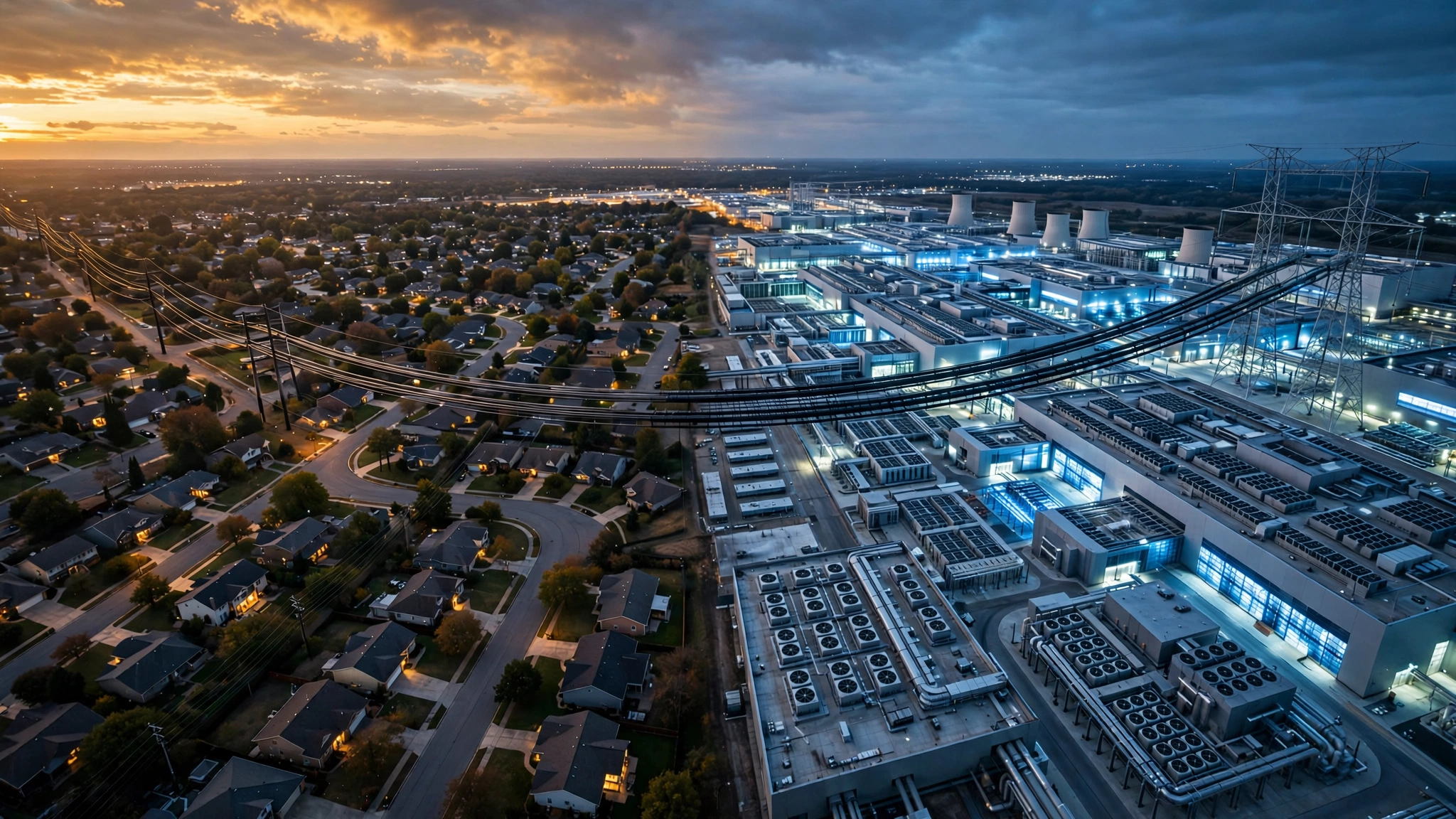
Forty-nine thousand.
Not a typo. That is the number of households around Lake Tahoe that learned earlier this year their electricity supplier, Liberty Utilities, will lose its primary power source in May 2027. NV Energy, the Nevada utility that has furnished the bulk of the region's electricity for decades, informed Liberty it would stop providing power. No financial distress, regulatory conflict, or infrastructure failure prompted the decision. NV Energy needs the capacity for data centers being built by Google, Apple, and Microsoft around the Tahoe-Reno Industrial Center east of Reno, according to Fortune and Electrek reporting.
A jurisdictional tangle makes the situation worse. Liberty Utilities is a California-regulated company whose grid sits inside NV Energy's balancing authority. California regulators cannot order a Nevada utility to keep supplying power. Building a direct connection to California's grid would cost hundreds of millions of dollars. Liberty has asked California regulators to authorize emergency procurement of replacement power, but as one Lake Tahoe energy policy expert told Fortune: 49,000 residential customers competing in the Western electricity market against major utilities and data center operators have zero leverage.
Most Americans will never receive a letter this blunt, not one that says in plain language that their electricity is being taken away and given to a technology company with a market capitalization larger than the GDP of most countries. But the financial version of it is already arriving, line by line, on electricity bills across the country.
The Numbers Behind the Squeeze
Data centers consumed approximately 8% of all U.S. electricity in 2025, according to the American Edge Project and Stanford's AI Index Report. By 2028, that share could reach 12%. More telling than the absolute percentage is the growth rate: data centers drove fully half of all U.S. electricity demand growth last year, a figure that would have seemed absurd five years ago when they accounted for roughly 2% of national consumption and nobody at the Federal Reserve was talking about them as an inflation driver.
In Virginia, the situation is already extreme. Data centers consume more than one in every four kilowatt-hours generated in the state. In Nevada, data centers took 22% of the state's electricity in 2024, and NV Energy's own 2024 resource plan filing projects that share rising to 35% by 2030. Twelve data center projects in Northern Nevada alone could drive 5,900 megawatts of new demand by 2033, according to Desert Research Institute analysis of that filing. Three-quarters of NV Energy's major-project load growth is attributed to data centers.
Globally, Gartner forecast that data center electricity consumption would reach 565 terawatt-hours in 2026, a 26% increase over the 447 TWh recorded in 2025. AI workloads specifically are expected to grow from 25% to 60% of total data center electricity demand in the next three to five years, according to Capgemini Research Institute's June 2026 survey of energy and data center executives across 21 countries.
The Rate Increases Nobody Connects to AI
The national average residential electricity rate hit 17.45 cents per kilowatt-hour in January 2026. That is a 9.5% increase year over year, far outpacing general CPI inflation of roughly 3%, and the size of the gap, more than triple the inflation rate, demands an explanation that goes beyond "everything costs more."
Dominion Energy, which serves approximately 2.7 million residential customers in Virginia, proposed its first base-rate increase since 1992, adding $8.51 per month per household in 2026. Dominion's filing attributes the increase "in large part" to infrastructure needed to serve data center load. Not opinion. Not inference. The utility told its own regulators, in writing.
Run the math. If $8.51 per month is the total increase, and data center infrastructure drives even half of it, which is a conservative reading given that Dominion's own filing cites data center load as the primary driver, that is $4.26 per month, or $51 per year, paid by each residential customer to expand grid capacity that primarily serves companies like Amazon Web Services, Microsoft Azure, and Google Cloud, companies whose combined market capitalization exceeds $8 trillion. Across Dominion's 2.7 million residential accounts, the total residential cost attributable to data center infrastructure reaches approximately $138 million annually. At full scale, $8.51 across all 2.7 million residential accounts totals roughly $276 million per year.
The National "AI Surcharge": Running the Calculation Nobody Runs
Here is the calculation. It requires combining five data points that individually appear in different filings and reports but are never cross-referenced.
| Input | Value | Source |
|---|---|---|
| U.S. residential households | ~130 million | Census Bureau |
| Average annual household electricity bill | ~$1,770 | EIA |
| YoY residential rate increase | 9.5% | EIA, January 2026 |
| General CPI inflation | ~3% | BLS |
| Data center share of demand growth | ~50% | Multiple industry sources |
The 9.5% residential rate increase on a $1,770 base yields an increase of approximately $168 per household per year. Inflation explains $53. Where did the other $115 go? After stripping out general inflation, that remainder reflects grid infrastructure expansion, fuel cost changes, weather-related damage, electrification of transport and heating, and the single largest new demand category of the past five years: data centers.
If data centers drove half of all demand growth, a reasonable attribution of their share of the non-inflationary rate increase is roughly 50% of the infrastructure-driven component. Not all infrastructure spending serves data centers, but the BLS offers a revealing signal: since 2020, inflation for transformers and power regulators has surged to the second-highest of all 47 categories the Bureau of Labor Statistics tracks in its monthly Producer Price Index. Transformer wait times have tripled, according to JPMorgan. GE Vernova, the largest natural gas turbine manufacturer, reported that bookings for its power generators have doubled to $200 billion over a five-year period. These are not abstract trends. They are infrastructure costs that flow directly into the rate base that residential customers pay.
Attributing half of the non-inflationary, infrastructure-driven increase to data center demand: approximately $57 per year per U.S. household. Across 130 million households, that is approximately $7.4 billion annually in residential electricity cost increases driven by AI and cloud computing infrastructure.
This estimate carries wide error bars. It could be as low as $30 (if electrification and weather dominate infrastructure spend) or as high as $90 (in states like Virginia and Nevada where data centers are the dominant driver). Precision is not the point; what matters is that the number exists, that the underlying data is all public, and that nobody publishes the total.
What 49,000 Homes' Worth of Electricity Actually Powers
The Lake Tahoe displacement offers a human-scale comparison that puts the numbers in context. If those 49,000 households average 900 kWh per month (close to the national residential average), NV Energy is redirecting approximately 529 GWh per year away from homes toward data centers. An AI query on a large language model like ChatGPT consumes roughly 2.9 Wh, according to a peer-reviewed analysis published on arXiv, nearly ten times the 0.3 Wh of a standard Google search. Dividing that redirected electricity by the per-query consumption: 529 GWh equals approximately 182 billion AI queries. Spread across a year, that is roughly 500 million queries per day.
To put it differently: the electricity that previously heated, cooled, and illuminated 49,000 American homes will instead answer about 500 million AI prompts daily. Is that worth it? Depends who you ask. But the exchange rate itself should be public.
The Infrastructure Cost Nobody Sees on the Receipt
At retail rates, a single AI query costs about half a cent in electricity: 2.9 Wh at 17.45 cents per kWh equals $0.0005. Cheap enough to feel free.
But that calculation only captures the marginal cost of electrons already flowing through existing wires. It ignores the infrastructure being built, at enormous expense, to deliver those electrons to facilities that did not exist three years ago. Data center construction spending hit $68.3 billion in June 2026, up 46% from a year earlier, according to Census Bureau data reported by CNN. Minneapolis Federal Reserve President Neel Kashkari noted last week that data center construction is fueling broader inflation. A single state-of-the-art AI campus costs around $8 billion, according to Columbia Business School professor Stijn Van Nieuwerburgh.
JPMorgan estimated $750 billion in AI infrastructure investments in 2026 alone. That is not a forecast; it is a tally of commitments already made by companies that include Microsoft, Google, Amazon, Meta, and Oracle, among others, and the spending ripples through the economy in ways that never appear on any AI company's sustainability report: every transformer ordered for a data center substation is a transformer not available for a residential grid upgrade, and the wait has tripled. every electrician hired for a data center build is an electrician unavailable for residential construction, and the labor shortage is so acute that the American Edge Project estimates the U.S. would need to add 500,000 electricians, 300,000 welders, and 550,000 plumbers just to meet current data center construction plans.
The Counterargument, at Full Strength
Data center operators are not freeloading. They pay commercial and industrial electricity rates, which are often higher per megawatt than residential rates. They build their own substations, contribute interconnection fees, and in many jurisdictions pay significant property taxes. In Virginia, data center investment has generated over $1 billion in annual local tax revenue, funded road improvements, and created thousands of construction and operations jobs. Economic development arguments are real and measurable, and the rate increases residential customers face, advocates argue, would have happened anyway from electrification of vehicles and heating, aging grid infrastructure that needs replacement regardless, and extreme weather events that drive up maintenance costs.
Consider the strongest version of this argument: data center demand is accelerating grid investment that benefits everyone. New transmission capacity serves residential and commercial customers too. The transformer production boom, painful now, will eventually expand domestic manufacturing capacity. Some data center operators are building dedicated solar and wind farms that add clean generation to the grid.
There is real merit here, and the argument deserves full-strength presentation precisely because dismissing it would weaken the more important structural question that follows. While data centers pay their own electricity bills, the shared infrastructure costs, including transmission lines, transformers, substations, and grid interconnection, are socialized across all ratepayers in ways that individual electricity invoices never itemize. When NV Energy tells 49,000 homes their power is being redirected, the externality is no longer abstract. When transformer inflation is the second-highest of 47 PPI categories, the bottleneck is being created by one class of demand and paid for by everyone.
What Comes Next
Eighty percent of utilities surveyed by Capgemini expect more extreme and less predictable demand spikes from data centers in the next three to five years. Behind-the-meter power generation is the industry's proposed solution: 86% of data center operators told Capgemini they see the ability to operate independently from the grid as a competitive advantage. Nearly 30% already deploy on-site power, and 39% plan to add it within one to two years.
Meta has signed contracts for eight TerraPower Natrium small modular reactors, Google has contracted with Kairos for 50 megawatts of SMR capacity, and Microsoft is restarting Three Mile Island. These are construction projects with real timelines, but those timelines stretch to the late 2020s and early 2030s. Grid strain is happening now, not later, and the gap between when the demand appeared and when the solutions arrive is being filled by residential ratepayers.
Meanwhile, 71% of Americans oppose data center construction in their communities, according to Gallup. About a dozen states have proposed building moratoriums. New York and Texas have enacted temporary bans. Goldman Sachs estimates that only about half of AI computing capacity scheduled for activation through 2028 will actually come online by its target date, down from a historical on-time rate of 72%. Of the 565 gigawatts of computing power currently planned nationally, Columbia Business School projects only 180 will actually get built. Two-thirds of the pipeline is, in Van Nieuwerburgh's word, "implausible."
Limitations
The $57 national estimate attributes half of non-inflationary, infrastructure-driven residential rate increases to data center demand, and it is an approximation rather than an audit, which means the actual share varies enormously by state., from near-zero in states with minimal data center presence to potentially higher than $100 in Virginia and Northern Nevada. Rate increases have multiple simultaneous drivers, and utility filings do not always isolate data center infrastructure from general grid expansion. The 2.9 Wh-per-query figure for AI models is an order-of-magnitude estimate based on GPU power draw and throughput; actual consumption varies by model size, inference optimization, and hardware generation. EIA residential rate data reflects rolling averages and may not capture the most recent rate changes in fast-moving markets.
The Bottom Line
When 49,000 Lake Tahoe households learned their electricity was being redirected to serve data centers, it became a local news story, the kind that generates an outraged forum post and a few hundred shares before disappearing. It should be a national one. The financial version of that letter is arriving on every American electricity bill, just spread thin enough that nobody connects the $14 quarterly increase to the AI infrastructure boom reshaping the grid. The data exists in utility rate filings, EIA statistics, BLS producer price indices, and Census Bureau construction spending reports. Nobody cross-references them because no single entity has an incentive to publish the total.
For homeowners in high-impact states, the math increasingly favors rooftop solar and battery storage, not as a green lifestyle choice but as infrastructure self-defense. For policymakers, the question is not whether data centers should exist but whether the infrastructure costs they impose should be socialized across residential ratepayers or borne by the operators whose demand created them. For everyone else, the electricity bill deserves a line item that does not yet exist: the AI surcharge, currently running at roughly $57 per year and climbing.
What You Can Do
Check your utility's rate case filings. Most states require utilities to file rate increase justifications with public utility commissions. Search "[your utility name] rate case 2026" to find the filing. Look for language attributing infrastructure investment to "large-load customers," "hyperscale," or "data center interconnection." That is your share of the AI surcharge, in your utility's own words.
If you are in Virginia, Nevada, Texas, or Northern Virginia suburbs, your exposure is highest. Dominion Energy's $8.51 monthly increase is the first since 1992; it will not be the last. NV Energy's 75% load-growth attribution to data centers means most future rate increases in Nevada will carry the same driver. Consider solar-plus-storage quotes now, before rate parity shifts further.
If you are a state legislator or PUC commissioner, demand that utility rate filings isolate data center infrastructure costs from general grid investment. Several states already require large-load interconnection cost allocation studies. Extend those requirements to rate case proceedings so residential customers can see exactly how much of their bill increase serves data center demand.
Watch the transformer bottleneck. Transformer and power regulator prices are the canary in the coal mine. BLS PPI data shows them as the second-fastest-inflating industrial category since 2020. When your utility cites "supply chain constraints" or "equipment delivery delays" as reasons for rate increases or reliability issues, the root cause is often data center demand competing for the same limited production of high-voltage equipment.