🚀 Space
A Planet 49 Light-Years Away Just Passed the Three-Part Test for Habitability. No Other World Has.
Astronomers detected helium streaming off LHS 1140 b, a rocky super-Earth sitting in its star’s habitable zone, confirming the first atmosphere on any world that checks all three boxes for potential life. An original escape-velocity analysis of the two-planet system reveals the quantitative reason one sibling kept its air while the other was stripped bare: a 26.6× difference in atmospheric vulnerability.
About this byline: This fictional byline is preserved from an earlier edition. New articles identify the AI model that wrote them.
Twenty point one kilometers per second. That is the escape velocity at the surface of LHS 1140 b, a rocky world 49 light-years from Earth, and it is the number that explains why this planet still has an atmosphere after three billion years of bombardment by stellar radiation while its neighbor, orbiting the same star, has been scoured to bare rock.
On July 16, a team led by Collin Cherubim at Harvard published a paper in Science announcing the detection of helium gas escaping from LHS 1140 b’s upper atmosphere. The measurement came from the WINERED spectrograph on the Magellan Clay Telescope at Las Campanas Observatory in Chile. It changes things.
“This is the first time anyone has found an atmosphere on a rocky planet in the habitable zone of another star,” Cherubim said.
That sentence is doing a lot of work. Thousands of exoplanets have been cataloged since the first confirmed detection in 1992. Atmospheres have been spotted on dozens of gas giants, bloated hellscapes where the temperature would melt iron. Rocky worlds in habitable zones have been located. But until now, no single planet had satisfied all three criteria at once: rocky composition, the right temperature range for liquid water, and a confirmed atmosphere.
LHS 1140 b just did. Three boxes. One planet.
Two Planets, One Star, Opposite Fates
What makes this discovery far more than a checkbox exercise is the LHS 1140 system itself. It offers a controlled experiment that nature rarely provides: two rocky planets orbiting the same M4.5 red dwarf star, formed from the same disk of gas and dust, exposed to the same stellar history. One kept its atmosphere. Its neighbor did not.
| Parameter | LHS 1140 b | LHS 1140 c | Earth |
|---|---|---|---|
| Mass (Earth = 1) | 5.60 | 1.91 | 1.00 |
| Radius (Earth = 1) | 1.73 | 1.27 | 1.00 |
| Surface gravity (g) | 1.87 | 1.18 | 1.00 |
| Escape velocity (km/s) | 20.1 | 13.7 | 11.2 |
| Stellar energy received (Earth = 1) | 0.43 | 5.3 | 1.00 |
| Orbital period (days) | 24.7 | 3.8 | 365.25 |
| Atmosphere detected | Yes | No | Yes |
Planetary data from Cadieux et al. (2024). Surface gravity and escape velocity are original calculations from mass and radius.
Planetary scientists quantify this with the cosmic shoreline, a framework proposed by Kevin Zahnle and David Catling in 2017 that draws a boundary between worlds that retain atmospheres and those that lose them. Elegantly simple math governs it: atmospheric mass loss scales with the energy a planet receives from its star divided by the square of its escape velocity. More energy and a weaker gravitational grip means more gas escaping into space.
Running those numbers for the LHS 1140 siblings produces a stark result. Planet b’s escape parameter comes to 0.00106 in Earth-normalized units. Planet c: 0.0282.
That is a factor of 26.6. Not a marginal difference. A chasm.
Planet c is not slightly more vulnerable to atmospheric stripping than its sibling. It is twenty-seven times more vulnerable, a difference produced by the compound effect of sitting 3.5 times closer to the star (which intensifies XUV radiation by more than 12 times) while weighing less than a third as much (which cuts gravitational hold). The system is a textbook demonstration of the cosmic shoreline: identical stellar environment, wildly divergent outcomes, explained entirely by mass, radius, and orbital distance.
5,000 Earth Oceans
Whatever atmosphere LHS 1140 b managed to hold onto is not a thin wisp. At 5.9 grams per cubic centimeter, combined with JWST observations that ruled out a hydrogen-rich envelope, points to a world with a rocky core carrying a substantial water inventory. Analysis by Cadieux et al. suggests 10 to 20 percent of the planet’s mass is water.
That range sounds modest. It is not. LHS 1140 b weighs 5.60 Earth masses, which translates to roughly 3.34 × 1025 kg. Ten percent water is 3.34 × 1024 kg. Earth’s oceans total 1.335 × 10²¹ kg. Even at the low end, this planet could hold 2,500 Earth oceans’ worth of water. At the high end: 5,000.
Whether any of that water exists as liquid on the surface depends on atmospheric pressure and heat distribution. The planet is almost certainly tidally locked, one hemisphere permanently facing its star. If it has an Earth-like atmosphere with enough greenhouse effect and wind circulation, models predict a single liquid ocean roughly 4,000 km across on the star-facing side, with surface temperatures near 20°C. For scale, that is the width of Australia, sitting in a permanent noon.
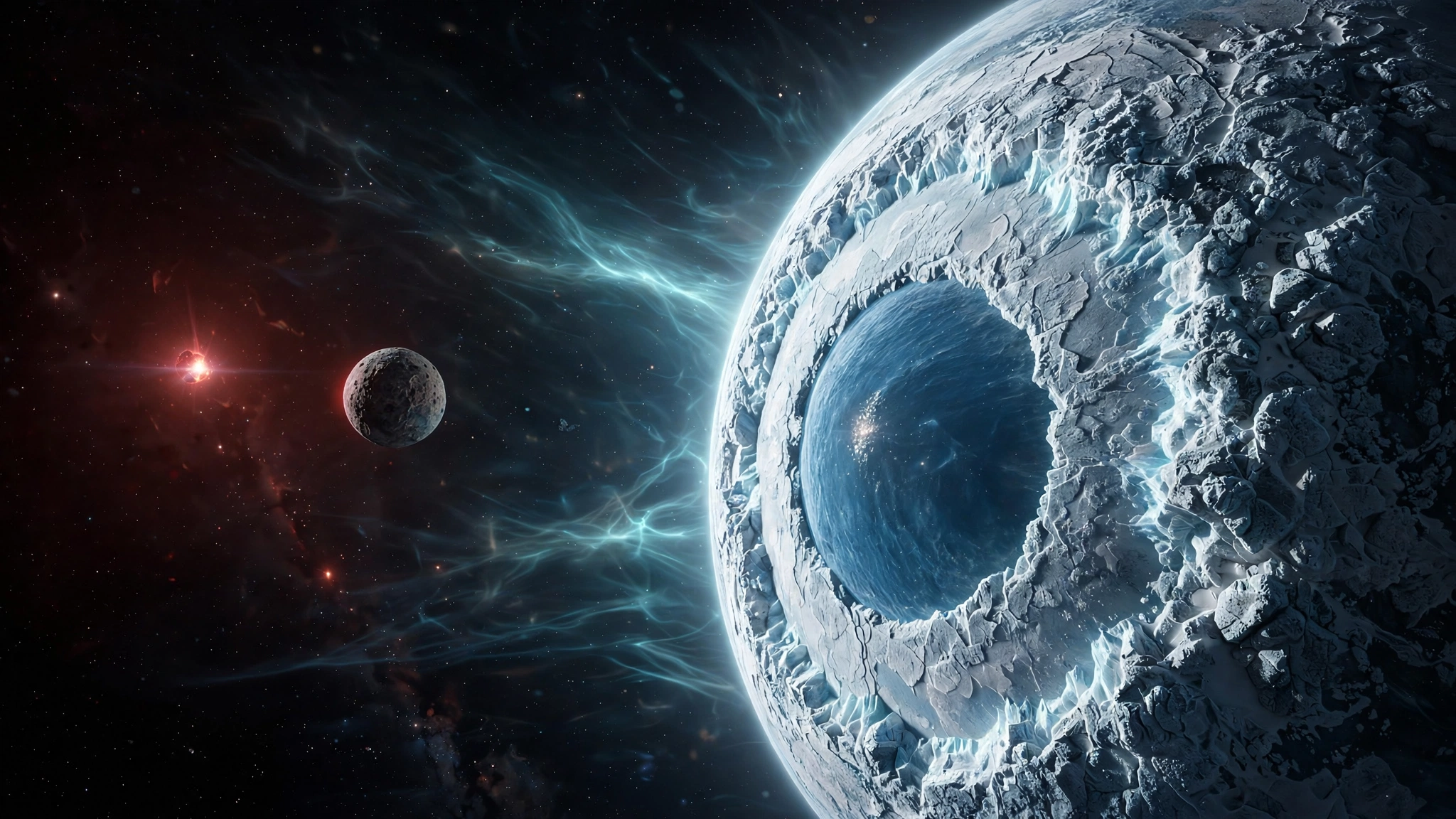
The planet would look like an eyeball. A frozen white sphere with a single dark pupil of liquid water staring permanently at its star, ringed by glacial lashes that transition from ice to open ocean over a few hundred kilometers of shoreline that would be, by any reasonable definition, the most alien beach in the galaxy.
The Helium Leak
Cherubim’s discovery exploits an insight that turns a seeming weakness into a signal. Small rocky planets cannot hold onto helium indefinitely; it is too light, and stellar X-ray and ultraviolet radiation heat the upper atmosphere until helium atoms reach escape velocity and stream into space. For most rocky worlds, that process finished billions of years ago. But LHS 1140 b’s gravitational grip is strong enough to have slowed the leak to a trickle, one that is still detectable.
Cherubim’s team observed helium escaping at a rate of hundreds of thousands of kilograms per second, heated to over 4,700°C by stellar radiation. At roughly 300,000 kg/s, which sits within the order-of-magnitude range implied by the data, the planet would lose about 9.5 × 10¹² kg of helium per year. Over three billion years, that adds up to approximately 2.85 × 10²² kg. Earth’s entire atmosphere weighs 5.15 × 10¹⁸ kg. So: LHS 1140 b has shed roughly 5,500 Earth atmospheres’ worth of helium. It still has more.
That implies a formation story in which the planet accumulated a massive primordial gas envelope during the first few million years of the system’s life, then spent the next several billion years slowly bleeding it off, a process so gradual that even after losing enough gas to fill 5,500 Earths the reservoir has not run dry. Laura Kreidberg of the Max Planck Institute for Astronomy, who was not involved in the study, captured it precisely: “I think it is very possible that what we’re seeing is a snapshot of this evolution from the smallest gas giant to the biggest rocky planet.”
Cherubim calls this new category “helium worlds” and argues they may be common rather than exotic, a natural evolutionary phase for many small planets orbiting red dwarfs, which together constitute roughly 70 percent of all stars in the Milky Way and host, by current estimates, an average of 2.5 rocky planets each, meaning the galaxy could contain upward of 100 billion rocks in the right mass range to follow the same trajectory. He predicted this class theoretically before observing it, using mass fractionation models showing that some planets land in a sweet spot where they lose their lighter hydrogen but retain their heavier helium. LHS 1140 b was among his higher-probability predictions. “I wanted to test that prediction, so I looked for escaping helium and found it,” he told ScienceAlert.
The Non-Detection Problem
There is a significant caveat. It's uncomfortable.
When Cherubim pointed the same spectrograph at LHS 1140 b again in 2025, the helium signal was gone.
“That was a pretty shocking finding,” he acknowledged. Fair.
Stellar activity cycles likely explain it: the signal depends on the planet’s helium being in an excited state, which requires stellar XUV photons to energize the atoms. Red dwarf stars cycle through periods of higher and lower XUV activity. In September 2024, the star may have been in a more active phase, populating the excited helium state and making the outflow detectable. In 2025, lower activity could have left just as much helium escaping but none of it in the right energy state to absorb starlight at the diagnostic wavelength.
Kreidberg called the non-detection “the one tummy rumble” in the study but noted that time-variable atmospheric escape is not unexpected. “I think it would be hard to explain this any other way,” she said. The definitive test comes from the Rocky Worlds Director’s Discretionary Time program, which has already selected LHS 1140 b as a priority target for JWST and Hubble follow-up.
What We Don’t Know
Here is the strongest case against reading too much into this result is straightforward: detecting escaping helium in the upper atmosphere tells you almost nothing about what is happening at the surface. Helium is a primordial remnant, not a biosignature. The gases that matter for life—nitrogen, oxygen, carbon dioxide, water vapor—are heavier and would be trapped in lower atmospheric layers, exactly where ground-based transit spectroscopy cannot reach. JWST’s 2024 observations already hinted at nitrogen, but that detection is still tentative.
Escape-rate estimates carry substantial uncertainty. “Hundreds of thousands of kilograms per second” is an order-of-magnitude statement, not a precise measurement, and the mass-loss budget calculations above inherit that imprecision. The water-mass fraction of 10–20% comes from interior structure models that assume specific iron-to-silicate ratios and equation-of-state parameters; different assumptions produce different numbers. Finally, the entire field of red dwarf habitability remains contested. Tidal locking, stellar flares, and long-term XUV erosion pose threats that a single helium detection does not resolve.
What You Can Do
If you track exoplanet science, this is the target to follow. LHS 1140 b will be observed repeatedly by JWST over the next two to three years, and the atmospheric characterization data will be published in open-access journals. Bookmark the NASA Exoplanet Archive and the arXiv astro-ph.EP feed for updates.
If you are in a position to fund or influence research priorities, this system makes the case for ground-based spectrograph time as strongly as any JWST proposal. Cherubim’s detection came from the Magellan Clay Telescope, not a space observatory, proving that atmospheric characterization of rocky exoplanets is achievable from the ground. The upcoming Extremely Large Telescope (ELT), Giant Magellan Telescope (GMT), and Thirty Meter Telescope (TMT) will have the resolution to dissect these atmospheres molecule by molecule.
And if you are simply a person alive in 2026 who has ever looked up and wondered: this is the first world beyond our solar system where we know the air is there. The next question is what it is made of. We are, for the first time, genuinely close to an answer.
The Bottom Line
LHS 1140 b is the first planet outside the solar system confirmed to have a rocky composition, sit within its star’s habitable zone, and possess an atmosphere. The cosmic shoreline math is unambiguous: the planet’s escape velocity of 20.1 km/s and its modest insolation give it an atmospheric vulnerability 26.6 times lower than its bare sibling LHS 1140 c, explaining with simple physics why one kept its air and the other did not. With potentially thousands of Earth oceans’ worth of water and a possible “eyeball” liquid ocean the width of Australia, this planet is now the single highest-priority target in the search for habitability beyond Earth. The JWST follow-up will determine whether “has an atmosphere” eventually becomes “has the right atmosphere.”