🚀 Space
Google Says Orbital AI Works at $200 a Kilogram. Its Own Math Says $140.
Google just booked Blue Origin's New Glenn rocket to launch rack-sized AI satellites in early 2029. Run the numbers in Google's own research paper and the famous $200-per-kilogram threshold only clears the middle of the terrestrial power band. Against the cheapest power on the ground, the real breakeven is about $140 a kilogram.
$200 a kilogram is the most quoted number in orbital computing. Google's Project Suncatcher paper names it as the launch price where space-based AI power becomes roughly comparable to a terrestrial data center's energy bill, and every story about the program repeats it as the finish line. We ran the paper's own arithmetic one step further. $200 clears the middle of the band. It does not clear the floor. Against the cheapest electricity a hyperscaler can buy on the ground, orbital power breaks even at about $140 a kilogram, which means Google's threshold is 43 percent too generous, and the rocket Google just hired to close the gap has flown to orbit three times.
What Actually Happened
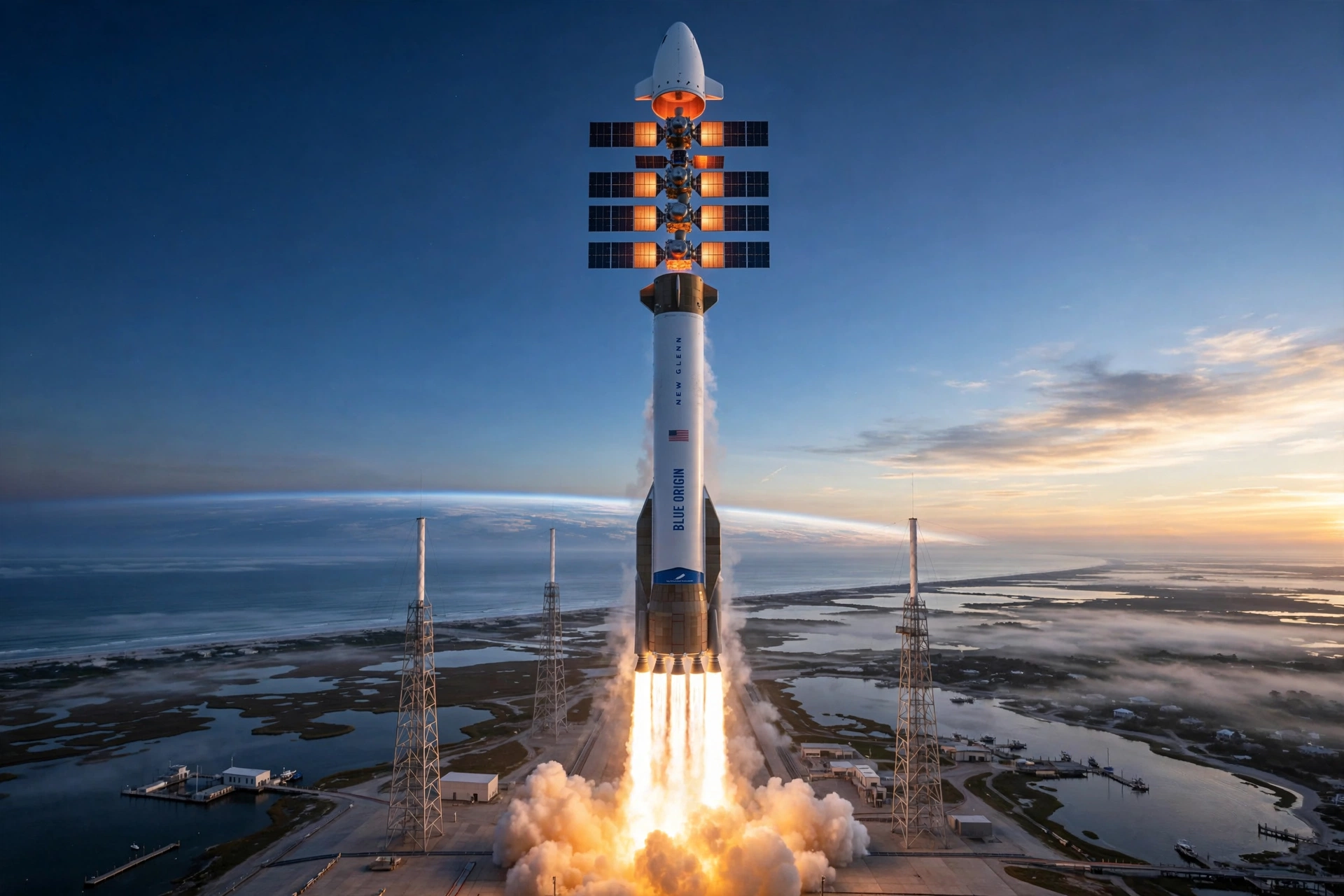
On November 19, 2026, Google and Blue Origin announced a launch services agreement for Project Suncatcher, Google's research moonshot to run machine learning on solar-powered satellites. Blue Origin's heavy-lift New Glenn rocket will deploy satellites, each with roughly the computing capacity of a data center rack, into sun-synchronous orbit. Target date: the first quarter of 2029, about 28 months from the announcement. Neither company disclosed a price or a satellite count.
Two details matter more than the press release language. First, this is Google's first dedicated heavy-lift launch for Suncatcher, a step past the single fridge-sized prototype that flew on a SpaceX Falcon 9 rideshare on October 1 and answered its first prompt from orbit on October 30. Second, Google picked Jeff Bezos's rocket after SpaceX flew the prototype. Rivalry aside, New Glenn's 7-meter fairing has 1.81 times the cross-section of Falcon 9's 5.2-meter fairing, and wide matters when the cargo is unfolding solar wings and radiators rather than a compact box. Between now and launch, Google plans a two-satellite mission in 2027 to test the laser links that would connect a cluster.
One Rocket Could Carry the Whole Cluster
Start with the rocket, because the result surprises everyone who pictures orbital data centers as a launch-constrained problem. Google's paper sketches an illustrative cluster of 81 satellites and uses a Starlink v2 mini-class reference satellite weighing 575 kilograms. New Glenn advertises 45,000 kilograms to low Earth orbit. Divide, and one New Glenn lifts 78 satellites of that class, or 96 percent of the entire 81-satellite cluster in a single flight.
Sun-synchronous orbit costs payload versus an equatorial launch, so apply a blunt 20 percent haircut. At 36,000 kilograms, one New Glenn still lifts 62 satellites, or 77 percent of the cluster. Lift capacity was never the constraint. A single heavy-lift rocket can loft Google's whole illustrative constellation. What stands between the vision and a business is not tonnage. It is price per kilogram, flight cadence, and a rocket with a thin flight record.
The Breakeven Is $140, Not $200
Now the money. Google's paper prices launched orbital power at $14,700 per kilowatt-year at today's launch prices, around $3,600 per kilogram, falling to about $810 per kilowatt-year at $200 per kilogram. Terrestrial data-center power, the paper says, runs $570 to $3,000 per kilowatt-year. At $200 a kilogram, $810 lands inside that band, and the paper calls the two roughly comparable. That sentence is accurate. It is also doing quiet work, because a band that wide contains multitudes.
| Launch price to LEO | Orbital power cost | Versus cheapest ground power ($570/kW-yr) |
|---|---|---|
| $3,600/kg (today's benchmark) | $14,700/kW-yr | 25.8x as expensive |
| $735/kg | $3,000/kW-yr | Breaks even with the most expensive ground power |
| $200/kg (Google's threshold) | $810/kW-yr | 42% more expensive |
| $140/kg (our breakeven) | $570/kW-yr | Breaks even with the cheapest ground power |
Here is the step the coverage skipped: the paper's launched-power price scales linearly with dollars per kilogram, $4.08 of annual power cost for every $1 of launch price, so the breakeven against any terrestrial price is one division away. Divide the cheapest ground power, $570, by 4.08 and you get about $140 per kilogram. Divide the most expensive, $3,000, and you get about $735. At Google's $200, orbital power costs 42 percent more than the cheapest terrestrial kilowatt, and the cheapest kilowatt is the one hyperscalers actually buy, in bulk, on long contracts, in places picked precisely because power is cheap.
None of this makes $200 meaningless. It makes it a threshold for competing with expensive ground power, the kind bought in constrained markets with long interconnection queues, not with the cheapest power on Earth. Framed that way, Suncatcher looks less like a cost play and more like an escape hatch from grids that cannot deliver.
Sunlight Checks Out. The Rocket Schedule Does Not
One part of the pitch survives contact with independent numbers. Google's paper says a panel in the right orbit collects up to 8 times more energy per year than a panel at mid-latitudes on Earth, thanks to near-constant sunlight in a dawn-dusk orbit. We checked it from first principles: the solar constant is 1,361 watts per square meter, a 30-percent-efficient panel in near-constant sun averages about 396 watts per square meter, while a ground panel at the U.S. Energy Information Administration's 2024 utility-solar capacity factor of 23.2 percent averages about 70 watts per square meter. Ratio: about 5.7 to 1. Google's 8x is the optimistic end, plausibly sunnier sites and tracking mounts, but our conservative 5.7x confirms the order of magnitude. Sunlight is real. Sunlight is also free only after you pay to get there.
Getting there is where the schedule gets thin. New Glenn has flown to orbit three times in 16 months, from January 2025 to April 2026, a rate of about 2.25 flights a year, and it has been grounded since a static-fire explosion on May 28, 2026, with return to flight expected in early 2027. From return to flight to the first quarter of 2029 is roughly 24 months. At the demonstrated rate, that is about four or five more flights before Google's window, making Google's launch roughly the eighth New Glenn flight ever. Amazon's Leo broadband constellation is also booked on New Glenn, so Google is queuing behind Amazon's own manifest on a rocket Amazon's founder owns. None of that makes the launch impossible. It makes the 28-month target a reservation, not a countdown.
What You Can Do
If you run AI infrastructure, stop tracking the $200-per-kilogram headline and track the $140 figure instead: until launch prices fall to about $140, orbital power cannot beat the cheapest ground power, and until they reach $200 it cannot even match the middle of the band. Watch New Glenn's return to flight in early 2027 and its cadence after that, because a rocket flying twice a year cannot build a constellation on any schedule that matters.
If you invest in space or AI stocks, separate the two bets in this deal. Google is buying radiation and thermal data plus an option on cheap launch, and Blue Origin is buying a marquee customer for a rocket that needs flight history more than revenue. Neither side has disclosed a price, so treat any valuation of the agreement as speculation.
If you just like the idea, watch the 2027 twin-satellite test. Two satellites talking by laser is the first milestone whose failure would actually kill the vision, while a slipped 2029 date would merely delay it.
Limitations
This analysis assumes the paper's launched-power price scales linearly with dollars per kilogram and holds the reference satellite constant at 575 kilograms, about 28 kilowatts, and a five-year life. Real costs include manufacturing, operations, insurance, and ground stations, which the paper's per-kilowatt-year figure excludes, so $140 is a launch-cost breakeven, not a total-cost breakeven. Google has not published the mass, power, or count of the 2029 satellites. Our 20 percent sun-synchronous payload haircut is an assumption, since Blue Origin publishes no SSO payload figure, and the 45-tonne figure is the advertised expendable capacity with no verified reusable-profile number. New Glenn's flight rate rests on three flights, a small sample. Google is the source for its own cost model, and no independent party has reproduced it.
The Strongest Case Against This Analysis
Here is the best case against taking this article seriously. Suncatcher is a research moonshot with a 2029 technology-demonstration launch, and grading it against the cheapest electricity on Earth misses the point. Google's paper explicitly frames $200 per kilogram as the point where orbital power enters the terrestrial band, not where it beats the cheapest grid contract in Texas. Orbital compute's value is not beating $570 per kilowatt-year. It is escaping interconnection queues, land constraints, water limits, and community opposition that now delay ground data centers for years, and the paper's own numbers show the 81-satellite cluster is a rounding error in launch mass for a single New Glenn. Our $140 figure is a stricter bar than Google ever claimed to clear.
Most of that is correct, which is why the $200 figure is not wrong, only narrower than its reputation. But the counterargument concedes the key point while making it: the $200 figure has been repeated in coverage as the point where orbital AI works, and that framing is 42 percent too generous against the floor hyperscalers actually pay. At $200 a kilogram, orbital power competes with expensive ground power, while the cheapest ground power needs about $140. And the single-launch finding cuts both ways: if one New Glenn can lift the whole cluster, then the constraint was never lift capacity. It is price, cadence, and a rocket that has flown three times and is currently grounded.
The Bottom Line
Google just bought a ride for its orbital data center, and the ride is the least interesting number in the story. One New Glenn could carry 96 percent of Google's entire illustrative cluster in a single launch, yet the economics only close at about $140 a kilogram against the cheapest power on the ground, not the $200 Google cites, and the rocket meant to get there has flown three times in 16 months and is grounded until early 2027. Sunlight in orbit is abundant and nearly free. Everything else about putting a data center up there still has a price, and for now the price is the story.
Related
- Google's First AI Answer From Orbit Was a Haiku. Its 4 TPUs Average 14-19% of One H100.
- In 90 Days, Five Companies Asked to Put 1.1 Million Data Centers in Orbit. Earth Has 16,000 Satellites.
- SpaceX Says Orbital AI Will Beat Ground Data Centers on Cost. The Math Needs Launch Prices to Fall 98%.
Sources: Blue Origin, Google Selects Blue Origin's New Glenn for Project Suncatcher; Google Research Blog, Blue Origin partnership; Agüera y Arcas et al., Towards a future space-based, highly scalable AI infrastructure system design; arXiv:2511.19468; Google, first response from the Project Suncatcher prototype satellite; EIA, State Energy Data System 2024, Table N3. New Glenn flight history and the May 28, 2026 static-fire explosion come from trade coverage (USA Today, Orbital Intel). The $2.07M-per-satellite launch figure at $3,600/kg was independently published by ThePricer on November 20, 2026. Calculations are the author's own.