SpaceX Just Pledged $74 Billion for Two AI Campuses. One Would Swallow 58% of Arizona's Electricity.
The Cochise County campus would draw 6 gigawatts at full build, 58 percent of everything Arizona consumed in 2024, in buildings packed 1.35 kilowatts per square foot. Neither site has a permit yet. Both face votes on December 9.
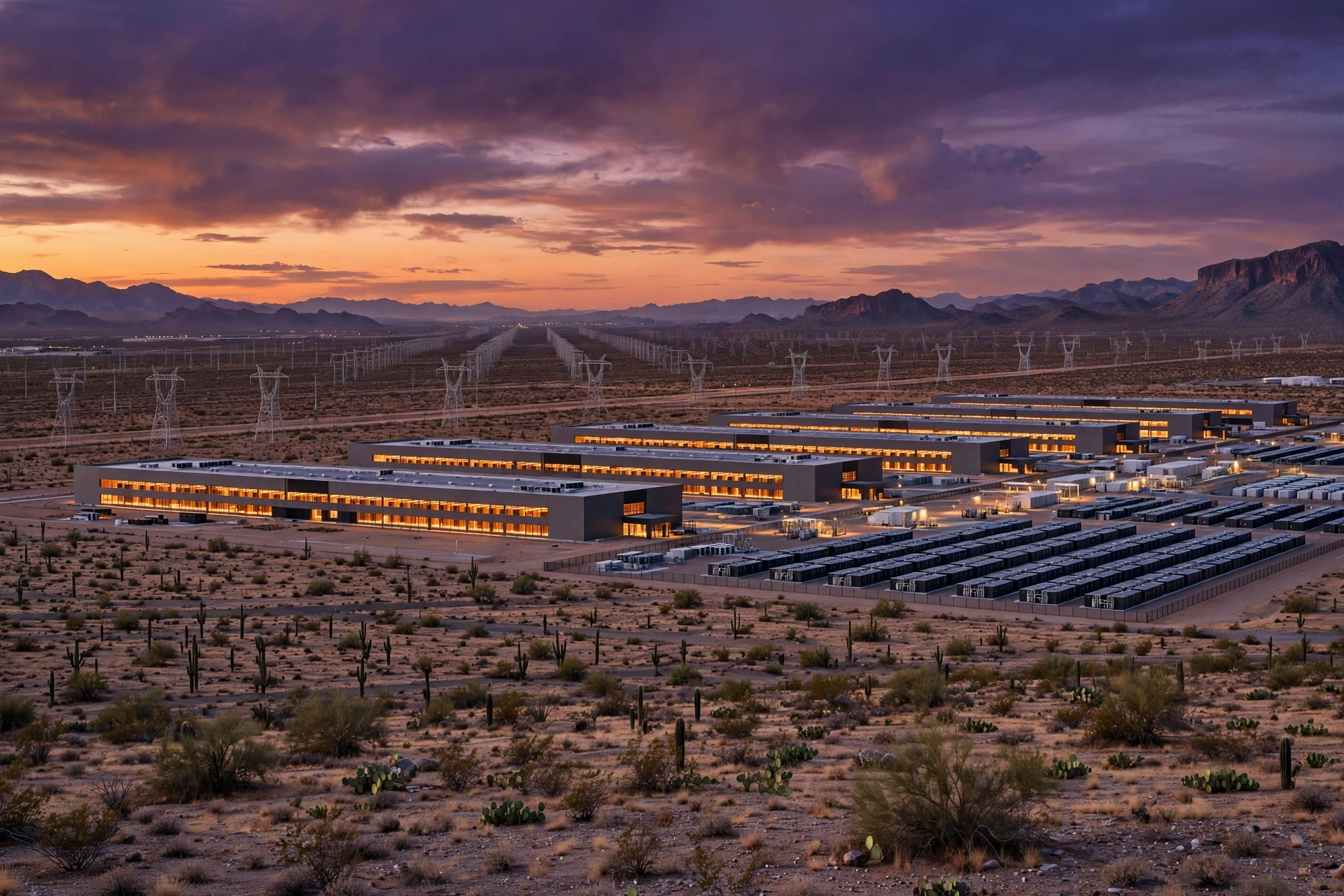
Six gigawatts. That is the power draw SpaceX says its planned Arizona AI campus would reach at full build, enough electricity, on average, for about five million American homes, drawn by a single customer in a rural county of 125,000 people. On November 12, the company announced it will spend more than $74 billion on two supercomputing campuses, more than $24 billion at its Starbase site in Texas and roughly $50 billion in Cochise County, Arizona. Reuters reported the announcement the same day. Both projects are still unapproved, and both face local votes on December 9.
Start with the Arizona number, because it is the one that breaks every scale you try to put it on. Six gigawatts, running around the clock, consumes 52.6 terawatt-hours a year. Arizona as a whole consumed 90.8 terawatt-hours in 2024, according to the U.S. Energy Information Administration. One campus would use 58 percent of everything the state used, homes, offices, factories, air conditioning and all. It would also equal 47 percent of everything Arizona generated that year, and 21 percent of the state's entire generating capacity, all 28.7 gigawatts of it, net summer rating. A single building permit, in effect, for a fifth of a state's power grid.
Two campuses, two different gambles
Texas and Arizona are not the same bet wearing two hats. Starbase is the self-reliance play: a 444-acre site where SpaceX will build, own and operate a gas-fired power plant beside the supercomputers, generating its own electricity rather than waiting years for a grid connection, with an air permit sought for a 748-megawatt plant. SpaceX says the site has already generated more than 3,000 construction jobs and would support 500-plus permanent ones, and it has committed $220 million to Brownsville's water and wastewater systems, $40 million of which is paid. Arizona is the scale play: 747 acres near Willcox Playa, nine buildings of about 493,000 square feet each, four phases of roughly 1.5 gigawatts, a 24 gigawatt-hour battery system, and about $3.6 billion in grid upgrades. SpaceX promises about 5,500 construction jobs and 1,000 permanent ones there, plus electricity bill cuts of up to 20 percent for members of the local cooperatives.
| Figure | Starbase, Texas | Cochise County, Arizona |
|---|---|---|
| Planned investment | More than $24 billion | Roughly $50 billion |
| Site | 444 acres | 747 acres |
| Power | 748 MW gas plant, off-grid | Up to 6 GW, four 1.5 GW phases |
| Buildings | Not disclosed | 9, about 493,000 sq ft each |
| Storage / grid | Own generation | 24 GWh battery; $3.6B grid upgrades |
| Construction jobs | 3,000+ already generated | About 5,500 |
| Permanent jobs | 500+ | About 1,000 |
| Decision date | Dec 9, tax abatement vote | Dec 9, zoning hearing |
The math nobody ran
Density first. Nine buildings at 493,000 square feet each is 4.44 million square feet of floor space, and 6,000 megawatts spread across it works out to 1.35 kilowatts per square foot. A conventional enterprise data center is designed around 0.15 to 0.25 kilowatts per square foot, which means the Arizona buildings would run roughly five to nine times denser than a normal facility. Each building alone would draw about 667 megawatts, more than most entire data-center campuses in operation today. That density is the whole story in one number: this is not a warehouse full of servers, it is a power plant with computers bolted on.
Then the battery, because the headline number flatters it. A 24 gigawatt-hour battery sounds enormous until you divide by the load it serves: 24 divided by 6 is exactly four hours. Four hours of full-load operation, and then the campus needs the grid, or the gas plant next door, or darkness. Batteries at this scale are a buffer against flickers and price spikes, not a power source, and anyone describing the 24 gigawatt-hour figure as energy independence has not done the division.
Jobs per dollar tell a similar story of scale without employment. Combined, the two campuses promise about 1,500 permanent jobs for more than $74 billion, which is 20 jobs per billion dollars, or about $49.3 million of capital for every permanent job created. Construction is better, roughly 8,500 jobs, or 115 per billion, but construction ends. For comparison, the two sites agree with each other almost exactly, 20 permanent jobs per billion in Arizona and about 21 in Texas, which suggests the ratio is a property of the industry, not of either location. AI campuses are the most capital-intensive job creation in the American economy, and the numbers say so plainly.
Two more ratios complete the picture. SpaceX reported $48.1 billion of capital spending in the first nine months of 2026, an annualized run rate of about $64.1 billion a year, so the $74 billion pledge equals roughly 14 months of the spending pace the company already runs at. This is not a new level of ambition. It is a statement of where the next year and a bit of existing burn is headed. And the Arizona campus alone, at 6 gigawatts, would be 3.5 times SpaceX's entire current fleet: the company ended the third quarter with 1.7 gigawatts of nameplate compute, and one county in Arizona would more than triple it.
| Figure | Value | How it was computed |
|---|---|---|
| Power density, Arizona | 1.35 kW / sq ft | 6,000,000 kW / (9 x 493,000 sq ft) |
| Power per building | 667 MW | 6,000 MW / 9 buildings |
| Annual energy at full load | 52.6 TWh | 6 GW x 8,760 hours |
| Share of Arizona 2024 consumption | 58% | 52.6 / 90.8 TWh (EIA SEDS) |
| Share of Arizona 2024 generation | 47% | 52.6 / 112.3 TWh (EIA) |
| Share of Arizona capacity | 21% | 6 / 28.7 GW net summer capacity |
| Battery endurance at full load | 4.0 hours | 24 GWh / 6 GW |
| Capital per permanent job | $49.3 million | $74B / 1,500 jobs |
| Grid upgrades per MW | $600,000 | $3.6B / 6,000 MW |
| Pledge vs. current capex pace | ~14 months | $74B / ($48.1B x 4/3 annualized) |
| Arizona vs. current compute fleet | 3.5x | 6 GW / 1.7 GW nameplate |
| Texas gas plant CO2, estimated | ~2.2M tonnes / yr | 748 MW x 8,760 h x 85% x 0.4 t/MWh |
The Texas plant's carbon bill
Starbase's gas plant deserves its own arithmetic, because SpaceX has not published an emissions figure and the permit application is the only public trace. A 748-megawatt plant running at an 85 percent capacity factor generates about 5.6 terawatt-hours a year, and at the combined-cycle emission factor of roughly 0.4 tonnes of CO2 per megawatt-hour, that is about 2.2 million tonnes of CO2 a year, roughly the annual emissions of 484,000 passenger cars. If the turbines are simple-cycle peaking units instead of combined-cycle, the factor rises toward 0.55 tonnes per megawatt-hour and the total passes 3 million tonnes. Either way, the off-grid strategy has a carbon price that no press release mentions, and it lands in a county that did not ask for it.
Nothing is approved yet
All of this is a pledge, not a contract, and the permission gap is the most important number in the story. Cochise County does not allow data centers by right. SpaceX's application, filed under the name Tombstone Resources LLC, needs a special-use permit, and a company representative told residents at a packed November 4 town hall that the filing used another name because putting SpaceX on it draws attention from outside the county. A petition asking the county to deny the permit has gathered about 2,400 signatures. Written comments are due November 27, the Planning and Zoning Commission holds its hearing December 9 in Bisbee, and if approved, construction could start in March 2027. Starbase faces its own vote the same day, when the city commission considers a property-tax abatement.
Power is the bigger question in Arizona, and it is unresolved in a way the square footage is not. The site sits beside the Apache Generating Station, a coal and gas plant with about 1 gigawatt of capacity that had been slated to retire by 2028, and SpaceX told residents its investment could expand the station to more than 6 gigawatts. That expansion, like the campus, is unapproved, and the Arizona power deal still has to clear the state regulator. At full build the campus would draw about 2.5 times more power than every data center in Maricopa County combined, according to an Arizona Republic analysis. Meanwhile the nearby Willcox Playa is a landing spot for federally protected sandhill cranes, which SpaceX says its design accounts for, and the campus would use dry cooling with no industrial groundwater use, estimating ongoing water needs of 7 to 10 acre-feet a year, roughly what 20 to 30 homes consume. Water, for once, is not the fight. Power and permission are.
Limitations
Several numbers here carry asterisks that belong in the open. Six gigawatts is the figure in SpaceX's county application, a nameplate maximum, not metered load, and AI campuses rarely run at 100 percent utilization, so 52.6 terawatt-hours a year is an upper bound; at 70 percent average utilization the figure falls to about 37 terawatt-hours, still 41 percent of Arizona's 2024 consumption. SpaceX has disclosed no split of the $74 billion between buildings, power equipment and chips, so the per-megawatt and per-job ratios mix categories that the company itself has not separated, and the Texas gas plant's capacity factor and turbine type are unstated, which makes the 2.2 million tonne CO2 estimate an assumption-laden calculation rather than a measured figure; the stated 85 percent factor and 0.4 tonnes per megawatt-hour are disclosed so readers can redo it. Arizona consumption and generation figures are 2024 EIA data, the latest full year available, and the state has grown since. Finally, the job figures are SpaceX's own estimates, and the 20 percent electricity bill cut promised to local cooperative members is a company claim, not a regulated rate.
Strongest case against
Steelman: the skeptic's case against worrying starts with track record and ends with the offer on the table. SpaceX built Colossus in Memphis from dirt to more than 100,000 GPUs in months, a build speed no other company in the industry has matched, and it did so largely on gas turbines while the grid connection crawled, which is exactly the playbook Starbase repeats. Self-generation is not evasion; it is the rational response to interconnection queues that run five to seven years, and a company that lands rockets on ships is entitled to some credibility on building big things fast. In Arizona, dry cooling and 7 to 10 acre-feet of annual water answer the desert objection before it is raised, the 24 gigawatt-hour battery is genuinely large grid support even if it only covers four hours, and 1,000 permanent jobs plus cheaper power for cooperative members is a real offer to a rural county where the largest employer is the Army's Fort Huachuca. Every clause of that case is true, and it is also compatible with the central finding here: a single customer asking for a fifth of a state's generating capacity is a grid-planning event, not a construction project, and it deserves to be judged as one.
What you can do
If you live in Cochise County, written comments on the special-use permit are due November 27, and the hearing is December 9 in Bisbee; that hearing, not the press release, is where the campus is actually decided. If you track AI infrastructure spending, ignore the $74 billion headline and watch SpaceX's quarterly capital expenditure instead, because the pledge is 14 months of the pace the company already runs at, and the signal is whether that pace holds. If you own land or a home near Willcox Playa, the decision that matters most is not the data center permit but the Apache Generating Station expansion, a coal and gas plant slated for retirement that could grow sixfold. And if you are simply watching the AI buildout, the number to remember is 1.35 kilowatts per square foot, because it says the constraint on AI is no longer chips or money, it is watts per square foot of desert, and the desert is running out of both.
The Bottom Line
SpaceX pledged more than $74 billion for two AI campuses on November 12, and the numbers underneath the headline are more extreme than the headline itself: a single Arizona campus that would consume 58 percent of the state's electricity, in buildings five to nine times denser than a normal data center, backed by a battery that lasts four hours and a grid bill of $600,000 per megawatt before a single chip is bought, while the Texas site burns enough gas to emit 2.2 million tonnes of CO2 a year. None of it is approved. Both sites face votes on December 9, and the Arizona power deal still needs the state regulator. SpaceX has earned its reputation for building the impossible quickly, but a fifth of a state's power grid is not a construction schedule. It is a public decision, and December 9 is when the public gets to make it.
Related articles
- Google Owns the World's Third-Largest Cloud. It's Paying a Rocket Company $920 Million a Month for GPUs.
- 69 U.S. Jurisdictions Have Banned New Data Centers. The Grid's Watchdog Just Explained Why.
- America Is Adding 86 Gigawatts of Power This Year. Only 7 Can Run at Night. Data Centers Need 14.5 Every Year, Around the Clock.