OpenAI Wants 900,000 Memory Wafers a Month. That’s 56% of Today’s Global Output. South Korea Just Bet $576 Billion It Can Deliver.
South Korea announced the largest semiconductor investment any country has ever announced: $576 billion across new fabs, packaging clusters, and AI data centers. An original demand-absorption calculation reveals the force behind the number. OpenAI’s Stargate project alone has contracted for 900,000 DRAM wafers per month by 2029, equivalent to 56% of current global DRAM output. Even after Samsung and SK Hynix double capacity, one customer would still consume 41% of their combined production.
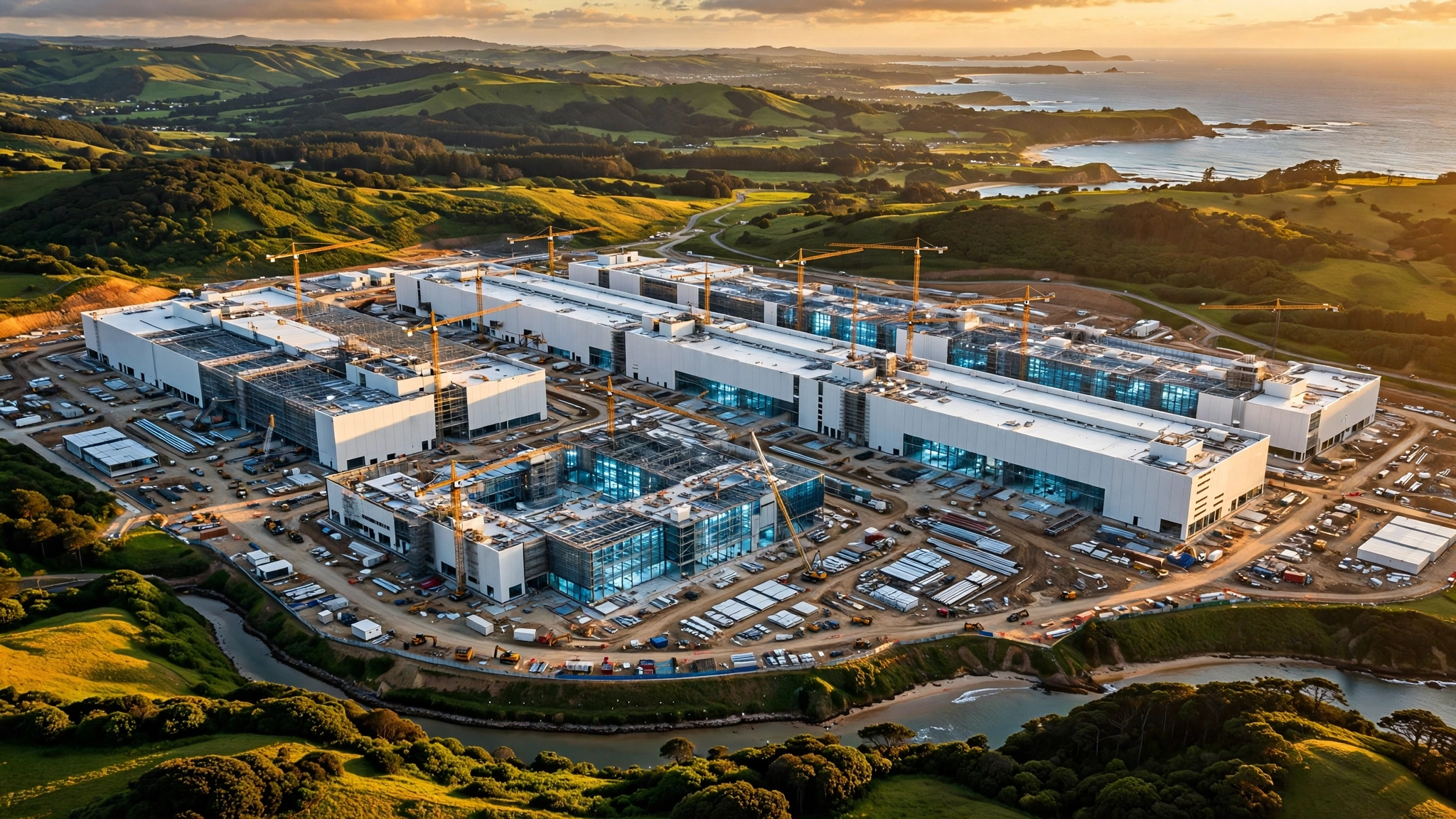
Nine hundred thousand. That is the number of DRAM wafers per month that OpenAI contracted from Samsung Electronics and SK Hynix in October 2025, locked in via letters of intent for the Stargate project. SK Group described the figure publicly as "more than double the current industry capacity for high-bandwidth memory chips." On June 29, 2026, South Korea answered with the largest semiconductor investment any country has ever announced: $576 billion in new fabs, packaging facilities, and AI data centers, backstopped by a presidential directive to double DRAM output within five years.
One customer drove that decision, and the arithmetic behind South Korea’s response is worth laying out in full.
One Customer, 56% of the World’s Memory
Samsung currently produces between 650,000 and 700,000 DRAM wafers per month, according to TrendForce estimates. Samsung and SK Hynix together hold roughly 70% of the global DRAM market, putting their combined output near 1.1 million wafers per month and implying a global total of about 1.57 million. OpenAI wants 900,000 of those wafers for Stargate by 2029. Divide 900,000 by 1,570,000: that is 57.3% of all DRAM wafers currently produced on Earth. One project, for one company, consuming more than half the global memory supply.
Measured against Samsung and SK Hynix alone, the ratio climbs even higher: their combined 1.1 million wafers per month means OpenAI has contracted for 82% of their current joint production capacity, not unused headroom sitting idle but rather the entirety of what both companies manufacture today.
What $576 Billion Actually Buys
South Korea’s plan, unveiled by President Lee Jae Myung flanked by Samsung Chairman Jay Y. Lee and SK Group Chairman Chey Tae-won, breaks into three pillars. Samsung will invest 400 trillion won ($259 billion) in new fabrication clusters in the southwestern city of Gwangju, plus 56 trillion won in HBM fabs at Cheonan and Onyang. SK Hynix will invest 400 trillion won in its own southwestern fab complex, though Chairman Chey said the company still needs time to finalize a location and secure infrastructure. Another 81 trillion won goes toward an advanced chip packaging cluster in the Chungcheong region, where individual DRAM dies get stacked into the high-bandwidth memory modules that AI accelerators require.
Samsung’s ambitions extend well beyond even this figure: a regulatory filing disclosed plans to invest 2,450 trillion won ($1.59 trillion) in domestic semiconductor capacity through 2040. South Korea’s annual GDP is approximately $1.8 trillion, making Samsung’s 15-year commitment equivalent to 88% of the country’s economic output.
Even Doubling Barely Closes the Gap
South Korea’s industry minister Kim Jung-kwan set the target: double DRAM output within five years by accelerating construction at existing Seoul-area clusters and completing the southwestern fabs. If Samsung and SK Hynix hit that mark, combined capacity rises to roughly 2.2 million wafers per month. OpenAI’s 900,000-wafer demand would then absorb 41% of the doubled total, a meaningful improvement over 82% but still extraordinary for one buyer, leaving just 1.3 million wafers for everyone else, below today’s global DRAM production of 1.57 million.
OpenAI is not alone in the queue. Google, Microsoft, Meta, Amazon, and xAI are each constructing multi-gigawatt data center campuses that will need comparable memory allocations, and a conservative estimate of their combined HBM demand matches or exceeds OpenAI’s. Stack those orders together and the arithmetic becomes stark: roughly 1.8 million wafers per month for hyperscaler AI alone, against 2.2 million wafers of doubled capacity, leaving 18% of global DRAM for smartphones, laptops, gaming consoles, automobiles, and everything else. Smartphones alone consume approximately 30% of today’s DRAM output.
| Scenario | Samsung + SK Hynix Capacity | OpenAI Demand | OpenAI Share | Remaining for All Others |
|---|---|---|---|---|
| Today (2026) | ~1.1M wafers/mo | 900K | 82% | ~200K wafers/mo |
| Doubled (2031 target) | ~2.2M wafers/mo | 900K | 41% | ~1.3M wafers/mo |
| Doubled + All Hyperscalers | ~2.2M wafers/mo | ~1.8M (est.) | 82% | ~400K wafers/mo |
No Other Country Is Close
To appreciate the scale, compare it to every other national semiconductor program. The U.S. CHIPS and Science Act allocated $77 billion in subsidies and tax credits. The EU’s Chips Act targets €43 billion ($47 billion). Japan has committed roughly $25 billion, and China has allocated over $150 billion through 2030 according to SEMI estimates. Those four programs total $299 billion; South Korea’s $576 billion nearly doubles all of them combined.
The comparison is somewhat misleading because American, European, and Japanese figures represent government subsidies, while South Korea’s headline is overwhelmingly corporate spending backstopped by government infrastructure commitments. Even accounting for U.S. private-sector pledges (TSMC’s $100 billion Arizona expansion, Intel’s fab spending, Samsung’s $45 billion Taylor, Texas facility), the American total approaches $400–450 billion. South Korea’s corporate-only component of 800 trillion won ($518 billion) still exceeds it.
Limitations
Several caveats apply. The 900,000-wafer figure comes from a letter of intent, not a binding supply contract, and South Korea’s top presidential adviser specified that OpenAI is "seeking to order" that quantity by 2029, leaving room for actual orders to differ substantially. "Doubling DRAM capacity in five years" is an industrial policy target, not an engineering commitment with contractual penalties; SK Hynix Chairman Chey acknowledged that building the Yongin cluster took nine years and cautioned that "a chip factory requires massive land, power, water and talent." Not every DRAM wafer becomes HBM, either: the stacking and packaging steps involved in converting raw wafers into 8- or 12-high memory stacks introduce their own yield losses. Finally, Chinese manufacturer CXMT is projected by SemiAnalysis to grow from 11% to 17% of global DRAM supply by 2028, adding capacity outside the Samsung/SK Hynix duopoly.
Strongest Counterargument
Professor Lee Jong-ho of Seoul National University made the clearest case against the investment’s scale: "It would be ideal if demand remained strong for the next 20 or 30 years, but no one can know that with certainty. If demand were to decline, the consequences would be severe." South Korea has seen this before. In the mid-2000s, Samsung and LG invested billions in LCD panel capacity expecting demand to keep climbing; the global financial crisis collapsed panel prices by more than 50%, and both companies absorbed losses that took years to recover from. Samsung is now making a bet two orders of magnitude larger, concentrated on a single demand driver that depends on AI model scaling continuing at current rates. If an efficiency breakthrough reduces memory requirements per parameter by 10×, or if AI spending proves cyclical rather than secular, the consequences for a country that just pledged 88% of its annual GDP to semiconductor expansion would be severe.
The Bottom Line
South Korea did not just announce the largest chip investment in history. It revealed how severely the global memory supply chain is mismatched against the demand that a single AI infrastructure project generates. When one customer absorbs 56% of today’s global DRAM output, and doubling capacity still leaves that customer holding 41%, the conventional understanding of semiconductor supply chains breaks down. For investors, memory stocks face a supply-constrained upcycle that could last into the 2030s, subject to the demand durability risk that Professor Lee identified. For hardware engineers at any company that depends on DRAM, lead times are extending and allocation politics will intensify. For policymakers in Washington and Brussels, one South Korean corporate commitment now exceeds everything the U.S. and EU have pledged combined. Memory, not logic, is becoming the binding constraint on how fast AI scales.