🤖 Robotics
Six Humanoid Robots Launched in Ten Days. Tesla Wants 20,000 a Week. The Planet Makes 846.
Between October 21 and October 30, six humanoid robots launched from NVIDIA, Tesla, NEURA, Faraday Future, AiMOGA, and SynDexy. Tesla's 20,000-per-week target would require one company to ship roughly 24 times the entire current global output.
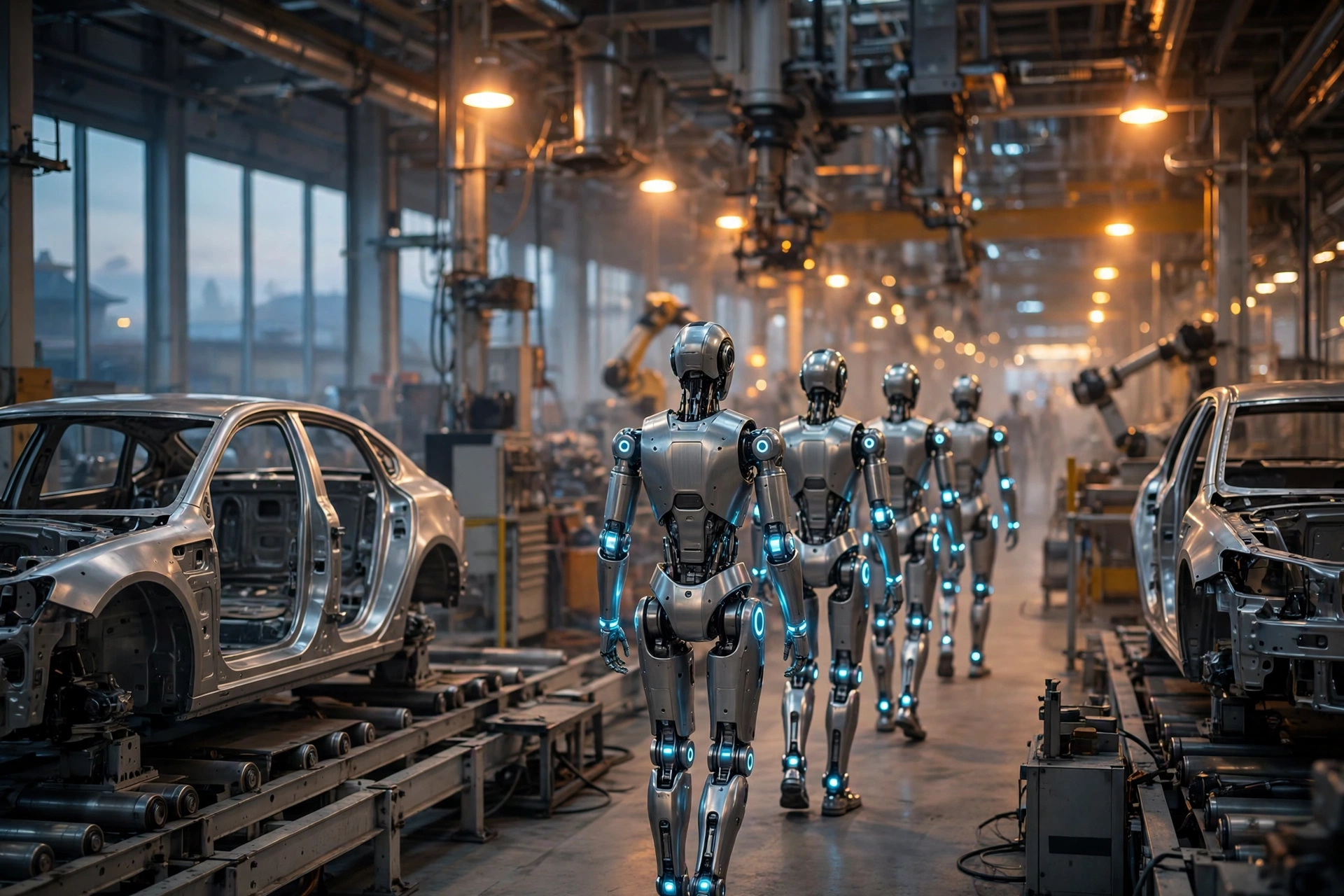
846. That is the number of humanoid robots the world currently ships per week, based on Counterpoint Research's count of more than 22,000 units shipped in the first half of 2026, which means Elon Musk's newly stated target of 20,000 Optimus robots per week by the end of 2027 would require Tesla alone to out-produce the entire planet by a factor of roughly 24. Sit with that arithmetic. The last ten days produced the busiest humanoid robot launch window in history, and almost none of the headlines did this math.
Start with the blitz itself, because it is genuinely remarkable. On October 21, NVIDIA unveiled the Agile ONE SN at GTC Berlin, a 1.4-meter, 40-kilogram research humanoid from Munich's Agile Robots with 31 degrees of freedom, running NVIDIA's Jetson Thor computer and the open GR00T 1.7 vision-language-action model, with planned availability in early 2027 and the company telling Reuters it plans to build 1,000 to 2,000 of them next year. Jensen Huang's keynote line, that "the ChatGPT moment for robotics is fast approaching," was backed by a genuinely substantial platform push: Isaac Lab 3.0 generally available, an Isaac OS runtime, more than 2,000 simulation-ready robot assets released on Hugging Face, and a dataset of human activity filmed from three angles for teaching robots by example.
On the very same day, Tesla's third-quarter shareholder letter announced that the first production-quality Optimus robots are coming off a line in Fremont, California, built in factory space freed up by tearing down the Model S and X assembly lines in 46 days this summer. Musk told investors this is "early production," that the ramp will be slow and "somewhat bumpy," and that the design still needs changes for the robot to survive more than a month of use, while simultaneously projecting 20,000 units per week by the end of 2027, a 1-million-unit-per-year line already mostly equipped, and a 10-million-unit-per-year line planned for Texas. External customer deliveries are forecast for the end of 2027, with AI5 chips arriving around April.
Eight days later the rest arrived in a pile. NEURA Robotics unveiled the 4NE1 Gen 4 at a new €17 million training facility at Munich Airport, built around what it calls Smart Limbs: Qualcomm Dragonwing processors embedded at the joint level, so reflexive grip adjustments and balance corrections happen in the limb itself instead of making the round trip to a central computer. Faraday Future put its $89,900 Futurist on a Brooklyn sidewalk for New Yorkers to gawk at, projecting more than 300 robots shipped in October, a cumulative 1,100 by month's end, and nearly 2,000 in its first full year. AiMOGA opened global pre-orders for Mobo, a 0.9-meter, 22-degree-of-freedom consumer companion that speaks more than 20 languages and has attracted 10,000 prospective users since August; the company says it has sold 3,000 robots across more than 100 scenarios in 60 countries. And on October 30, SynDexy announced its first small-batch delivery of the C1, a vision-tactile-force-fusion dual-arm wheeled humanoid that claims better than 98% success on critical tasks and 1-millisecond motion control, developed from kickoff to delivery in six months.
Six launches in ten days. Serious money behind them. Now the uncomfortable numbers.
The Capital-per-Robot Calculation
Figure AI has raised $3.68 billion across four rounds, at a $39 billion valuation set in September 2025, and says it has built more than 1,000 Figure 03 robots at its BotQ factory in San Jose, where it went from one robot per day to one per hour in about 120 days. Divide the capital by the hardware proof: $3.68 billion divided by roughly 1,000 built robots is about $3.7 million of capital for every robot that actually exists. That is not the cost of building a robot. It is the capital intensity of proving you can build one, and it folds in the September commitment of at least $3.5 billion in Nscale compute spend, which by itself exceeds Figure's total lifetime fundraising. What the ratio is honest about: at this stage of the industry, investors are not paying for robots. They are paying for the right to be present when robots become a business.
This is not a Figure-only phenomenon. NEURA raised $1.4 billion in June at a $7 billion valuation, the largest humanoid round in Europe. Unitree went public at a reported $50 billion. Goldman Sachs projects the entire global humanoid market at $38 billion in 2035, which means Figure's 2025 valuation already prices it above the bank's estimate of the whole market a decade out. These are bets on a future, not valuations of a present, and everyone in the trade knows it.
The BMW Audit: What a Robot Actually Earns
Figure's deployment at BMW's Spartanburg plant remains the most documented production-scale humanoid trial anywhere: 90,000-plus parts loaded, more than 1,250 runtime hours, support for more than 30,000 X3 vehicles over eleven months, with a stated accuracy target above 99% successful cycles per shift. It is also the only deployment with enough published data to audit, so here is the audit.
| Metric | Value | Source |
|---|---|---|
| Parts loaded per operating hour | 90,000 / 1,250 = 72 | Figure deployment summary, BMW press release |
| Working days at 10-hour shifts | 1,250 / 10 = 125 | Figure: ten-hour weekday shifts |
| Estimated robot cost per hour | $150,000 / (5 yrs x 2,000 hrs) = $15/hr | Author calculation; $150K est. unit price |
| Loaded human labor cost | $25-35/hr | US manufacturing loaded wage estimates |
Seventy-two parts an hour. That is a real throughput number from a real factory floor, and it matters more than every demo video this year combined. At $15 an hour in amortized machine cost, the robot undercuts human labor on paper, before maintenance, integration, supervision, and the downtime that never appears in a launch announcement. Integration alone, analysts estimate, can roughly double a robot's sticker price.
But there is a second half to the BMW story that the launch-era headlines left out. BMW told Forbes that only one Figure robot worked at a time in the original deployment, with another rotating for charging. BMW later described the follow-on phase as a non-production test involving two or three robots. By the time Forbes investigated in October 2026, no Figure robots were operating at Spartanburg at all. That best-documented humanoid deployment in automotive history, the one carrying the industry's credibility, currently has zero robots on the factory floor. This is not a verdict on the technology. It is the context the capital math needs.
Shipped Is Not Deployed, and China Is Not the Exception
The global volume numbers are genuinely dominated by Chinese manufacturers. Counterpoint credits Chinese makers, led by AGIBOT and Unitree, with the vast majority of the 22,000-plus units shipped in the first half of 2026, and one research house puts the Chinese share at 97%. But here is the number that should temper every "China is winning" narrative: from more than 5,500 Unitree robots shipped in 2025, that same research house estimates only about 250 in active deployment. That is a deployment rate of roughly 4.5%. Most of the world's humanoid volume went to entertainment, research, and data production, not factory work.
AGIBOT shipped around 8,400 units in H1 2026, Unitree about 5,900, and Bank of America Institute estimates a China-built bill of materials near $35,000 in 2025, projected under $17,000 by 2030. Cost curves are real and moving fast. The deployment curve is not.
One more data point sharpens the picture. A 2026 industry analysis found that humanoid robots fail real-world tasks at roughly an 88% rate when transferred from simulation to factory environments. NVIDIA's SimReady library and Isaac Lab 3.0 are, in this light, aimed directly at the industry's central wound: the domain gap between what a robot does in simulation and what it does on a concrete floor. Companies funding that infrastructure have correctly identified the problem. Nobody has credibly claimed to have solved it.
The Strongest Counterargument
Fairness demands the other side: commercialization is real for the first time, and not all of it looks like Figure's BMW story. Agility Robotics has Digit units doing revenue-generating logistics work at GXO, where the robots moved more than 100,000 totes, and has deployments with Toyota and Schaeffler; GXO is paying money for robot labor, which is the definition of commercial. Apptronik's Apollo is in pilot operations at Mercedes-Benz and Jabil. Figure itself took BotQ from one robot per day to one per hour in 120 days, which is a genuine manufacturing learning curve, and its reported backlog includes BMW, UPS, Catalyst Brands, and Brookfield. Paid pilots at real logistics companies are not demos. It is not all vapor.
Put honestly: 2026 is the first year both sides have real evidence, and the optimists finally have something to point at that is not a video. But "paid pilot" and "sustained production volume with published payback" remain different things, and nobody has crossed from the first to the second with audited numbers. Even Musk conceded in January 2026 that Optimus was "not doing useful work in a material way" in Tesla's own factories, the single most favorable deployment environment a robot company could ever have, since the factory owner and the robot maker are the same person. If the most capitalized promoter in the category could not deploy into his own plants as of January, that is the baseline against which every 20,000-per-week projection should be judged.
Limitations
This analysis is only as good as its sources, and most of them are the companies themselves. Deployment counts, shipment counts, and production pace are company-reported and rarely audited; NEURA's cited 88% failure rate comes from one 2026 industry analysis whose methodology we could not independently verify. Prices exclude integration, which is the industry's favorite hidden multiplier. Tesla's 20,000-per-week figure is a target, and Musk's history of 12-to-24-month timeline slippage is documented. That capital-per-robot ratio is deliberately provocative: it mixes R&D, compute, and manufacturing spend, so treat it as a measure of how much conviction money each built unit represents, not as a unit cost. And the global weekly shipment rate is annualized from a single half-year estimate; the second half of 2026 could differ.
What You Can Do
If you run a factory considering a humanoid pilot, demand published intervention rates and operating ratios before signing; the vendors have BMW's runtime-hours precedent and should match it. Ask for the shipped-to-deployed distinction in writing: how many units like the one being quoted are actually working at paying customer sites right now. If you invest, value humanoid companies on deployed paid fleets rather than on shipped units or on valuations that already exceed the projected 2035 market. If you work on the floor, the math in the table above is the one that matters for your job: a robot needs to run close to two full shifts a day, every day, at BMW-like throughput, to earn its keep against human labor. Ask the sales team to show you one doing exactly that. And if you are simply watching, the signal to follow is audited operating hours, not launch counts. Six launches in ten days is a spectacle. One thousand two hundred and fifty logged hours was the substance, and it has gone quiet.
The Bottom Line
Six humanoid robots launched in ten days, and the week deserves its excitement: NVIDIA is building the open infrastructure, NEURA is rethinking the nervous system, Chinese factories are driving the bill of materials toward $17,000, and Figure is genuinely manufacturing robots at an accelerating pace. But the industry currently ships 846 robots a week against a decade-scale ambition of hundreds of thousands, deploys only a single-digit percentage of what it ships, prices its leaders above the projected 2035 market, and has exactly one audited production deployment whose robots have since left the building. This blitz was real. A working fleet at scale is not there yet. Judge the next ten days of launches by the hour count, not the headline count.
Related
- Shanghai Wants 8,000 Humanoid Robots in Its Factories by 2028. That Is 57% of All Robots Shipped Worldwide Last Half.
- Figure's $3.5 Billion Brain: $291,667 of Compute for Every Robot It Builds
- Unitree Is Worth $50 Billion. It Shipped 5,500 Robots. That Is $9.1 Million Per Unit.
Sources
- NVIDIA Advances Isaac Platform for General-Purpose Robotics, NVIDIA via GlobeNewswire, October 21, 2026
- Agile ONE SN humanoid: 1,000 to 2,000 units planned for 2027, Tesla News Wire (Reuters reporting), October 21, 2026
- Tesla starts Optimus robot production in California as profit falls 43%, TechCrunch, October 21, 2026
- Tesla Begins Optimus Production in Fremont, Targets Customer Deliveries in Late 2027, Humanoids Daily, October 22, 2026
- NEURA Robotics Launches Gen 4 Humanoid: Each Arm Makes Its Own Millisecond Decisions, Tech Times, October 27, 2026
- Mobo Makes Global Debut and Opens Pre-Orders, AiMOGA via GlobeNewswire, October 27, 2026
- Robotics company Faraday Future promotes $90K humanoid robot, Christian Post, October 28, 2026
- SynDexy dexterous manipulation humanoid robot completes first small-batch delivery, Gasgoo, October 30, 2026
- Figure AI: The Race to Commercialize Humanoid Robots, The CodeW, October 4, 2026
- NVIDIA's Reported $1B Figure AI Investment Prices Startup Above Goldman Sachs' 2035 Humanoid Market, Tech Times, October 13, 2026
- Humanoid Robots 2026: Deployments, Cost, TAM, Analysis Atlas, October 2026
- The Robotics Economy: Physical AI, Machine Labor and the Economics of Automation, Ankaistes Research, August 2026
- Investing in Figure AI: funding, valuation and BMW deployment, Securities.io, September 2026