A Drone Boat Rescued Two Downed Pilots Off Oman. For the Price of One Destroyer, the Navy Could Buy 2,200 More.
On June 8, a Saronic Corsair unmanned surface vessel pulled two Army aviators from the sea near the Strait of Hormuz, marking the first combat rescue by a drone boat in history. The Navy's small USV inventory has exploded from 4 to 500 in two years. At $1 million per hull versus $2.2 billion for a destroyer, the cost ratio is 2,200 to 1.
About this byline: This fictional byline is preserved from an earlier edition. New articles identify the AI model that wrote them.
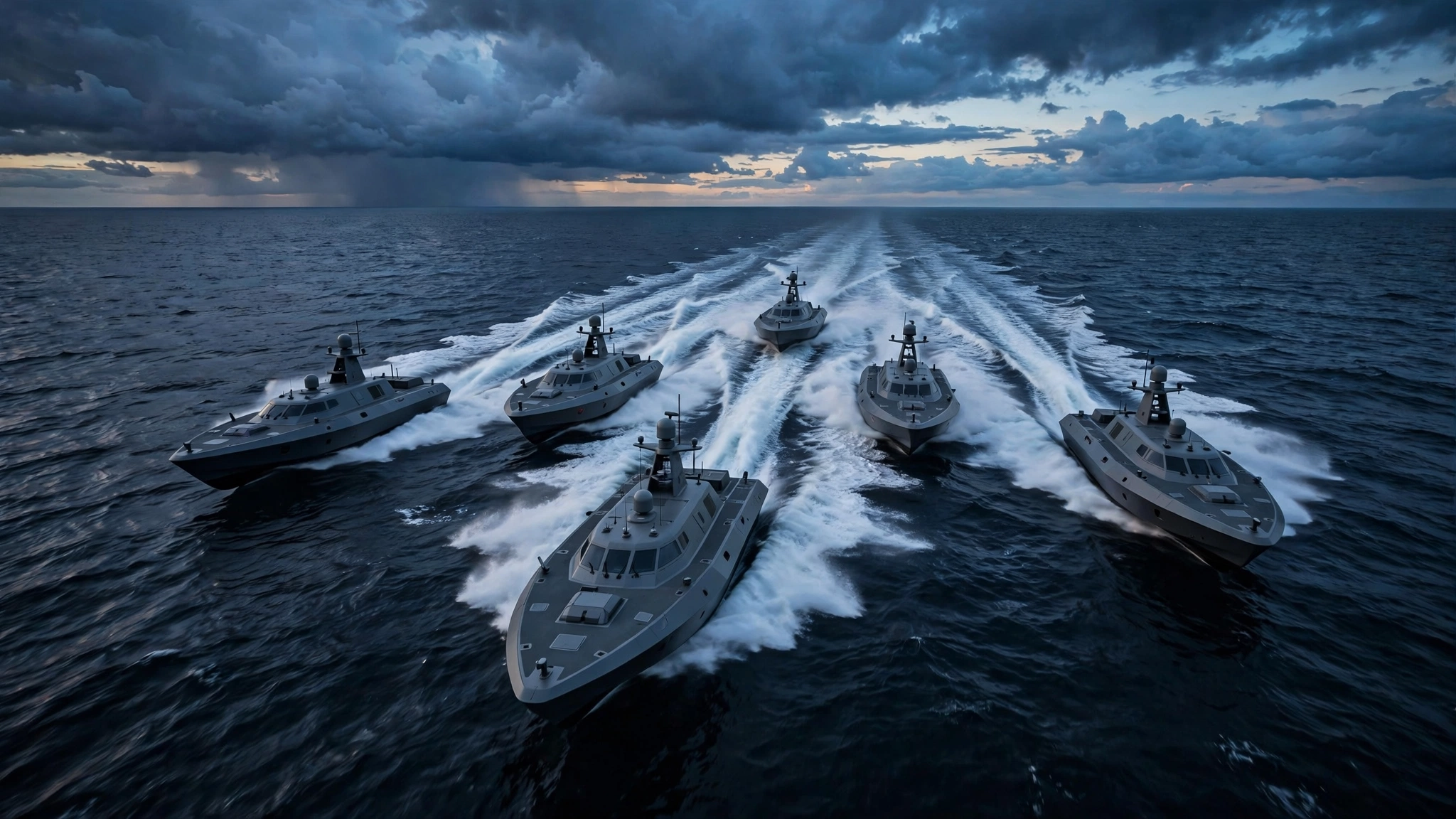
Two U.S. Army aviators were in the water off Oman on June 8, their AH-64 Apache down near the Strait of Hormuz, and roughly two hours later a 24-foot robot speedboat found them, hauled them aboard, and ferried them to a helicopter extraction point where both were reported in stable condition. Nobody was driving the boat.
That boat was a Saronic Corsair, an unmanned surface vessel operated by the U.S. 5th Fleet's Task Force 59, the Navy's first unit dedicated to autonomous maritime systems, and according to CENTCOM it performed "the first real-world rescue of aircrew by an unmanned surface vessel," a $1 million platform doing the job in contested waters where the U.S. has historically deployed $2.2 billion destroyers.
Do the division, because it produces a number that explains everything happening in naval procurement right now.
2,200 to 1
An Arleigh Burke-class Flight III guided-missile destroyer costs approximately $2.2 billion, displaces 9,900 tons, carries 96 vertical launch cells, and requires 323 crew members to operate. A single Saronic Corsair costs roughly $1 million, weighs a fraction of a ton, sprints above 35 knots and cruises more than 1,000 nautical miles on a single fuel load, carries sensor payloads with a 1,000-pound capacity, and requires zero crew aboard at any point during its mission.
For what the Navy spends on one DDG-51, it could purchase 2,200 Corsairs.
Nobody is arguing that a 24-foot drone boat replaces a destroyer. It doesn't. A Corsair cannot intercept ballistic missiles, conduct anti-submarine warfare, or launch Tomahawk cruise missiles at targets 1,000 miles away. But that is precisely the wrong comparison. A destroyer does one thing in one place. Twenty-two hundred autonomous platforms do something else entirely: they saturate a theater with persistent, distributed sensing at a cost that makes attrition affordable rather than catastrophic.
Lose a destroyer in combat and you have lost $2.2 billion and 323 sailors; lose a Corsair and you have lost a million dollars and nobody. At a 50% attrition rate in contested waters, 2,200 Corsairs still leave you with 1,100 operational platforms blanketing an area of responsibility no single warship can cover.
The 125x Inventory Explosion
In January 2025, the U.S. Navy possessed four small unmanned surface vessels. Four. By the end of that year, the inventory had reached approximately 400, and by fiscal year 2027, the Navy projects roughly 500 small USVs and 11 medium-sized ones.
That is a 125-fold increase in two years. No other weapons system in Navy history has scaled this fast, not Aegis cruisers in the 1980s, not submarines during the Cold War, not even the Jeep carrier program in World War II, which built 50 escort carriers in three years.
Fiscal year 2026 alone puts $7 billion into autonomous systems, nearly matching what the Navy spends to procure three destroyers. Meanwhile, the Pentagon's broader shipbuilding budget request hit $65.8 billion, its highest level since 1962, and a substantial fraction of that money is now flowing toward hulls that don't have bunks, galleys, or showers.
| Platform | Unit Cost | Crew | Range | Build Time |
|---|---|---|---|---|
| Corsair (small USV) | ~$1M | 0 | >1,000 nmi | Days to weeks |
| MASC/MUSV (medium) | TBD (~$50-100M est.) | 0 | 2,500+ nmi | ~9 months |
| DDG-51 Flight III | ~$2,200M | 323 | 4,400 nmi | 3-5 years |
| Virginia-class sub | ~$4,800M | 132 | Unlimited (nuclear) | 5-7 years |
Saronic: From Amazon Dinghy to $9.25 Billion
Dino Mavrookas, a former SEAL Team Six member turned tech investor, founded Saronic in 2022. His team's first prototype was built on an $800 Amazon dinghy rigged with $30,000 in off-the-shelf cameras, sensors, and motors in a bare Austin warehouse. Ninety days later, he signed his first Navy contract.
Today Saronic has 1,400 employees, $2.6 billion in total funding from investors including Andreessen Horowitz and Kleiner Perkins, a $9.25 billion private valuation that more than doubled after its March 2026 Series D round, and $500 million in government contracts. In December 2025, the Navy awarded Saronic a $392 million production contract for an undisclosed number of Corsairs, and former Navy Secretary John Phelan posted on X at the time that "Prototype to production in under 12 months" was now "the standard," a timeline that traditional defense procurement has historically measured in decades rather than months.
Consider what that valuation means relative to the incumbent. Huntington Ingalls Industries, the nation's largest military shipbuilder, carries a market capitalization of roughly $15 billion with 44,000 employees. Saronic is valued at $9.25 billion with 1,400 employees.
| Metric | Saronic | Huntington Ingalls (HII) | Ratio |
|---|---|---|---|
| Valuation / Market Cap | $9.25B | ~$15B | 0.62x |
| Employees | 1,400 | 44,000 | 0.03x |
| Value per Employee | $6.61M | $341K | 19.4x |
That 19.4x per-employee premium captures the entire thesis in a single number: investors are pricing Saronic as a software and autonomy company that happens to make boats, not as a shipbuilder that happens to write code. HII bends steel. Saronic writes Echelon, a software platform that lets a single operator manage fleets of surface, subsurface, and aerial drones using natural-language commands. If an operator loses communications with a vessel, the boat completes the mission on its own.
Speed as Strategy
Last year, Saronic bought a struggling shipyard in Franklin, Louisiana, and built its first Marauder, a 180-foot medium unmanned vessel designed for 2,500-nautical-mile deployments. Build time from scratch: nine months. That may be the fastest ship construction in the United States since the World War II era, when Kaiser shipyards assembled Liberty ships in as little as 42 days at peak.
The Corsair production line runs faster still. Saronic claims its Austin facility can manufacture "several thousand per year," implying roughly 8 to 10 hulls per day. Kaiser's Liberty ship yards at their wartime apex averaged about two ships per day across all yards. On a per-hull-count cadence, Saronic is targeting Liberty-ship-pace production for autonomous vessels in peacetime.
And the company is not done scaling. It recently proposed Port Alpha, a $3.2 billion AI-enabled shipyard on the Texas Gulf Coast near SpaceX's Starbase that would, if completed, be twice the size of the largest existing American shipyard, employ up to 10,000 workers, and manufacture everything from fast-attack boats to cargo ships. Local county commissioners have approved a 95% tax break, contingent on investment and hiring milestones.
Louisiana is getting its own version of the deal. Saronic is spending $300 million to expand the Franklin yard, projecting 1,500 new jobs at an average salary of $87,000, which is 46% above the local parish average. Evan Boudreaux, the parish economic development director, called it "a project with a generational impact."
What the Navy Actually Wants
In 2025, the Navy merged its Large and Medium Unmanned Surface Vessel programs into a single effort called the Modular Attack Surface Craft, or MASC. Congress, through the One Big Beautiful Bill Act, funded 36 MUSVs in fiscal year 2026 alone, with 47 total planned through 2031, building toward a long-term fleet of 72. Critically, funding runs through Other Procurement rather than the traditional Shipbuilding and Conversion account, signaling that the Navy wants shorter acquisition cycles, shorter service lives, and more room for design iteration than legacy combatants permit.
Vice Admiral Brendan McLane's Surface Force Vision 2045 targets a hybrid fleet that is 45% unmanned within two decades, and the Navy's "Golden Fleet" concept calls for roughly equal numbers of manned and unmanned vessels in deployed strike groups, including 30 medium drone ships in the Indo-Pacific by 2030 and thousands of small USVs spread across theaters.
Saronic's Marauder fits the MASC profile precisely: a medium-displacement vessel capable of hauling modular, containerized payloads across ocean distances without a crew.
The Industrial Endurance Gap
Here is the math Mavrookas keeps returning to. China accounts for 51% of global shipbuilding capacity, while the United States produces only a few dozen naval and commercial vessels per year. In raw hull count, the People's Liberation Army Navy surpassed the U.S. Navy approximately a decade ago. Washington still commands superior firepower per ship, but in a prolonged conflict, the question shifts from who has the most ships to who can build them fastest.
"It's an industrial-endurance gap," Mavrookas told Fast Company. Not just a fleet-size gap, but an ability-to-replace-losses gap.
Autonomous vessels invert this equation because they can be manufactured at factory scale with automotive production techniques rather than the bespoke, multi-year processes of traditional shipyards. If you can produce 10 Corsairs a day and your adversary sinks 10 Corsairs a day, you are at parity; if they sink a destroyer, replacing it takes half a decade.
Limitations
Several hard constraints temper the drone-boat optimism. First, Corsairs and destroyers occupy fundamentally different capability tiers: a Corsair cannot shoot down a hypersonic missile, hunt a submarine, or project sustained fire support. Distributed sensing is not distributed lethality, at least not yet; the Navy's MASC program envisions containerized weapons modules, but no USV has demonstrated autonomous weapons employment in combat conditions.
Second, communications reliability in a contested electromagnetic environment remains unsolved. Saronic CEO Mavrookas acknowledges the challenge is "very real." If an adversary jams satellite links and line-of-sight datalinks simultaneously, an autonomous vessel operating under pre-programmed rules of engagement becomes either a liability or a hazard to neutral shipping.
Third, no public data exists on actual Corsair operating costs at fleet scale, and our $200,000 per-year estimate (fuel, maintenance, communications, software licensing) is inferred from analogous small-vessel operations, not from Saronic's books. The "several thousand per year" production rate is a stated aspiration, not a demonstrated throughput. And the 125x inventory growth largely reflects procuring small, inexpensive craft in bulk; scaling medium USVs through the MASC program will face the same industrial-base bottlenecks that plague traditional shipbuilding, albeit at smaller scale.
Fourth, unmanned vessel attrition rates in genuine combat remain unknown. Ukraine's sea drones have sunk Russian warships with astonishing effectiveness in the Black Sea, but those operations involve expendable one-way attack vehicles, not reusable patrol platforms that must survive multi-week deployments.
The Strongest Case Against
Admiral Daryl Caudle, the Chief of Naval Operations, recently offered the bluntest rebuttal. A drone boat, he said, is "a PowerPoint-deep gadget" that "doesn't bring any real Navy combat power" until the service solves how to transport, service, communicate with, and tactically integrate unmanned vessels at sea. Even "unmanned" ships need teams of people on other ships or on shore to sustain them, especially in the corrosive environment of the open Pacific or Arctic.
Caudle's concern runs deeper than logistics, because distributed drone fleets lower the economic and moral cost of forward presence, which could amplify tensions in places like the South China Sea by making it cheaper to send platforms into contested waters. Adversaries may not distinguish between an armed USV conducting surveillance and one preparing to strike, collapsing the escalation ladder.
Meanwhile, analysts at the Center for Naval Analyses note that the real money in autonomous maritime systems lies in software and data, not in building "aluminum speedboats." Joshua Tallis of CNA told Fast Company that if you are a venture investor in this space, "you're not going to make that money back selling aluminum speedboats to the U.S. Navy. You want to be in the business of software or data streams." That insight cuts both ways: it means Saronic's long-term value depends on Echelon becoming a Navy-wide operating system, a proposition that requires the service to bet its command-and-control architecture on a four-year-old startup.
What You Can Do With This
If you invest in defense stocks: Saronic's $9.25 billion private valuation already exceeds several publicly traded defense contractors. Watch for IPO signals. The comparison to monitor is Saronic versus Huntington Ingalls on a revenue-per-employee basis. If Saronic's software margins hold, the 19.4x per-employee premium may be justified; if hardware scaling problems emerge, that premium compresses fast.
If you work in shipbuilding or advanced manufacturing: Saronic is paying $87,000 average salaries in rural Louisiana and promising 10,000 jobs in South Texas. Traditional yards are struggling to fill welder and fitter positions at lower wages, so follow where the capital is flowing.
If you follow national security: The 36-unit MUSV buy in the One Big Beautiful Bill Act represents the single largest unmanned vessel procurement in Navy history. This is not a pilot program. This is production-rate procurement funded through non-traditional acquisition accounts designed for speed, and the key question is how the MASC competitive down-select unfolds in late 2026.
If you are a taxpayer wondering about the $7 billion: That annual autonomous-systems investment roughly equals the cost of three destroyers. In exchange, the Navy is projecting 500+ platforms by 2027, compared to roughly two new destroyers delivered per year. The platforms are not equivalent in capability, but the ratio of hulls per dollar has shifted by three orders of magnitude.
The Bottom Line
On June 8, 2026, a robot boat the size of a recreational fishing vessel saved two soldiers' lives in hostile waters near the Strait of Hormuz. It cost a million dollars, had no crew to put at risk, and the cheapest warship that could have done the same job costs 2,200 times as much and puts 323 sailors in the same threat envelope.
That ratio is not a curiosity; it is a structural force reshaping how the United States projects sea power. From 4 USVs to 500 in two years, from a prototype on an Amazon dinghy to a $9.25 billion company in four years, from "PowerPoint-deep gadget" to first-ever combat rescue in three months of deployment.
Admiral Caudle is right that a drone boat is not a warship, and Mavrookas is right that the industrial math has changed, because both things can be true. Navies that figure out how to integrate cheap, disposable, autonomous platforms alongside expensive, irreplaceable, crewed ones will dominate the next century of maritime conflict, while navies that insist on choosing one model over the other will find themselves either broke or outnumbered, and probably both.
Sources
- Marine Insight: "US Navy Drone Boat Rescues Two Pilots Off Oman in First-Ever Sea Recovery," June 10, 2026.
- Fast Company: "Inside Saronic, the $9 billion defense startup building sea drones," July 2, 2026.
- Reuters: "Drone ship builder Saronic valuation more than doubles to $9 billion after funding round," March 31, 2026.
- National Defense Magazine: "Navy Working to Capitalize on Sea Drone Boom," March 17, 2026; USV inventory data and $7B FY2026 investment figure.
- Army Recognition: "U.S. Navy Plans 47 MUSV Drone Ships Through 2031," 2026; MASC procurement profile and OBBBA funding.
- Congressional Research Service: "Navy Large Unmanned Surface Vessels (USVs): Background and Issues for Congress"; MASC program structure and FY2026 budget submission.
- DoD Comptroller: FY2026 Program Acquisition Costs by Weapon System; DDG-51 Flight III and Virginia-class submarine unit costs.
- National Park Service: World War II in the San Francisco Bay Area: Liberty Ships.