$20 Billion to a 9-Year-Old Startup. Zero Manned Cockpits. The Pentagon Just Bet on Autonomous Weapons.
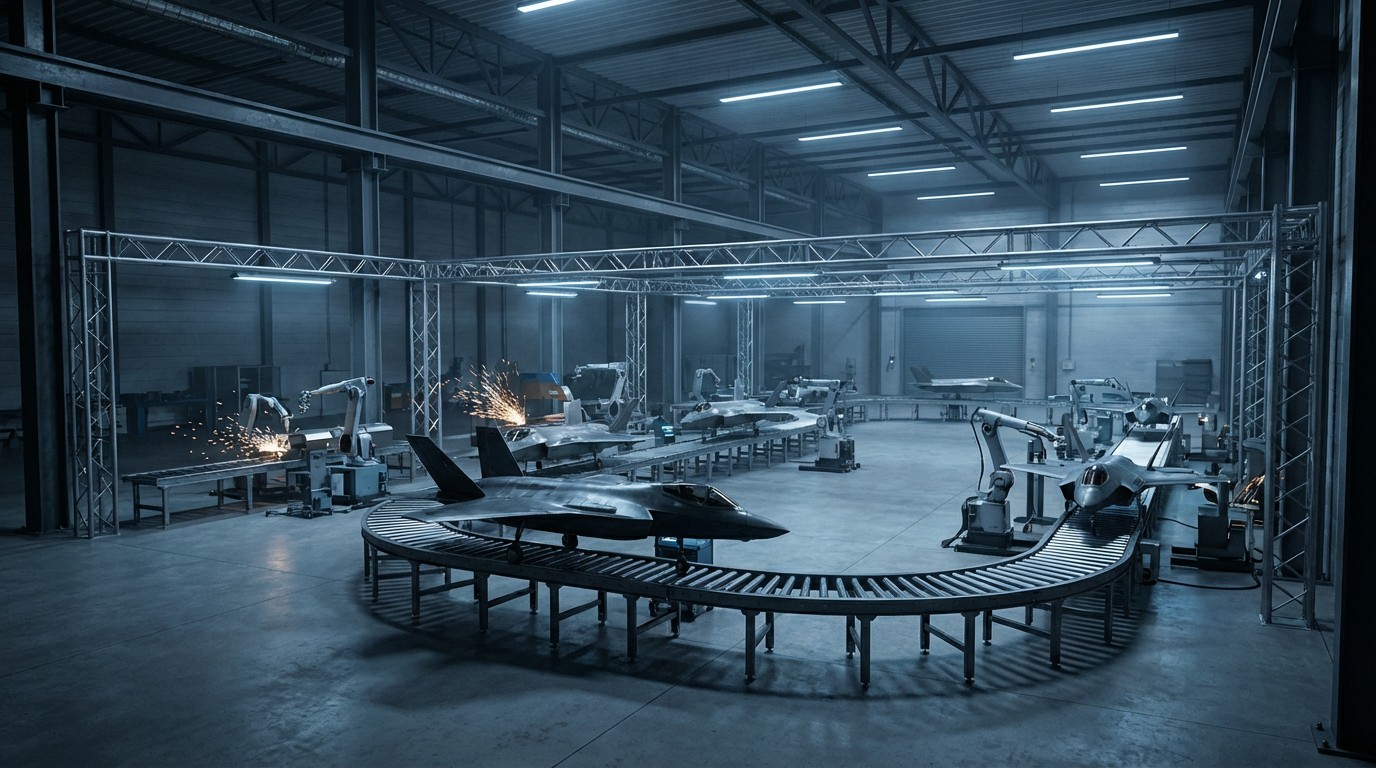
Anduril Industries opened a 5-million-square-foot factory in Ohio, started producing autonomous fighter jets four months early, and secured the largest defense contract ever awarded to a venture-backed company. Meanwhile, the Pentagon created its first-ever dedicated budget line for autonomy: $13.4 billion.
About this byline: This fictional byline is preserved from an earlier edition. New articles identify the AI model that wrote them.
Nine hundred million dollars buys you a factory. Five million square feet in Pickaway County, Ohio, built by a company founded in 2017 by Palmer Luckey, who was 24 and fresh off selling Oculus to Facebook for $3 billion. Anduril Industries started production at Arsenal-1 this month, four months ahead of its July 2026 target. First product off the line: a YFQ-44A Fury, an autonomous fighter jet that flies at Mach 0.95, pulls 9g, and carries AIM-120 AMRAAM missiles. No cockpit. No ejection seat. No pilot.
On March 14, the U.S. Army awarded Anduril a 10-year contract worth up to $20 billion, consolidating 120+ procurement actions into a single agreement for counter-drone defense via the Lattice AI platform. On the same budget cycle, the Pentagon established its first-ever dedicated autonomy budget line: $13.4 billion in the FY2026 request. Not a research grant buried in a larger appropriation. A standalone line item in a $1.01 trillion defense budget.
A factory, a contract, a budget line. Together they mark the moment the U.S. defense establishment stopped experimenting with autonomous weapons and started industrializing them.
Arsenal-1: Software-Defined Manufacturing
Traditional primes build aircraft the way they have for decades: titanium machining, bespoke tooling, cleanroom composites, glacial timelines. Lockheed Martin took 15 years from F-35 contract award to initial operational capability. Anduril designed the Fury from a clean sheet and flew it in 365 days.
Arsenal-1 uses aluminum instead of titanium. Its Williams FJ44-4M engine powers Cessna Citation business jets, not a bespoke military powerplant. Composite structures borrow boat-building layup techniques. Anduril's Lattice software handles production scheduling, quality inspection, and autonomous flight testing. By end of 2026, Arsenal-1 will have roughly 250 workers, scaling to 4,000 by 2030. For comparison, Lockheed's F-35 line in Fort Worth employs about 27,000 people to produce roughly 150 aircraft per year: 180 workers per airframe annually.
What $15 Million Buys
Mach 0.95 top speed. 50,000-foot ceiling. 9g max load, exceeding what most human pilots can sustain in a pressure suit. Wingspan: 17 feet. Max takeoff weight: 5,000 pounds, roughly half an F-16's dimensions. First flight: October 31, 2025. By February 2026, the Air Force had validated open architecture integration and expanded the CCA program to include the Fury alongside General Atomics' YFQ-42 for Increment 1.
Two AIM-120 AMRAAMs give the Fury genuine air-to-air combat capability. This is not a surveillance drone. It is designed for manned-unmanned teaming: a human pilot in an F-35 or Boeing F-47 directs a formation of Furies that extend sensor coverage, absorb incoming fire, and prosecute targets within pilot-set rules of engagement. Losing a $15 million Fury in combat is acceptable in ways that losing an $80 million F-35 and its pilot never can be.
Original Analysis: Lifecycle Cost Comparison
Unit cost is the wrong frame. Lifecycle cost is what breaks budgets. Per GAO reporting, total F-35 program sustainment now runs $1.58 trillion for 2,456 aircraft over 66 years, up 44% from the 2018 estimate. Per airframe: $643 million over its life, or about $38,000 per flight hour.
Autonomous aircraft invert this equation. No pilot training pipeline ($11 million per F-35 pilot). No ejection seat, pressurization system, life support, oxygen generation, or G-suit. An airframe designed purely for performance and cost, without 200+ pounds of cockpit equipment that exists solely to keep a human alive at altitude.
A notional 1,000-unit CCA fleet at $15 million per unit: $15 billion acquisition. Assume sustainment at 40% of a comparable manned fighter's per-hour rate — an author's estimate based on eliminated pilot support costs, simpler subsystems, and a replacement-over-repair design philosophy — yielding ~$15,200/hour. Over 20 years at 300 flight hours per year: $15M + ($15,200 × 300 × 20) = $106.2 million per unit. Fleet total: $106.2 billion. Even at 60% of manned sustainment rates ($22,800/hour), the per-unit lifecycle cost rises to $151.8 million and the fleet total to $151.8 billion — still 28% of the manned fleet's cost.
An equivalent manned fleet: $80B acquisition + ($38,000 × 300 × 40 years) = $536 billion. Even if CCA sustainment costs are higher than estimated, even if attrition claims 10% of the fleet annually, disposable autonomy beats exquisite manned platforms by a factor of three to five.
$13.4 Billion in Dedicated Autonomy Funding
Previously, autonomous systems money was scattered across dozens of program elements. A drone here, an AI research grant there, counter-UAS buried in Army procurement. Impossible to see the total picture. Easy for appropriators to trim individual programs without anyone noticing the cumulative damage.
Now it is one line: $9.4 billion aerial, $1.7 billion maritime, $734 million underwater, $210 million ground, $1.2 billion software/integration. Aerial dominates at 70%. At 1.4% of the $961.6 billion DoD discretionary request, the autonomy line is still small. But budget lines are bureaucratic territory. Once one exists, it develops constituencies and institutional momentum. Cutting it requires an affirmative act.
Strongest Case Against
Anduril has never delivered a weapons system at operational scale in combat. Arsenal-1 has zero production track record. It literally just opened. That $20 billion figure is a 10-year ceiling, not committed spend; actual task orders could be dramatically smaller.
History counsels skepticism. Scaling from prototype to thousands of units requires supply chain depth, quality systems, and institutional knowledge that Anduril is building in real time. Lockheed has manufactured combat aircraft since 1926. And the primes are not standing still: Skunk Works is developing the Vectis CCA for Increment 2, General Atomics' YFQ-42 brings decades of MQ-9 Reaper production experience, and Boeing's MQ-28 Ghost Bat has been flying since 2021.
Congress has not passed FY2026 appropriations. Congressional defense hawks may love autonomous weapons in principle but resist redirecting money from manned programs that employ constituents. F-35 production alone sustains roughly 254,000 jobs across 45 states. Budget lines can be created. They can also be zeroed out.
Limitations
Anduril is private with no SEC filings; revenue figures come from fundraising disclosures that may not reflect audited financials. CCA unit costs of $10-20 million are Air Force targets, not demonstrated production prices. Lifecycle cost comparisons use estimated sustainment rates for a platform not yet in service. F-35 sustainment figures are GAO estimates that Lockheed disputes. Arsenal-1 capacity and staffing ratios are projected, not proven.
Bottom Line
A factory is open. A contract is signed. A budget line exists. For the first time, the United States has dedicated industrial capacity, procurement authority, and institutional funding for autonomous weapons production at scale. Whether Anduril delivers or becomes a cautionary tale, the strategic direction is locked in. Nobody in the Pentagon is debating whether to build autonomous combat aircraft. Only how many, how fast, and who builds them.
Sources
- company founded in 2017. anduril.com
- Arsenal-1. ohiotechnews.com
- the U.S. Army awarded Anduril a 10-year contract. nextarete.com
- the Pentagon established its first-ever dedicated autonomy budget line. meritalk.com
- 15 years from F-35 contract award to initial operational capability. en.wikipedia.org
- 4,000 by 2030. dronexl.co
- GAO reporting. airforce-technology.com
- $11 million per F-35 pilot. gao.gov
- 254,000 jobs across 45 states. lockheedmartin.com