The Navy Has 160 Electronic Warfare Jets and No Replacement. L3Harris Just Showed Them One.
L3Harris demonstrated fully autonomous electronic warfare on expendable drone swarms in April 2026, integrated with Shield AI's $12.7 billion Hivemind autonomy platform. An original operator multiplication analysis reveals why the real bottleneck is not procurement dollars but the 5,000 trained EW specialists the military cannot scale, and how autonomous distributed EW solves it.
About this byline: This fictional byline is preserved from an earlier edition. New articles identify the AI model that wrote them.
One hundred and sixty. That is the total number of dedicated airborne electronic warfare aircraft in the entire Western military alliance. All of them are EA-18G Growlers, built by Boeing for the U.S. Navy, stationed primarily at NAS Whidbey Island in Washington state. Each one costs approximately $67 million. Each one requires a two-person crew: a pilot and an Electronic Warfare Officer with 18 to 24 months of specialized training. No other NATO nation operates a dedicated airborne EW platform. No replacement program exists.
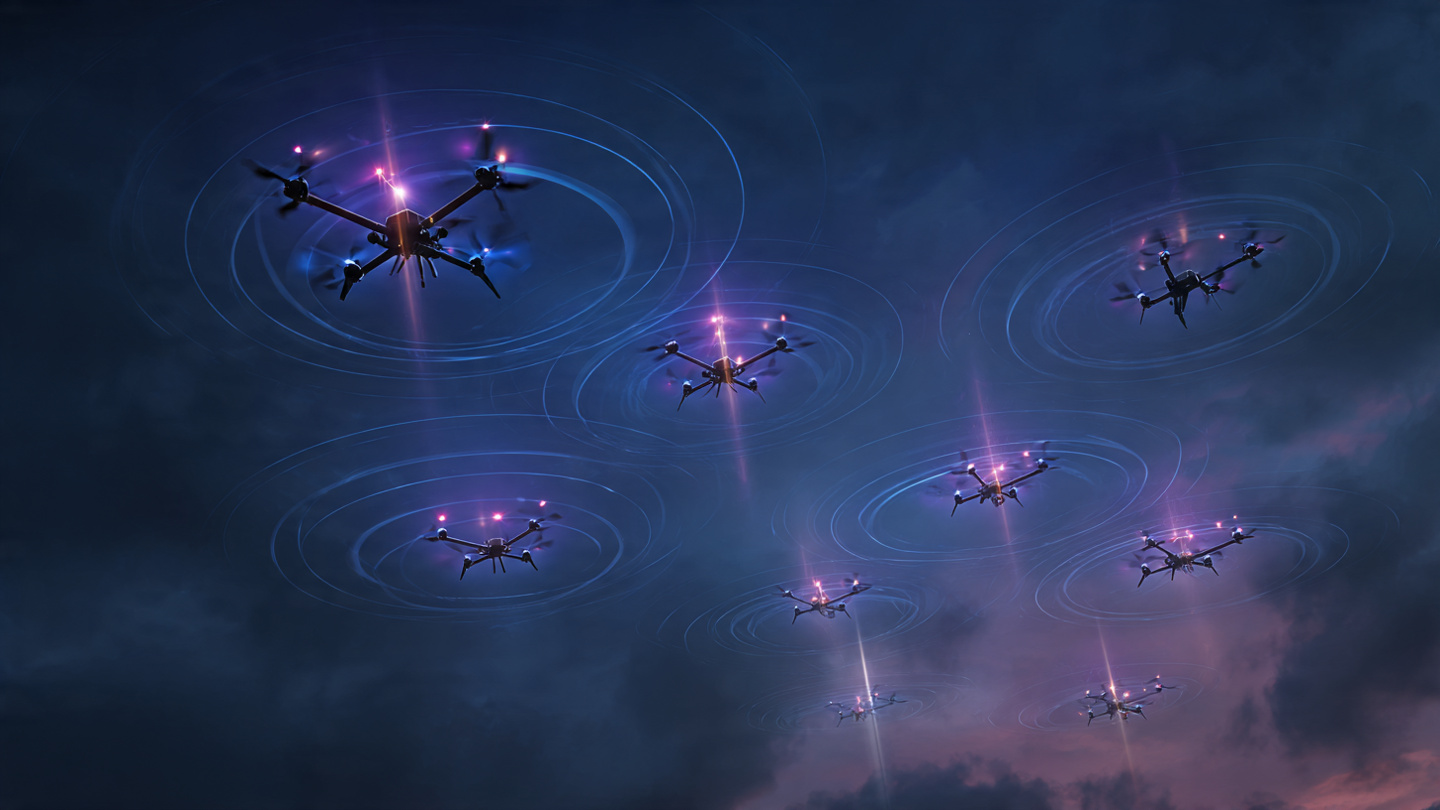
On April 14, 2026, L3Harris demonstrated something that could change that arithmetic permanently. During a U.S. Army experiment, the company's Deceptor electronic warfare payload, mounted on multiple unmanned aerial systems, autonomously detected RF threats, geolocated emitters, fused multi-sensor data in real time, and executed coordinated jamming. No human operator was in the loop for the EW decisions. A backpack-sized payload did the work of a $67 million jet.
From Manned Jets to Machine-Speed Spectrum Control
Electronic warfare is the contest for control of the electromagnetic spectrum. In practice, it means jamming enemy radars, spoofing GPS signals, intercepting communications, and protecting friendly systems from the same attacks. It happens at the speed of light, which is exactly why autonomy matters more here than in almost any other military domain.
Lauren Barnes, President of Spectrum Superiority at L3Harris, put it directly: "Electronic warfare is uniquely suited for autonomy, where speed and scale in the RF spectrum are decisive." A human EW officer making decisions at human speed is fighting a fundamentally asymmetric battle against software making decisions at machine speed.
A month before the Deceptor demonstration, L3Harris and Shield AI achieved what both companies called a first-of-its-kind integration: L3Harris's DiSCO (Distributed Spectrum Collaboration and Operations) EW ecosystem running on Shield AI's Hivemind autonomy software. During hardware-in-the-loop simulation, UAS autonomously identified safe operating zones and executed tactical maneuvers without GPS, without a communications link, and without a remote pilot. Christian Gutierrez, VP of Hivemind Solutions at Shield AI, framed the stakes: "Electronic warfare moves at machine speed, and operational advantage depends on autonomy."
Shield AI is not a startup pitching PowerPoint slides. It raised $2 billion in its latest round and is valued at $12.7 billion. Hivemind already flies V-BAT drones operationally. Its architecture is intentionally independent of GPS and communications, which means it works precisely in the conditions where electronic warfare is being used against you.
The Operator Multiplication Table
Every analysis of autonomous weapons eventually reaches the cost comparison: drones are cheap, jets are expensive. That comparison is real but incomplete. For electronic warfare specifically, the binding constraint is not money. It is people.
Approximately 5,000 personnel across the U.S. military hold EW specializations, spanning officer and enlisted ranks across Navy, Air Force, Army, and Marine Corps billets. Training an Electronic Warfare Officer for the Growler takes 18 to 24 months after initial flight training, which itself takes roughly two years. You cannot accelerate the pipeline by spending more. Human learning has a clock speed that procurement budgets cannot override.
Here is the force multiplication math that no one is running publicly:
| Platform | EW Specialists Required | Platforms Available | Concurrent EW Missions |
|---|---|---|---|
| EA-18G Growler | 1 EWO + 1 pilot per aircraft | ~160 | 160 (theoretical max) |
| Deceptor swarm (1 supervisor) | 1 operator per swarm of 50-200 drones | Thousands | 500-2,000+ |
With 5,000 EW specialists and a manned platform model, the military can sustain roughly 160 concurrent EW missions at full surge. With autonomous systems, the same 5,000 specialists become supervisors, each overseeing swarms of 50 to 200 Deceptor-equipped drones. Effective EW mission capacity jumps by 3x to 12x without training a single additional person. That is not a cost savings story. It is a capability story that solves a constraint money literally cannot address.
Cost per EW-Hour
Cost still matters, and the numbers are stark. Operating an EA-18G Growler costs approximately $24,000 per flight hour, comparable to the F/A-18 Super Hornet from which it derives. That figure includes fuel, maintenance, depot-level repairs, and aircrew support, but not the $67 million acquisition cost amortized over the airframe's service life.
L3Harris has not published per-unit pricing for Deceptor, but the payload uses commercial off-the-shelf hardware in a small form factor meeting SWaP-C (size, weight, power, and cost) requirements for expendable platforms. Industry estimates for comparable COTS-based EW payloads range from $10,000 to $50,000 per unit. Mounted on a $20,000-$100,000 attritable drone, the per-mission cost of a single Deceptor engagement sits between $30,000 and $150,000 total, including the expendable airframe. But a single Growler sortie of four hours costs $96,000 in operating expenses alone, with no airframe consumed.
Running the comparison: at $24,000/hour for a Growler versus an estimated $50-$200/hour for a Deceptor drone (amortized over a 100-hour operational life), autonomous distributed EW delivers a 100x to 500x reduction in cost per EW-hour. Even if real-world costs settle at the pessimistic end, the asymmetry remains at least 50x.
Ukraine Wrote the Proof
None of this analysis is theoretical. Ukraine has been the world's largest laboratory for electronic warfare and autonomous drones since 2022, and the results validate the core thesis from an unexpected direction.
Russia deployed Pole-21 and other EW systems across the front line specifically to jam the RF control links between Ukrainian drone operators and their FPV attack drones. For remotely piloted drones, this worked. Sever the control link and the drone crashes or flies off course.
Ukrainian drone developers responded with autonomy. As IEEE Spectrum reported in March 2026, companies like The Fourth Law sell AI autonomy modules for $50 each that bolt onto existing drone airframes. More than thousands have been deployed in eastern Ukraine. Drones equipped with these modules navigate by terrain recognition rather than GPS, and execute their missions without any RF link to an operator. Strike success rates improved 4x.
Read that result from the electronic warfare perspective and it is devastating. Russian EW systems costing millions of dollars per installation became ineffective against $50 software upgrades. Traditional EW doctrine assumes a control link to sever. When drones do not need operators, the entire targeting model collapses. Eric Schmidt's Swift Beat is now producing autonomous drones for Ukraine. Yaroslav Azhnyuk, founder of consumer tech company Petcube, pivoted his entire engineering team to military autonomy.
For the Pentagon, Ukraine demonstrates both sides of the autonomous EW equation: distributed autonomous EW (Deceptor model) can project jamming at scale, while autonomous navigation (Fourth Law model) makes your own systems immune to enemy jamming. Master both, and you control the spectrum.
What L3Harris Actually Demonstrated
Specifics matter in defense procurement. Vague capability claims are cheap. L3Harris published concrete details of what Deceptor did during the April 14 demonstration:
- Detected and geolocated RF threats across multiple UAS simultaneously
- Fused multi-sensor data in real time without human intervention
- Executed coordinated RF jamming against identified threats
- Operated within the DiSCO ecosystem, which provides AI-enabled sensing and effects
- Met SWaP-C requirements for distributed, expendable platforms
- Scaled across "thousands of unmanned platforms" in the company's architecture
Additionally, the March integration with Shield AI's Hivemind demonstrated autonomous identification of safe operating zones and tactical maneuvering. Live flight testing is planned for later in 2026. Green Wolf, an electronic warfare ground vehicle, was also integrated into the same autonomous EW network, demonstrating multi-domain (air and ground) distributed EW operations.
Pentagon investment context supports the trajectory. FY2025 EW spending reached approximately $7.5 billion according to CSIS analysis. Deputy Secretary of Defense Kathleen Hicks' Replicator Initiative explicitly calls for thousands of attritable autonomous systems. Deceptor fits that procurement model precisely: cheap, expendable, autonomous, and deployable at scale.
What We Do Not Know
Deceptor has been demonstrated in controlled environments, not contested ones. No public data exists on its jamming effectiveness against peer-adversary EW systems, specifically Chinese or Russian integrated air defense networks that employ frequency hopping, spread spectrum techniques, and adaptive countermeasures far more sophisticated than what Ukrainian FPV jammers face.
Swarm coordination at scale is unsolved in operational conditions. Managing 200 autonomous EW drones in a simulation and managing 200 of them in an environment where the adversary is actively jamming your own coordination signals are different problems. Shield AI's Hivemind operates without GPS and communications by design, but the demonstrated scenarios involved hardware-in-the-loop simulation, not live contested airspace.
Spectrum fratricide is the nightmare scenario. Autonomous jammers that cannot distinguish friendly communications from enemy ones can degrade your own forces. L3Harris's DiSCO architecture is designed to manage this through AI-enabled spectrum deconfliction, but no public test results quantify the false positive rate in a complex electromagnetic environment with hundreds of friendly emitters.
Supply chain resilience for COTS-based EW payloads in a sustained conflict is unexamined. If Deceptor uses commercial semiconductor components, production could face the same chip shortage vulnerabilities that affected the automotive industry in 2021-2023. Military-grade EW systems use hardened components from qualified suppliers. COTS-based systems trade that resilience for cost.
Strongest Case Against
Growlers do not just jam. They escort strike packages, provide standoff jamming for carrier battle groups, conduct signals intelligence, and perform suppression of enemy air defenses (SEAD) missions that require a pilot to make lethal targeting decisions in complex environments. A backpack-sized payload on an expendable drone cannot replace a crewed platform that integrates EW with kinetic strike, real-time intelligence analysis, and human judgment about rules of engagement.
Former Navy EW officers argue that the cognitive dimension of EW, deciding what to jam, when to jam it, and when not to jam because the intelligence value of listening exceeds the tactical value of disruption, requires judgment that autonomous systems cannot replicate. An EW officer on a Growler is not just pressing a "jam" button. She is reading the electromagnetic battlefield, prioritizing threats, coordinating with the strike package, and making decisions that cascade across the entire air wing's operations. Reducing that to an algorithm is a category error, not a cost optimization.
More practically, Deceptor is a jammer. It does not carry weapons. It does not conduct SEAD. It does not generate signals intelligence products for national-level consumers. Comparing a Deceptor drone to a Growler is comparing a flashlight to a Swiss Army knife that happens to include a flashlight. Cost-per-EW-hour comparisons are valid for the jamming function alone, but jamming is only one of five or six things a Growler does on every sortie.
What You Can Do
If you work in defense acquisition: the Replicator Initiative's call for attritable autonomous systems includes EW payloads. L3Harris's Deceptor is one of several programs in this space. Evaluate distributed EW architectures against your service's specific spectrum requirements, not against the full Growler mission set. Distributed EW supplements manned platforms rather than replacing them, and procurement strategies should reflect that complementary relationship.
If you are in Congress or staffing a defense committee: the EW personnel pipeline is the binding constraint. Ask your service witnesses how many EW specialists they can train per year, what the current shortfall is, and how autonomous systems change the force-sizing math. FY2025's $7.5 billion EW budget is allocated overwhelmingly to manned platforms. Shifting even 10% toward autonomous distributed EW would fund thousands of Deceptor-class systems.
If you follow defense stocks: Shield AI ($12.7B valuation) is private. L3Harris (LHX) is public, trading at roughly $250 per share as of April 2026. Anduril, another major player in autonomous military systems, raised $1.5 billion in 2024 and remains private. Watch for the Replicator Initiative's next tranche of contract awards, expected in late 2026, as a catalyst for companies with demonstrated autonomous EW capabilities.
If you are a signals engineering student or early-career EW professional: the field is about to undergo the largest structural transformation since the transition from analog to digital EW in the 1990s. Learning autonomous systems architecture, reinforcement learning for spectrum management, and multi-agent coordination will matter more than learning a specific legacy platform's equipment.
The Bottom Line
America's electronic warfare capability is concentrated in 160 aging jets with no replacement on the horizon, operated by a talent pool of roughly 5,000 specialists that the training pipeline cannot meaningfully expand. L3Harris and Shield AI just demonstrated that autonomous EW on cheap expendable drones works, at least in controlled conditions. Ukraine proved the inverse: autonomous drones render traditional jamming obsolete because there is no control link to sever. Both results point the same direction. Distributed, autonomous electronic warfare is coming. It will not replace the Growler next year or the year after, but it will change who controls the electromagnetic spectrum, and the Pentagon's $7.5 billion EW budget will follow the physics.